
In wearable devices, the smart ring is one of the most space-sensitive products.
Compared with smart watches and wristbands, a smart ring is much smaller and has a more enclosed structure. However, users still expect the same features: continuous heart rate monitoring, sleep tracking, blood oxygen measurement, and Bluetooth connectivity. All these need a stable and sufficient battery.
That’s exactly the problem:
Space is already extremely limited, but battery capacity cannot be reduced.
In this case study, we share how we solved the conflict between internal space and battery life in a real smart ring project, using custom curved LiPo battery.
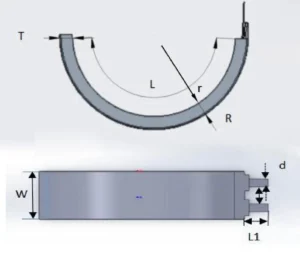
Project Background: A Typical But Difficult Requirement
Our client is a consumer health monitoring device company. They were developing a new generation of smart ring for users who want to manage their daily health.
Their core goals were clear:
- Look as close to a regular ring as possible (no bulky design)
- Support 24/7 health data tracking
- Last at least 1–2 days on one charge
- Be comfortable to wear (strict limits on weight and thickness)
These requirements make perfect sense in product design. But from a battery engineering perspective, this is a classic high-constraint system challenge.
Core Challenge: It’s Not “Small Space” — It’s “Unusable Space”
Many people think the problem with smart rings is simply limited space.
But in real projects, we prefer to describe it this way:
The issue is not just small space — it’s that the usable space for the battery is extremely limited and irregularly shaped.
Here are the main constraints of this project:
- The ring shape makes normal battery placement impossibleThe internal structure of a smart ring is a closed loop:
- The PCB is curved
- Sensors are placed in specific areas
- The antenna and charging components also take up space
This means the space left for the battery is not a regular rectangle or circle, but a curved section along the inner wall of the ring.
- Very strict thickness limitsFor comfortable daily wear, the client set clear rules:
- No bulky or protruding appearance
- Inner diameter must be ergonomic
- Thickness must stay consistent across the ring
The battery must not only fit inside, but also distribute evenly — otherwise, the wearing experience will be poor.
- Power consumption is continuous, not occasionalUnlike devices used only occasionally, this smart ring:
- Monitors heart rate and blood oxygen continuously
- Syncs data regularly
- Maintains a long-term Bluetooth connection
This requires the battery to provide:
stable power output + sufficient capacity, rather than short bursts of high power.
- Higher safety and reliability requirementsSince the device is worn directly against skin:
It must have excellent cycle stability
It is very sensitive to temperature rise
It has extremely low tolerance for battery swelling
Why Standard Battery Solutions Won’t Work
At the start of the project, the client evaluated several common options, but all had critical flaws:
- Standard rectangular LiPo batteriesThe problem was straightforward:
- Could not fit the curved shape
- Wasted a lot of internal space
- Caused extra thickness in some areas
👉 The real issue: extremely low space efficiency.
- Coin cell batteriesThey are small, but have clear disadvantages:
- Insufficient capacity
- Could not support continuous health monitoring
- Hard to implement advanced charging and discharging management
👉 Only suitable for low-power devices, not for this use case.
- Multiple small batteries connected togetherIn theory, this could improve fitting, but brought many practical problems:
Higher cost
Complicated structure
Poor connection reliability
More difficult BMS design
Solution: Custom Curved LiPo Battery
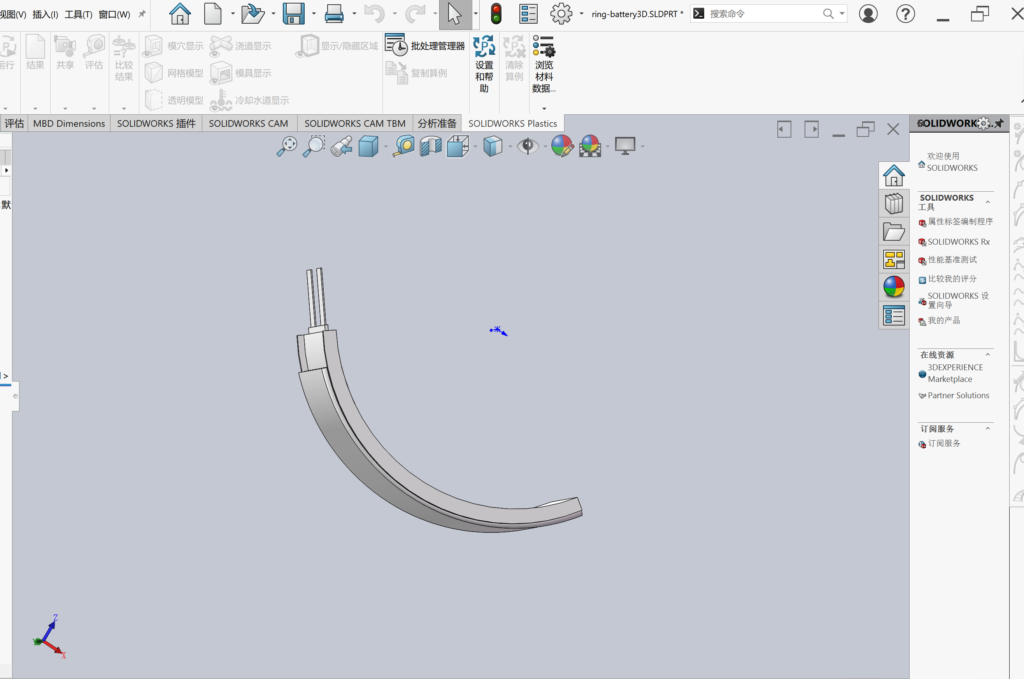
Once we clearly understood all constraints, our approach was straightforward:
Instead of adapting the device to fit a standard battery, we designed the battery to fit the device structure.
The final solution we used was:
👉 custom curved LiPo battery
1. Battery Shape: Curved Structure Along the Inner Ring
The battery was designed as:
- a curved shape with precise curvature
- able to fit tightly against the inner wall of the ring
- avoiding sensors and main control areas
The direct result:
👉 Previously unusable space was converted into effective battery space.
2. Greatly Improved Space Efficiency
Compared with rectangular batteries:
- The curved shape reduced empty gaps
- It fully filled the internal space
- It increased the proportion of active material
From an engineering perspective, this essentially:
improved volumetric energy density
(not through material upgrades, but through structural optimization).
3. More Uniform Thickness
With optimized structural distribution:
- No local bulging
- Thickness is evenly distributed along the curve
- Improved wearing comfort
4. Synchronized Optimization of Electrical and Safety Design
Beyond structure, we also optimized for real‑world usage:
- Controlled charge/discharge voltage window to slow aging
- Optimized tab layout to reduce internal resistance
- Enhanced packaging stability to lower the risk of battery swelling
Results & Engineering Review: Not “Bigger,” But “More Efficient”
The improvements in this project were direct and measurable:
👉 Battery capacity increased by about 20% without increasing device size or thickness
👉 Overall battery life improved significantly
👉 Wearing experience remained consistent, with no uneven thickness or unbalanced weight
👉 Design freedom for the internal structure was also improved
From an engineering perspective, however, the real value of this project was not just how much capacity was increased, but how the increase was achieved.
This optimization did not rely on:
❌ More aggressive material systems
❌ Higher-risk energy density designs
Instead, it came from two fundamental improvements:
✅ Redefining how internal space is used
✅ Co-optimizing battery structure and overall device design
In other words, we did not make the battery “stronger” — we made it fit better within the specific structure.
Looking back, we can summarize several key engineering lessons for highly constrained devices:
1. The battery should be part of structural design, not an afterthought
Many projects follow this flow:
Finish structural design → Then look for a suitable battery
This works fine for products with plenty of space. But for extremely constrained devices like smart rings, it often leads to:
- Limited battery options
- Lower space efficiency
- Final compromises on either capacity or structure
A more reasonable approach:
Integrate battery solutions early in structural design to define space allocation together.
2. The “capacity problem” is really a “space problem”
A common question during project discussions:
“Can we make the mAh larger?”
In most cases, the upper limit of battery capacity is not determined by materials, but by:
The effectively usable space inside the device.
If the space shape is poorly designed (e.g., only fitting a rectangular battery inside a curved structure), even advanced materials cannot prevent limited overall capacity.
3. The core value of custom batteries is “fit,” not “higher specs”
Many people think custom batteries mean:
- Higher energy density
- Higher discharge rate
But in real engineering, the most critical point is often:
Let the battery shape fit the product, not the other way around.
In this project, the curved battery used the same material system, but structural matching achieved:
- Higher space efficiency
- More uniform thickness
- More reasonable internal layout
The result was better overall performance under the same constraints.
The key takeaway from this case is not that “we made a curved battery.”
It proves a broader principle:
In space-constrained devices, improvements in battery performance often come from changes in design approach, not just higher single parameters.
That is why co-design of structure and battery is becoming increasingly important for smart rings, wearables, and similar applications.
Conclusion
Products like smart rings push battery design to an extreme:
extremely small space, complex structure, and very high demands. In such scenarios, standard batteries often fall short, while customized, structure‑optimized battery solutions become the better choice.
This project shows one essential truth:
A battery is never just a separate component — it is part of the entire product design.
When structure, space, and electrical performance are considered together, many seemingly unsolvable problems actually have solutions.
If you are developing smart rings, wearable devices, or any product with extreme space constraints:
LanDazzle provides curved batteries, ultra‑thin batteries, and various custom LiPo battery solutions. We help you achieve higher performance and longer battery life without compromising your design.
👉 Contact us today, and let’s optimize your battery solution together.
Email: info@landazzle.com
Whatsapp: +8618938252128