Table of Contents
Lithium batteries are widely used in drones, electric vehicles, and all kinds of outdoor electronic devices, and this is familiar to most people. But anyone who has actually used them knows: problems start to appear in winter.
In low temperatures, the performance of ordinary lithium batteries drops sharply. Once the temperature falls below freezing, reduced capacity, insufficient power, and sudden shutdowns become common. In some cases, battery capacity can drop by more than 40%.
This is why ordinary lithium batteries are not suitable for long-term use in cold regions or during winter. For this reason, low-temperature lithium batteries are especially important. They are not just simple upgrades of regular batteries. Instead, they are specially optimized for low-temperature environments in terms of materials, electrolytes, and system design.
In this article, we will explain three things from an engineering perspective:
What exactly happens to lithium batteries in low temperatures, why cold weather weakens them, and what core technologies allow lithium battery low temperature to work stably even below zero.
Why Lithium Batteries Struggle in Cold Weather
First, ion movement slows down.
The electrolyte becomes thicker in low temperatures. The speed at which lithium ions move between the positive and negative electrodes drops sharply. Simply put, the path becomes “congested.”
Next, internal resistance rises.
The speed of electrochemical reactions decreases, and the internal resistance goes up. As a result, voltage drops faster, and the battery cannot provide enough power.
Even more serious is the risk of lithium plating.
If you charge a battery forcibly in low temperatures, lithium ions cannot enter the negative electrode structure in time. Instead, they may deposit directly on the negative surface as metallic lithium.
This not only causes permanent capacity loss but can also lead to internal short circuits in severe cases.
The final result: the battery cannot discharge properly and cannot charge normally. This is why in winter, phones, electric vehicles, and drones often lose power quickly and shut down suddenly.
To solve this problem, the key is to help the battery maintain normal ion transport and reaction speed even at -20°C or lower temperatures.
How Does Low Temperature Lithium Battery Work?
The core idea is actually simple: Don’t let the electrolyte “freeze up.”
If there’s one thing that defines a lithium battery, it’s the electrolyte. It acts like a highway, moving lithium ions back and forth between the positive and negative electrodes. The most important step for low-temperature lithium batteries is keeping this “highway” open even in freezing conditions.
Engineers usually use several methods:
1. Use low-freezing-point solvents
Common solvents in traditional electrolytes, such as EC and DMC, have poor flow at low temperatures. So engineers add solvents like EMC and DEC, which stay thin and fluid even in the cold, preventing the electrolyte from becoming thick or frozen.
2. Choose better low-temperature lithium salts
Most standard batteries use LiPF₆, which works well at room temperature but loses ionic conductivity in extreme cold. Low-temperature batteries often use more advanced salts like LiTFSI, which allow ions to move smoothly even at -40°C.
3. Improve the stability of the SEI layer
Special additives help form a stable, uniform SEI layer on the negative electrode. This greatly reduces the risk of lithium plating during low-temperature charging.
For reference:
- EC (Ethylene Carbonate) – helps make the battery more stable but is thick and doesn’t flow well at low temperatures.
- DMC (Dimethyl Carbonate) – thin and flows easily, improves low-temperature performance.
- EMC (Ethyl Methyl Carbonate) – flows well at low temperatures and conducts ions efficiently.
- DEC (Diethyl Carbonate) – thin and easy to flow, often mixed with others to improve low-temperature performance.
- LiPF₆ (Lithium hexafluorophosphate) – the standard lithium salt in most batteries, works well at room temperature but loses performance in extreme cold.
- LiTFSI (Lithium bis(trifluoromethanesulfonyl)imide) – a more advanced salt that keeps ions moving smoothly even at very low temperatures, improving battery performance in the cold.
Thanks to these improvements to the electrolyte system, low-temperature lithium batteries can keep working smoothly inside, even when their outer case is freezing cold.
Electrode Material Innovations
Besides the electrolyte, the choice of electrode materials also has a huge effect on performance in cold weather. For the negative electrode (anode): traditional graphite easily causes lithium plating below 0°C.
So in low-temperature batteries, engineers prefer materials that work better in the cold, such as hard carbon or lithium titanate (LTO). These materials have much stronger charging performance at low temperatures.
For the positive electrode (cathode): materials like LFP and NMC are often treated with conductive coatings or made into nanoscale particles to lower resistance and improve efficiency in cold conditions.
Another important point that is often overlooked: particle size.
Smaller particles mean shorter paths for lithium ions to move, which is especially critical at low temperatures. With these material improvements, low-temperature lithium batteries can still keep more than 70% of their rated capacity at -40°C. In comparison, standard batteries usually keep less than 30%.— often over 70% of rated capacity at -40°C, compared to less than 30% for standard cells.
Structural and Design Enhancements
Low-temperature lithium batteries are not just about changing materials. In real use, structure and system design matter just as much. Many low-temperature battery packs have built-in self-heating components. They warm up the cells to a safe temperature range before charging.
At the same time, insulation materials and protective structures, greatly slow down heat loss and prevent sudden temperature drops.
For internal structure: thinner separators with higher porosity also help improve ion movement at low temperatures.
And of course, we need a smart BMS (Battery Management System). It monitors temperature in real time and automatically adjusts charging voltage and current based on conditions to avoid charging at unsafe temperatures. When all these designs work together, the battery can operate safely in extremely cold areas, high altitudes, and even polar environments.
Charging and Discharging Behavior in Cold Environments
In cold environments, how you charge the battery matters more than usual.
Common practices include:
- Preheating before charging, to avoid charging when the battery is cold
- Adjusting charging voltage dynamically based on temperature
- Using pulse charging to reduce the risk of lithium dendrites
Performance is also greatly improved when discharging. At -20°C, well-designed low-temperature lithium batteries can still deliver about 80% of their capacity. Some high-end solutions can work stably even at -40°C.
Applications of Lithium Battery Low Temperature
Because of their ability to maintain energy output in freezing environments, these batteries are widely used in:
- Drones and UAVs operating in winter
- Outdoor positioning devices, sensors, and low-temperature cameras
- Electric vehicles used in cold regions
- Aerospace and defense equipment Energy storage systems exposed to low temperatures
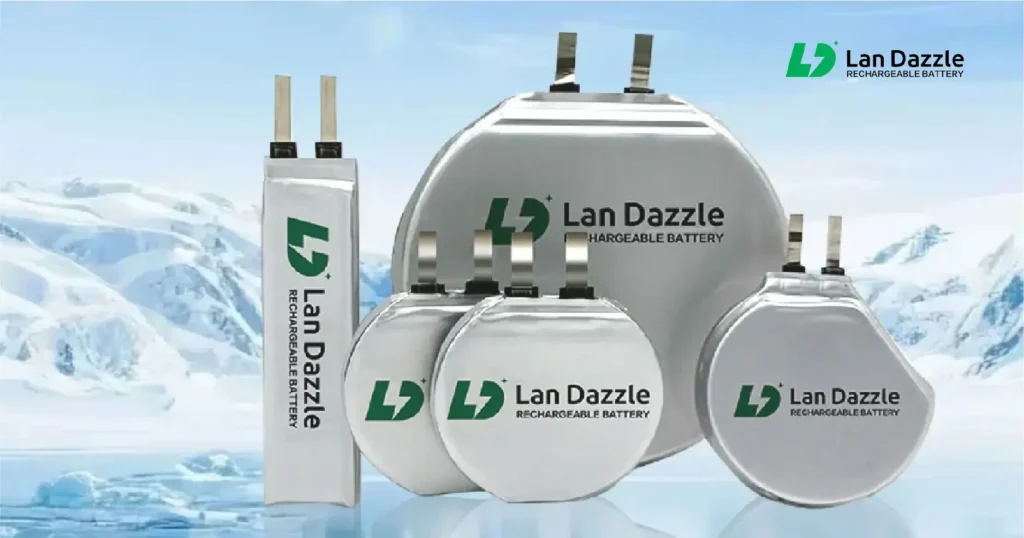
LanDazzle focuses on low‑temperature lithium battery solutions.
Through comprehensive optimization of electrolytes, electrode materials, and thermal management systems, we ensure reliable battery performance even in sub‑zero environments.
Lightweight, high energy density, and excellent cold resistance make them the true all‑weather battery solution for cold conditions.
Conclusion: What Makes Low Temperature Lithium Batteries Work
To summarize, low temperature lithium batteries outperform regular lithium-ion cells due to a combination of chemical innovation and intelligent design:
| Key Component | Function in Cold Weather |
| Low-freezing-point electrolytes | Maintain ion flow at -40°C |
| Stable SEI additives | Prevent lithium plating |
| Modified anode/cathode materials | Increase lithium ion movement and reaction rate |
| Internal heating & insulation | Maintain operational temperature |
| Smart BMS algorithms | Enable safe charging below 0°C |
Through these advancements, engineers have successfully extended the usability of lithium batteries to extreme climates — ensuring reliable performance whether it’s powering a drone in the Arctic or an electric car in winter.
If you are working on projects that require reliable performance in freezing conditions, understanding how low temperature lithium batteries work is only the first step. To ensure your devices operate efficiently and safely in sub-zero environments, choosing a battery specifically engineered for cold weather is essential. LanDazzle offers specialized low temperature lithium batteries designed with optimized electrolytes, electrode materials, and smart thermal management, providing dependable performance when it matters most. Explore our custom battery solutions today and make sure your applications stay powered, even in the coldest conditions.
Email: info@landazzle.com
Whatsapp: +8618938252128