
Ultra-Thin Battery Solutions
LanDazzle provides ultra-thin batteries from 0.6–9 mm thick. These paper-thin batteries offer excellent cycle life and very low self-discharge..
Why Choose Our Ultra-Thin Battery
- Experts in custom ultra-thin battery development
- Experienced chemists and engineers supporting your design
- Fast transition from specifications to mass production
Our Ultra-Thin Battery Features
- High Performance: High operating voltage and excellent charge/discharge behavior
- Long-Lasting: Very low self-discharge with long cycle life
- Reliable & Safe: Outstanding safety and stability
- User-Friendly: No memory effect and consistent performance

Ultra Thin Battery: Challenges & Our Technology
Overcoming the core obstacles of ultra-thin battery manufacturing with innovative engineering and material science
Core Challenges
Energy Density Limitation
Thinner form factors lead to reduced active material volume, resulting in insufficient energy storage capacity for practical use.
Mechanical Stability
Ultra-thin electrodes are prone to bending, cracking, or delamination during manufacturing and daily usage.
Electrolyte Leakage Risk
Thin packaging increases the risk of electrolyte leakage, compromising safety and performance.
Manufacturing Precision
Requires micron-level precision in coating and assembly, increasing production complexity and cost.
Our Innovative Technology
Nanocomposite Electrode Material
Custom-developed nanocomposite materials boost energy density by 35% while maintaining ultra-thin form factor (≤0.1mm).
Flexible Substrate Technology
Polymer-based flexible substrate enhances mechanical stability, withstanding 500+ cycles without damage.
Seamless Encapsulation Process
Vacuum-assisted encapsulation eliminates electrolyte leakage, achieving IP67-level waterproof and leak-proof performance.
AI-Driven Precision Manufacturing
AI-controlled coating and assembly lines ensure ±1 micron precision, reducing production cost by 20%.
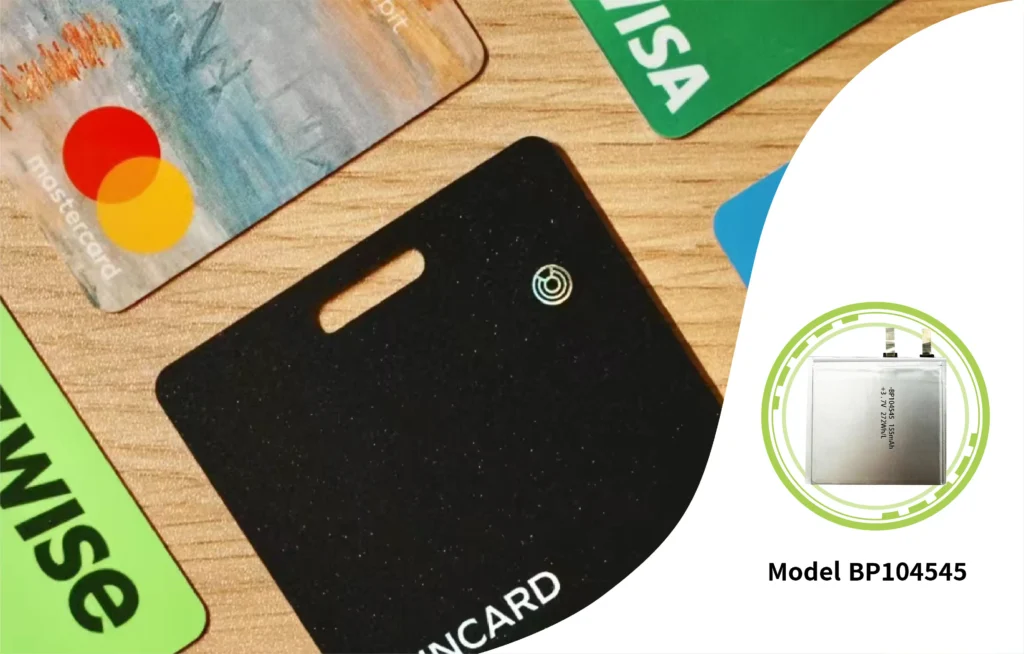
A 1 mm Battery Design for Space-Constrained Smart Cards
Smart cards leave very little room for energy storage. A compact cell must fit the available profile while meeting the device’s power, runtime and integration requirements.
Extremely limited internal space
Thin profile and package integration
Capacity, dimensions and electrical behavior
Sample review before production decisions

Make the Prototype Repeatable.
For a very thin cell, small differences in dimensions or packaging can affect product integration. A clear validation plan helps identify risks before production decisions are made.
Dimensional inspection
Measure the agreed cell profile and critical dimensions.
Electrical testing
Check capacity, voltage and internal resistance as specified.
Cycle & storage tests
Use conditions and acceptance criteria agreed for the project.
Packaging verification
Evaluate sealing integrity and package performance.
- |
- Contact us
Let's Evaluate Your Ultra-Thin Battery Design.
You need our support. We’re here to help.
Working on a smart card, wearable, medical device or another space-constrained product? Share what you know today. You do not need a complete specification to start a feasibility discussion.
Frequently Asked Questions
How thin can an ultra-thin battery be?
Thickness ≥ 0.6mm are achievable depending on capacity and structure.
Is there a MOQ for custom ultra-thin batteries?
Low-volume prototyping is supported. MOQ depends on design complexity.
Do you support engineering collaboration?
Yes. We provide feasibility feedback and design optimization, not just manufacturing.
What information is needed to start?
Available space, target voltage/capacity, application type, and power profile.