Table of Contents
When temperatures drop below freezing, most batteries lose power significantly. This is not a quality issue—it’s just how physics and chemistry work. Low temperatures slow down chemical reactions inside the battery, increase internal resistance, and directly reduce usable capacity.
If you use lithium batteries for drones, outdoor sensors, winter vehicles, or other outdoor equipment, choosing the right battery type and using it correctly can mean the difference between steady performance and sudden power loss or shutdown.
This guide uses simple engineering principles to answer three key questions:
- How to choose and lithium battery for cold weather?
- How exactly does low temperature affect lithium batteries?
- Which lithium battery chemistries work best in cold conditions?
Why Cold Weather Affects Lithium Batteries?
All lithium-based batteries rely on the movement of lithium ions through an electrolyte between the Whether they are lithium-ion, lithium-polymer, or lithium iron phosphate batteries, they all work the same way:
lithium ions move back and forth in the electrolyte to charge and discharge.
And that’s where the problem starts.
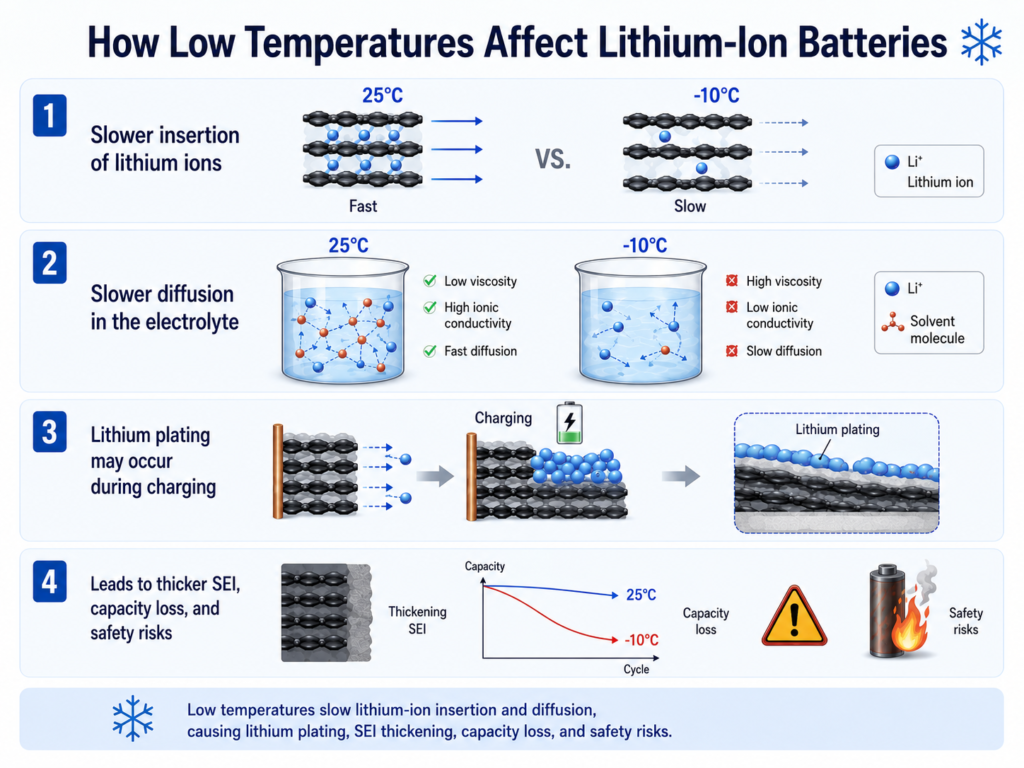
When it gets cold, the ions slow down. As temperature drops, several clear things happen:
- Lithium ions move slower: Fewer ions can take part in the reaction, so the battery’s output drops.
- Internal resistance rises sharply: Under load, voltage drops quickly — especially in high-current applications.
- Usable capacity decreases: At around –10 °C (14 °F), many lithium batteries only deliver 50%–70% of their rated capacity.
Even more important:
Cold weather also makes the electrolyte thicker. If you charge a battery when it’s too cold, lithium plating can easily happen. That’s why almost every manufacturer clearly states in their specs:
Do NOT charge below 0 °C (32 °F)
Otherwise, the battery can suffer permanent damage.
What Temperature Is Bad for Lithium Batteries?
From an engineering perspective, the ideal operating temperature for lithium‑ion batteries is 20°C–25°C (68°F–77°F). Performance starts to drop once outside this range, just to different degrees.
Here’s a simple breakdown:
0°C to –10°C (32°F to 14°F)
Capacity drops, but most devices still work normally — just with shorter runtime.
–10°C to –20°C (14°F to –4°F)
Performance drops sharply. Voltage becomes unstable, and output power falls greatly.
Below –20°C (–4°F)
Risk rises quickly. Charging, in particular, can easily cause permanent damage.
In extremely cold conditions, charging is the most dangerous operation. Lithium plating can form tiny short circuits inside the cell, creating serious long-term safety risks.
LiPo vs. LiFePO₄: Which Is Better for Cold Weather?
Many customers ask:“For low-temperature use, is LiPo better, or LiFePO₄?”
The answer is: Neither is absolutely better — only more suitable.
Both are mature lithium battery systems, but they have completely different design goals, and their performance in cold conditions is very different.
Let’s compare them from the most critical engineering perspectives:
| Feature | LiPo Battery | LiFePO₄ Battery |
| Energy Density | High | Moderate |
| Low-Temperature Performance | Moderate: usable down to –20 °C with preheating | Excellent: retains capacity to –30 °C with built-in heating |
| Discharge Power | High (great for high-current devices like drones) | Moderate (stable but less peak current) |
| Cycle Life | 500–1000 cycles typical | 2000+ cycles possible |
| Weight | Lightweight, flexible form factor | Heavier and bulkier for the same capacity |
| Safety | Sensitive to overcharge/heat | Chemically stable and safer |
| Ideal Applications | Drones, wearables, robotics, portable devices | RVs, solar systems, cold storage, power backup |
How to Choose Lithium Battery for Cold Weather?
These applications are better suited for LiPo batteries:
- Drones / RC models
- Wearable devices
- High-performance RC cars
- Portable electronics highly sensitive to size and weight
In these scenarios, high power-to-weight ratio and small size are essential.
But the trade-off is clear:
You have to accept that LiPo performance drops in low temperatures, and follow strict rules:
✔ Always warm up the battery before charging
✔ Avoid fast charging in winter
These applications are better suited for LiFePO₄ batteries:
- RV / marine power systems
- Solar energy storage systems
- Portable power stations
- Outdoor power for ice fishing, camping
- Car starter or auxiliary batteries
These uses are usually fixed-installed and not weight-sensitive, but demand extremely high safety, long life and stability.
In these cases, LiFePO₄ has clear advantages — it can even work reliably for 8–10 years.
Custom Low Temperature Battery Solutions – LanDazzle
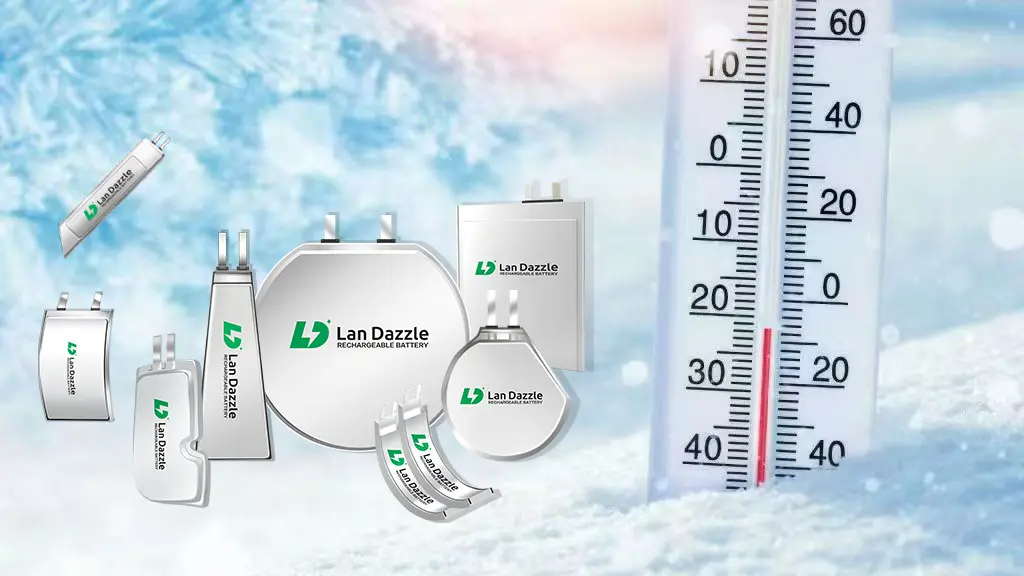
Founded in 2018, LanDazzle is a leading lithium manufacturer focusing on the R&D of special shaped lipo battery, low temperature battery and lithium battery pack.
Our Low Temperature Battery Advantages:
- Structure & Shape Advantage
With advanced stacking technology, we can highly customize battery shapes to make full use of internal space. This allows for smaller, thinner, and complex designs, ideal for professional devices with limited space and a need for low-temperature stability. - Low-Temperature Performance Advantage
At –40°C and 0.5C discharge, the battery still maintains over 60% efficiency.
At –30°C, it can deliver about 80% of its rated capacity.
The operating temperature range is –40°C to 60°C, and the battery has passed safety certifications including UL, CE, and UN. - Weight Advantage
At the same voltage and capacity, our low-temperature LiPo batteries are significantly lighter and thinner than LiFePO₄ batteries, making them perfect for weight‑ and space‑sensitive devices.
How to Charge Lithium Battery in Cold Weather?
Charging is the most critical process for lithium batteries in cold weather. Always follow these best practices:
- Never charge below 0 °C (32 °F).
Charging frozen cells leads to lithium plating and internal shorting. - Warm batteries before charging.
If a battery is cold, bring it indoors and let it reach room temperature gradually. - Use a BMS or charger with temperature protection.
Many modern systems automatically delay charging until the internal temperature is safe. - Charge at lower currents.
A slow charge (e.g., 0.3C–0.5C) generates less stress on cold cells. - Avoid fast charging in winter.
Quick charging amplifies internal heating and can cause uneven lithium deposition.
How to Protect Your Lithium Batteries in Cold Weather?
While cold weather poses a challenge to lithium batteries, you can take proactive steps to ensure optimal performance and longevity throughout the winter. Here are four key strategies for effective cold-weather battery management:
- Keep batteries warm when storing
When not in use, keep them above 10°C. - Use insulation
Battery warmers and insulating materials work well. - Pre‑heat before use
Do not use or charge cold batteries directly. - Use active heating in extreme cold
Batteries with a built‑in heating system have much better stability.
Conclusion
Choosing lithium batteries for cold weather requires understanding how temperature impacts performance and safety. LiPo batteries offer unmatched power-to-weight ratio, making them ideal for compact and high-drain applications — but they must be protected, insulated, and warmed before use. For users operating in extremely cold environments, LiFePO₄ or custom low-temperature LiPo solutions with integrated heaters provide the most dependable results.
Whether you’re powering a drone in Alaska, a camera in Canada, or an outdoor sensor in Colorado, following these cold-weather best practices ensures your lithium batteries stay reliable — even when the temperature drops far below zero.
Ready to find the perfect low temperature battery solution for your products? Contact our team at LanDazzle today to discuss your custom battery needs and discover how our high-performance solutions can power your devices in any environment.
Contact us today to get a free consultation and explore how our custom battery solutions can bring your devices to life.
Email: info@landazzle.com
Whatsapp: +8618938252128