Table of Contents
Lipo battery vs lithium ion is a common question when choosing the best power source for modern devices. While both belong to the lithium battery family and may seem similar, but they are actually quite different in real‑world use. Once you understand these differences, choosing the right battery is not difficult.
Lithium ion Battery vs Lipo: What’s the Difference
If you don’t want to get confused by technical terms, I’ll put it simply in one sentence:
The biggest difference between LiPo and lithium‑ion batteries comes down to their structure.
Here’s an easy analogy:
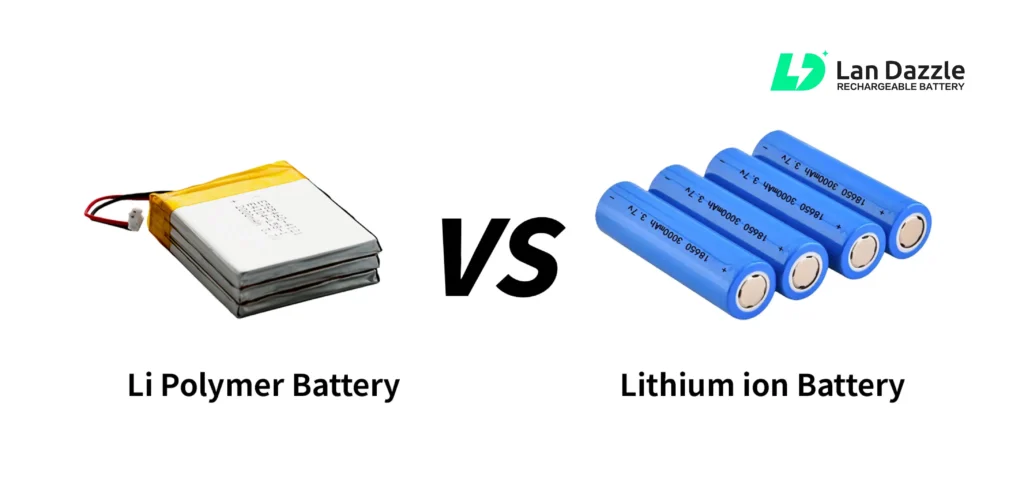
- Lithium‑ion batteries are like batteries sealed inside a rigid metal can.Common types like 18650 and 21700 use this structure.
- LiPo batteries are like batteries packed in a flexible aluminum‑plastic bag,with a gel or semi‑solid material inside.
This one difference — rigid case vs. flexible pouch — directly shapes their shape, weight, discharge performance, and best applications.
Put plainly:
Understand this, and you understand about 80% of their differences.rformance, design possibilities, and applications. Once you grasp this, you’ve already understood 80% of the difference.
How to Choose the Right One?
Before deciding between a Lithium ion Battery vs Lipo, ask yourself two simple questions:
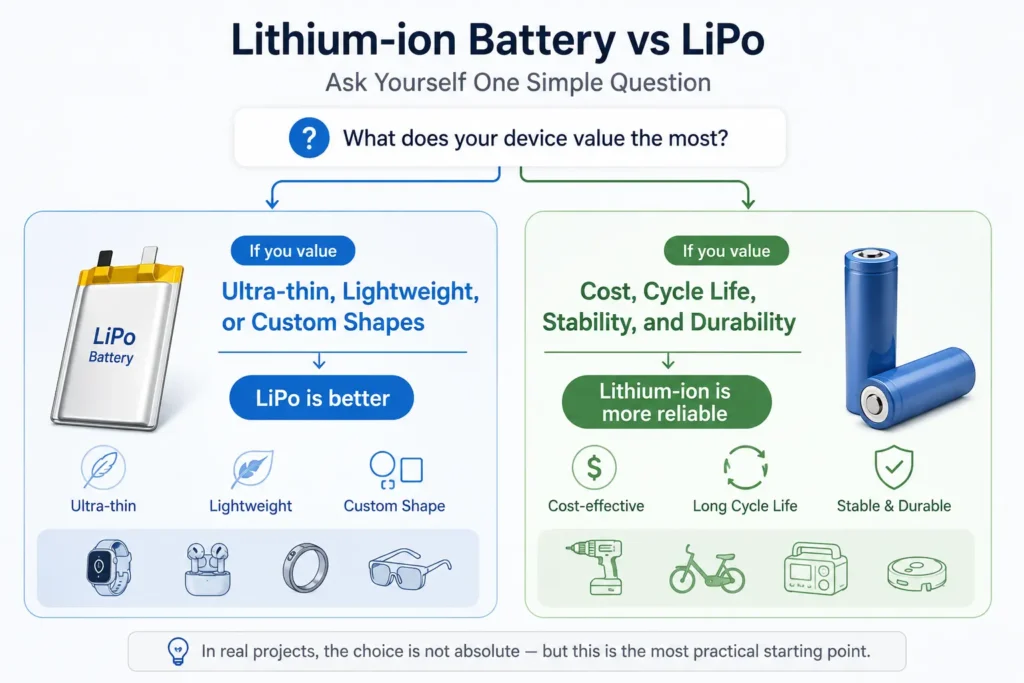
1. What does your device value the most?
If you want ultra-thin, lightweight, or custom shapes→ LiPo is better
If you care more about cost, cycle life, stability, and durability→ Lithium-ion is more reliable
In real projects, it’s not always absolute, but this is already a very practical starting point.
2. What is your specific application?
Different uses have very clear battery preferences:
- Smartphones, ultra-thin laptops, wearables→ LiPo. Tight space, complex structure — flexible pouch batteries perform best.
- Drones, RC models, hobby devices→ LiPo. Lightweight, strong discharge, high instant power output.
- Power tools (drills, saws, etc.)→ Lithium-ion. Cylindrical cells like 18650, 21700 are tough, durable, and long-lasting.
- Home energy storage, solar systems→ Lithium-ion. Long cycle life, lower long-term cost.
- E-bikes, e-scooters→ Lithium-ion. Balances energy density, price, and reliability.
- Medical devices→ Lithium-ion. Stability and reliability always come first.
- Industrial robots, logistics equipment→ Lithium-ion. Stable output even under heavy cycling.
In short: If your project demands design freedom, lightweight, and high discharge power, go with LiPo. If it requires longevity, cost-effectiveness, and robustness, Lithium ion is the clear winner.
Why LiPo or Lithium ion? The Science Behind the Decision
Many people ask: Since both are lithium batteries, why do they perform so differently? The answer lies in their structure and material choices. The advantages of LiPo batteries are mainly these:
- High energy density: For the same weight, LiPo provides more energy,making it ideal for weight-sensitive devices
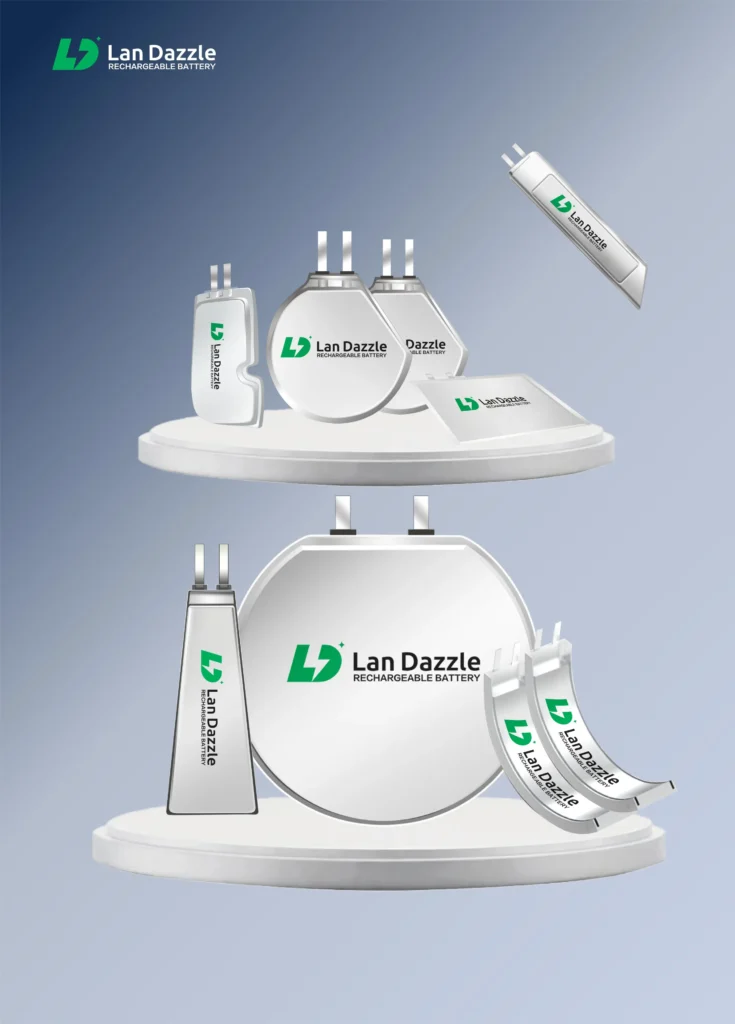
- High shape flexibility: The flexible pouch structure frees the battery from standard shapes, allowing extensive customization
- Strong discharge performance: Supports high-rate discharge with powerful instant current output —that’s why drones prefer it
- Stable voltage output: Safer and more reliable for voltage-sensitive electronics
- Lighter overall weight: A real advantage for drones and wearable devices
- Low self-discharge: Holds its charge well even when not in use
Lithium ion Battery Features:
- High Energy Density: Providing long battery life while keeping size and weight under control
- Long cycle life: It can withstand hundreds or even thousands of charge–discharge cycles, making it more reliable for long‑term use
- High efficiency, low loss: The overall system performance is more stable
- More robust structure: The rigid casing provides better resistance to mechanical shock and impact
Lipo Battery Advantages:
- Extended Usage Time
With their high energy density and lightweight design, LiPo batteries allow devices to operate for longer periods on a single charge, maximizing usability and convenience. - Enhanced Power Delivery
Thanks to their ability to deliver high discharge rates, LiPo batteries provide the instant power needed for rapid acceleration and demanding performance, making them ideal for applications like RC cars, planes, and high-drain electronics. - Customized Fit
LiPo batteries can be produced in a wide range of shapes and sizes, ensuring a perfect fit within devices. This flexibility helps optimize space utilization and can improve overall device performance. - Reduced Device Weight
By offering high capacity in a lightweight form, LiPo batteries contribute to lighter end products—an essential advantage for portable and handheld applications.
Reliable Storage Life
With a naturally low self-discharge rate, LiPo batteries retain their charge for extended periods when not in use, ensuring they remain ready and dependable even after long storage intervals.
Lithium ion Battery Advantages:
- Weight Reduction
The inherently lightweight design of Li-ion batteries plays a vital role in applications where minimizing total system weight directly impacts performance and efficiency. This is especially important for drones, electric vehicles, and other equipment requiring extended operational ranges. - Consistent Power Delivery
Li-ion batteries are capable of providing a stable and reliable power output throughout their discharge cycle. This consistency is critical for high-demand applications that rely on steady performance without power fluctuations. - Lower Environmental Impact
Compared with older battery chemistries, Li-ion batteries offer a smaller environmental footprint. Their recyclability further supports sustainable energy practices, aligning with the growing demand for greener solutions. - Built-in Safety Features
Modern Li-ion batteries are engineered with multiple safety mechanisms, including integrated protection circuits to guard against overcharging, overheating, and short circuits. These features significantly enhance operational safety and reliability.
LiPo or Lithium ion: Which is Safer?
To be honest, no battery is 100% safe — the key is how you use it.
LiPo batteries: If they swell or bulge, that’s a warning sign — you must stop using them immediately. Always use a balance charger, and avoid leaving them charging unattended.
Lithium‑ion batteries: The metal casing is more impact-resistant, but if punctured or severely damaged, the risk is also very high. So avoid physical damage and always use official/qualified chargers.
FAQs
1. Can I replace LiPo with lithium‑ion batteries in my device, or vice versa?
Simply put: you can’t just swap them freely. Although LiPo and lithium‑ion batteries have similar nominal voltages, they differ significantly in discharge performance, internal resistance, capacity decay curve, and physical structure. Many devices are optimized for one specific battery type. Random replacement may reduce performance or even cause safety risks. The safest way is to check your device specifications or confirm with your battery supplier.
2. How to charge LiPo and lithium‑ion batteries safely?
For LiPo batteries: always use a balance charger, and avoid leaving them charging unattended. This reduces the risk of unbalanced cell voltage. For lithium‑ion batteries: use only original or certified chargers to prevent overcharging and overheating.
3. Why do LiPo batteries swell? Is it serious?
Swelling is never a small problem. It usually happens because of overcharging, overheating, aging, or internal damage, which causes gas to build up inside. This is a clear warning sign.
Once you see swelling, stop using the battery immediately. Do not charge or use it further. Continuing to use it may lead to fire or burning.
4. Which battery is better for high‑power devices like drones or power tools?
For applications that need instant high current, such as drones and RC models, LiPo batteries are usually better. For power tools, which need durability, stability and long cycle life, lithium‑ion batteries are more suitable. The key is your actual application, not just the battery type.
5. Can LiPo or lithium‑ion batteries be used in irregularly shaped devices?
LiPo batteries have a clear advantage here. Thanks to their flexible pouch structure, they are highly customizable in size and shape, perfect for irregular designs or tight spaces.
Lithium‑ion batteries are usually cylindrical or rectangular, so they have limited shape flexibility.
6. How to tell if a battery is genuine and good quality?
A few simple rules:
- Choose a reliable manufacturer
- Check if the specifications are clear and realistic
- Confirm it has necessary certifications and test reports
If the price is unreasonably low, the manufacturer probably cut corners on materials or safety. It may seem cheap at first, but it’s not worth it in the long run.
7. Does storage condition really affect battery life?
Yes, quite a lot.Batteries should be stored in a cool, dry place.Avoid long‑term storage at full charge or completely empty. Proper storage conditions slow down aging and extend service life.
8. What should I do if a battery is damaged or punctured?
First: stop using it immediately and keep it away from flammable materials.Do not try to charge it or repair it yourself.A damaged battery has an unstable internal structure and high risks.
The correct way is to dispose of or recycle it safely according to local regulations.
Conclusion
Choosing between a Lithium ion Battery vs Lipo doesn’t have to be complicated. By understanding their fundamental differences in structure, performance, and application, you can select the battery that best fits your device’s needs—whether it’s lightweight flexibility for drones and wearables or durability and long life for power tools and energy storage.
Ready to find the perfect battery for your project? Explore our custom battery solutions today and power your devices with confidence.
Email: info@landazzle.com
Whatsapp: +8618938252128