Table of Contents
Silicon-carbon batteries are gaining popularity in smartphones because they can help increase battery capacity without significantly increasing device size. But are they better than conventional lithium-ion batteries? Do they charge faster, last longer, or offer better safety?
The key point is that silicon-carbon batteries are still a type of lithium-ion battery. The main difference is their anode material: conventional lithium-ion batteries typically use graphite, while silicon-carbon batteries incorporate silicon into a carbon-based composite.
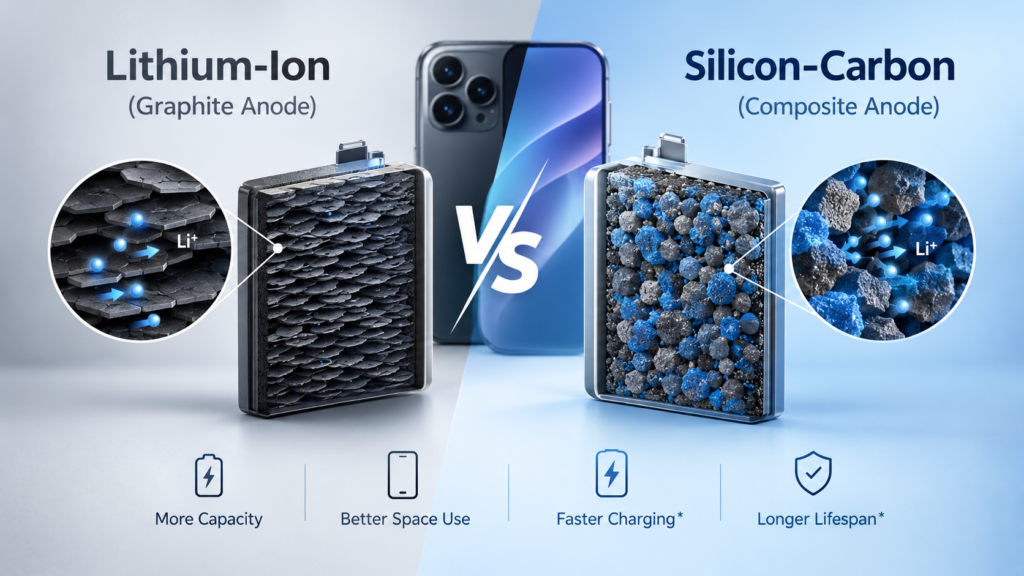
This change creates opportunities for higher energy density, but it also introduces challenges involving expansion, cycle life, and long-term stability. Let’s compare the two approaches and explore what they mean for smartphone users and product designers.
Silicon Carbon Battery vs Lithium ion: What’s the Differences?
Conventional Lithium-Ion Batteries
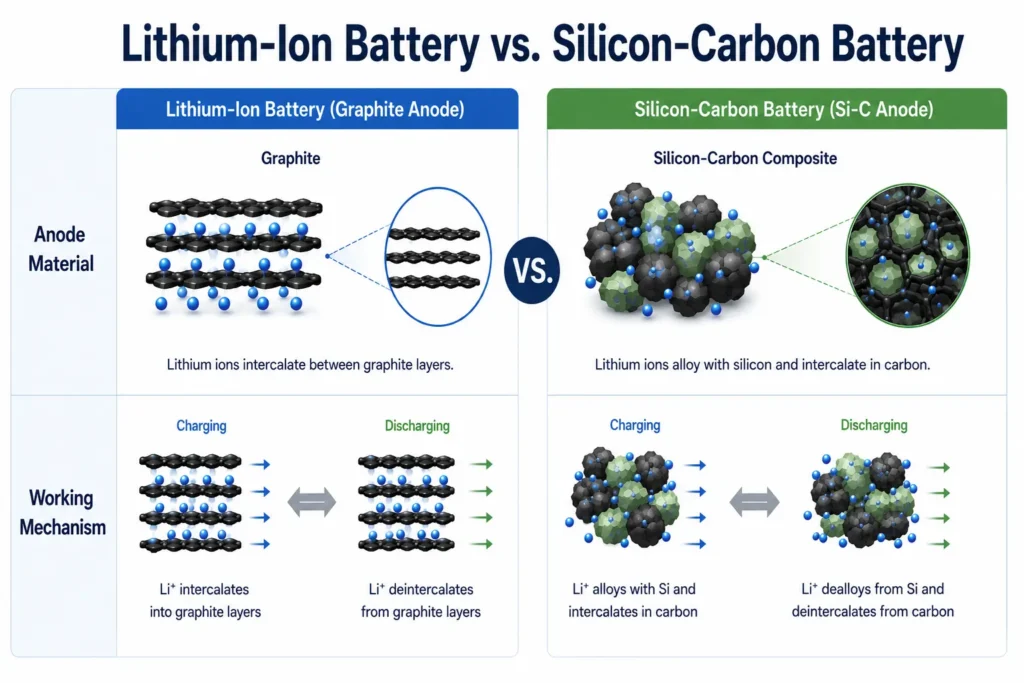
Conventional lithium-ion batteries commonly use graphite as the anode material. During charging and discharging, lithium ions move between the positive and negative electrodes through the electrolyte.
Graphite is widely used because it provides relatively stable cycling performance and benefits from mature manufacturing processes. However, its theoretical specific capacity is approximately 372 mAh/g, which limits the amount of lithium it can store per unit mass of active material.
Silicon-Carbon Batteries
Silicon-carbon batteries incorporate silicon into a carbon-based anode composite. Silicon can store significantly more lithium than graphite, with a commonly cited theoretical specific capacity of approximately 4,200 mAh/g under a particular lithiation assumption.
This figure describes the active material, not the capacity of a complete battery cell. Actual cell-level performance depends on the anode formulation, cathode, electrode design, electrolyte, and other components.
Silicon also undergoes substantial volume changes during charging and discharging. These changes can damage the electrode structure and reduce capacity retention over time. Combining silicon with carbon and optimizing the electrode design can help address these challenges.
Source: Multi-scale Design of Silicon/Carbon Composite Anode Materials for Lithium-Ion Batteries: A Review.
| Feature | Conventional Graphite-Anode Li-ion | Silicon-Carbon Li-ion |
|---|---|---|
| Anode material | Primarily graphite | Silicon-carbon composite |
| Energy density | Depends on the complete cell design | Potential to achieve higher energy density |
| Capacity in limited space | Depends on cell materials and construction | May enable greater capacity within a similar space |
| Charging speed | Depends on cell design and charging protocol | May support high-rate charging, but not automatically faster |
| Cycle life | Established performance across many commercial designs | Depends on silicon content and degradation control |
| Manufacturing | Mature supply chain and processes | Requires careful control of materials and electrode design |
| Best suited for | Cost-sensitive products with established performance requirements | Compact devices seeking higher capacity |
Silicon-carbon technology is not universally superior. Its main advantage is the potential to increase energy density, while conventional graphite-anode batteries benefit from established manufacturing processes and extensive commercial experience.
Comparisons should always use data from complete battery cells tested under equivalent conditions rather than theoretical material capacities alone.
Advantages and Disadvantages of Silicon-Carbon Batteries
Advantages
Higher capacity potential
Silicon’s high theoretical lithium-storage capacity creates opportunities to improve cell-level energy density. For smartphones, this may mean longer battery life within a similar form factor or greater design flexibility when space is limited.
However, the improvement is not fixed. Silicon content, electrode loading, cathode chemistry, and cell construction all influence the final result.
Greater design flexibility
Higher energy density can help manufacturers balance battery capacity, thickness, and device weight. Depending on the design, engineers may increase capacity without substantially enlarging the battery or use the available space to develop a slimmer device.
Potential for improved charging performance
Silicon-based anodes are being investigated for fast-charging applications. Nevertheless, charging performance depends on more than anode capacity. Electrode structure, electrolyte formulation, heat management, and lithium-deposition risks must also be considered.
Research source: Recent Status, Key Strategies, and Challenging Prospects for Fast-Charging Silicon-Based Anodes for Lithium-Ion Batteries.
Disadvantages
Volume expansion
Silicon can experience volume expansion exceeding 300% under certain lithiation conditions. Repeated expansion and contraction may cause particle damage, disrupt electrical connections, and destabilize the solid-electrolyte interphase (SEI).
This figure describes silicon material under specific conditions, not the expansion of an entire battery.
Cycle-life challenges
Silicon-related structural damage and interfacial instability can contribute to capacity loss over time. Manufacturers must balance silicon content with durability, efficiency, and consistent performance.
Manufacturing complexity
Silicon-carbon anodes may require specialized material structures, binders, and electrolyte formulations. Cost and production yield depend on the selected materials, manufacturing processes, and production scale.
Research source: A Review of Silicon-Carbon Anode Materials: The Role of Precursor and Its Effect on Lithium-Ion Battery Performance.
Are Silicon-Carbon Batteries Better for Smartphones?
Smartphone manufacturers must fit the battery alongside displays, cameras, processors, and other components inside a compact enclosure. Higher energy density can provide more flexibility when balancing capacity, thickness, and weight.
A commercial example is the Xiaomi 17T Pro. According to Xiaomi’s official global product page, it features a 7,000 mAh typical-capacity silicon-carbon battery with 16% high silicon content. The manufacturer also lists 100 W wired charging, 50 W wireless charging, and battery health of at least 80% after 1,600 charging cycles under its specified test conditions.
Source: Xiaomi 17T Pro — Official Product Specifications.

This example demonstrates the commercial use of silicon-carbon technology, but it does not prove that every silicon-carbon battery offers the same performance.
The phone’s capacity, charging speed, and durability also depend on cell construction, power management, thermal design, and operating conditions. The stated cycle-life result should be understood as a manufacturer claim under specified conditions, not a universal guarantee.
For smartphone buyers, silicon-carbon technology is worth considering, but actual battery-life tests, charging performance, warranty coverage, and overall device quality remain important factors.
Safety, Lifespan, and Charging: What Should You Know?
Are Silicon-Carbon Batteries Safe?
Silicon-carbon batteries remain lithium-ion batteries, so their safety depends on the complete cell and device design. Electrode stability, electrolyte behavior, manufacturing quality, thermal management, and protection circuitry all matter.
Silicon content alone does not establish whether a battery is safer or less safe than a conventional lithium-ion battery. Specific products must be evaluated through appropriate testing.
Do Silicon-Carbon Batteries Last Longer?
Not necessarily. Higher anode capacity does not automatically translate into longer cycle life.
Durability depends on silicon content, electrode engineering, electrolyte formulation, operating temperature, charging conditions, and depth of discharge. Compare documented cycle-life results using equivalent test conditions rather than assuming one battery type always lasts longer.
Do Silicon-Carbon Batteries Charge Faster?
Not automatically. Although silicon-based anodes are being developed for high-rate applications, real charging performance depends on the complete cell and charging system.
For consumers, manufacturer specifications and independent charging tests provide more meaningful evidence than the anode material alone.
Which Battery Technology Should You Choose?
There is no single winner for every application.
Silicon-carbon batteries may be a better fit when:
- High capacity is needed within limited internal space.
- Longer runtime is a priority without substantially increasing device size.
- The product benefits from newer high-energy-density battery designs.
Conventional graphite-anode lithium-ion batteries may be sufficient when:
- Existing battery capacity already meets the product’s requirements.
- Established manufacturing processes and cost are important priorities.
- Proven performance data matters more than pursuing additional capacity.
Ultimately, compare the performance of complete battery cells or finished devices rather than relying on chemistry labels alone.
Conclusion
Silicon-carbon batteries offer a promising route to higher energy density in lithium-ion batteries, particularly for smartphones and other compact electronics. Their main opportunity is improved capacity within limited space, while their principal challenges include silicon expansion, cycle-life management, and manufacturing consistency.
For consumers, the best choice depends on the performance of the complete device. For product engineers, the priority is finding a battery that balances capacity, dimensions, reliability, and safety.
Exploring Silicon-Carbon Batteries for Your Product?
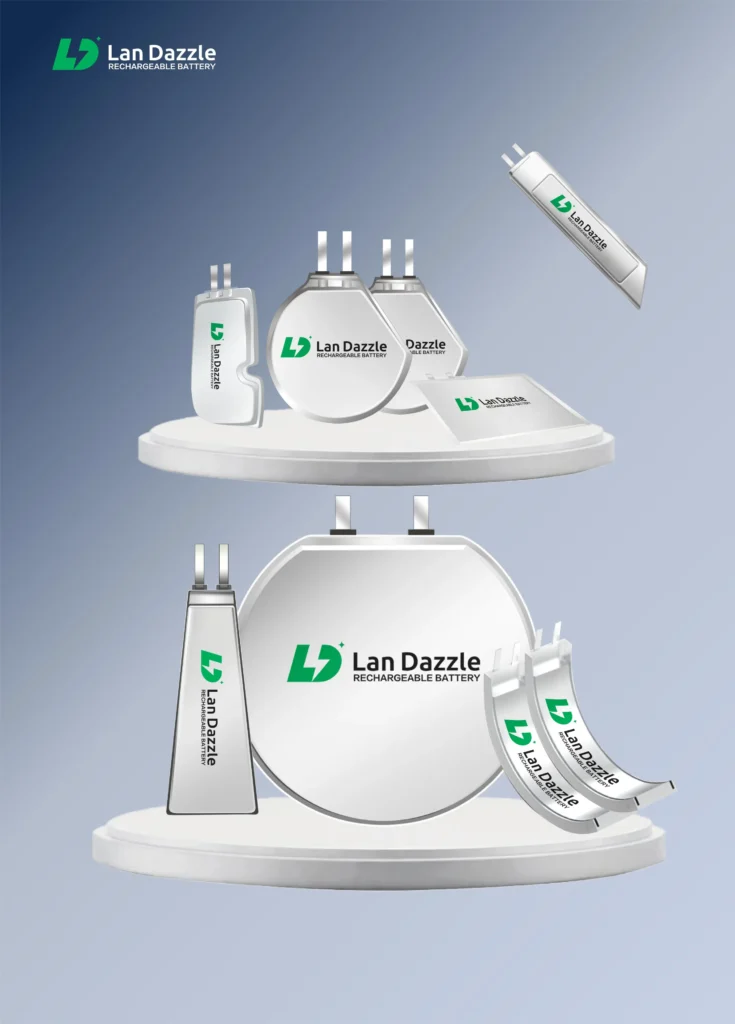
LanDazzle develops custom lithium battery solutions for space-constrained electronic devices. Explore our silicon-carbon battery solutions or learn about our custom-shaped battery design.
Share your target capacity, available dimensions, and performance requirements with our engineering team to discuss a suitable battery solution.
Email: info@landazzle.com
Whatsapp: +8618938252128