Table of Contents

What is a Pouch Battery?
Let’s start with the most straightforward explanation.
A pouch battery, often called a LiPo pouch cell, is still a type of lithium-ion battery.
Instead of a rigid metal case, it uses a flexible aluminum-plastic composite film for packaging.
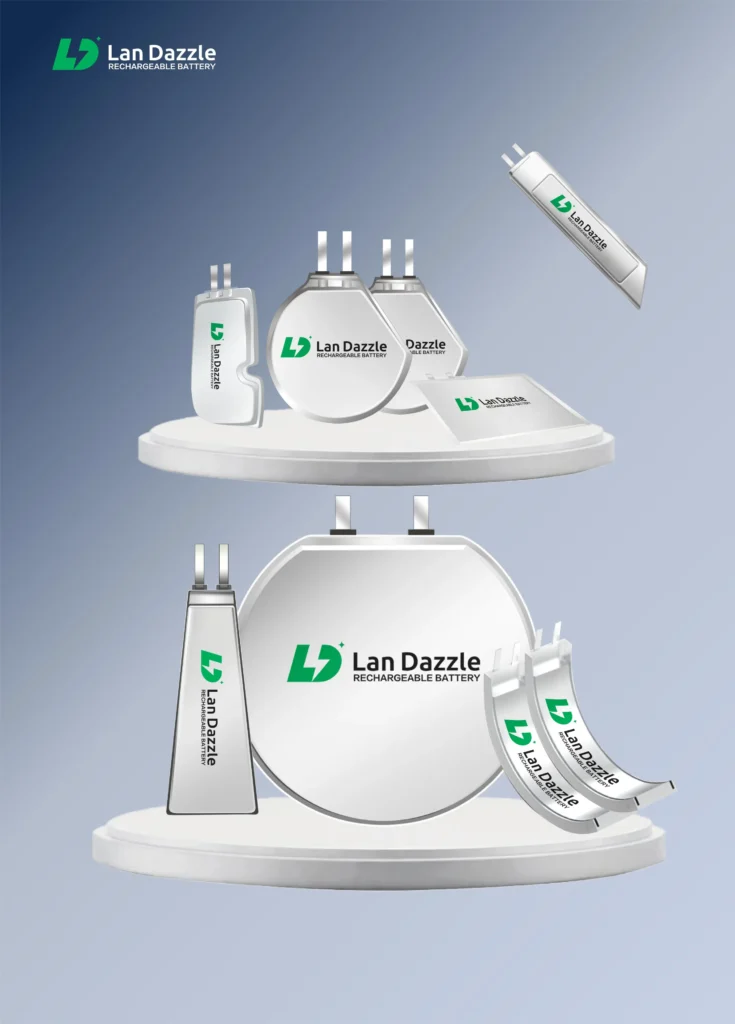
This packaging method gives pouch cells great freedom in shape and structure.
They can be made thinner and lighter, and designed into various shapes and thicknesses to fit product structures.
That is why they are widely used in devices with limited or irregular space.
1. Electrodes: Positive and Negative
The core of any pouch cell is still its electrode system.
It consists of a cathode (positive electrode) and an anode (negative electrode).
Active materials are coated on metal foils — this is the basic structure of all lithium batteries.
Common cathode materials include:
- Lithium Cobalt Oxide (LCO)
- NMC (Nickel Manganese Cobalt)
- Lithium Iron Phosphate (LFP)
The anode is usually made of graphite, sometimes with silicon-based materials to improve performance.
It is important to note that the choice of electrode materials is not a minor detail.
It directly determines the battery’s energy density, cycle life, and discharge performance, making it central to performance design.
2. Separator
Between the cathode and anode is a thin, porous separator.
Its role is simple but critical:
- It prevents direct contact between the positive and negative electrodes to avoid short circuits.
- It allows lithium ions to pass through freely.
The quality of the separator directly affects the battery’s safety, stability, and long-term reliability.
This is especially important for pouch cells, which have a softer structure.
3. Electrolyte
The electrolyte transports lithium ions inside the battery and is essential for charging and discharging reactions.
Its role goes beyond just conducting electricity.
The electrolyte formula affects:
- Temperature performance
- Charge and discharge rate
- Safety
By optimizing the electrolyte system, we can greatly improve low-temperature performance or stability under high-current conditions.
4. Flexible Pouch Packaging
This is the biggest difference between pouch cells and cylindrical or prismatic cells.
Pouch cells use aluminum-plastic composite film packaging instead of heavy metal cases.
This makes them lighter and more compact, and easier to customize.
However, the flexible structure also brings new challenges.
During design, we must fully consider swelling during charging and discharging and mechanical stress management over time.
Otherwise, battery life and safety can be affected.
How to Make a Pouch Battery?
High-quality pouch cells are not made by simply putting materials together and sealing them.
From an engineering perspective, they require a complete, precise and highly controlled manufacturing process:
- Electrode preparation
- Lamination or winding
- Electrolyte injection
- Sealing
- Formation and testing
Every step has strict requirements for environment, technology, and consistency.
We explain the full production process in detail in our dedicated videos and articles.
To learn how custom LiPo batteries are made, including key points of custom design and quality control, watch our video or read our full article: how a custom lipo battery is made?
Why Choose a Pouch Battery? Customization and Application Advantages
Many modern electronic devices choose pouch batteries for clear reasons:
high space utilization, lighter weight, and great design flexibility.
Compared with cylindrical or prismatic cells, pouch cells have advantages in energy-to-weight ratio and structural adaptability — critical for portable and compact products.
1. Space-Efficient and Lightweight
Pouch cells have a flat structure and can fit tightly inside a device.
This allows products to be thinner and lighter without reducing capacity, making them ideal for:
- Portable medical devices
- Wearable devices
- Smart glasses
2. Design Flexibility
If we had to name the biggest advantage of pouch cells, it would be shape freedom.
Pouch batteries can be customized in different sizes, shapes, and thicknesses.
Curved designs, ultra-thin structures, and multi-cell combinations are all possible.
3. High Performance for Specialized Applications
Pouch batteries are not just easy to install and space-saving.
With optimized design, they can support:
- High power output
- Longer battery life
- Special environmental requirements, such as low-temperature operation
We can also integrate safety features like temperature sensors and protection circuits based on application needs.
4. Customization for OEMs and Integrators
For OEMs and system integrators, the greatest value of pouch cells is that
product design is no longer limited by standard battery sizes.
LanDazzle focuses on fully customized pouch battery solutions
that precisely match your product’s requirements for voltage, capacity, and shape.
5. Versatile Applications
Pouch batteries offer an excellent balance of size, weight, and performance.
They are used in:
- Drones and robots
- Power tools
- Smart locks
- Aerospace equipment
Their modular design also makes them suitable for battery packs and multi-cell systems.
Comparison: Pouch vs Cylindrical vs Prismatic
| Feature | Pouch Cell | Cylindrical Cell | Prismatic Cell |
|---|---|---|---|
| Shape & Structure | Soft, flexible foil pouch | Rigid round metal casing | Rectangular metal casing |
| Energy Density | High | Medium | Medium–High |
| Weight | Lightest | Heavier | Heavy |
| Space Efficiency | Excellent – fits compact or irregular designs | Moderate – gaps between cells | Good – flat and space-saving |
| Mechanical Strength | Requires external protection | Very strong and durable | Strong, but heavier |
| Thermal Performance | Good | Excellent | Good |
| Design Flexibility | Highly customizable in shape and size | Fixed cylindrical size | Limited flexibility |
| Manufacturing Cost | Moderate | Low (mass production) | Higher |
| Cycle Life | Good | Long | Good |
| Best For | Wearables, drones, robotics | Power tools, e-bikes, industrial use | EVs, energy storage systems |
Challenges in Pouch Battery Design
1. Mechanical & Structural Challenges
- Swelling: Cells can bulge from gas build-up and material expansion during charging. This strains components and can break the seal.
- Puncture Risk: The soft, flexible pouch is easily damaged by sharp objects or crushing, leading to serious safety hazards.
- Seal Integrity: The edge seal is a weak point. If it fails, electrolyte can leak out, or moisture can get in, ruining the cell.
2. Electrical & Manufacturing Challenges
- Tab Design: Small metal tabs (the electrical contacts) can be a bottleneck for high current, causing heat and limiting fast charging.
- Stack Pressure: The internal layers need uniform pressure to work properly. Uneven pressure causes rapid aging.
- Complex Manufacturing: The assembly process is delicate and sensitive to moisture, making consistent quality hard to achieve.
Custom Pouch Battery Solutions from LanDazzle
We understand the challenges in pouch battery design and that’s why our custom solutions are engineered to address these issues while delivering optimal performance.
1. Advanced Mechanical Design
We optimize cell structure and materials to minimize swelling and reinforce packaging against punctures and external stress. Our precise sealing technology ensures long-term integrity, preventing leaks and protecting against environmental factors.
2. Electrical and Performance Optimization
Our engineers carefully design tab placement and thickness to support high-current applications, enabling fast charging and stable power output. We also ensure uniform stack pressure for consistent performance and extended cycle life.
3. Tailored for Your Application
Whether it’s a drone, robotic system, wearable device, or industrial tool, we customize pouch cells to meet specific voltage, capacity, size, and shape requirements. Low-temperature performance, high-power output, and integrated BMS solutions are all available to match your exact needs.
4. Quality and Reliability
Every battery undergoes strict quality control, including moisture-sensitive assembly, thermal management, and mechanical testing, ensuring reliable operation even in demanding conditions.
Conclusion
With light weight, high flexibility, and excellent performance, pouch batteries are changing how modern electronic products are designed.
Their ability to adapt to different shapes, sizes, and capacities makes them ideal for drones, robots, wearables, and aerospace systems.
Although challenges remain in swelling control, structural protection, and manufacturing difficulty,
these issues can be effectively solved with mature engineering and customized solutions.
By choosing the right custom pouch battery solution, OEMs and system integrators can maximize space use and product performance without compromising safety.
Contact LanDazzle today to discuss your custom battery solutions and discover how our solutions can enhance your product.
Email: info@landazzle.com
Whatsapp: +8618938252128