Table of Contents
When a gadget gets smaller, the battery often becomes one of the hardest components to fit. A compact device may have only a few millimeters of usable space for its power source. At the same time, the battery still needs to provide enough energy, meet the device’s current demand, and work reliably inside a tightly packed enclosure.
This creates a common problem for product designers:
How do you choose a thin battery for a small gadget without compromising the rest of the product?
For many space-constrained electronics, thin lithium-polymer (LiPo) pouch batteries are a practical option because their flexible packaging allows manufacturers to develop lightweight cells in compact and non-standard form factors. Pouch cells also make efficient use of the available package volume, although the final device design still needs to account for mechanical support and potential cell expansion.
The key is to look beyond battery thickness alone. For a small gadget, battery dimensions, shape, capacity, electrical performance, mechanical integration, and safety all need to be considered together.

What Makes a Battery Suitable for a Small Gadget?
A battery for a small electronic device is not simply a smaller version of a conventional battery. The right battery needs to fit the actual internal architecture of the product while providing the required electrical performance. Several factors usually matter at the same time:
| Requirement | Why It Matters |
|---|---|
| Thickness | Determines whether the battery can fit inside the available space |
| Length and width | Define the usable footprint inside the enclosure |
| Shape | Helps the battery follow irregular or curved internal structures |
| Capacity | Determines how much energy the device can store |
| Discharge capability | Must support the device’s operating and peak loads |
| Weight | Can directly affect the feel and portability of small products |
| Operating temperature | Determines whether the cell is suitable for the intended environment |
| Protection | Helps manage charging, discharge, temperature, and other safety requirements |
This is why battery selection should happen alongside mechanical and electrical design rather than after the product structure has already been finalized. A standard rectangular cell may have the required voltage and capacity, but still be the wrong choice if it leaves too much unused space or interferes with other internal components.
For many small gadgets, battery geometry becomes part of the product design itself.
How Thin Can a Lithium Battery Be?
There is no single thickness that defines a “thin battery.”
Available thickness depends on factors such as cell chemistry, electrode structure, capacity requirements, packaging, manufacturing process, and the mechanical requirements of the application. LiPo pouch technology is particularly suitable for compact products because it does not rely on the same rigid cylindrical or metal-can structure used by many traditional cells. Its flexible pouch format can support thin and lightweight designs and allows manufacturers to adapt the cell geometry to different applications.
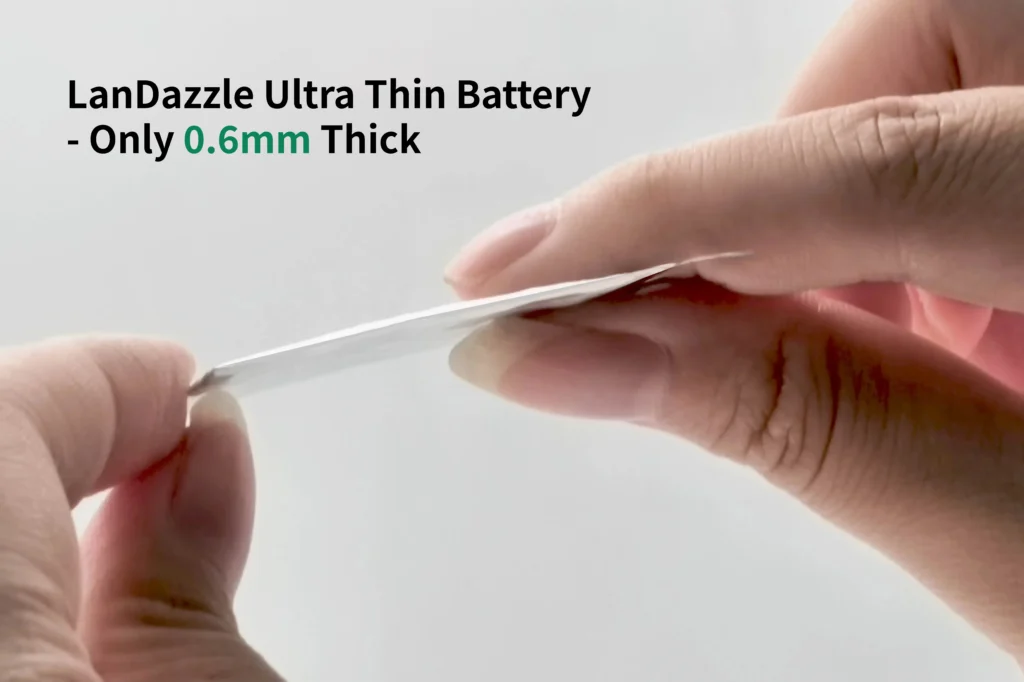
Depending on the product, thin batteries may range from a few millimeters thick to specialized ultra-thin designs below 1 mm. For example, LanDazzle currently lists custom lithium batteries with thicknesses starting from 0.6 mm, with custom dimensions and shapes designed for compact products.
However, a smaller thickness target does not automatically produce a better battery.
The thinner the design becomes, the more carefully the internal cell structure, packaging, dimensional tolerance, mechanical support, and manufacturing process need to be controlled. At ultra-thin dimensions, even individual material layers and sealing structures become important parts of the overall design.
Should You Choose the Thinnest Battery Possible?
Not necessarily. The thinnest battery is not always the most suitable battery for a small gadget. Imagine a device has enough room for a 1.5 mm battery, but the product team specifies a 0.6 mm cell simply because it is thinner. That extra reduction in thickness may not provide a meaningful product advantage if the available space could instead be used to achieve the required capacity or improve the overall battery design.
The objective should be to find the minimum practical thickness that meets the product’s mechanical and electrical requirements. A battery that is slightly thicker but significantly better matched to the available footprint may be more useful than an ultra-thin battery with insufficient energy or an unsuitable shape.
This becomes especially important when the device contains other components such as:
- sensors
- antennas
- speakers
- displays
- cameras
- processors
- charging coils
- flexible circuits
The battery cannot be considered independently from these components. A good battery design therefore balances:
thickness + footprint + shape + capacity + electrical performance + mechanical integration
rather than optimizing a single specification.
What Battery Shape Works Best for a Small Gadget?
For many compact products, the problem is not simply that the battery is too thick. The bigger problem may be that the battery has the wrong shape. Traditional rectangular cells work well when the internal enclosure is also rectangular. But many modern products are not built around a simple box-shaped cavity.
Think about:
- smart glasses with narrow temples
- smart rings with circular internal spaces
- wristbands with curved housings
- medical patches with thin body-contact surfaces
- compact sensors with irregular PCB layouts
- handheld devices with tapered edges
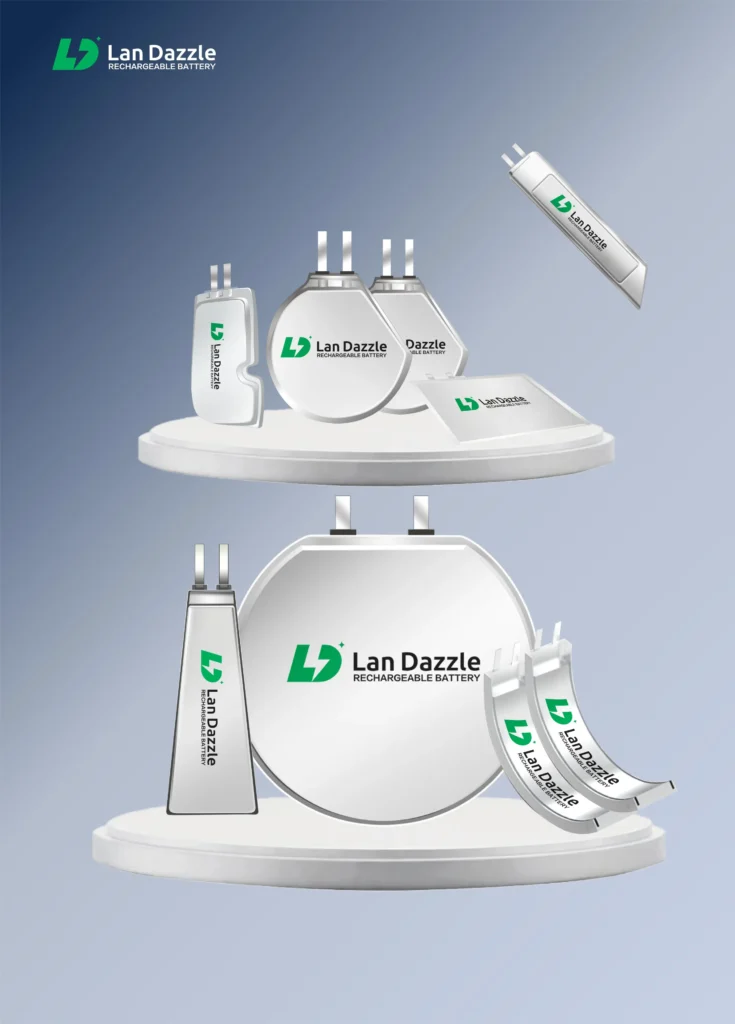
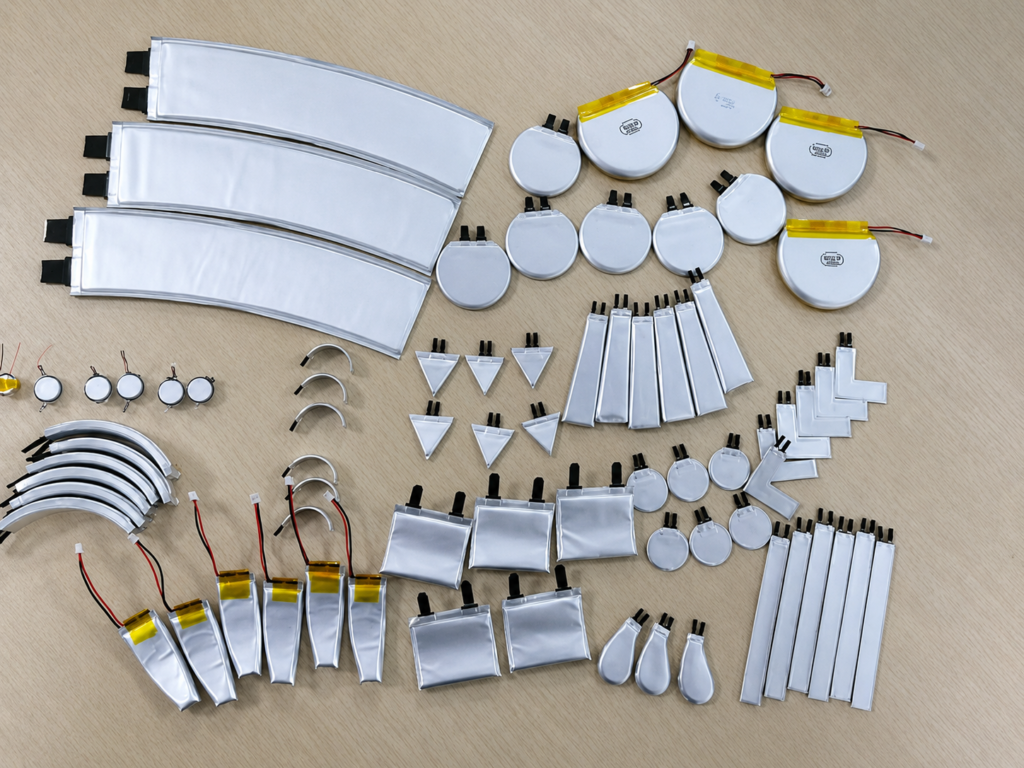
In these applications, a standard rectangular cell may fit only part of the available space. Pouch cells provide more flexibility because custom geometries can be developed around the target enclosure. Custom battery manufacturers commonly produce curved, narrow, round, L-shaped, stepped, and other non-standard designs for space-constrained devices.
Flat Rectangular Batteries
These are usually the simplest option when the battery compartment has a conventional rectangular shape. They can work well for:
- small handheld electronics
- sensors
- compact consumer products
- simple wearable devices
When the available cavity already matches the battery footprint, there may be little reason to introduce a more complex geometry.
Ultra-Narrow Batteries
Some products have a very long but narrow space rather than a large rectangular cavity. This is common in devices such as smart glasses, where battery placement may need to follow the narrow profile of the frame or temple. LanDazzle, for example, develops narrow custom cells with widths down to 5 mm for compact wearable designs.
Curved Batteries
A curved battery can follow the shape of a wearable product rather than forcing the product to create a flat battery compartment.
This can be useful for:
- smart rings
- wrist wearables
- curved medical devices
- smart glasses
- other body-worn products
The purpose is not simply to make the battery look different. The goal is to make better use of the available internal volume.
Round and Irregular-Shaped Batteries
Some products simply do not have a rectangular battery cavity. For these designs, round, oval, trapezoidal, L-shaped, T-shaped, or other irregular geometries may be considered. LanDazzle’s custom battery portfolio includes rectangular, curved, oval, semicircular, arc, bent, T-shaped, and irregular cell geometries for compact wearable and XR applications. The right shape depends entirely on the mechanical structure of the device.
What Are the Common Applications of Thin Batteries?
Thin batteries are most useful when a product has strict limitations on internal space, thickness, weight, or industrial design.
Smart Rings
Smart rings have an unusually difficult battery geometry because the usable space follows a circular form factor. A conventional rectangular battery can leave significant unused space or simply fail to fit inside the ring. Curved or arc-shaped LiPo cells can be designed around the ring structure, allowing the battery footprint to follow the available space.
Smart Glasses
Smart glasses are another clear example. The temples are typically long and narrow, leaving limited room for both electronics and battery storage. A narrow or custom-shaped pouch cell can be designed around the internal frame rather than forcing the frame to accommodate a standard battery.
LanDazzle currently develops ultra-thin and ultra-narrow battery solutions for smart glasses, including custom-shaped cells designed around different temple structures.
Medical Wearables
Medical patches and other body-worn medical devices often require a combination of low profile, low weight, and reliable operation. In this type of application, the battery can affect not only the size of the device but also how comfortably it sits on the body.
Custom-shaped pouch cells can help designers work around sensors, circuit boards, adhesives, and other internal components while keeping the overall product compact.
IoT Sensors
Small IoT products often have very limited internal volume. A sensor may be installed inside a compact enclosure, attached to a surface, or integrated into another product. In these cases, battery dimensions can become one of the main limitations on the final form factor. A thin battery can make it easier to keep the device compact without relying on a larger external power source.
Compact Consumer Electronics
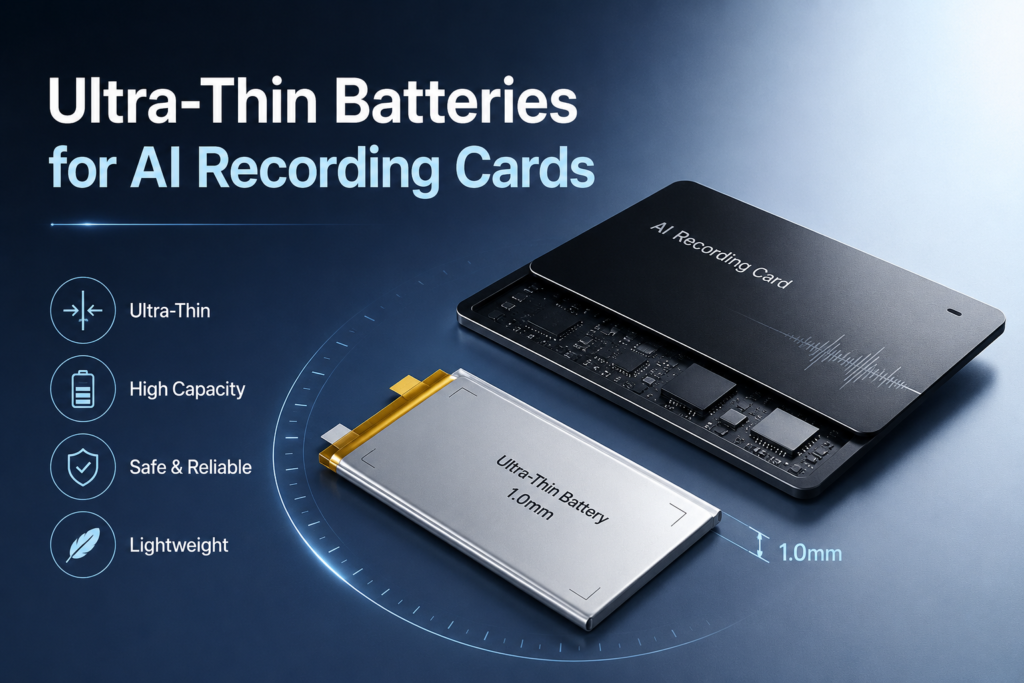
Thin batteries are also used in other small electronics where product thickness and internal space are important design constraints.
For example:
- smart cards
- miniature trackers
- compact controllers
- portable instruments
- smart clothing
- small audio devices
The common requirement is simple: the battery has to occupy as little useful product space as possible while still providing the required performance.
What Are the Limitations of Thin Batteries?
Making a battery thinner introduces engineering trade-offs.
The first is physical space. A very thin cell has less room for the active materials and packaging structure that make up the battery. The design therefore needs to balance the target thickness with capacity, durability, and manufacturing feasibility.
The second is mechanical integration. Pouch cells are lightweight and flexible, but they still require appropriate support inside the product. Battery designers also need to account for possible changes in cell dimensions over the operating life. Battery references note that pouch-cell applications should allow for swelling and provide suitable support within the battery compartment.
The third issue is tolerance. In a compact product, a dimensional difference that seems small on paper can become important during assembly. The battery needs to work with the tolerances of the enclosure, adhesive layers, connectors, PCB, and other components.
The fourth issue is thermal and electrical performance. A small battery may need to power a device that has short periods of relatively high current demand. The battery therefore needs to be evaluated under the actual operating conditions rather than selected only by its physical dimensions.
Finally, safety and compliance cannot be treated as an afterthought. For lithium battery products, applicable safety standards and testing requirements depend on the battery type, application, and target market. IEC 62133-2, for example, specifies safety requirements and tests for portable sealed secondary lithium cells and batteries.
This means an ultra-thin battery project is not just a mechanical miniaturization exercise. It is a balance between form factor, electrochemical performance, mechanical reliability, manufacturing, and safety.
How Do You Choose Between a Standard and Custom Thin Battery?
The choice between a standard battery and a custom battery usually depends on how restrictive the product’s internal space is.
A standard battery can be the simpler option when:
- the enclosure already matches an available cell
- the capacity requirement is within the standard range
- there is enough space around the battery
- connector placement does not create problems
- the product does not require a unique shape
In these cases, there may be little benefit in developing a completely new cell. A custom battery becomes more relevant when the battery itself is limiting the product design.
For example:
| Standard Battery | Custom Thin Battery |
|---|---|
| Fixed dimensions | Custom dimensions |
| Standard rectangular geometry | Curved or irregular geometry |
| Easier to source | Designed around the product |
| Less development effort | More engineering collaboration |
| Best for compatible enclosures | Useful for highly space-constrained designs |
| Limited connector and configuration options | Connector, wire, and configuration can be customized |
The key question is not: “Is a custom battery better?”
A more useful question is: “Is the standard battery limiting the product design?”
If the answer is yes, custom battery development may become part of the product engineering process rather than simply a purchasing decision.
How Does Custom Battery Design Work for a Small Gadget?
Custom battery development usually starts with the product’s actual internal space. Instead of selecting a battery first and designing the enclosure around it, the battery manufacturer can work backward from the available cavity.
That may involve:
- Reviewing the available battery space.
- Evaluating the required cell geometry.
- Determining a practical thickness range.
- Matching the cell’s electrical characteristics to the application.
- Designing the pouch and electrode structure.
- Reviewing tabs, wires, connectors, and protection components.
- Producing samples for fit and performance validation.
- Refining the design before mass production.
This approach is particularly useful when the available volume is irregular.
For example, an L-shaped battery can occupy space around another component, while a curved cell can follow the internal radius of a wearable housing. A narrow battery can also be positioned inside a long, slim section where a conventional rectangular cell would not fit.
The principle is straightforward:
The battery should adapt to the product when the product cannot afford to adapt to the battery.
That is the basic idea behind custom-shaped lithium battery engineering.
Conclusion
In today’s era of miniaturized electronics, a reliable and efficient thin battery for a small gadget is no longer optional—it’s essential. Ultra-thin lithium polymer batteries provide the perfect combination of high energy density, lightweight design, and flexible form factor, making them ideal for wearables, medical devices, IoT sensors, and other compact gadgets.
At LanDazzle, we specialize in creating custom thin batteries tailored to your product’s unique dimensions, power requirements, and safety standards. From curved and irregular designs to high-capacity solutions, our engineering team ensures that every battery delivers reliable performance and seamless integration.
If you’re ready to enhance your small device with a thin lithium polymer battery that meets your exact specifications, contact LanDazzle today. Let us help you bring your product to life with a powerful, compact, and custom battery solution.
Email: info@landazzle.com
Whatsapp: +8618938252128