Table of Contents
Wearable devices are becoming smaller, lighter, and more capable. From smart rings and fitness trackers to smart glasses and medical patches, product designers need batteries that fit into increasingly limited spaces without compromising runtime or reliability.
However, making a battery thinner is not simply a matter of reducing its dimensions. Battery thickness affects available active material, capacity, mechanical strength, and manufacturing complexity. The real challenge is finding the right balance between these factors.
At LanDazzle, we approach thin battery solutions from an engineering perspective. Instead of choosing a standard cell first and adjusting the product around it, we evaluate the available space, electrical requirements, and application constraints to develop a battery that fits the device.
What Is a Thin Battery?
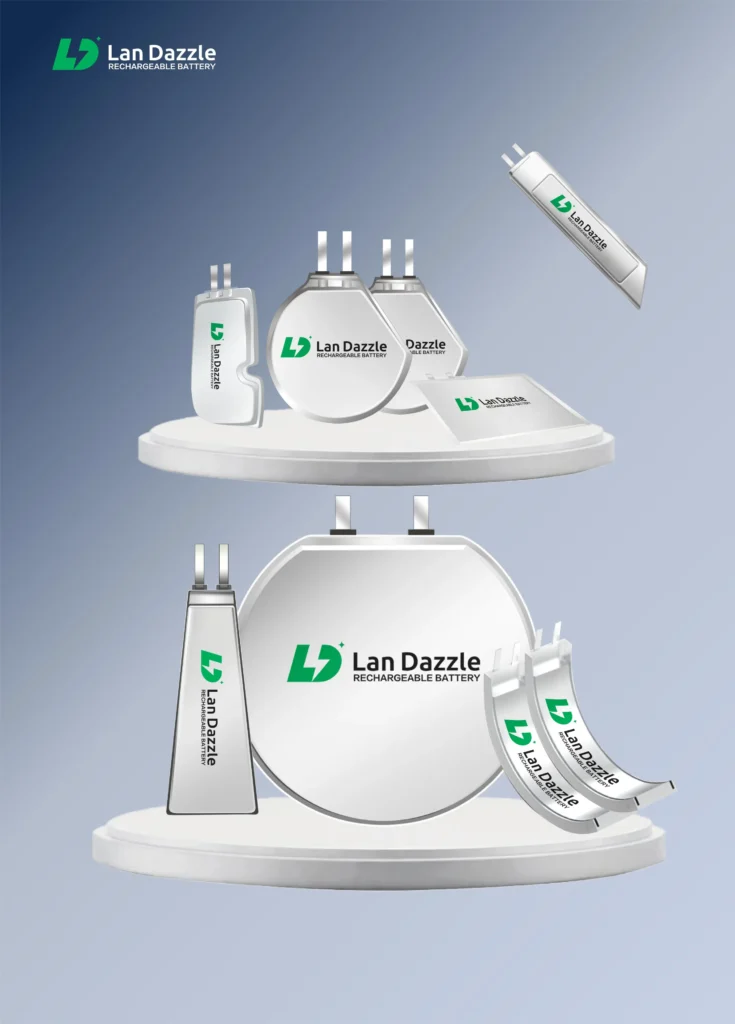
A thin battery is designed for applications where the available installation space and overall device profile are restricted. Rechargeable lithium-ion and lithium-polymer pouch cells are common options for compact wearable electronics because their dimensions can be tailored to specific product designs.
Unlike standard cylindrical cells, pouch cells can be manufactured in different lengths, widths, and thicknesses. This makes them suitable for products with narrow compartments, flat housings, or unconventional internal layouts.
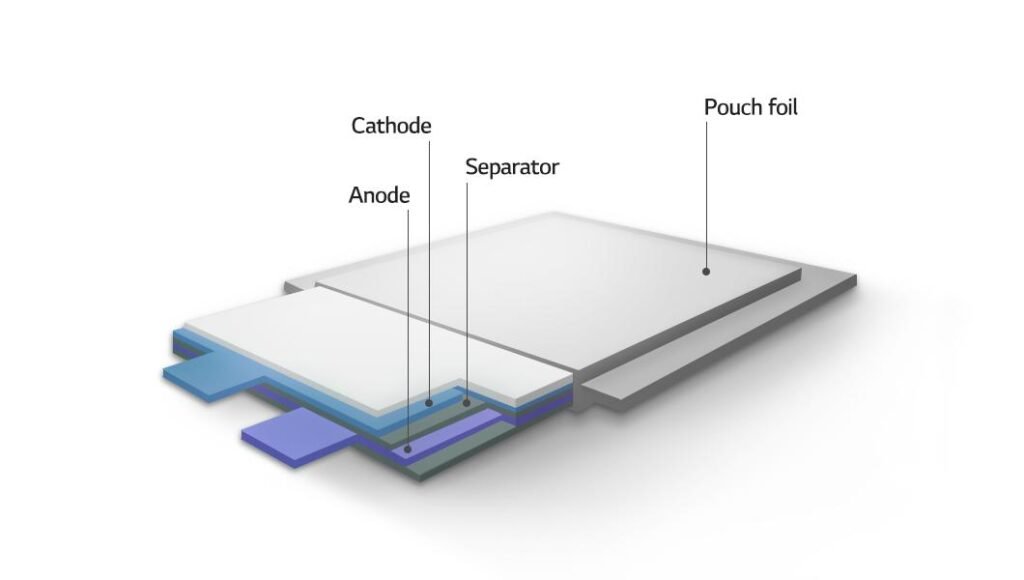
Thin batteries should not be confused with batteries that can withstand repeated bending. A thin pouch cell may have a low-profile structure, but that does not automatically make it mechanically flexible. Repeated bending can damage internal layers, connections, or packaging unless the cell has been specifically designed and validated for such conditions.
The appropriate battery depends on the product’s space limitations, power requirements, and mechanical design—not thickness alone.
Key Engineering Challenges in Thin Battery Design
1. Balancing Thickness and Capacity
Reducing battery thickness generally reduces the available volume for active materials. As a result, a thinner cell may provide less capacity unless other design parameters can compensate.
When I review a wearable battery concept, I start by looking at the required runtime and the space available for the cell. These two requirements establish the initial design boundaries.
For example, a fitness tracker that records activity periodically may have a different power profile from smart glasses running displays, sensors, and wireless communication. Even if both devices have similar battery compartments, their energy requirements may be very different.
The goal is not to create the thinnest possible battery. It is to achieve sufficient capacity within the available space.
2. Fitting the Battery into the Product Structure
Wearable devices rarely offer a simple rectangular compartment with generous clearance. A smart ring has a compact, curved interior, while smart glasses may have narrow spaces along the temples. Medical patches often require a low-profile design that sits comfortably against the body.
In these cases, custom dimensions or shapes can help engineers use internal space more efficiently.
However, the battery should not occupy every millimeter of the available cavity. Assembly clearance, dimensional tolerances, protective materials, electrical connections, and housing constraints must also be considered.
Defining these requirements early can reduce mechanical redesigns later in development.
3. Managing Power, Heat, and Safety
A small battery must still support the device’s operating current. Components such as wireless transmitters, displays, motors, and sensors can create short periods of high power demand.
Engineers should therefore evaluate average power consumption, peak current, operating voltage, and duty cycle rather than selecting a battery based only on its advertised capacity.
Charging conditions, operating temperature, protection circuitry, and the space available for thermal management also affect the final design. Since wearables often remain close to the user’s body, battery safety and product-level validation are particularly important.
4. Maintaining Mechanical Reliability
Thin cells require careful control during manufacturing, handling, and installation. Excessive pressure, sharp housing edges, inappropriate adhesive placement, or damage around the tabs can compromise cell integrity.
A suitable mechanical design should protect the battery throughout assembly and normal use. Any bending, compression, vibration, or other mechanical testing should reflect the actual requirements of the product.
How to Choose the Right Thin Battery for Your Wearable
A practical battery specification begins with the product’s operating requirements. Before requesting a sample, prepare the following information:
| Design Parameter | What to Define |
|---|---|
| Available space | Maximum length, width, and thickness |
| Electrical requirements | Nominal voltage, target capacity, and peak current |
| Runtime | Expected operating time and device power profile |
| Charging | Charging current, charging time, and charging conditions |
| Mechanical design | Housing shape, installation method, connectors, and clearance |
| Operating environment | Temperature range, humidity exposure, and expected use conditions |
| Production requirements | Prototype quantity, estimated annual demand, and target launch date |
These parameters help determine whether an existing cell can meet the requirements or whether a custom design is more appropriate.
Capacity calculations should begin with the device’s estimated energy consumption. For a preliminary estimate, multiply average power by the intended operating time, then account for conversion losses, usable battery capacity, and an appropriate design margin. Actual runtime should ultimately be verified through testing.
For example, a device that operates intermittently may achieve a different runtime from one that continuously streams data, even if both use batteries with the same rated capacity.
It is also important to review voltage requirements, discharge capability, charging limits, and end-of-life expectations together. A battery that meets the dimensional specification but cannot support the required electrical performance is not a suitable solution.
Thin Battery Applications Across Wearable Devices
Different wearable products place different demands on battery design.

Smartwatches and fitness trackers: These devices need a balance of runtime, compact dimensions, and comfortable daily wear. Battery capacity should be evaluated against display usage, sensor activity, wireless communication, and standby consumption.
Smart rings: Space is extremely limited, and the battery must fit within a compact housing. Custom dimensions and careful integration with the ring’s internal structure are often more important than simply maximizing cell capacity.
Smart glasses: Battery compartments may be long and narrow, particularly around the temples. A slim or elongated cell can help use this space while maintaining the product’s weight distribution and comfort.
Medical patches and wearable sensors: Low-profile construction can support unobtrusive designs. Battery selection must also reflect the device’s monitoring schedule, wireless communication requirements, intended wear duration, and applicable safety requirements.
Wearable audio devices: Compact housings leave limited room for batteries, while audio playback and wireless functions create specific power demands. Engineers need to balance size, capacity, and discharge capability.
These examples illustrate why a single standard battery cannot meet every wearable application’s requirements equally well.
How Custom Thin Batteries Solve Design Constraints
Custom battery development allows key dimensions and electrical parameters to be evaluated together rather than treating the battery as an off-the-shelf component.
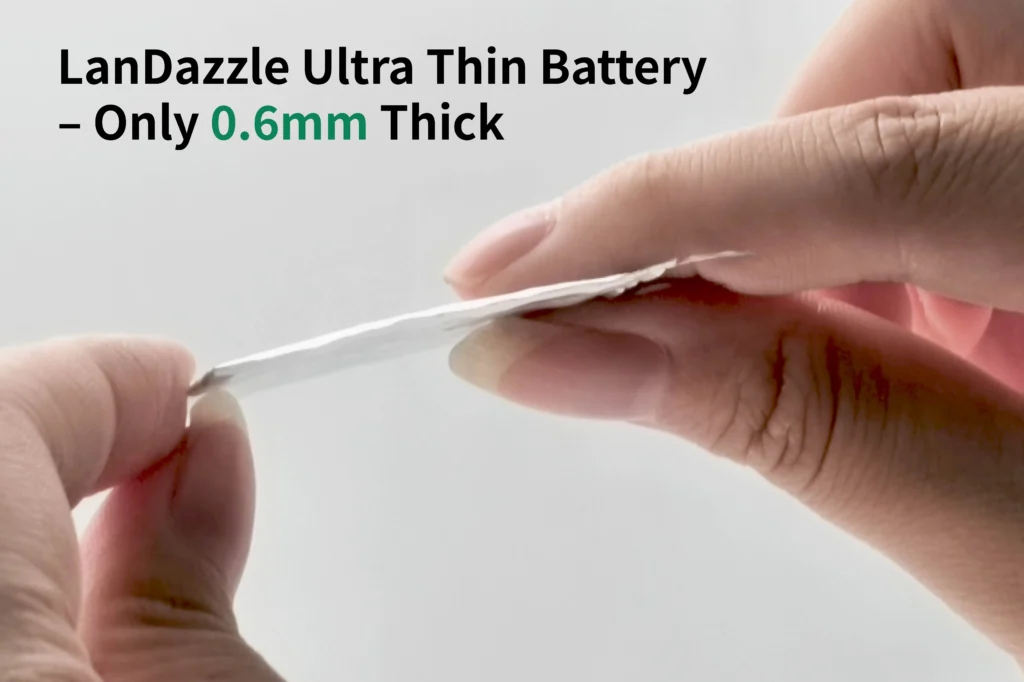
Depending on the application, design options may include a thin rectangular cell, a narrow elongated cell, or a shape tailored to a specific housing. LanDazzle’s custom ultra-thin battery solutions cover thickness options from 0.6 mm to 9 mm, with feasibility depending on the required capacity, dimensions, and cell structure.
Custom design does not remove the physical trade-offs involved in battery engineering. Instead, it helps identify the most practical configuration for a particular product.
For example, increasing the available surface area may help achieve the required capacity without increasing thickness. In another design, a different compartment layout may provide more useful battery volume. The best solution depends on the complete product architecture.
Electrical integration matters just as much as physical fit. Cell voltage, charging requirements, protection circuitry, temperature monitoring where needed, and connection methods should be reviewed as part of the overall power system.
From Prototype to Mass Production: What Should Be Verified?
A battery design that works in an early prototype is not automatically ready for mass production. Before finalizing a custom thin battery, engineers should evaluate both cell performance and integration with the finished device.
Dimensional inspection: Verify the agreed length, width, thickness, and critical features against the drawing. Confirm that tolerances are suitable for the assembly process.
Electrical testing: Measure parameters such as voltage, capacity, and internal resistance according to the project specification. Verify that the cell supports the device’s expected operating profile.
Cycle and storage evaluation: Assess performance under agreed charging, discharging, storage, and temperature conditions. Acceptance criteria should reflect the product’s intended service life.
Mechanical and integration checks: Confirm that the battery fits the housing, that tabs and connections are protected, and that installation does not create damaging pressure or deformation.
Production consistency: Establish inspection methods, process controls, and acceptance criteria that can be applied consistently across batches.
The specific validation plan depends on the device and its regulatory requirements. Medical applications, for example, may require additional product-level risk assessment and compliance activities.
In our engineering approach, feedback from prototype testing should be used to refine the design before production requirements are finalized. This helps identify fit or performance issues earlier and reduces the risk of discovering them after the product has entered mass production.
Working with LanDazzle on Your Wearable Battery Project
A useful battery development partnership begins with a clear understanding of the product, not just a request for a particular thickness.
LanDazzle supports custom lithium battery development for compact electronic devices, including applications that require thin, narrow, curved, or otherwise specialized cell dimensions.
To assess a project, our engineering team needs the available battery space, target voltage and capacity, expected runtime, power profile, operating environment, and estimated production volume. CAD or STEP files can also help clarify mechanical constraints and identify potential integration issues.
Providing these details early makes it easier to assess feasibility, discuss trade-offs, and define the next steps for prototype development and validation.
Conclusion
Thin battery design is an engineering trade-off between physical dimensions, usable capacity, electrical performance, mechanical protection, and manufacturing consistency. The right solution is not necessarily the thinnest cell, but the one that meets the device’s requirements within its available space.
By defining electrical and mechanical requirements early and validating the design before mass production, wearable device developers can make more informed battery decisions.
Developing a wearable device that needs a custom thin battery? Share your battery compartment dimensions, target capacity, operating voltage, and expected runtime with LanDazzle. Our team can review your requirements and help assess a suitable battery design.
Email: info@landazzle.com
Whatsapp: +8618938252128