Table of Contents
What is a Silicon Carbon Battery?
In short, silicon-carbon batteries are a major upgrade of the anode material based on traditional lithium-ion batteries. Traditional lithium-ion batteries use graphite anodes, while silicon-carbon batteries adopt composite anodes of silicon and carbon.
The reason is simple: graphite has reached its performance limit, and silicon can store far more lithium ions.
However, pure silicon has obvious drawbacks. It expands greatly during charging. Without proper control, the battery structure will be damaged and its cycle life will drop sharply.
Instead of using pure silicon directly, the industry chooses a more reliable solution:
Coat, buffer and support silicon with carbon materials.
This is the core principle of silicon-carbon anodes. With stable structure guaranteed, silicon-carbon batteries deliver higher energy density in the same size and support faster charging. Therefore, they are widely used in high-demand scenarios such as flagship phones, electric vehicles and high-performance energy storage systems.
Silicon Carbon Battery vs Lithium-ion Battery
Many people ask:
“Are silicon-carbon batteries the next-generation lithium batteries?”
Technically speaking, it is more of an incremental upgrade rather than a complete replacement.
Silicon-carbon batteries have three core advantages:
- Higher energy density
- Better fast-charging performance
- Greater adaptability in space-limited applications
Even so, it does not completely outperform traditional batteries.
Traditional lithium-ion batteries feature:
- Mature technology
- Lower cost
- Proven long-term stability
In reality:
Silicon-carbon batteries suit applications that pursue top performance.
Traditional lithium-ion batteries remain the first choice for large-scale and cost-sensitive products.
This explains why the two technologies will coexist for a long time instead of one simply replacing the other.
| Feature | Silicon Carbon Battery | Traditional Lithium-ion Battery |
|---|---|---|
| Energy Density | Higher (up to 20–40% increase) | Moderate (limited by graphite anode) |
| Cycle Life | Improving, typically 500–1000 cycles | Mature, 1000–2000 cycles |
| Charging Speed | Faster due to better conductivity | Standard charging rate |
| Safety | More stable temperature performance | Well-established safety but heat-sensitive |
| Cost | Currently higher due to new materials | Lower and mass-produced |
| Best Applications | EVs, smartphones, drones, energy storage | Consumer electronics, e-bikes, power tools |
How Does Silicon Carbon Battery Work?
In terms of working principle, silicon-carbon batteries do not change the basic logic of lithium batteries.
They still charge and discharge through lithium ions moving between the cathode and anode. The real difference only lies inside the anode.
During charging, lithium ions insert into the silicon-carbon composite structure.
Silicon stores more lithium, while carbon keeps the structure stable.
Silicon greatly improves lithium storage capacity, yet its expansion must be controlled.
The carbon layer relieves stress, maintains conductive paths and prevents rapid structure decay.
From an engineering perspective, silicon-carbon anodes are not simple material mixtures. They require sophisticated system design in proportion, structure and production processes.
Advantages and Disadvantages of Silicon Carbon Batteries
No practical technology has only advantages, and silicon-carbon batteries are no exception—benefits and costs always come together.
Advantages of Silicon-Carbon Batteries
Higher energy density
With product size nearly fixed, silicon-carbon batteries still offer larger capacity. This is why they are used in premium phones, EVs and drones.
Better fast charging performance
With proper structure design, silicon-carbon anodes enable faster electron and ion transport, supporting higher power input for excellent fast-charging ability.
Stronger environmental adaptability
In low temperature or high-load conditions, silicon-carbon materials maintain performance better than traditional graphite, ideal for outdoor and high-power devices.
Clear practical challenges remain
Persistent volume expansion
Silicon expansion during lithium insertion is an inherent material property. Engineering design can only relieve, not eliminate this issue.
Relatively high cost
Higher material cost and stricter process requirements push up overall expenses, limiting large-scale widespread use for now.
Higher manufacturing difficulty
Silicon content, particle size distribution, coating method and process stability all matter. Any flaw will cause problems in cycle life and batch consistency.
Applications of Silicon Carbon Battery
In practical applications, silicon-carbon batteries are first adopted by products with strict limits on space and performance.
Smartphones
With almost no room to increase thickness, silicon-carbon batteries become a practical solution to boost battery life.
Electric vehicles
Car manufacturers aim for longer driving ranges with smaller battery packs.
Energy storage systems
Higher storage capacity per unit weight and volume greatly improves overall system efficiency.
Drones and robots
Light weight directly extends flight time and improves working efficiency.
Wearable and medical devices
Compact and lightweight design is required, without compromising stability.
All these scenarios share one common feature:
There is no extra space for batteries — higher efficiency is the only way forward.
What is the Energy Density of Silicon Carbon Batteries?
The theoretical gap between materials is striking:
The theoretical capacity of graphite anode is about 372 mAh/g.
Silicon anode can reach up to 4200 mAh/g.
Of course, pure silicon is never used in practical engineering.
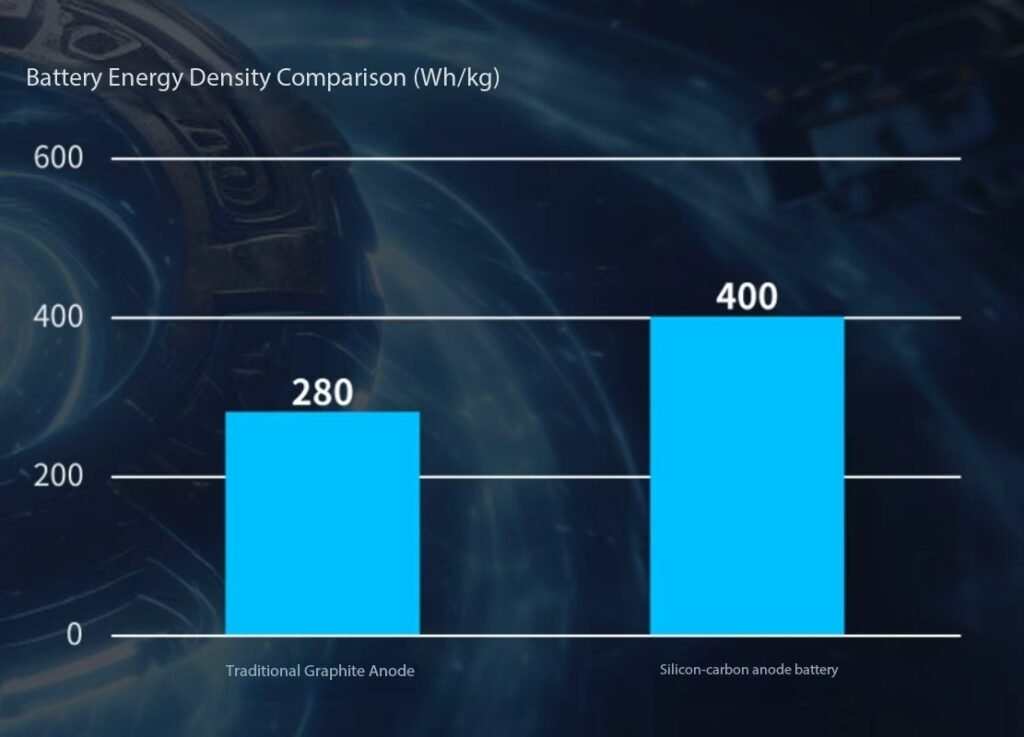
Under current commercial conditions, silicon-carbon batteries usually raise overall energy density by over 20%, with the gravimetric energy density around 350 Wh/kg.
It may not look like a huge leap, but in the highly mature lithium battery industry, such improvement is extremely valuable.
What is the Lifespan of Silicon Carbon Battery?
Cycle life is an unavoidable topic for silicon-carbon batteries, but one point needs clarifying:
Their service life is not necessarily shorter than traditional lithium batteries. The key lies in structure design and manufacturing processes.
In mass production, controlling silicon content matters, and cell forming technology is equally important.
Compared with traditional winding processes, stacking processes show more advantages for silicon-carbon systems.
The main reasons are as follows:
- More uniform stress distributionIn stacked structures, electrodes and separators are laid flat. Volume changes of silicon during charging and discharging are spread evenly across the whole structure instead of concentrating locally.
- Better control over electrode deformationWinding structures easily cause concentrated internal stress during expansion. Stacking brings less pulling and squeezing to electrodes and slows down material fatigue.
- Higher interface stabilitySilicon-carbon anodes demand intact interfaces. Stacking maintains steady contact between electrodes and separators, effectively slowing performance decay.
Thanks to these structural strengths, when matched with proper silicon content and optimized BMS strategies, silicon-carbon batteries made by stacking processes can achieve stable and acceptable cycle life. They are not simply high-energy batteries with short lifespans.
Is Silicon Carbon Battery Better Than Lithium-ion?
To be more precise:
It delivers stronger performance, yet comes with stricter application requirements.
If your goal is higher energy density within limited space, or a balance of fast charging and high power output, silicon-carbon batteries offer clear advantages. This is why they are first applied in premium consumer electronics, electric vehicles and high-performance devices.
However, if your priorities are cost control, mature processes and long-term consistent stability, traditional lithium-ion batteries remain the safer choice. Their material systems and manufacturing techniques have been fully verified on a large scale, keeping them reliable for most common applications.
Therefore, silicon-carbon batteries are not universally better—they are more suitable under specific conditions.
The right choice depends on whether your product needs a performance breakthrough with no room left for structural compromises, rather than simply chasing newer technology trends.
Are Silicon Carbon Batteries Safe?
The conclusion is clear:
Well-designed and properly manufactured silicon-carbon batteries are safe.
Silicon-carbon itself is not an unsafe material. Most risks come from improper engineering, not the technology itself.
Common risks mainly fall into three points:
- Excessive silicon contentBlindly raising silicon content for higher energy density amplifies expansion and internal stress, weakening stability and safety margins.
- Poor process controlSilicon-carbon anodes require high consistency. Unstable coating, compaction or coverage causes local stress concentration during use.
- Mismatched BMS designSilicon-carbon systems are more sensitive to charge and discharge ranges. Traditional lithium battery strategies will accelerate aging and even bring safety risks.
It should be noted that mature silicon-carbon batteries must pass full safety tests, including overcharge, short circuit, thermal shock and extrusion. Their safety standards are no lower than traditional lithium-ion batteries.
The Future of Silicon Carbon Battery Technology
From the perspective of lithium battery technology evolution, silicon-carbon is not a short-term transitional solution, but a long-term and gradual upgrade path.
Its future development focuses on three main directions:
- More stable silicon structure designOptimize material and microstructure to raise capacity and further suppress expansion.
- Integration with solid or semi-solid systemsA more stable electrolyte can further amplify the advantages of silicon-carbon anodes and improve overall safety.
- Low-cost mass productionWith mature processes and higher yield rates, silicon-carbon anodes will shift from a high-end option to a mainstream solution for large-scale use.
Based on these trends, many in the industry believe:
In the coming years, silicon-carbon anodes will gradually become a standard part of lithium batteries, just like graphite did in the past.
Custom Silicon Carbon Battery Solutions from LanDazzle
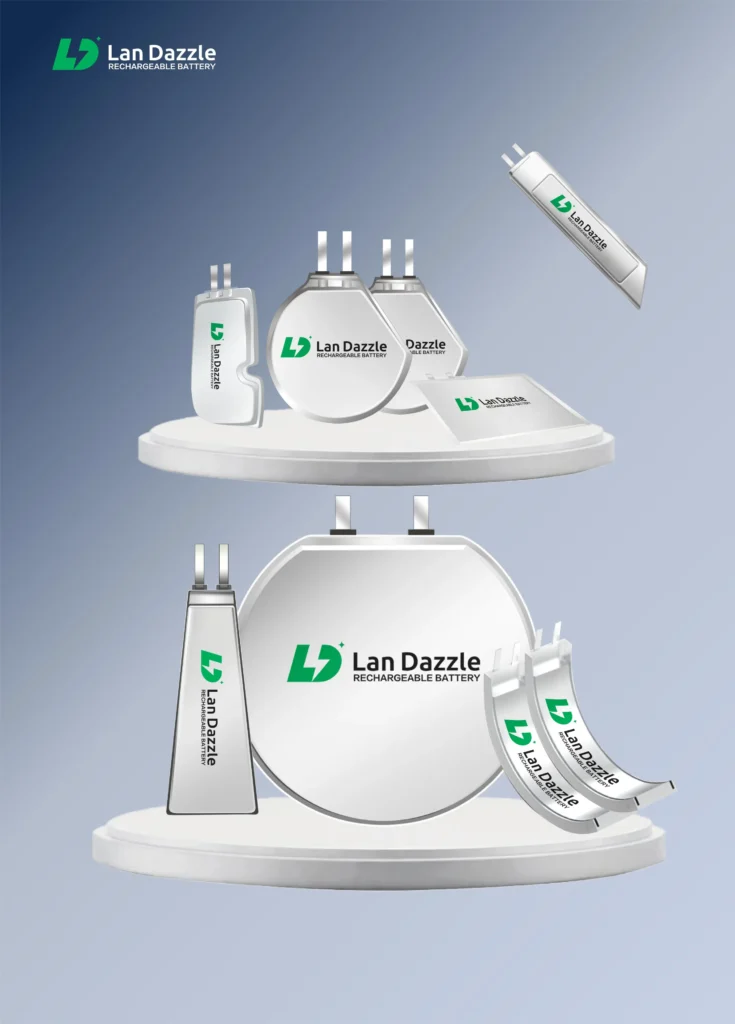
LanDazzle specializes in custom battery solutions for clients who need batteries tailored to specific devices and applications. While our focus is on high-quality lithium polymer batteries, some customers require higher energy capacity in a compact space. In this case, we apply silicon-carbon anode technology to enhance battery density without increasing size.
This approach allows us to deliver smaller, more powerful batteries that maintain the flexibility, safety, and reliability of traditional LiPo cells. Our custom solutions can be tailored for drones, wearable devices, portable electronics, and other compact applications, providing the exact voltage, capacity, and form factor each client needs.
Contact us today to explore how our advanced battery engineering can bring longer runtime and faster charging to your smartphones, wearables, drones, and more.
Email: info@landazzle.com
Whatsapp: +8618938252128
By combining advanced materials with precise LiPo battery engineering, LanDazzle ensures that even in limited space, your devices can achieve longer runtime and higher performance.
Conclusion
Silicon-carbon batteries do not completely replace traditional lithium-ion batteries. Instead, they offer a practical, applicable upgrade path as the existing system nears its performance limit.
Adding silicon improves the battery’s energy density. With proper structural design, mature manufacturing processes and optimized BMS strategies, this improvement does not have to come at the cost of safety or cycle life. Reliable silicon-carbon batteries rely on proper engineering control and overall system balance.
It should also be noted that silicon-carbon solutions are not suitable for all products. They work best for compact, high-performance applications, rather than serving as a universal option.
As technology matures and costs drop, silicon-carbon anodes will gradually become a common choice in the lithium battery industry. The key is not simply adopting silicon-carbon, but applying it in a proper and professional way.
Related Articles:
Silicon Carbon Battery vs Lithium ion: Which Is Better for Smartphones?