Table of Contents
Smart glasses have changed a lot in recent years.
Early models were more like tech showpieces. Packed with full functions and high specs, they cared little about real wearing experience. Short battery life, heavy weight and obvious overheating were easily forgiven as cutting-edge tech flaws.
Today is totally different. As smart glasses enter daily use, the focus is no longer on “whether it can be made”, but “whether it can be worn all day long”. Among all factors affecting comfort, the battery is the most underrated yet costly part. Many product flaws come not from poor functions, but wrong battery selection.
Basic Requirements of Battery for Smart Glasses Are Simple
On the surface, battery requirements for smart glasses are similar to most wearables.
Size and weight: the top strict limit
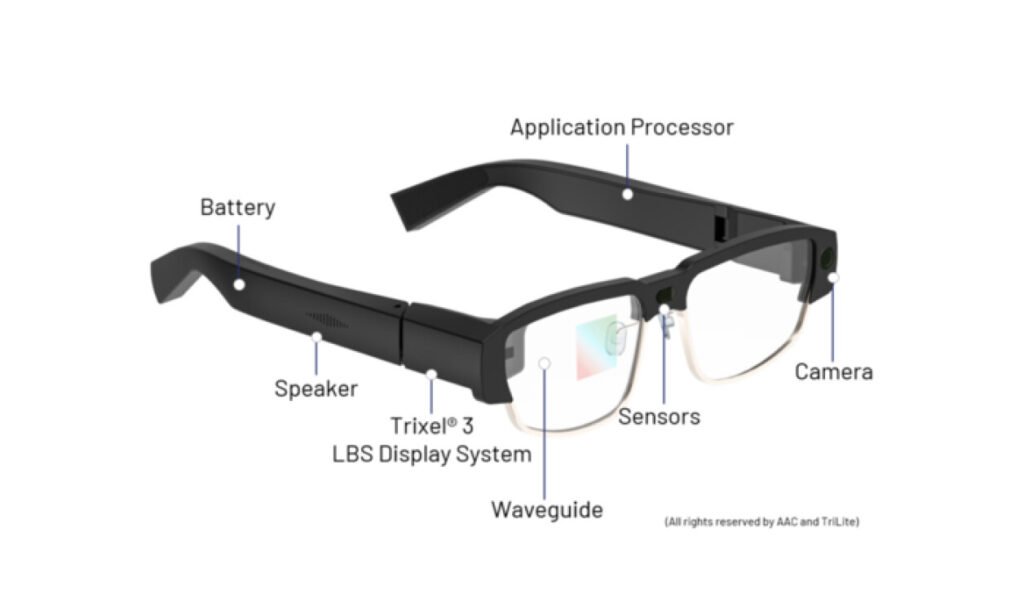
Smart glasses batteries are almost exclusively placed in the temples.
The space is narrow and slim. Balance on both sides also needs to be ensured.
This means:
- The battery cannot be thick
- It needs high energy utilization per unit volume
- Weight distribution must be well controlled
Even a few extra grams will bring obvious pressure on the nose bridge and ears.
Battery life is more than runtime alone
Many people only ask “How many hours can it last?” when choosing batteries.
For smart glasses, this is not the key question.
Beyond maximum battery life, it matters more whether the battery fits daily usage within limited size and weight.
For example:
- 1 hour of continuous navigation
- Multiple uses of shooting and voice interaction
- All-day standby and intermittent use
It relies on energy density and system efficiency, not just capacity.
Safety and stability are non-negotiable
The battery sits very close to the user’s face.
Overheating, swelling or abnormal decay will cause serious safety hazards, not just poor experience. Therefore, smart glasses batteries adopt more conservative safety designs than ordinary consumer electronics.
Hidden Battery Requirements Set by Tech Giants
Following the basic standards above will keep risks low in theory, yet problems still often occur in real products.
The reason: the industry’s actual requirements have quietly changed.
Specs are no longer the core focus
Mature brands rarely highlight battery mAh as a selling point now.
They care more about user experience results:
- Natural wearing feel
- No burden after all-day use
- Zero perceptible presence during operation
These experience goals are not listed as battery parameters, but they ultimately set strict constraints on battery design.
Fast charging is not a gimmick, but a real user demand
Users seldom fully charge smart glasses intentionally.
Common usage scenarios:
- Quick charging before going out
- Top-up during lunch breaks
- Fast power recovery for emergency use
This requires batteries to support fast charging with high efficiency and low heat generation. Obvious temperature rise during fast charging will trigger current limiting and ruin the user experience.
Stability tops all priorities
For devices worn close to the head:
- Unstable cycle life
- Poor consistency
- Large batch-to-batch variations
These issues may seem minor in lab tests, but become severe once mass-produced and used in daily life.
As a result, the screening standards for battery suppliers have been completely reshaped.
Battery Selection Is a Structural Decision, Not Just a Spec Choice
In smart glasses projects, the battery is no longer just a matter of choosing the right model.
In the past, the battery was usually confirmed last. After the product structure was finalized, engineers simply fitted a standard battery with matching capacity and voltage into place. This logic no longer works for modern smart glasses design.
The reason is simple: the battery itself now directly defines the product structure.
The temple is narrow, asymmetrical and extremely space-limited, while most commercial batteries are regular standard shapes. Forcing standard batteries into such space always leads to compromises.
Common problems include:
- Low space utilization inside the temple
- Thicker or longer structure required to fit the battery
- Unbalanced left-and-right weight and shifted center of gravity
These issues never show on specification sheets, but they all directly affect wearing comfort.
More practically, if the battery cannot fit perfectly, the industrial design has to adjust around it.
Appearance, curves and stress points all make compromises for the battery shape.
Users will feel the problems immediately after wearing:
- One side obviously heavier
- Pressure on ears or face at certain spots
- Local fatigue after long wear
These comfort flaws can hardly be fixed by later adjustments. Once the structure is finalized, the negative effects of the battery become permanent.
Therefore, proper battery selection must start from structural design, not capacity parameters.
For smart glasses, battery shape is part of its performance.
How well it fits the temple directly determines effective energy density, weight distribution and overall structural stability.
Instead of focusing on total capacity, ask a more practical question:
Within the temple, how much real usable usage time can each extra 1 mm of thickness bring?
If a small gain in battery life requires a clear drop in wearing comfort, such performance improvement is questionable. This is not a competition of numbers, but a typical engineering trade-off.
The same applies to fast charging.
Rather than focusing on full charging time, look at real usage scenarios:
- How long can the glasses last after a 10-minute charge?
- Is the charging stable without obvious overheating?
- Will long-term use hurt battery lifespan and consistency?
These details decide long-term user experience more than charging power figures.
When the battery is treated as a structural-level decision, many complex problems become clear.
The battery should not merely adapt to the product; it must be designed as an integral part of the structure.
Battery Technology Built for Smart Glasses Is Rewriting the Rules
As product needs for smart glasses become clear, the direction of battery innovation is also clearly defined.
At LanDazzle, smart glasses do not need the most cutting-edge battery technology. They need the tech combo that best fits daily wear. All choices come down to one question: Does it truly improve wearing experience, instead of creating new compromises?
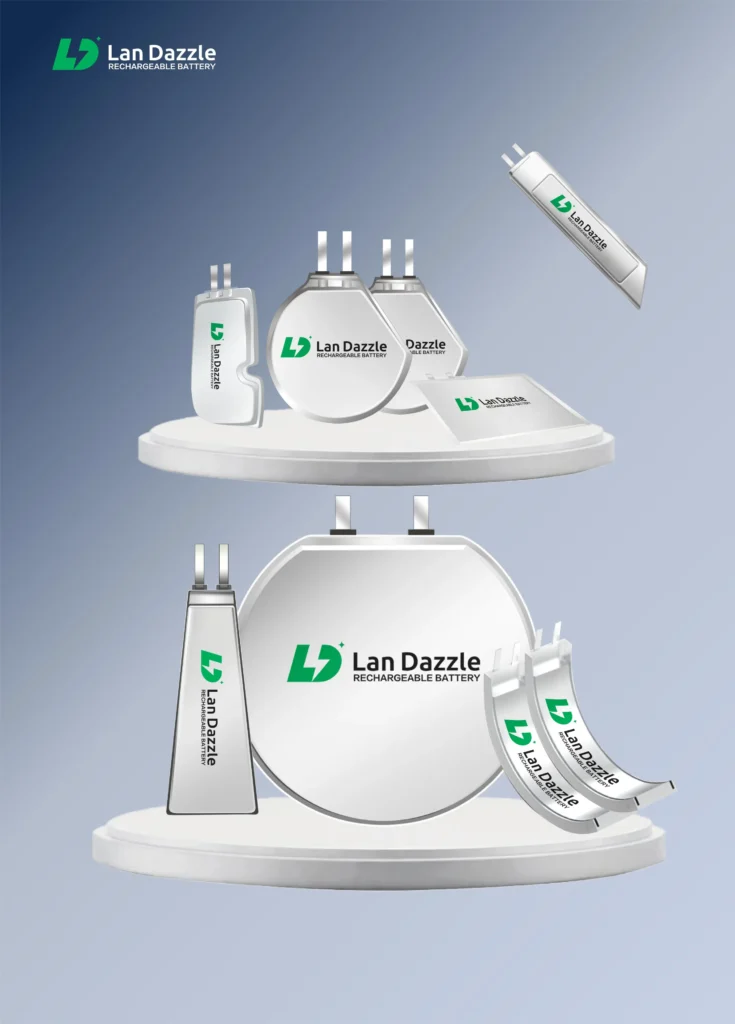
Ultra-narrow custom special-shaped batteries: design around structure, not standard models
We almost never recommend off-the-shelf standard batteries for smart glasses projects. The reason is simple: the temple is not made for batteries. Batteries must be made for the temple.
Compared with standard batteries, customized ultra-narrow irregular batteries bring three core advantages:
- Better space fitting: The battery fits the inner contour of the temple, reduces wasted space, and makes full use of every volume for power.
- Higher design freedom: Industrial design no longer needs to compromise for batteries. Temple thickness, curve and weight balance can focus fully on wearing comfort.
- Longer battery life without sacrificing look or comfort: There is no need to thicken or add weight to extend runtime — something standard batteries cannot easily achieve.
In the narrow, limited space of temples, fitting itself equals performance.
Better use of the same volume brings overall experience improvement, not just small parameter changes.
Silicon-carbon anode technology: gain more energy in fixed-size devices
Smart glasses face a clear limit:
Their size is almost fixed.
Temples cannot be thickened endlessly, and total weight cannot rise obviously. There is little room to extend battery life by changing structure. To boost energy performance, material upgrades are the only way.
This is why we adopt silicon-carbon anode tech for smart glass battery solutions.
Compared with traditional anode materials, its strengths are:
- Deliver more energy without noticeable size increase
- Add extra battery capacity at the material level
- Perfect match fixed-size devices with rising power demands
We also understand silicon-carbon anode is not a simple material replacement.
It sets higher standards for cell design, structure stability and production control. Without rich experience, it may cause risks in consistency and cycle life. Therefore, we focus on controlled, practical designs for real scenarios, rather than blindly chasing material data.
Technology serves experience, not show-off
LanDazzle always sticks to one principle:
Battery tech is not for spec sheets — it should be unnoticeable to users.
The best battery technology for smart glasses shows itself not in big numbers, but in subtle, vital experiences:
- Lighter weight and less pressure
- Slimmer temples for natural wearing
- Stable performance with no sudden heat or power drops
- No distraction caused by the battery during long-time wear
These details rarely appear on product manuals, yet they decide whether users will wear smart glasses every day. For us, technology is never the goal. It only exists to make smart glasses feel just like a pair of everyday glasses you can wear all the time.
How to Choose Battery for Smart Glasses
In smart glasses projects, choosing a battery solution means choosing a long-term battery supplier.
Most problems do not come from battery specifications alone. They lie in whether the supplier truly understands smart glasses — devices worn close to the body, with limited structure and high sensitivity to wearing experience.
You can quickly judge whether a battery solution is truly suitable for smart glasses from the following points.
Support structural customization, not just parameter adjustment
For smart glasses, simply changing capacity, voltage or size tolerance cannot solve core problems.
What matters more is whether the supplier can design batteries based on product structure. This includes irregular shapes, ultra-narrow sizes, and internal layouts that perfectly fit temple space. If the battery only fits with compromise, problems will eventually show in user experience.
Understand sensitivity to long-term stability for wearable devices
Smart glasses are not used briefly; they are worn repeatedly over a long time.
This means battery consistency, cycle stability and temperature control matter more than extreme performance. A reliable solution maintains stable performance throughout its whole life cycle, not just passing initial tests.
Improve energy density within safe limits
For devices worn near the head, safety is always non-negotiable.
The focus is not how high the energy density can reach. It is whether the supplier can improve performance while staying within safety boundaries, instead of boosting data by aggressive material use or cutting safety margins.
Have real mass production experience in wearables
There is a huge gap between lab samples and mass-produced products.
Mature battery suppliers have rich experience in wearable mass production. They fully understand consistency control, batch stability and yield rates for real product launch.
Join co-design in the early product stage
For smart glasses, the earlier the battery team joins, the better the overall solution.
A reliable long-term supplier participates in discussions before the structure is finalized. It helps balance structure, performance, safety and experience, instead of only cooperating passively after design completion.
If a battery solution looks perfect on the spec sheet but cannot answer the above points clearly, its hidden risks will far outweigh its apparent cost advantages.
Conclusion
The development of smart glasses has entered a highly practical stage.
Advanced functions or cutting-edge technology are no longer the only deciding factors. What truly determines a product’s success is whether users are willing to wear it every day.
And the battery is the core foundation that supports long-term comfortable wear.
From structural fitting and weight distribution to fast charging performance and long-term stability, smart glasses set far higher requirements for batteries than simply selecting a standard model. It is a structural and system-level engineering decision, requiring the battery solution to be integrated into product design from the very start.
At LanDazzle, we always believe:
Batteries should never force product compromises — they should make the product work better.
Whether it is ultra-narrow custom special-shaped batteries or silicon-carbon anode technology for size-limited devices, all our technical choices follow one simple goal:
to make smart glasses lighter, more natural and more reliable.
Looking for the right battery solution for your smart glasses project?
If you are developing or optimizing smart glasses, and want a better balance among wearing comfort, structural design, battery life, safety and stability, we are ready to join discussions at the early design stage to help you find the most suitable custom battery solution.
Email: info@landazzle.com
Whatsapp: +8618938252128