Table of Contents
As a manufacturer that has been deeply involved in the custom lithium battery industry for many years, we talk to a large number of customers every day. Among all the questions we receive, the most common one is:
“When I need a custom lithium battery, which parameters do I need to confirm?”
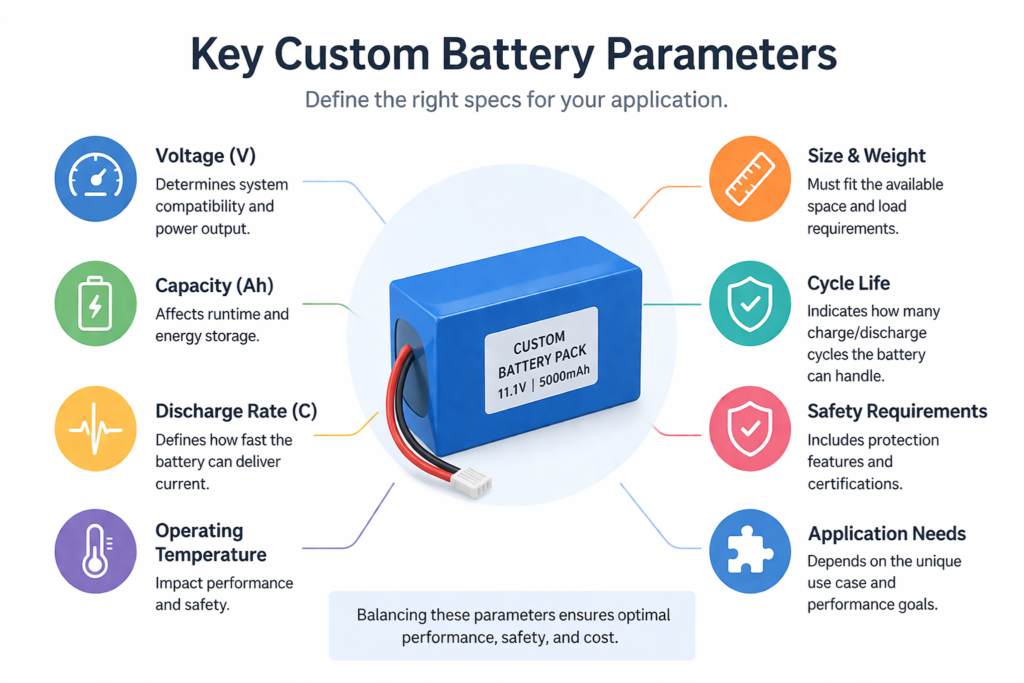
Today, we’ll explain this in plain and simple language, based on our real manufacturing experience. We’ll walk you through the key custom battery parameters that must be confirmed before starting a project. Whether you are an engineer, purchaser, or product manager, this guide will help you clearly define your requirements, avoid repeated changes and rework later, and make our communication much more efficient—so we can match you with the most accurate and reliable custom battery solution.
Voltage, Current, and Power Requirements
Voltage, current, and power are the three basic elements of any custom lithium battery design. Many customers tend to mix these concepts up, so let’s clearly separate them first and then explain how to confirm each one.
1. Voltage: Match Your Device Exactly
Voltage is like the “driving force” of a lithium battery. It must match your device.
If the voltage is too high, it can damage the device. If it’s too low, the device may not start or may work unstably.
There are two voltage points you must confirm:
- Nominal voltage
This is the average voltage during normal operation.- Ternary lithium cells: 3.6V nominal
- LiFePO₄ cells: 3.2V nominal
For example, if your device needs 36V, using 10 × 3.6V lithium cells in series gives a 36V nominal voltage. - Operating voltage range
You should also provide the acceptable voltage range of your device.
For example, if the device allows 30V–42V, we will design the battery pack to operate safely within this range to avoid overvoltage or undervoltage damage.
2. Current: Continuous vs. Peak
Current directly determines the battery’s discharge capability and affects cell selection and BMS design. There are two key current values:
- Continuous discharge current
This is the current the battery can supply steadily over a long time.- AGV robots may require 40A or more
- Consumer electronics may only need 0.5A–2A
- Peak discharge current
This is the maximum current during startup or sudden acceleration.
For example, power tools may draw 2–3 times the continuous current at startup.
We always design based on the peak current to prevent damage caused by short-term high loads.
3. Power: How Much Energy Your Device Needs
Power is calculated as:
Power = Voltage × Current
It shows how much energy the battery must deliver to your device.
For example, if your device needs 500W at 48V, the required continuous current is about 10.4A. From this, we can determine:
- Cell discharge rating
- Series and parallel configuration
As a manufacturer, we use your power requirements to optimize the cell combination—meeting performance needs while keeping the battery compact and cost-effective.
Capacity and Runtime Calculation
Capacity is one of the most discussed battery parameters because it directly affects runtime. Many customers start by saying, “I need a large-capacity battery.”
However, bigger is not always better. The key is matching the capacity to your real runtime needs—because higher capacity also means larger size, heavier weight, and higher cost.
1. Understanding Battery Capacity: Ah vs. Wh
Battery capacity is usually expressed in Ah (ampere-hours) or Wh (watt-hours).
- Wh = Voltage (V) × Capacity (Ah)
Wh is the more intuitive unit, because it directly shows how much energy the battery can deliver.
Comparing Ah alone can be misleading when voltages are different.
For example:
- 3.6V × 10Ah = 36Wh
- 7.2V × 10Ah = 72Wh
Even though both are 10Ah batteries, the second one provides twice the energy and much longer runtime.
2. How to Calculate Runtime
The core formula is simple:
Theoretical runtime (hours) = Battery energy (Wh) ÷ Device power consumption (W)
This result is based on ideal laboratory conditions. In real applications, various losses must be considered.
3. Real-World Factors That Affect Capacity
In actual use, available capacity is influenced by several factors:
- Discharge rate (C-rate)
At high discharge currents, usable capacity may drop by 10%–20% compared to low-rate discharge. - Temperature
In low-temperature environments, capacity will decrease noticeably.
When designing a custom battery, we account for these factors in advance to ensure that the real-world runtime matches your expectations, not just the theoretical numbers.
How to Determine the Discharge Rate (C-rate)
The discharge rate (C-rate) is a parameter that many customers overlook, but it has a huge impact on battery performance.
In simple terms, C-rate describes how fast a battery releases its energy.
- A higher C-rate means faster discharge and higher power output
- But it also puts more stress on the battery and can shorten its lifespan
1. Simple C-rate Calculation
The formula is straightforward:
C-rate (C) = Discharge current (A) ÷ Rated capacity (Ah)
Examples:
- 100Ah battery discharging at 50A → 0.5C
- 100Ah battery discharging at 100A → 1C
- 100Ah battery discharging at 300A → 3C
The higher the current, the higher the C-rate.
2. Choose C-rate Based on Your Application
From our years of manufacturing experience, the best way to select C-rate is to look at how your device is actually used. You can directly refer to the scenarios below:
1) Energy storage, home solar, backup power
- Smooth, long-term discharge
- No need for instant high power
- Recommended: 0.2C–0.5C
- LiFePO₄ is preferred for long cycle life and lower cost
2) E-bikes, forklifts, general industrial equipment
- Balance between runtime and startup power
- Recommended: 0.5C–2C
- Good performance without sacrificing battery life
3) Power tools, drones, AGV robots
- Require instant high current and strong power output
- Recommended: 5C–20C+
- Drones often need 10C or higher to support takeoff and flight
3. Continuous C-rate vs. Peak C-rate
This point is very important:
- Continuous C-rate: the current the battery can deliver stably for a long time
- Peak C-rate: short bursts (usually a few seconds)
When selecting a battery, continuous C-rate is the main reference, and peak C-rate is used as a supplement.
As a manufacturer, we don’t just look at numbers. Based on your application:
- We select the right cells
- Optimize the pack structure
- Configure proper BMS protection
Our goal is to meet your C-rate requirements while extending battery life and reducing long-term replacement costs.
Choosing the right C-rate means better performance, better safety, and better value—not just higher power.
Size, Weight, and Space Constraints
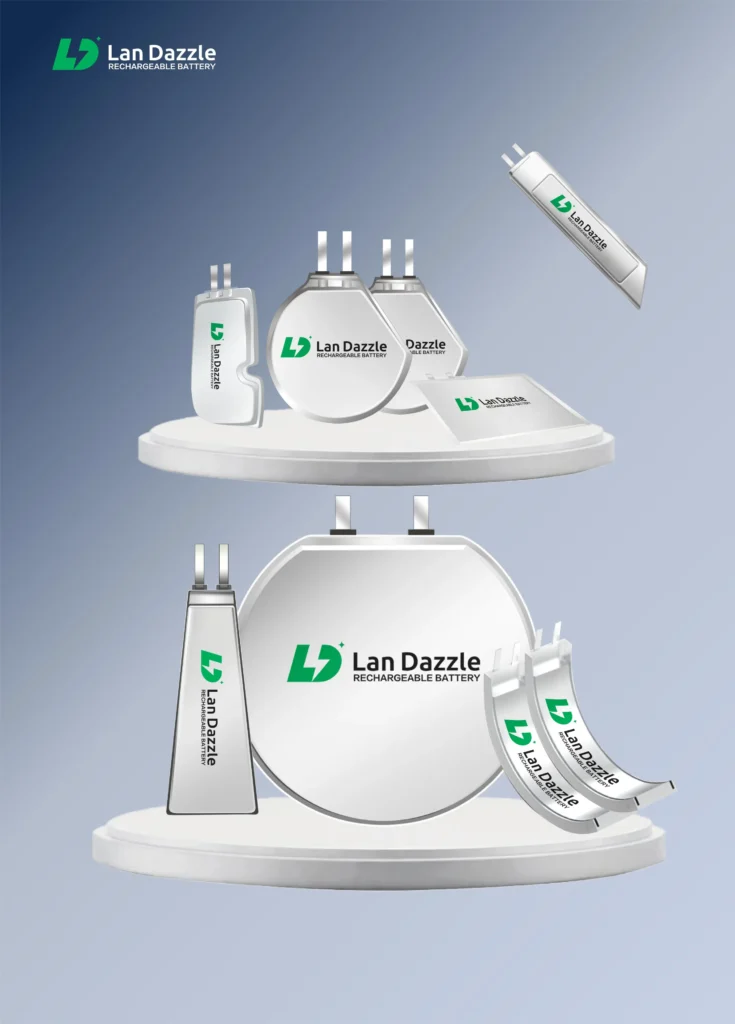
The biggest advantage of custom lithium batteries is fit. Size, weight, and available space directly determine the battery design. This is especially important for irregular-shaped batteries and ultra-thin batteries, where the requirements are much stricter.
Size comes first. You should provide accurate battery compartment dimensions (length × width × height). If possible, a 3D model or real product photos are very helpful. Based on this information, we design the battery shape—including options like L-shaped or curved designs—to make sure the battery fits perfectly inside the device, uses the space efficiently, and avoids installation issues.
Weight is the next key factor. Many devices, such as drones and wearable products, have very strict weight limits. Even an extra 1 gram can affect performance. Based on your weight requirements, we select suitable battery cells and packaging materials to reduce weight as much as possible while still meeting capacity and performance needs.
Space limitations also affect many details. The position of terminals, the direction of the poles, and wire length must match the device’s connectors. Poor matching can cause wiring difficulties or connector conflicts. As a manufacturer, we use 3D simulation and design to identify and solve these issues in advance, ensuring the battery meets size and weight targets and is easy to install.
Operating Environment and Lifetime Targets
Many customers overlook the operating environment and lifetime targets, which often causes custom batteries to fail early or degrade too quickly in real use. In fact, these two factors directly determine material selection, protection design, and manufacturing processes, so they must be confirmed in advance.
Temperature conditions are the most critical factor affecting battery performance. The optimal operating temperature for lithium batteries is 16–25°C.
- If the temperature is too high, battery lifespan will be greatly reduced.
- If the temperature is too low, available capacity drops sharply.
If your device operates in extreme low temperatures (down to –40°C), such as polar research equipment, we use low-temperature electrolyte formulations. For high-temperature environments (above 60°C), we apply PI separators coated with an aluminum oxide layer, combined with phase-change material (PCM) packaging, to increase the thermal runaway trigger temperature and improve safety.
Lifetime targets are the next key consideration. Battery life is usually defined in two ways:
- Cycle life: one full charge and discharge equals one cycle. It is commonly measured by how many cycles the battery can complete while maintaining at least 80% of its original capacity.
- Calendar life: how long the battery can be stored without use while still retaining 80% or more of its initial capacity.
Different applications have different lifetime requirements. For example:
Wearable devices usually only need 500–1,000 cycles, which is sufficient for their expected usage period.
Energy storage systems and medical devices typically require a cycle life of 3,000+ cycles and a calendar life of 10 years or more.
Key Custom Battery Parameters-Conclusion
In summary, for custom lithium batteries, once you clearly define these five key parameters—
voltage, current, and power; capacity and runtime; discharge rate (C-rate); size, weight, and space constraints; and operating environment and lifetime targets—and avoid common mistakes, the customization process can move forward quickly and smoothly, with far fewer detours.
If you still have questions about any of these parameters, or if you’d like us to help organize your requirements, feel free to contact us at any time. We will arrange one-on-one support from a professional engineer to help you develop a lithium battery solution that truly fits your application.
Email: info@landazzle.com
Whatsapp: +8618938252128