If you are designing a pair of smart glasses, a smart ring, AI earbuds, or a medical patch, one of the hardest battery questions is not simply, “How many mAh do we need?”
The more important question is: How much usable energy can we fit into the exact space available? This is where silicon-carbon batteries are attracting increasing attention in wearable technology.
For a smartphone, adding a few millimeters to the battery footprint may still be possible. For smart glasses, however, the battery may need to fit inside a temple arm only a few millimeters wide. In a smart ring, the available battery space can be even more constrained by sensors, PCBs, and the curved enclosure.
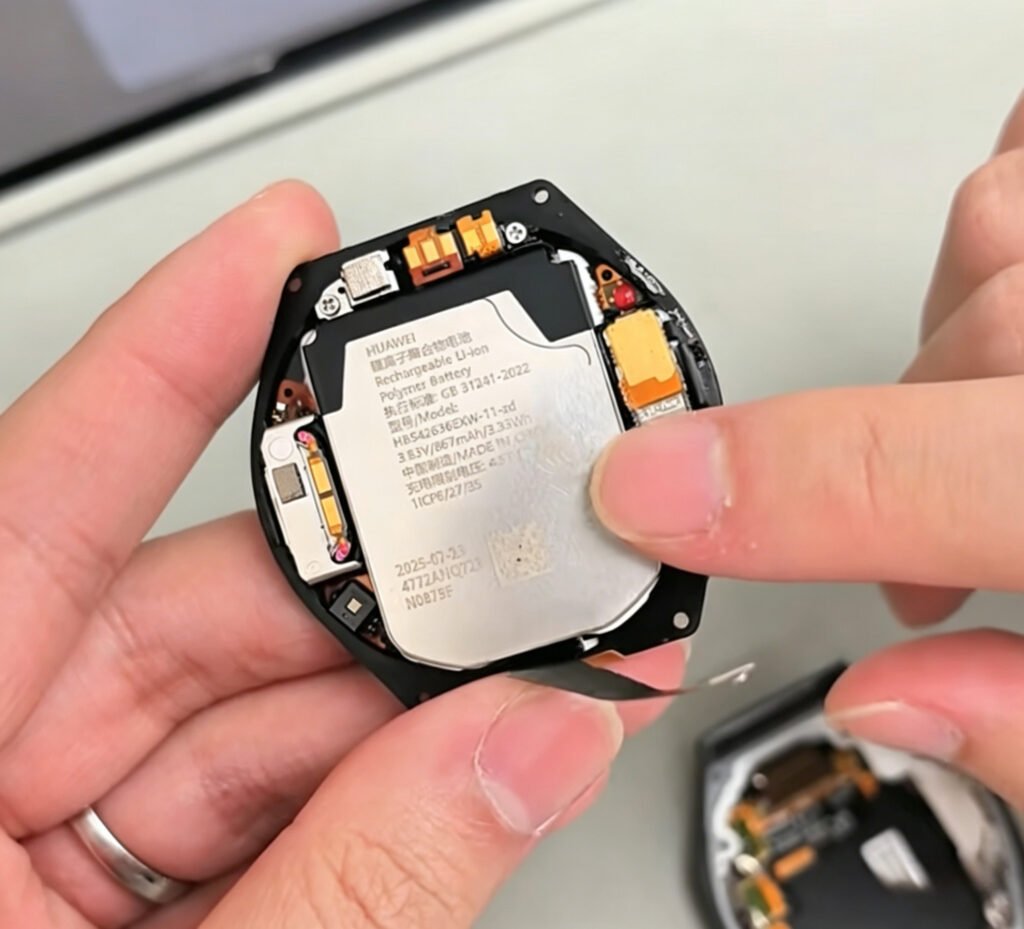
Under these conditions, volumetric energy density (Wh/L) can matter more than gravimetric energy density alone. But that does not mean silicon-carbon is automatically the best choice for every wearable.
From our experience working on custom battery projects, the real question is not how high silicon’s theoretical capacity is. It is:
How much usable energy can silicon-carbon deliver under the same volume, weight, thickness, and mechanical constraints?
The Wearable Battery Problem Is Not Capacity. It Is Space.
In custom battery projects, we often encounter the same situation: the customer’s PCB, sensors, FPC, antenna, and enclosure have already been defined, leaving the battery with a highly irregular pocket. At that point, simply looking for a “higher-capacity standard battery” usually does not solve the problem. Consider smart glasses. The temple arm may only provide a few millimeters of usable width. Even if a standard battery offers higher capacity, it has little value if it cannot physically fit into the available space.
This is why we typically look at two questions first:
- How much usable volume is actually available for the battery?
- How efficiently can the battery occupy that volume?
This is where silicon-carbon technology becomes particularly interesting.
Silicon-carbon is not a completely different battery chemistry from lithium-ion. Instead, silicon-based materials are incorporated into the anode to increase lithium storage capability. However, the real-world value of silicon-carbon is not determined by silicon’s theoretical capacity alone. Electrode design, carbon structure, interface stability, electrolyte formulation, manufacturing processes, and expansion control all influence the final cell-level performance.
For wearable applications, therefore, the number that matters is not simply the theoretical capacity of silicon. It is the actual cell-level energy density delivered within the required mechanical envelope.
Why Volumetric Energy Density Matters More for Wearables
Imagine two batteries with the same weight. One can store more energy within the same physical volume.
For an electric vehicle, weight may be one of the dominant constraints. For a smart ring or smart glasses, the situation can be very different. The physical space occupied by the battery may be much harder to change than its weight. That is why volumetric energy density is particularly important in compact wearable devices.
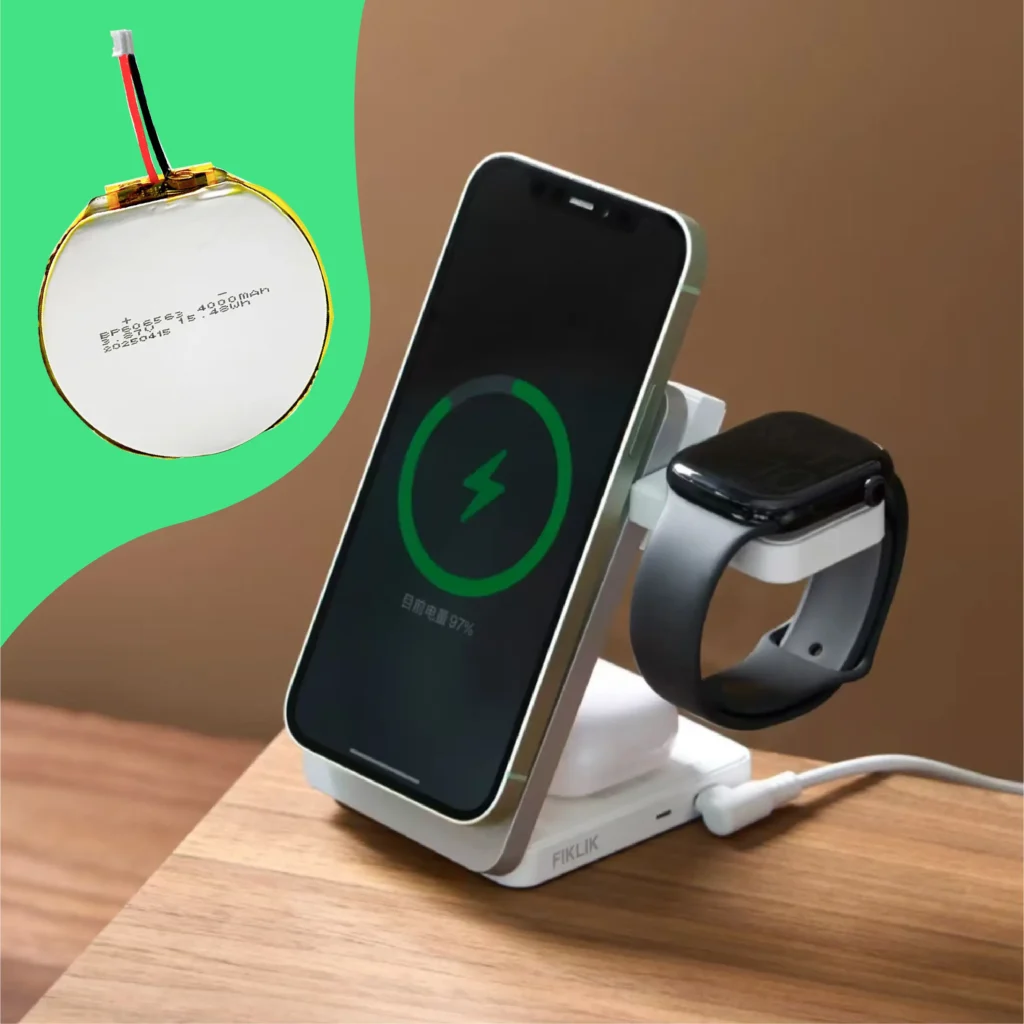
For example, one of our silicon-carbon battery solutions has reached 778 Wh/L of volumetric energy density.
Assume a wearable device provides 10 cm³ of usable battery volume:
- 600 Wh/L → approximately 6 Wh
- 778 Wh/L → approximately 7.78 Wh
With exactly the same volume, the second battery could theoretically provide around 1.78 Wh more energy, representing approximately a 29.7% increase. This is a simplified calculation. Actual runtime will also depend on DC-DC conversion efficiency, peak power consumption, temperature, battery utilization, and aging.
But the calculation illustrates an important point: For space-constrained wearables, increasing Wh/L can sometimes be more valuable than simply increasing battery size.
What Does a 778 Wh/L Battery Actually Mean?
We do not like to tell customers only that a battery has “high energy density.” A number becomes meaningful only when it is connected to a real product. One of our silicon-carbon battery solutions, for example, has the following published specifications:
- Capacity: 4000mAh
- Nominal Voltage: 3.87V
- Thickness: 6mm
- Weight: 47g
- Volumetric Energy Density: 778 Wh/L
- Internal Resistance: ≤130mΩ
- Cycle Life: 500 cycles
The important point is not simply the 778 Wh/L figure. It is that high energy density needs to coexist with practical cell characteristics such as thickness, internal resistance, and cycle life. Increasing capacity alone is not necessarily difficult. The real engineering challenge is balancing:
energy density + thickness + internal resistance + cycle life + mechanical stability.
This is why simply comparing the theoretical capacity of silicon with graphite does not tell the full story of the final battery.
A Smart Glasses Case: When Battery Shape Matters as Much as Chemistry
Smart glasses provide a particularly good example. In one type of smart glasses battery project, the customer was not simply looking for a higher-capacity cell. The battery also needed to make better use of the limited space inside the temple. A standard rectangular battery could fit into part of the available area, but it would leave unused space around the cell.
That unused volume represents a hidden loss of battery capacity. Instead of simply making the battery larger, the solution was to rethink the battery geometry.
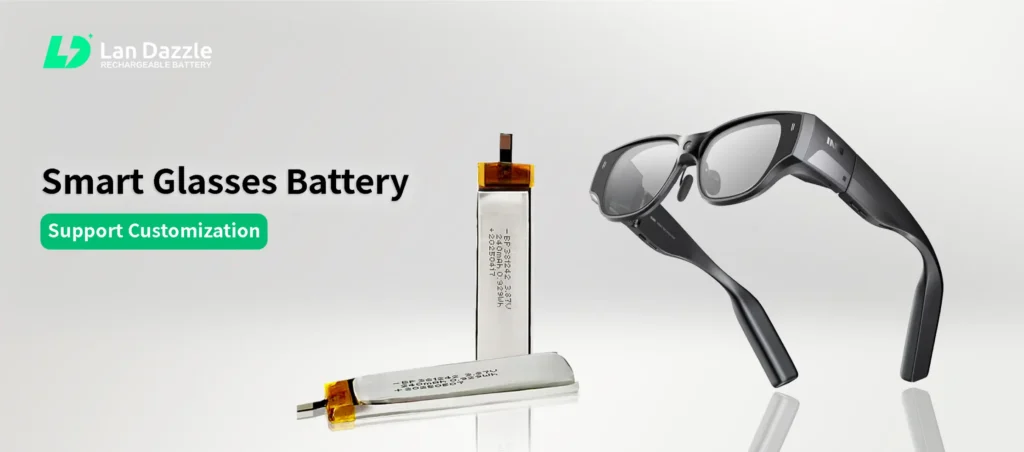
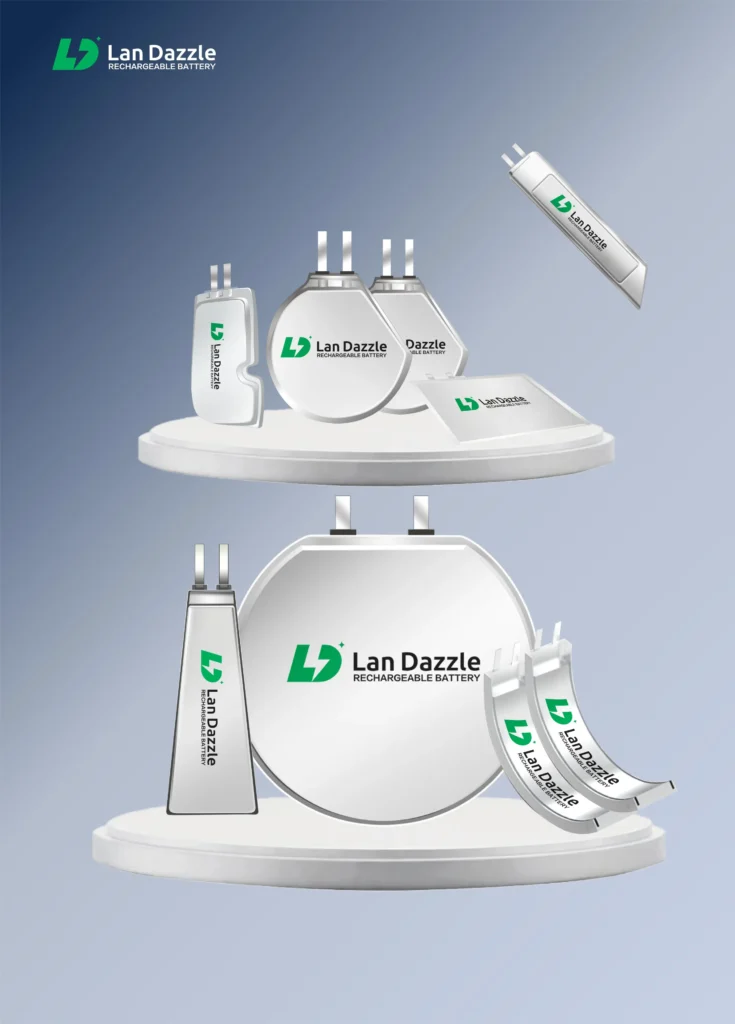
We have developed custom-shaped batteries for applications such as smart glasses, including narrow and specially shaped cells designed around the internal structure of the device. Our custom battery solutions can reach approximately 0.6 mm in thickness, with narrow widths down to around 5 mm, while the length, width, thickness, and overall profile can be customized around the device architecture.
This type of project has made one thing increasingly clear to us:
Wearable battery development is no longer just a competition between chemistries. It is a combination of chemistry and geometry.
A standard battery may have a higher Wh/L on paper, but if 15% of its potential volume is lost because of poor mechanical fit, that advantage can quickly disappear. A slightly lower-density battery that completely conforms to the available space may deliver more usable capacity at the system level.
Higher Energy Density Does Not Come for Free
If we only look at energy density, silicon-carbon can seem like an obvious answer. But once a battery enters actual product development, the engineering picture becomes more complicated.
One of the major challenges associated with silicon is its significant volume change during charge and discharge. This can affect particle integrity, SEI stability, and long-term cycling performance.
For wearable devices, this challenge can become even more important. Smart glasses, smart rings, and medical patches often have very little mechanical tolerance inside the enclosure. If the battery design considers only its initial thickness and ignores dimensional changes during long-term cycling, a high-energy-density cell can eventually create mechanical reliability problems.
That is why we do not look only at:“How many Wh/L does the battery have?” We also need to ask:“How much does the battery thickness change after hundreds of cycles?”
For a wearable device, that question may be more important than the initial energy density number.
High Energy Density Must Also Handle Wearable Peak Loads
Another factor that is often overlooked is: High energy density does not automatically mean high power performance.
Consider an AI smart glasses product. Its power consumption is not necessarily constant. The device may move between:
standby → camera activation → wireless transmission → AI processing → audio output → low-power mode.
During these transitions, the SoC, camera, wireless module, and audio system can create short periods of high current demand. A 778 Wh/L battery with insufficient power capability may experience significant voltage drop during these peak loads. In some applications, a slightly lower-density cell with lower internal resistance may actually deliver better real-world performance.
This is why we evaluate multiple parameters together: Wh/L, internal resistance, C-rate, peak current, and cycle life. For wearable devices, the best battery is rarely the one with the highest single specification. It is the one that achieves the right balance across the entire operating profile.
Silicon Carbon vs. Lithium-Ion: Which One Should You Choose?
The choice becomes much clearer when the battery is evaluated against the actual product requirements.
| Product Requirement | Priority |
|---|---|
| Extremely limited battery volume | Silicon-carbon |
| More capacity within the same volume | Silicon-carbon |
| Smart glasses or smart rings | Silicon-carbon + custom shape |
| Extremely tight thickness constraints | Evaluate expansion control carefully |
| High peak current demand | Compare internal resistance and C-rate |
| Long cycle life | Compare actual cycle retention |
| Highly cost-sensitive product | Conventional Li-ion may be more practical |
| Plenty of unused battery space | Silicon-carbon may not be necessary |
This means silicon-carbon should not be treated as a simple replacement for conventional lithium-ion batteries. If a product has plenty of unused internal space, paying more for higher energy density may not create meaningful product value.
But if the battery has already reached the physical limit of the enclosure, the situation changes.
If the battery cannot become another 0.5 mm thicker, but the product still needs 15% more runtime, increasing volumetric energy density may be far more practical than increasing battery dimensions. That is where silicon-carbon can become a meaningful design option.
Silicon-Carbon Is Not Automatically the Winner
If we look only at technology trends, silicon-carbon clearly has significant potential for the next generation of wearable batteries.
But from the perspective of actual battery development, our conclusion is slightly different: Silicon-carbon is not automatically the winner. The right battery design is.
- If the main constraint is volume, prioritize Wh/L.
- If the main constraint is weight, prioritize Wh/kg.
- If the main constraint is peak power, focus on internal resistance and C-rate.
- If the main constraint is long-term reliability, cycle life and expansion control may matter more than a headline energy-density number.
- If the battery must fit inside an irregular 5 mm-wide smart glasses temple, the final solution may not be a simple change in anode chemistry or capacity. It may require silicon-carbon chemistry + custom battery geometry + optimized electrode design.
That combination may represent the more practical direction for next-generation wearable batteries. For smart glasses, smart rings, medical patches, and other compact devices, the battery race is no longer simply about who can achieve the highest material capacity. It is about who can reliably deliver the most usable energy in the smallest possible space?
Need a Battery Designed Around Your Wearable?
If your product has limited internal space, irregular battery geometry, strict thickness requirements, or higher energy-density targets, a standard battery may not be the best starting point.
At LanDazzle, we develop custom LiPo and silicon-carbon battery solutions for smart glasses, smart rings, medical wearables, IoT devices, and other space-constrained electronics.
From ultra-thin cells and narrow-width batteries to custom-shaped designs and high-volumetric-energy-density solutions, our engineering team can work from your available battery space and electrical requirements to develop a cell around the product—not force the product around a standard cell.
Have a challenging battery space to fill? Talk to LanDazzle about your custom battery requirements.
Email: info@landazzle.com
Whatsapp: +8618938252128