Table of Contents
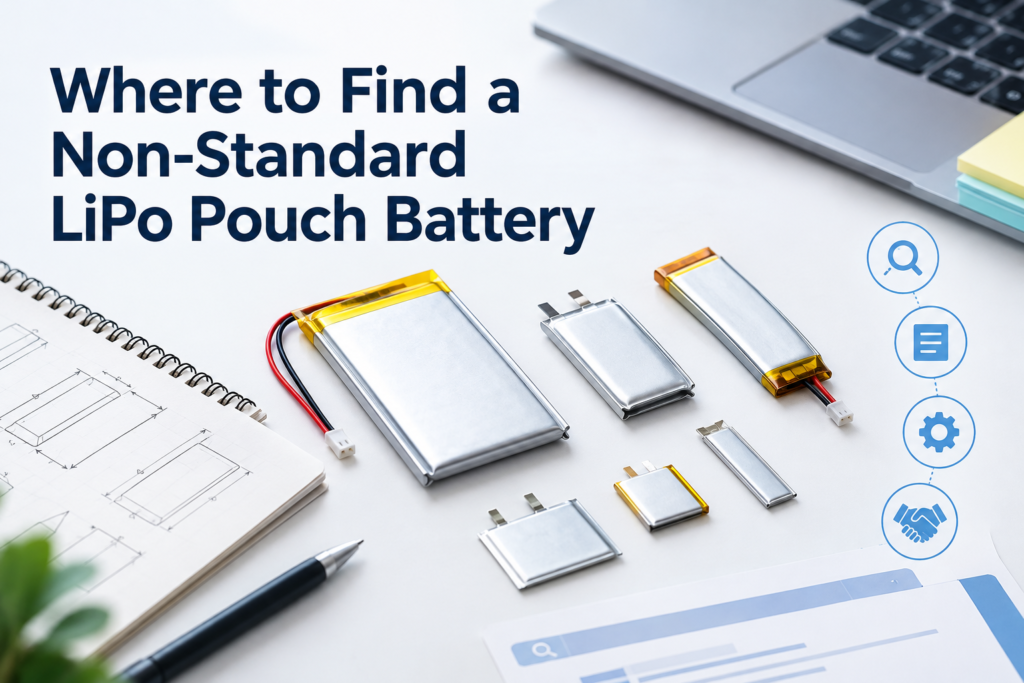
Finding a LiPo pouch battery with the right dimensions can be surprisingly difficult. You may know the voltage and capacity you need, but standard batteries are either too thick, too long, or simply unavailable in the size your device requires.
Before ordering a custom battery, there are a few practical ways to find an existing option. If none of them works, you can then approach a manufacturer with a much clearer specification.
1. Search by Battery Code, Not Just Capacity
If you’re replacing an existing battery, start by checking the label or markings on the original cell.
Some pouch batteries have model codes that indicate their approximate dimensions. For example, a code such as 104545 may refer to dimensions around 1.0 × 45 × 45 mm, depending on the manufacturer’s coding convention.
Try searching for:
- The complete battery code
- The code plus its nominal voltage
- The measured dimensions and capacity
For example, search for 3.7V 104545 Lipo battery or 1.0*45*45mm pouch cell.
One important detail: Battery size codes are not universally standardized. Always verify the actual dimensions against a datasheet or the seller’s specifications before ordering.
2. Check Replacement Batteries and Specialist Suppliers
You don’t have to start with a custom manufacturer.
Try these sources first:
- Original equipment manufacturers (OEMs): Ask the manufacturer of your device whether replacement batteries are available.
- Battery distributors: Search specialist battery suppliers for pouch cells with published dimensions and specifications.
- Replacement battery sellers: Batteries intended for bike lights, wearables, handheld electronics, and other devices can sometimes provide a suitable alternative.
When comparing options, don’t look at capacity alone. Check the nominal voltage, physical dimensions, connector, polarity, and discharge-current requirements as well.
Buy from a supplier that can provide meaningful technical specifications and traceability, particularly if the battery will be used in a commercial product.
3. Look for Near-Matching Sizes
You may not need an exact dimensional match.
Suppose your design allows a maximum battery size of 40 × 30 × 3 mm. A slightly shorter or narrower cell might work if it still provides enough capacity and meets your electrical requirements.
Before searching, divide your requirements into two categories:
- Non-negotiable: Maximum thickness, voltage, connector position, and essential safety requirements.
- Flexible: Target capacity, overall length, or width, if your enclosure allows some variation.
This makes it easier to identify usable alternatives without repeatedly searching for a battery that may not exist as a standard product.
However, don’t assume that a battery with similar dimensions will automatically deliver the same performance. Check the discharge requirements, operating temperature, charging limits, and protection arrangements for your application.
4. When Should You Consider a Custom LiPo Battery?
If the standard options still don’t fit, custom manufacturing may be the more practical route.
It’s worth contacting a custom battery manufacturer when:
- Your device has a strict thickness or width limit.
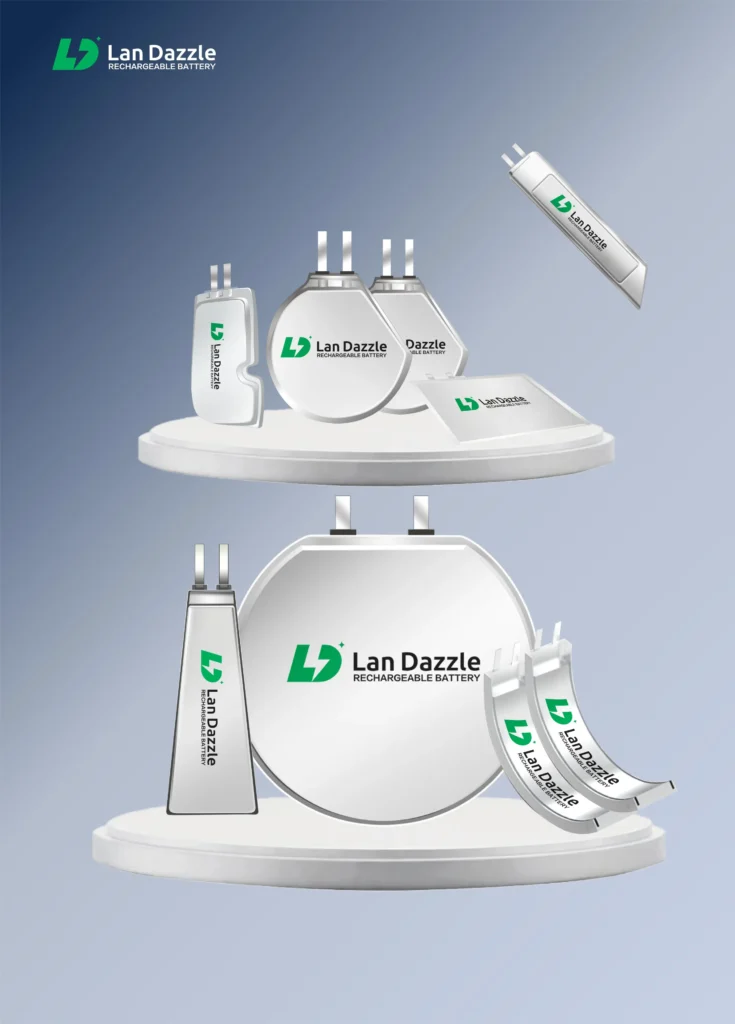
- The available space is irregular or curved.
- Standard batteries cannot provide sufficient capacity within your available space.
- You need a particular connector, wire arrangement, or electrical specification.
- You’re developing a product that will move from prototypes into production.
A custom battery is not automatically the best choice for every project. Development costs, minimum order quantities, sample availability, and production lead times vary by manufacturer and design. Ask about these early, especially if you’re building only a few prototypes.
5. What Information Should You Send a Battery Manufacturer?
You don’t need a complete battery specification to start a conversation. A short, clear brief is usually enough for an initial feasibility assessment.
| Information | What to provide |
|---|---|
| Available space | Maximum thickness × width × length, in mm |
| Voltage | Required nominal voltage |
| Capacity | Target capacity in mAh |
| Current | Continuous and peak discharge current |
| Operating conditions | Temperature range and typical usage |
| Connections | Connector type, wire length, and polarity |
| Protection | Whether overcharge, over-discharge, and other protection is needed |
| Project stage | Prototype quantity and estimated production volume |
If possible, include a drawing, CAD model, or photo showing the available battery space.
Make sure your dimensional limits account for the complete installed battery, including any sealing edges, wires, connectors, or protection circuitry that must fit inside the enclosure. Ask the manufacturer how its quoted dimensions are measured.
You should also request samples for a fit check and electrical testing before committing to production.
Need a Non-Standard Lipo Pouch Battery?
Sometimes the challenge isn’t finding a small LiPo battery. It’s finding one that fits your product without sacrificing too much capacity or changing the enclosure.
LanDazzle develops custom lithium battery solutions, including ultra-thin and non-standard form factors. If off-the-shelf options don’t meet your requirements, you can explore custom-shaped battery solutions and share your dimensions, electrical requirements, and project stage for an initial discussion.
The best place to start is simple: define the available space first, identify which specifications are flexible, and then decide whether a standard or custom battery makes more sense.
Email: info@landazzle.com
Whatsapp: +8618938252128