Table of Contents
For decades, the development direction of lithium-ion batteries has revolved around one core goal: storing more energy within a limited space.
From smartphones and smartwatches to emerging wearable devices such as smart glasses, battery technology has continued to improve. However, as smart hardware enters a new stage of development, traditional battery designs are facing new challenges.
- Smart glasses require batteries that can fit complex curved structures.
- Smart rings need to occupy extremely limited space while maintaining sufficient battery life.
- Medical devices require long-term stable operation while ensuring safety and reliability.
These products share one common characteristic: the internal space of devices is becoming increasingly fragmented, while batteries are expected to deliver higher and higher performance.
Traditional standardized batteries are becoming increasingly difficult to meet these requirements. As a result, battery manufacturing technologies must also evolve.
1. What Is the Stacking Process?
A lithium-ion battery mainly consists of a cathode, anode, separator, and electrolyte. Among these components, how the cathode and anode are assembled determines the internal structure of the cell and directly affects battery performance.
Currently, there are two main cell formation methods used in the industry:
- Winding process
- Stacking process
The winding process rolls continuous cathode sheets, anode sheets, and separators together like a roll of paper to form a wound electrode structure. The stacking process, on the other hand, cuts cathode sheets, separators, and anode sheets into individual pieces, then stacks them layer by layer in a specific order to form the battery cell.
Both technologies have their own application scenarios. However, for small-sized, high-performance, and customized batteries, the stacking process offers more significant advantages.

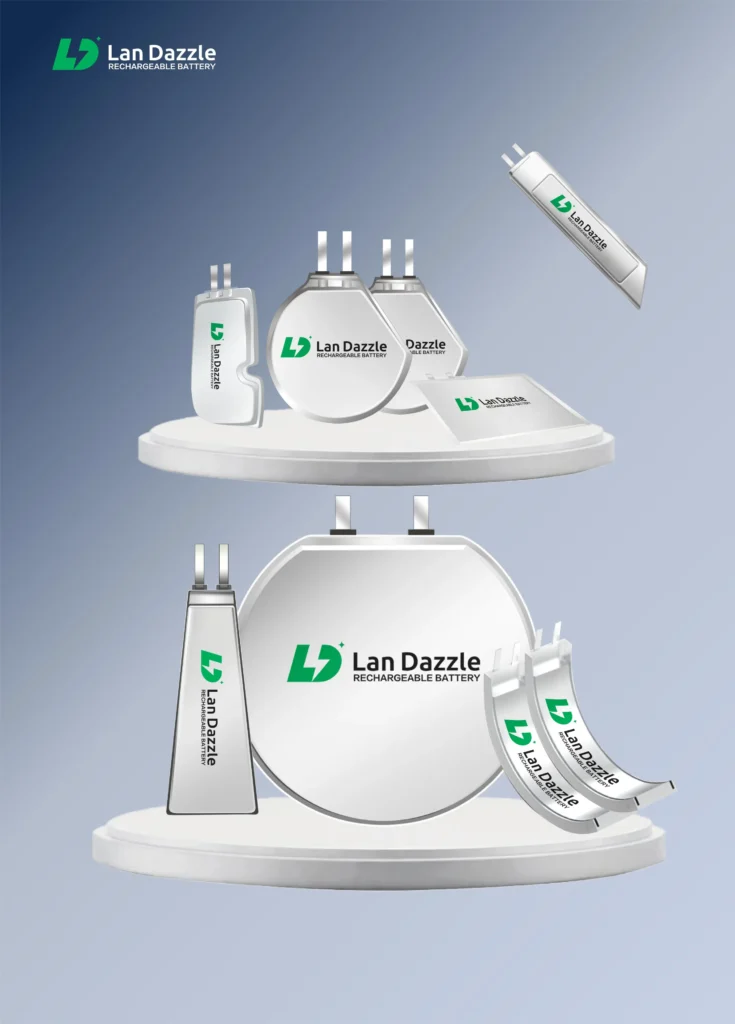
2. The Biggest Advantage of the Stacking Process: It Enables Batteries with Different Shapes
This is one of the most important reasons why we choose the stacking process.
Traditional winding technology uses continuous electrode sheets rolled into a cylindrical structure, which means it is limited by the bending radius of the electrode layers. When a battery needs to be designed into curved, L-shaped, U-shaped, ultra-thin, stepped, or other irregular forms, the winding structure has difficulty fully utilizing the available space. During the winding process, the electrode sheets must maintain continuous bending, which can create unused gaps inside the battery.
The stacking process is completely different. Since each electrode sheet is independently cut, the battery structure can be designed according to the internal space of the product:
- Electrode shapes can be customized
- The number of stacked layers can be adjusted
- The overall cell shape can be freely designed
This means the battery no longer needs to adapt to the device structure. Instead, the battery can be designed around the device. For products such as smart glasses, smart rings, and medical wearable devices, this capability is extremely important.
The smart hardware products of the future will not become more standardized — they will become increasingly personalized and differentiated.
3. Higher Space Utilization Brings Higher Energy Density
Increasing battery capacity does not only depend on adding more materials or making the battery larger. In reality, improving space utilization is also an effective way to increase battery capacity.
One of the major structural limitations of wound cells is the curved area inside the battery. During the winding process, electrode sheets must create curved transitions, resulting in areas known as “C-shaped corners”.
These areas cannot be utilized as effectively as the central region of the cell.

In contrast, the stacking structure uses flat electrode sheets layered together. Each layer can better utilize the available battery space.
Compared with winding structures, stacking technology provides:
- Higher utilization of corner areas
- Less unused space
- More active materials within the same dimensions
For small batteries, this advantage becomes even more significant because the proportion of corner areas increases as battery size decreases. Depending on the specific design, stacked cells can achieve higher volumetric energy density. Compared with traditional winding structures, the improvement in space utilization can reach approximately 20% or even higher.
4. Lower Internal Resistance Means Less Heat Generation
Besides capacity, modern smart devices are increasingly focusing on battery power performance.
- AI-powered smart glasses need to support more computing functions.
- Drones require rapid power output.
- Medical devices need stable and reliable operation.
These applications require batteries with better rate performance.
The stacking process has natural advantages in this area. In stacked structures, each electrode layer can be designed with independent tabs, and multiple tabs can be connected in parallel for current collection.
This allows the battery to:
- Shorten current transmission paths
- Reduce electrical resistance
- Minimize internal energy loss
Simply put: The shorter the path for current flow, the lower the resistance.
Lower internal resistance directly brings two major benefits:
- First, stronger discharge capability. The battery can support higher-rate output and meet the power requirements of demanding applications.
- Second, lower operating temperature. Reduced internal resistance means less heat generation during operation.
This is especially important for high-speed charging, fast discharge, and high-power applications. Because temperature not only affects user experience but also impacts battery lifespan and safety.
5. Lower Electrode Stress Enables More Stable Cycle Life
During usage, batteries continuously experience expansion during charging and contraction during discharging. Over time, electrode materials experience mechanical stress. Because winding technology requires electrodes to be bent during formation, stress and tension can accumulate in the curved areas of the wound cell.
In stacking structures, electrode sheets remain flat. Each layer experiences more uniform mechanical pressure without obvious bending areas.
As a result:
- Electrode stress is reduced
- Expansion becomes more uniform
- Interface stability improves
- Long-term cycling performance becomes more reliable
For devices that need to operate continuously for years, such as smart medical devices, industrial sensors, and wearable electronics, cycle life is a critical factor. A battery should not only provide long usage time after a full charge, but also maintain stable performance after years of operation.
Traditional wound batteries typically provide around 500 cycles, while batteries produced using stacking technology can achieve 800 cycles or even 1,000+ cycles.
6. Why Don’t All Batteries Use the Stacking Process?
If stacking technology offers so many advantages, why does the industry still use winding technology?
The answer is simple: Different applications require different solutions.
Winding technology has advantages including:
- Higher automation level
- Higher production efficiency
- Lower manufacturing cost
- More mature manufacturing processes
For standardized batteries produced in large volumes, such as some consumer electronics batteries, winding technology remains highly competitive.
Although the stacking process has higher manufacturing complexity, it provides:
- Greater freedom in shape design
- Higher energy density
- Lower internal resistance
- Better cycling performance
Therefore, there is no simple question of which technology replaces the other. The key is choosing the battery technology that best matches the product requirements.
7. Redefining Batteries for Future Smart Hardware
With the development of AI devices, smart wearables, robotics, and medical electronics, future products will continue to break traditional design limitations. We believe that batteries will no longer be just simple energy storage components. Instead, they will become an important part of product design.
Choosing the stacking process is not only about improving one specific parameter. It is about meeting the comprehensive requirements of next-generation smart devices:
- Smaller size
- Higher capacity
- Lower heat generation
- Longer lifespan
- Greater design flexibility
This is also why LanDazzle continues to invest in the research and development of stacking battery technology. We believe that customized battery solutions will become a key foundation for the next generation of intelligent hardware.
Need higher energy density, flexible shapes, and reliable performance for your next device? Talk to LanDazzle’s battery experts about your custom battery requirements.
Email: info@landazzle.com
Whatsapp: +8618938252128