When do you need to choose a custom lithium battery?
When a standard battery “barely works” and starts to hurt the product experience, it’s time to go custom.
Common situations include:
- The internal space is very limited, and standard batteries don’t fit.
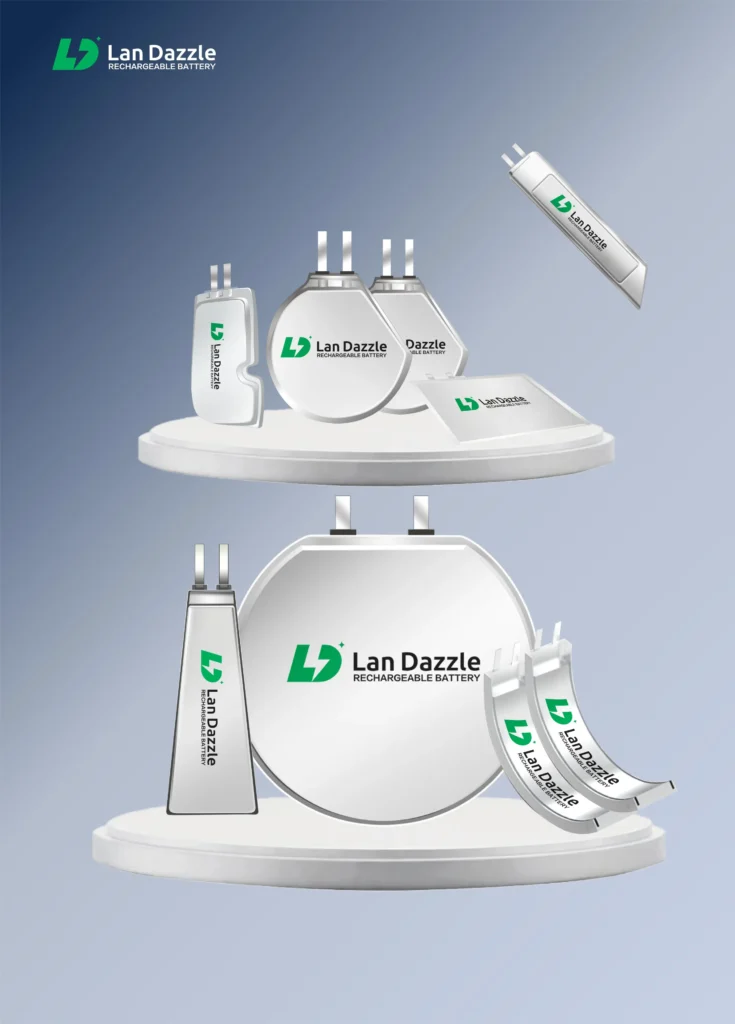
- The product needs an ultra-thin, irregular, or curved battery shape.
- There are clear requirements for runtime, discharge current, or working temperature.
If you keep changing the product structure just to “fit the battery,” or you’re constantly asking “why is the battery life so short,” that’s a strong sign that a standard battery is no longer the right choice.
Are custom lithium batteries suitable for small batches or startup projects?
Yes. In fact, many custom lithium battery projects start with small batches.
In real product development, very few customers go straight into mass production.
Most projects follow this path:
prototype validation → small-batch testing → full-scale production.
As a manufacturer, when we evaluate a project, we care more about feasibility and long-term potential than the initial order quantity.
As long as the requirements are clear and the product direction is well defined, small-batch production is absolutely workable.
My product is still at the concept stage. Can I start battery customization early?
Yes—and the earlier, the better.
Many teams wait until the mechanical design is fixed before talking to a battery supplier.
Then they find problems like:
- the battery doesn’t fit,
- the capacity is not enough,
- heat and safety become hard to manage.
From our experience, involving the battery at the concept or early design stage helps in three key ways:
- Check feasibility early (space, power, safety)
- Guide a more reasonable product structure and usage plan
- Avoid big design changes later just to fit the battery
At the concept stage, not everything needs to be final.
If you can share basic info—such as target runtime, power range, space limits, and application—we can already suggest a clear battery direction.
Instead of waiting until “everything is fixed,”
bringing the battery into the design early is exactly where custom batteries add real value.
Are irregular / ultra-thin / curved batteries really safe?
Yes—if the design and manufacturing process are done properly, they are safe.
The risk is not in the “shape,” but in forcing the structure too much, or ignoring internal stress and heat dissipation.
A true custom battery adjusts the cell type, tab position, packaging method, and protection design together—instead of forcing a standard solution into a special shape.
Who handles the housing, cables, and connectors?
In most cases, the battery manufacturer designs and integrates them as a complete solution.
This includes overall dimensions, tolerance control, cable length, connector type, and exit direction.
Doing this at the battery level helps reduce assembly issues, avoid rework later, and ensure good consistency in mass production.
If you already have specific connector or mechanical requirements, the battery manufacturer can also design the battery to match your full product structure.
Can the BMS be customized to match my device logic?
Yes—and for many custom projects, this is actually necessary.
A BMS is not just for protection.
It affects startup behavior, current limits, temperature control, and even how the battery works with your main controller.
If your device has specific requirements for power consumption, response time, or communication, a standard BMS often won’t be a good fit.
In these cases, the BMS needs to be customized—either by adjusting parameters or adding functions—to match your device logic.
What tests are required for custom lithium batteries?
They mainly fall into three categories:
- Performance tests: capacity, discharge rate, internal resistance, temperature rise
- Safety tests: overcharge, over-discharge, short circuit, drop tests, etc.
- Reliability tests: cycle life, aging, and environmental adaptability
The purpose of these tests is to confirm that the battery solution is truly suitable for mass production—not just that it can “power on the device.”
Do samples need full certification?
Usually, no.
At the sample stage, the focus is on verifying feasibility and basic safety.
Formal certifications are typically done after the design is stable and the project is ready for mass production—this is more efficient and cost-effective.
What is the typical cycle life of a custom lithium battery?
A common design target is 500–1000 charge cycles,
but the actual cycle life depends on factors like discharge rate, charge/discharge strategy, and the operating environment.
Cycle life is not an isolated number—it is closely tied to how well the battery design matches the overall system.
How can you tell if a custom battery manufacturer is truly professional?
Focus on four key points:
- Do they participate in solution design, instead of just quoting specs?
- Can they clearly explain trade-offs and risks?
- Do they care about mass production and long-term use, not just samples?
- Do they have complete testing and quality control capabilities?
A truly professional manufacturer cares more about whether your product can run stable and reliable in the long term, not just closing one order.
Custom Battery FAQs Summary
If you’ve read this far, you’re probably not just “learning about batteries.”
You’re actively pushing a custom lithium battery project forward.
In this final section, we won’t go deeper into technical details.
Instead, we’ll highlight two critical mistakes we see most often in real projects—mistakes that are easy to overlook, but have the biggest impact.
Common Mistakes in Custom Battery Projects
Focusing only on capacity or price, not system matching
A battery is not an isolated part.
It must match the device’s power consumption, available space, thermal conditions, and real usage scenarios over the long term.
Chasing the highest capacity or the lowest price often leads to problems later—
reduced stability, shorter lifespan, and higher after-sales costs that “pay back” the savings.
Comparing quotes, but not the manufacturer’s real capability
Custom lithium batteries are not a one-time purchase.
They are a long process—from design and testing to mass production and long-term support.
If a supplier can only give you a price, but cannot clearly explain design trade-offs, risks, or how mass production is controlled,
that risk usually ends up on the customer’s side.
How to Start a Custom Lithium Battery Project Efficiently
Getting started is simpler than you might think.
You don’t need a complete technical solution upfront.
As long as you can provide the following, early evaluation can begin:
- Working voltage and estimated power consumption
- Target runtime or capacity goal
- Available battery space or size limits
- Application and usage environment
- Any special requirements (ultra-thin, high discharge, low temperature, certifications, etc.)
This information defines the direction.
The actual battery structure, cell selection, and protection design should be handled by a professional battery manufacturer.
Contact Us|Get Battery Customization Advice for Your Project
The core of custom lithium batteries is not “choosing a battery,”
but designing the energy solution right at the early stage.
As a source manufacturer, we don’t just supply batteries.
We support solution design, testing validation, and mass production—helping you solve key issues early, instead of carrying risks after the product launches.
If you’re evaluating a custom battery solution or have questions about your current design,
feel free to contact us and talk directly with our engineers.
The earlier the discussion starts, the more stable the solution—and the more controllable the total cost.
Email: info@landazzle.com
Whatsapp: +8618938252128