More and more products are no longer designed to be square and straight these days.
Wearable devices, smart helmets, medical tools, curved consumer electronics… Their shells are becoming thinner, bent, and shaped to fit the human body or inner structures.
But the problem often lies in one single part — the battery.
Standard rectangular batteries are more and more like parts forced into products, instead of power solutions made for them.
This is why custom curved liPo batteries are now stepping into the spotlight.
What is a Curved LiPo Battery?
When most people first hear the term “curved battery”, their first thought is:
Is it just a regular battery bent into shape?
Strictly speaking, a real curved LiPo battery is not made by bending a finished battery later.
A Curved LiPo Battery refers to a lithium polymer battery that is customized according to the radian, curve and internal space of products during cell design and production.
It is completely different from these products:
❌ Soft-pack batteries bent after production
❌ Standard batteries forced into curved spaces
❌ Thin batteries that only have slight flexibility
In essence, a genuine curved battery is a fully customized cell built for special structural needs.
Why Custom Curved LiPo Batteries Are Needed
From an engineering view, the problems are very practical.
If you keep using standard batteries, you will often face these issues:
- Low use of inner space
- Have to cut down battery capacity
- The shell design has to change to fit the battery
- The thickness stays at an awkward level
Many products want to be thinner and more close-fitting, but the battery becomes the main limit.
What can a curved LiPo battery solve?
- Fit the structure: follow the product curve, no forced fitting
- Better space use: more real capacity in the same space
- Make the whole device thinner: perfect for thickness-sensitive devices
- More design freedom: engineers no longer need to design around standard batteries
For many products, curved LiPo batteries are not an extra upgrade — they are the only way to make the design work.
How are Custom Curved LiPo Batteries Made?
This process is exactly what most articles explain very vaguely.
Many materials only simply say “custom available” or “can be produced according to drawings”. But from an engineering perspective, custom curved LiPo batteries are far more than just designing a curved shape.
It is an engineering process that balances structure, electrical performance and safety over and over again.
Step 1: Product structure and curve analysis
The first step of customization is not discussing capacity, but judging whether the structure is suitable for battery installation.
At this stage, we focus on these key points:
- Radius of curvatureThe smaller the curvature radius, the higher the requirements for internal materials and lamination structures. The battery cannot be bent at will.
- Maximum and minimum thicknessCurved designs usually have uneven thickness. If the thinnest part reaches the safety limit, the design needs re-evaluation.
- Available space boundaryThe battery has to avoid screw posts, antennas and reinforcing ribs inside the device.
- Stress concentration pointsSharp corners and sudden transitions will easily cause hidden risks during long-term use.
Not all curved spaces are suitable for batteries directly.
Adjusting the curve or partial structure often makes the battery safer and more stable.
Step 2: Confirm electrical parameters
Discussing electrical parameters only makes sense after the structure is confirmed feasible.
We usually confirm these items:
Rated voltage (single cell / multi-cell series, space limitations included)
Target capacity (max capacity or basic functional capacity)
Discharge rate requirements (continuous output vs instant power supply)
Actual working conditions (continuous use / intermittent use / duration of peak load)
For curved battery projects, size, capacity and discharge rate cannot all reach the highest level at the same time.
The core of this step is to find a long-term stable balance for products, instead of only pursuing perfect data.
Step 3: Cell structure design
The first two steps are for feasibility assessment, while this step is the core of customization.
There are more factors to consider than most people think:
- Single-layer or multi-layer lamination structureMulti-layer design increases capacity, but requires higher consistency at curved parts.
- Tab position and wiring methodImproper tab placement will cause extra stress when bent and affect long-term reliability.
- Packaging solution selectionPackaging materials and processes directly prevent stress and deformation on curved areas.
- Internal consistency design for curved partsElectrode coating, lamination alignment and tolerance control all affect the service life.
This step decides not only whether the battery can be bent, but also whether it can work stably for a long time in a curved state.
Step 4: Safety and reliability testing
Most suppliers rarely talk about this part, but it is especially important for curved LiPo batteries.
Besides standard tests, we focus more on:
Charge and discharge consistency under bending state
Capacity fading after long cycle use
Stability of internal materials under long-term stress
Effectiveness of overcharge, overdischarge and short-circuit protection
A curved shape never means safety can be ignored.
On the contrary, highly customized batteries require stricter safety verification.
Custom Curved Lithium Polymer Battery According to Your Exact Specifications
We understand that every device has unique power requirements and design constraints. That’s why we specialize in fully custom curved LiPo batteries, engineered to fit your device perfectly while delivering optimal energy, safety, and reliability.
1. Shape & Size:
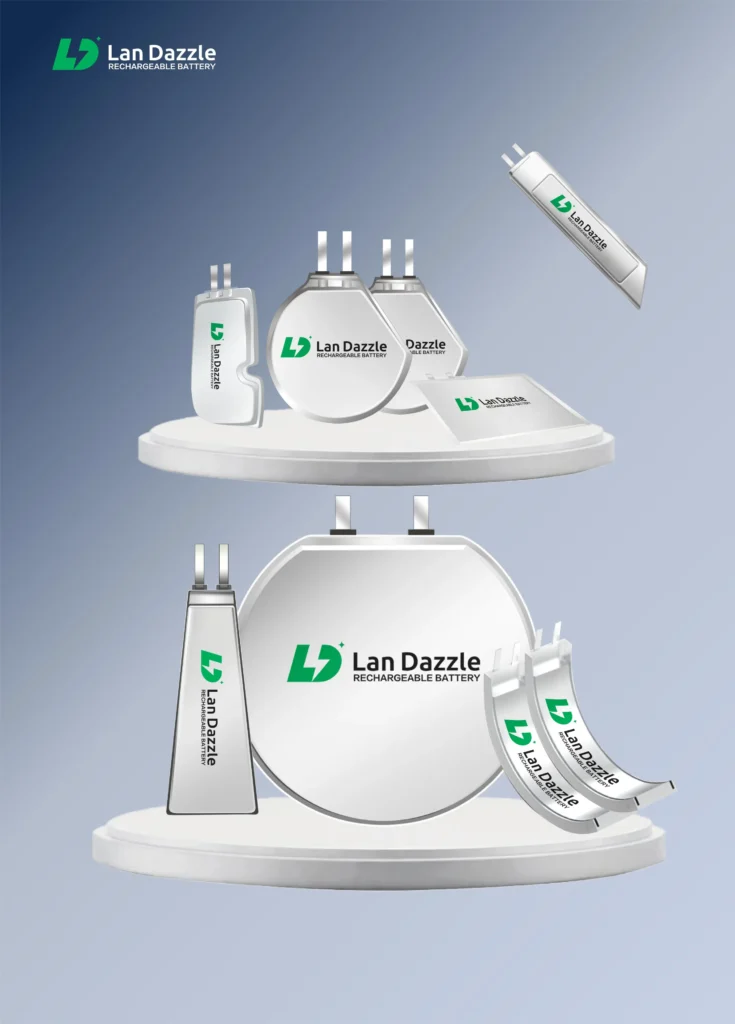
We specialize in designing batteries that precisely fit your device’s unique contours. Using your 3D files or sketches, we can bend, mold, and shape LiPo cells to match irregular internal spaces. This ensures maximum energy density without compromising your product’s form factor.
2. Capacity & Voltage:
Our custom batteries cover a wide range of energy requirements and can be configured at various voltages. By combining series and parallel connections, we can achieve the exact voltage and capacity your device needs.
3. Connectors & Interfaces:
We can match any connector type you require, including JST, XT60, Molex, or fully customized solutions. This flexibility ensures seamless integration into your product’s existing electrical system.
4. Protection Circuits (PCB):
Safety is a top priority. Our batteries can incorporate custom protection boards (PCB) tailored to your device’s requirements, providing overcharge, over-discharge, short-circuit, and thermal protection. This guarantees reliable operation and enhances user safety.
5. Cables & Packaging:
We offer customization of cable length, color, and connector orientation, as well as various casing materials for enhanced durability and aesthetic integration. This allows your battery to perfectly align with your product’s design and functional needs.
Curved LiPo batteries are not an easy solution with no technical challenges.
If someone tells you:
Curved batteries are just as simple and stable as standard batteries.
You need to stop and think carefully.
Curved LiPo batteries can solve many structural problems, but they are never a low-threshold option. They cannot be made simply by changing the shape of standard cells.
The real challenges of curved batteries usually include these points:
- Lower production yield than standard cellsDuring lamination, sealing and shaping, curved batteries require much stricter tolerance and consistency control.Even tiny errors will be enlarged on curved areas, directly affecting yield and stability.
- More complex curves mean harder internal consistency controlA simple arc and a complex curved shape are totally different in engineering difficulty.More curve changes make it harder to control electrode alignment, current distribution and internal resistance consistency.
- Higher requirements for material selection and process stabilityNot all materials can work well under long-term stress.The matching of electrode materials, adhesive systems and sealing layers will decide the service life of curved parts.
- Reliance on practical experience, not just standard proceduresMany key judgments cannot depend only on theory; they come from repeated tests of real projects.This is why curved batteries cannot be mass-produced quickly by copying existing designs.
- Not every project is suitable for curved batteriesIf the structure and space allow, standard or slightly shaped batteries are often more stable and cost-effective.Curved customization is a way to solve problems, not just to look more high-end.
Because of these real challenges, “being able to make a sample” is never the same as “being able to produce stable products for long-term use”.
A mature curved LiPo battery solution works well not only in the sample stage, but also keeps stable during long-term use, repeated charging cycles and complex working conditions.
If a supplier avoids these problems from the very start, your product will end up taking all the risks in later mass production.
Which scenarios fit Curved LiPo Batteries best?
From real project experience, curved LiPo batteries are not a one-size-fits-all solution.
They are mainly used for products whose structure cannot be changed or compromised.
Common application scenarios for curved LiPo batteries
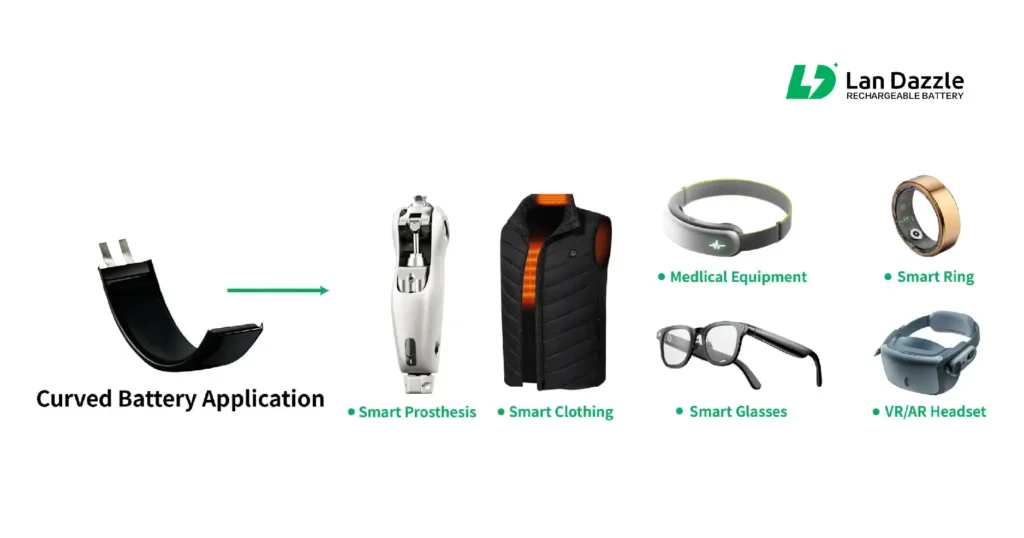
Wearable devices
Such as smart bands and medical monitoring devices. These products fit the body curve and are highly sensitive to thickness, weight and comfort. Regular-shaped batteries can hardly work here.
Smart helmets & wearable protective gear
They have complex inner space with continuous changing curves. Standard batteries will waste space and force structural compromises.
Medical devices (portable & body-worn types)
Many medical products stay in contact with the human body for a long time. Their shape comes first, and they require much higher safety and reliability than common consumer electronics.
Curved consumer electronics
These focus on industrial design and user experience. Batteries need to blend into the structure naturally, instead of limiting the design.
Custom devices with high requirements for industrial design
These products are not made in standard models. They are built around special structures and functions, and the battery is a key part of the whole custom design.
All these products share one clear feature:
The shape and structure are decided first, and the battery must follow the structure, not the other way around. This is why curved battery projects set much higher standards for manufacturers than normal custom batteries.
What to check when choosing a curved battery supplier
For curved LiPo projects, specification sheets only tell half the story.
The other half depends on whether the supplier truly understands your product structure and usage environment.
Focus on these key points:
- Complete custom design abilityNot only changing sizes or making odd shapes. Real curved customization needs full cooperation on structure, electrical performance and safety design.
- Deep understanding of structure and battery performanceThey need to know how curve changes affect internal resistance, cycle life and heat performance.
- Early design involvementA good supplier checks your project at the very beginning, not just produces after your design is fully finished. Most problems can only be fixed in the early design stage.
- Honest professional judgmentReliable suppliers will clearly tell you when curved batteries are not suitable for your project, instead of accepting every order blindly.
For curved battery projects, early communication decides nearly 70% of the final success. Choosing the right partner makes design, testing and mass production far smoother all the way.
Conclusion
Curved lithium polymer batteries are never chosen simply to make a product look more advanced.
Their real value lies in enabling a design to work — even when the product structure can no longer accommodate standard battery shapes — without compromising performance or safety.
At the same time, it is important to recognize that curved batteries are not a universal solution.
They place higher demands on design, materials, manufacturing processes, and experience, and they rely heavily on thorough evaluation in the early development stage.
A well-engineered custom battery solution does not begin with a specification sheet.
It starts with the product’s structure, real-world usage conditions, and long-term reliability requirements — and is refined step by step from there.
If battery shape has become a critical limitation in your product design,
it is often better to address it early, rather than making compromises later.
Treating the battery as an integral part of the product design from the beginning can make all the difference.
Let the Battery Truly Fit Your Product Design
If you are developing a product that:
- Features a curved or non-standard structure
- Has strict requirements for thickness and space utilization
- Is limited by standard battery solutions
- Cannot afford compromises in safety or reliability
We’re ready to help.
By providing your product geometry, target voltage, and capacity requirements, our engineering team can evaluate your needs and design a custom curved lithium polymer battery solution tailored specifically to your application.
Email: info@landazzle.com
Whatsapp: +8618938252128