Table of Contents
Wearable devices are becoming smaller while supporting increasingly demanding features, from health monitoring and wireless connectivity to cameras and AI-powered functions. This creates a fundamental battery design challenge: how can engineers deliver enough usable energy and power without compromising size, weight, or wearing comfort?
High-voltage lithium-ion cells may offer advantages in certain designs, but they are not a universal solution. Their performance depends on cell chemistry, charging requirements, and the power demands of the device.
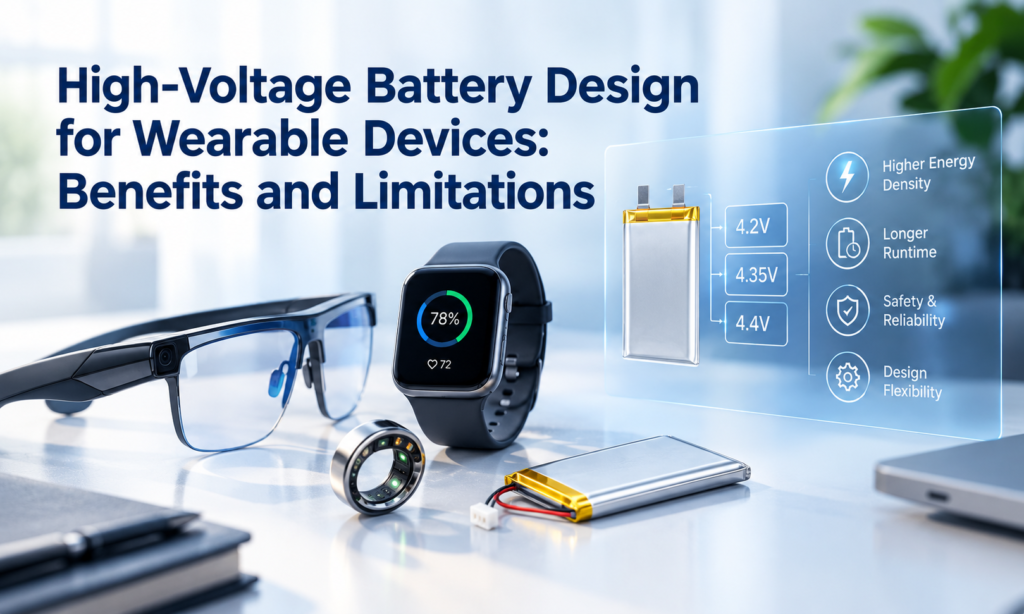
This article explores the benefits and limitations of high-voltage batteries for wearable devices, along with the key engineering considerations for selecting and integrating the right cell.
1. What Does a High-Voltage Battery Mean in Wearable Design?
In wearable electronics, the term high-voltage battery can refer to different technologies. We focus primarily on single-cell lithium-ion or lithium-polymer batteries designed for higher maximum charging voltages, such as 4.35V or 4.4V, rather than high-voltage battery packs used in electric vehicles.
It is also important to distinguish nominal voltage from maximum charging voltage. Nominal voltage describes the representative operating voltage of a cell, while maximum charging voltage is the specified upper limit reached during charging.
However, a higher charging-voltage rating does not automatically mean a battery is better. The cell must be specifically designed for its intended voltage range, and the charging system must be compatible with its specifications.
2. Potential Benefits of High Voltage Battery for Wearable Devices
More Usable Energy Within a Limited Space
Wearable devices have strict space and weight constraints. Increasing the upper charging voltage of a compatible lithium-ion cell can potentially increase the energy available from that cell. This is one reason researchers and manufacturers investigate higher-voltage battery designs.
However, higher charging voltage alone does not guarantee greater volumetric energy density, measured in Wh/L, or gravimetric energy density, measured in Wh/kg. Actual results depend on electrode materials, cell construction, active-material utilization, and the overall battery design. For wearable product developers, the practical objective is to maximize usable energy within the available battery volume and weight.
Potential Runtime Improvements for Wearables
A battery with more usable energy may help extend operating time when device power consumption remains comparable. This matters for smart glasses that combine cameras, wireless connectivity, audio, and AI functions. These features create different power demands: some require sustained energy, while others produce short bursts of high power.
However, runtime is not determined by charging voltage alone. Processor efficiency, display operation, wireless transmission, firmware, and power-management strategies all influence actual battery life.
Meta’s engineering team provides a useful example in its article, How Meta Engineered Ultra-Narrow Batteries for AI Glasses. The company describes how improvements to cell construction, available battery volume, and system-level power management contributed to the development of its smart glasses batteries.
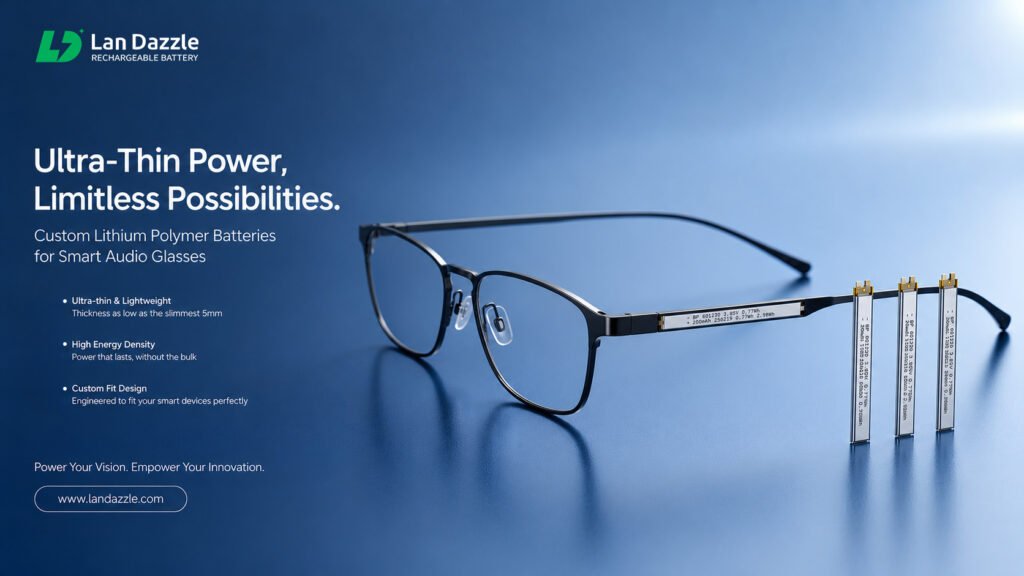
The broader lesson is that battery capacity and device efficiency need to be considered together. A higher-voltage cell may be helpful, but it cannot replace system-level power optimization.
3. Limitations and Engineering Challenges
Cycle Life and Long-Term Performance
Higher charging voltage can introduce additional electrochemical stress in certain lithium-ion battery chemistries. Depending on the materials and operating conditions, it can accelerate electrolyte decomposition and degradation of electrode materials.
These processes may lead to capacity loss, increased internal resistance, and shorter service life.
Nevertheless, it would be misleading to conclude that every high-voltage cell has a shorter cycle life than every conventional cell. Performance depends on the particular chemistry, electrolyte formulation, electrode design, charging current, temperature, and operating strategy.
Wearable devices also differ in their usage patterns. A fitness band that is charged frequently may have different lifetime requirements from smart glasses that experience repeated bursts of high power.
Charging Compatibility and Power Management
A high-voltage cell requires a charging system configured for its specified maximum charging voltage.
The charger IC, protection circuit, battery-monitoring system, and device electronics must all be compatible with the selected cell. A battery should never be charged above its manufacturer’s specified limit simply because a different charging profile is available.
Conversely, a charger with a lower voltage limit may leave a compatible higher-voltage cell partially charged relative to its intended full-charge condition.
Safety, Temperature, and Mechanical Protection
Wearable devices present additional design challenges because the battery is positioned close to the user and must fit within a compact enclosure.
Engineers need to consider charging temperature, operating temperature, mechanical protection, cell swelling, insulation, and the behavior of the battery protection system. Limited space can also make thermal management and component placement more difficult.
These considerations apply to conventional and high-voltage cells alike, although their specific requirements depend on the selected battery design. The research perspective Batteries for Wearables discusses the broader challenges of wearable battery development, including energy density, mechanical flexibility, and safety.
The appropriate approach is not to assume that higher voltage automatically makes a battery unsafe. Instead, engineers should verify that the cell, charging system, mechanical enclosure, and protection features are suitable for the intended application.
4. High-Voltage Batteries vs. Other Ways to Improve Wearable Battery Life
Increasing charging voltage is only one possible way to improve battery performance. Other design approaches may offer better results, depending on the device.
| Design Approach | Potential Benefit | Main Consideration |
|---|---|---|
| Higher-voltage cell design | May increase usable energy in a compatible cell | Charging compatibility and long-term aging |
| Higher energy-density cell | More energy within a given volume or weight | Chemistry, construction, and validation |
| Lower-impedance cell design | Better voltage stability under high loads | Required peak current and thermal performance |
| Lower device power consumption | Longer runtime without increasing battery size | Hardware and software optimization |
| Custom-shaped battery | Better use of available product space | Mechanical integration and manufacturing validation |
These approaches are not mutually exclusive. A product may benefit from a combination of suitable cell chemistry, efficient power management, and a battery shape designed around the available space.
5. How to Select a High-Voltage Battery for a Wearable Device
Selecting the right battery starts with the product’s requirements rather than a predetermined voltage target.
Define Power and Runtime Requirements
Determine the device’s average power consumption, peak power demand, and target operating time. Consider whether the product has intermittent high-power features, such as cameras, wireless transmission, or AI processing.
A suitable battery must support both the required energy and the necessary discharge performance.
Match the Cell to Available Space
Evaluate the maximum battery length, width, thickness, and weight allowed by the enclosure.
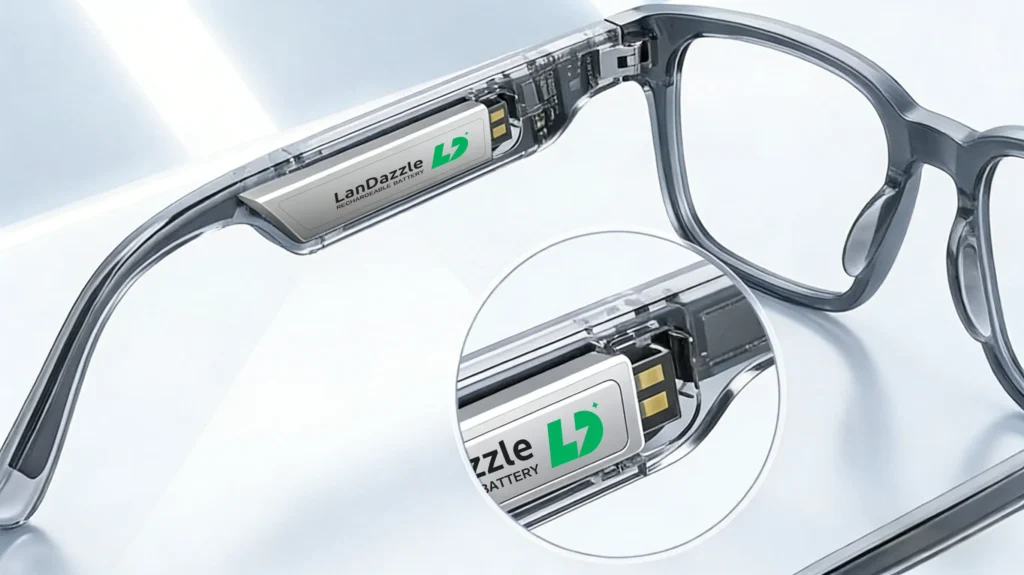
For smart glasses, the battery may need to fit into a narrow temple arm. For smart rings and other compact wearables, even small dimensional changes can affect internal component placement and product comfort.
Where standard cells cannot use the available space efficiently, a custom-shaped battery may be worth evaluating.
Verify Charging and Protection Requirements
Confirm the specified maximum charging voltage, compatible charger profile, discharge limits, temperature requirements, and protection-circuit configuration.
If the design uses a high-voltage cell, the complete charging and monitoring system must be validated for that cell.
Validate Before Mass Production
Prototype testing should cover relevant electrical, thermal, mechanical, and lifetime requirements. Depending on the application, this may include capacity testing, charge-discharge testing, temperature evaluation, and verification of the battery’s fit inside the finished product.
Validation should also confirm that the battery can be manufactured consistently at the required volume.
A successful design must work not only in the initial prototype but also across production batches and the intended service life of the device.
Conclusion: Design the Battery Around the Wearable
High-voltage lithium-ion cells can offer advantages for some wearable devices, but successful battery design requires more than a higher charging voltage.
Engineers must balance usable energy, battery dimensions, charging compatibility, cycle life, safety, and device-level power consumption. In many applications, improvements in cell construction and mechanical integration can be just as important as the voltage rating.
The most suitable battery is the one that meets the product’s electrical and mechanical requirements while remaining practical to validate and manufacture at scale.
Looking for a Battery Designed Around Your Wearable Product?
From ultra-thin cells to custom-shaped battery solutions, the right design starts with your device’s available space, energy requirements, and charging specifications. Share your design requirements with our engineering team to discuss a suitable custom battery solution.
Email: info@landazzle.com
Whatsapp: +8618938252128