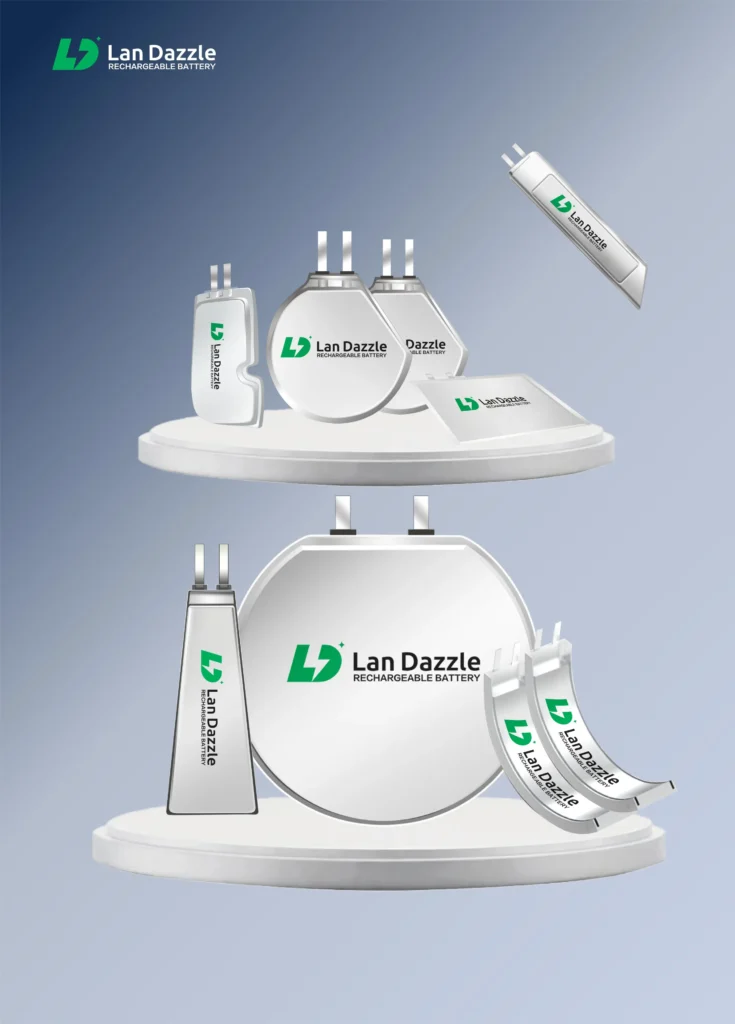
Mainstream Lithium Battery Chemistry Types
In today’s custom lithium battery market, there are four mainstream chemistry types, plus two special chemistries used for niche applications. In our daily production, over 95% of custom lithium battery orders are based on these chemistries.
1. Lithium Iron Phosphate (LFP)
LFP is the most common chemistry we use for industrial equipment and energy storage systems.
Its biggest advantage is high safety. It contains no cobalt or nickel, and its thermal decomposition temperature can reach around 800°C. Even under abuse conditions such as puncture or crushing, it is very unlikely to catch fire or explode.
LFP batteries also have long cycle life and relatively low cost.
The main drawback is medium energy density. For the same capacity, LFP batteries are usually larger and heavier than some other chemistries.
2. Ternary Lithium (NCM / NCA)
Ternary lithium batteries include Nickel Cobalt Manganese (NCM) and Nickel Cobalt Aluminum (NCA). They are widely used in consumer electronics and high-end energy storage.
Their key advantage is high energy density, which means more capacity in the same size. They also perform well at low temperatures.
For example, NCM811 cells can reach over 300 Wh/kg.
However, they have lower thermal stability compared to LFP and carry a higher risk of thermal runaway at high temperatures. In addition, their cost is more sensitive to cobalt and nickel price fluctuations.
3. Lithium Cobalt Oxide (LCO)
LCO was widely used in early smartphones, cameras, and small consumer electronics, but it is gradually being replaced by ternary lithium batteries.
It offers decent energy density and a high voltage platform, but it has clear disadvantages:
poor safety performance, short cycle life, and high material cost due to expensive cobalt.
4. Lithium Manganese Oxide (LMO)
LMO batteries are known for low cost, fast charging, and good low-temperature performance.
However, they suffer from short cycle life and rapid performance degradation at high temperatures. They are mainly used in low-end electric bicycles and power banks, where performance requirements are not very strict.
In custom battery projects, LMO accounts for a small share.
Special Chemistries for Niche Applications
Lithium Titanate (LTO)
LTO batteries have an extremely long cycle life, often exceeding 10,000 cycles, and excellent fast-charging capability.
The downside is very low energy density and high cost, so they are mainly used in special-purpose equipment.
Lithium Metal Batteries (Emerging Technology)
This is a new battery system with very high energy density and outstanding low-temperature performance. It can still operate at temperatures as low as -50°C.
At present, it is still in the early stage of mass production and is mainly used for polar exploration and other extreme environments.
Performance Comparison of Different Lithium Battery Chemistries
Choosing a battery chemistry is essentially a process of balancing performance trade-offs. Below, we compare the main lithium battery chemistries based on the five most important factors in custom battery design.
1. Energy Density Comparison
Energy density directly affects battery runtime and size, and is often the top concern for customers.
From highest to lowest:
- Lithium Metal Battery: 700 Wh/kg+ (laboratory data)
- Ternary Lithium (NCA / NCM): 200–350 Wh/kg
- Lithium Cobalt Oxide (LCO): 150–200 Wh/kg
- Lithium Iron Phosphate (LFP): 150–200 Wh/kg
- Lithium Manganese Oxide (LMO): 100–150 Wh/kg
- Lithium Titanate (LTO): 70–100 Wh/kg
Important note:
LFP and LCO have similar gravimetric energy density, but LFP has lower volumetric energy density. This means that for the same capacity, LFP batteries are usually slightly thicker than LCO batteries.
2. Safety and Thermal Stability Comparison
Safety is the baseline requirement, especially for industrial and medical devices where failure is not acceptable.
From highest to lowest safety:
- LFP
- LTO
- LMO
- LCO
- Ternary Lithium (NCM / NCA)
LFP performs extremely well in nail penetration, short-circuit, and thermal shock tests, with thermal runaway temperatures as high as 500–800°C.
In contrast, ternary lithium batteries can start decomposing and releasing gas at 200–300°C, increasing the risk of thermal runaway. Therefore, ternary lithium battery packs require more advanced protection design.
3. Cycle Life Comparison
Cycle life refers to the number of charge–discharge cycles until capacity drops below 80%, and it directly affects product lifespan.
From longest to shortest:
- LTO: 10,000+ cycles
- LFP: 2,000–3,000 cycles
- Ternary Lithium: 1,000–2,000 cycles
- LCO: 500–1,000 cycles
- LMO: 500–800 cycles
4. Discharge Rate and Power Capability
Discharge rate determines how much power a battery can deliver instantly, which is critical for applications like drones and power tools.
From strongest to weakest power capability:
- LTO
- Ternary Lithium
- LFP
- LMO
- LCO
5. Cost and Supply Chain Maturity
Cost (from low to high)
- LMO
- LFP
- Ternary Lithium (NCM523 < NCM622 < NCM811 < NCA)
- LCO
- LTO
- Lithium Metal Battery
Supply Chain Maturity
Custom lead times are usually longer
Most mature: LFP and ternary lithium
- Raw materials are easy to source
- Stable manufacturing processes
- Fast mass production
Moderate maturity: LCO and LMO
Some materials require advance stocking
Developing stage: LTO and lithium metal batteries
Supply chains are still improving
How to Choose the Right Lithium Battery Chemistry Based on Application Scenarios
After comparing performance, the most important step is matching the chemistry to the real application. This is also the core logic we use when recommending solutions to customers.
Different applications have different priorities—choosing the right chemistry helps balance performance and cost.
Applications That Prioritize High Energy Density
Examples include smartphones, smartwatches, drones, high-end laptops, and long-range electric passenger vehicles.
The core requirement is “small size, large capacity.”
The preferred choice is ternary lithium batteries, especially NCM811 or NCA, which offer very high energy density and help maximize runtime in limited space.
Applications That Prioritize High Safety and Long Service Life
Examples include energy storage systems (home storage and grid storage), industrial equipment, medical devices, and electric buses.
The core requirement is “safe, stable, and long-lasting.”
The best choice is lithium iron phosphate (LFP), thanks to its excellent thermal stability, long cycle life, and reliable performance over many years.
Space-Constrained or Irregular-Shaped Applications
Examples include smart glasses, smart rings, and irregular-shaped sensors.
The core requirement is “fit complex shapes and achieve ultra-compact size.”
The preferred options are ternary lithium batteries in pouch cell form or lithium cobalt oxide (LCO), which are easier to design into thin or custom shapes.
Special Environment Applications (Low Temperature / High Temperature)
Low-Temperature Environments
Examples include outdoor equipment operating at -40°C and polar exploration devices.
- Ternary lithium (NCM series) is usually preferred, as it can still maintain 70–80% discharge efficiency at -20°C.
- Lithium metal batteries perform even better and can operate normally at -50°C, making them suitable for extreme environments.
High-Temperature Environments
Examples include industrial equipment operating above 60°C.
- LFP is the best choice due to its excellent high-temperature stability and resistance to rapid performance degradation.
For low-temperature custom batteries, we don’t rely only on chemistry selection. We also optimize the electrolyte formulation to further improve low-temperature performance.
This system-level optimization is one of our key advantages as a battery manufacturer.
How Battery Chemistry Affects Custom Lithium Battery Design
Once the battery chemistry is selected, it has a direct impact on design and production. This is why, as a manufacturer, we always confirm the chemistry with customers early, to avoid design changes at a later stage.
Impact on Structure and Size Design
Different chemistries have different volumetric energy densities, which leads to different structural designs.
For example, lithium iron phosphate (LFP) has lower volumetric energy density. To achieve the same capacity, the battery must be larger in size or use stacked cell designs to improve space utilization.
In contrast, ternary lithium batteries have much higher volumetric energy density, making them ideal for ultra-thin, ultra-narrow, or irregular-shaped designs.
When we develop custom-shaped batteries, the chemistry directly guides the structural approach.
- Ternary lithium pouch cells can be folded or slightly bent, allowing them to fit complex and irregular spaces.
- LFP batteries are more suitable for prismatic or cylindrical formats, offering better structural stability.
Impact on BMS Design
The BMS (Battery Management System) is the “brain” of a custom battery pack.
Different chemistries require different protection thresholds and control algorithms.
- Ternary lithium batteries have lower thermal stability, so the BMS must include stricter protection for overcharge, over-discharge, and over-temperature. In many cases, thermal management features are also required.
- LFP batteries are inherently safer, allowing wider protection margins in the BMS design, which can help reduce overall system cost.
Impact on Testing and Certification
Battery chemistry also affects testing focus and certification requirements.
LFP batteries focus more on cycle life and high-temperature stability, and their certification process is generally simpler and more straightforward.
Ternary lithium batteries require more rigorous testing for thermal shock and short-circuit safety. For export markets, certifications such as UL and CE usually involve more test items.
Consultation & Contact CTA
If you’re still unsure which lithium battery chemistry is right for your application after reading this guide, or if you have specific custom requirements—such as irregular shapes or special environmental conditions—feel free to contact us directly.
As a professional custom lithium battery manufacturer with over 10 years of experience in chemistry selection and battery production, we can recommend the most suitable solution based on your application scenario, performance requirements, and budget.
We also offer free chemistry selection consultation and sample testing services to help you validate the solution before mass production.
👉 Contact us today to get your customized battery solution.
Email: info@landazzle.com
Whatsapp: +8618938252128