Custom lithium battery have evolved from “supplementary accessories” into “core energy solutions” that support high-end equipment and applications in extreme environments. Whether they are worth investing in depends on how well they match real use scenarios.
Is a custom lithium battery worth it?
Scenarios where investment is worthwhile:
Custom lithium batteries are a strong choice when devices have irregular or limited internal space, operate under extreme conditions (such as –40°C cold or temperatures above 60°C), or require clearly higher standards for battery life and safety. If production volume is large enough to offset customization costs, the benefits of custom batteries can clearly exceed those of standard batteries.
Scenarios requiring caution:
For common consumer electronics and standardized industrial equipment with mature supply chains, off-the-shelf batteries usually offer a clear cost advantage. In these cases, the performance gains from customization are often limited, and custom batteries may lead to a high-cost trap rather than real value.
What Is a Custom Lithium Battery?
A custom lithium battery is not just a simple change in size or capacity. It is a fully customized solution that covers the entire process—from cell material selection and BMS algorithm design to thermal management and structural design—to meet non-standard requirements.
Physical customization:
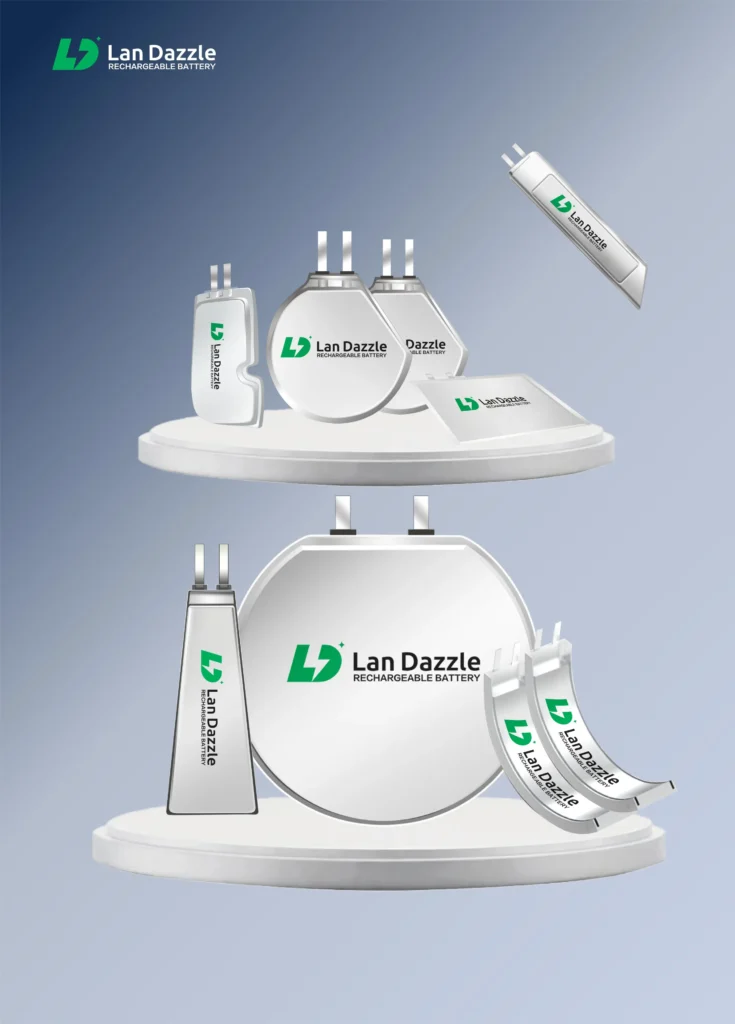
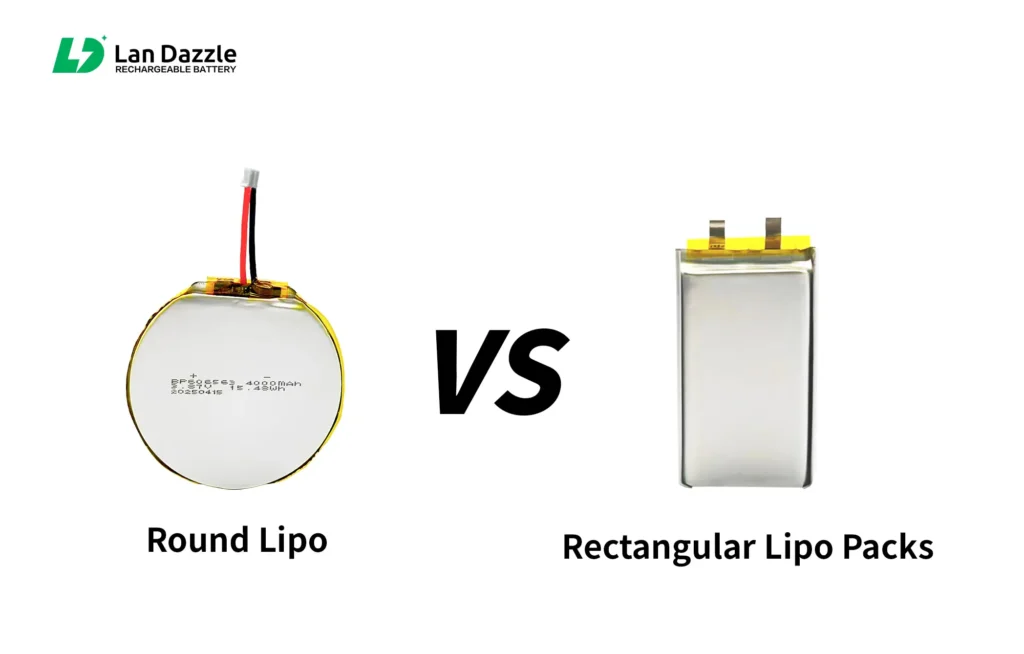
This focuses on fitting batteries into irregular spaces or meeting special weight and balance needs. Cell size and pack structure can be redesigned, such as ultra-thin pouch cells or special-shaped packs (ring-shaped, heart-shaped, etc.). The main goal is to solve the problem that standard batteries cannot fit into the device.
For example, LanDazzle offers custom-shaped battery solutions that can increase space utilization from about 70% to over 90%, making them suitable for smart wearables, implantable medical devices, and other compact applications.
Chemical customization:
By selecting or adjusting electrode materials and electrolyte formulas, custom batteries can achieve higher energy density, better low- or high-temperature performance, or longer cycle life. This helps batteries work reliably in extreme environments where standard batteries fall short.
BMS customization:
A custom BMS allows more accurate monitoring, better cell balancing, and tailored protection settings. This ensures the battery matches the device’s actual load and usage patterns, something standard BMS solutions often cannot do well.
Cost
Unit price and MOQ:
Standard batteries benefit from mass production, so their costs are relatively low. Custom batteries usually have higher unit prices because R&D costs are shared across the order. Prices vary greatly by capacity. For example, a 12V 10Ah battery from one supplier may cost about $70–$115, a 20Ah version $130–$215, and a 50Ah version $430–$570.
For small orders, the unit cost is even higher. For instance, a 650mAh Li-polymer battery for electric devices may be priced at $1.90 per piece for orders of 10–99 units, but drop to $1.70 per piece when the order volume increases to 1,000–4,999 units. In general, custom battery projects usually require a minimum order quantity (MOQ) of several hundred to several thousand units. Deeper customization depends on the level of investment and negotiation. Suppliers typically offer tiered discounts as order volume increases.
Development, certification, and tooling costs:
Custom batteries require upfront investment in design, prototype development, tooling, and certification testing. These are usually one-time but significant costs. Industry experience shows that custom housings or molds can cost tens of thousands of dollars, while certifications (such as IEC 62133, UN38.3, UL2054, etc.) may range from tens of thousands to hundreds of thousands of dollars, depending on how many certifications are needed.
These fixed costs must be spread across each battery unit, which can greatly increase the unit price for small production volumes.
Performance and Specifications
Energy density:
Custom batteries can use specific chemistries (such as high-nickel NMC or LFP) and optimized cell shapes to improve energy density or discharge rate. Standard batteries usually use general-purpose cells, which limits both energy density and power output. With custom batteries, voltage and capacity can be precisely matched to the available space and required runtime, and either high-energy or high-power cells can be selected to meet performance needs.
Cycle life:
Typical NMC batteries offer around 1,000 cycles at 80% depth of discharge, while LFP cells can reach 4,000+ cycles. Custom solutions allow manufacturers to choose the cell chemistry based on lifespan requirements. In high-end projects, system-level optimization and advanced BMS control can further extend battery life, reducing replacement costs.
Temperature range:
Custom batteries can use low-temperature active materials and even built-in heating systems to expand the operating temperature range. For example, some suppliers have developed battery packs with automatic heating for cold Nordic climates. Standard batteries have limited performance in extreme temperatures.
Size and weight optimization:
Custom battery packs can be designed to fit specific shapes and tight spaces, improving space utilization. Standard batteries are usually limited to common, fixed sizes.
BMS integration:
Custom solutions typically include a dedicated BMS with precise monitoring and cell balancing. Standard battery BMS functions are more basic and mainly focus on protection. Many suppliers offer one-stop solutions, integrating cells, circuitry, BMS, and housing into a finished battery module.
Analysis of Custom Battery Application Scenarios
Whether a custom battery is suitable does not depend on whether it can be made, but on whether the project truly needs to pay extra cost for performance, structure, or environment.
In general, products with irregular space, special performance needs, harsh environments, or high reliability requirements are more suitable for custom batteries. Products that are standardized, cost-sensitive, and can be well served by common batteries or modules are better suited for standard solutions.
1. High-fit scenarios
These cases usually involve one or more of the following: limited space, special shape, high performance demand, long battery life requirement, or high safety standards. In these situations, custom batteries bring clear value.
1) Devices with special shapes
Examples: smart rings, curved wearables, ultra-thin devices, custom-shaped tools.
These products often have irregular internal space, so standard batteries do not fit well or waste space. Custom batteries can be designed to match the structure and improve space usage.
2) High-performance mobile devices
Examples: drones, robots, portable testing devices, high-power hand tools.
These products need high discharge power and long runtime. Standard batteries may work, but not optimally. Custom batteries can be designed for higher power output, lighter weight, and better capacity matching.
3) Devices in extreme temperature environments
Examples: outdoor monitoring devices, cold-chain systems, cold-region equipment, extreme environment sensors.
Standard batteries often lose performance in low temperatures or unstable conditions. Custom batteries can improve low-temperature performance or high-temperature stability through material and design optimization.
4) Medical and high-reliability devices
Examples: portable medical devices, monitoring systems, diagnostic tools, emergency power systems.
These products require high safety, stability, and long life consistency. Custom batteries can be matched to the device’s usage pattern to reduce failure risk.
5) Long-life cycle products
Examples: industrial equipment, professional instruments, branded devices.
If a product is used for many years, battery replacement and downtime costs become important. Custom batteries can reduce long-term total cost.
6) Products with brand differentiation
Examples: consumer electronics, wearables, smart devices.
Battery performance can directly affect user experience, such as thinner design, lighter weight, or longer battery life, helping product differentiation.
2. Low-fit scenarios
These cases usually have the following features: standard size is enough, cost is the priority, or product changes quickly. In these situations, custom batteries are often not cost-effective.
1) Standardized products
Examples: common consumer electronics, standard handheld devices, fixed-size lighting products.
If standard batteries already fit, customization is usually unnecessary.
2) Cost-sensitive products
Examples: low-price consumer goods, highly competitive generic devices.
Custom batteries add extra costs such as design, testing, and certification, which may not be worth it.
3) Low power devices
Examples: basic sensors, simple remote controls, low-power electronics.
Standard batteries are already sufficient, with no clear benefit from customization.
4) Fast-changing products
Examples: short lifecycle electronics, fast-updating consumer products.
Custom battery development takes time, and the product may change before the investment is recovered.
5) Small and unstable demand projects
Examples: prototypes, early-stage samples, or uncertain small batches.
If specifications are not fixed, customization may lead to repeated changes, higher cost, and longer lead time.
Our Custom Battery Solutions
LanDazzle provides custom lithium battery solutions designed around your product, not the other way around. Whether your project requires an ultra-thin battery, a curved battery, a low-temperature battery, or a high-performance battery pack, we help you turn complex power requirements into reliable, manufacturable solutions.
From cell selection and structural design to BMS integration and safety testing, our team supports every stage of development. We focus on improving energy density, fitting limited installation space, enhancing battery life, and ensuring stable performance in demanding applications. Our custom battery solutions are widely used in drones, robots, wearable devices, medical equipment, smart hardware, and other advanced electronics.
If standard batteries cannot meet your needs, a customized solution may be the most efficient way to achieve better performance, better fit, and better product differentiation.
Email: info@landazzle.com
Whatsapp: +8618938252128