The pouch battery packaging process includes four steps: top sealing, side sealing, vacuum sealing and degassing. The process sequence is shown in the figure below.
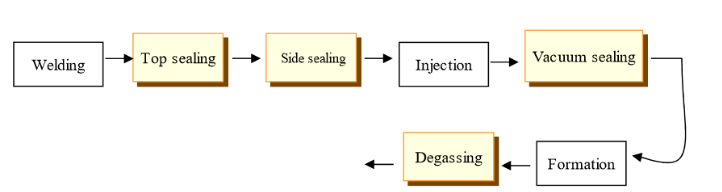
Brief introduction to functions of each sealing process
Top sealing & Side sealing
After tab welding, the cell is placed into the pocket and fixed on fixtures. Top and side sealing are conducted by sealing equipment.
Tabs of bare cells are coated with sealant. This material has similar properties to polypropylene and can fuse with it. During top sealing, tabs are tightly sealed inside the pocket via fusion of sealant and polypropylene. Other top areas and side edges get sealed through polypropylene bonding.
Vacuum sealing
Two openings of the pocket are sealed after top and side sealing, leaving one opening beside the air bag.
Electrolyte is injected into cells in dry room, followed by vacuum standing. To isolate cell interior from external environment during formation and subsequent processes, the last opening is sealed under vacuum. This step is vacuum sealing.
Degassing
Gas generates inside cells during formation and baking due to SEI film formation. Excess gas will degrade cell performance during charge and discharge. Internal gas needs to be exhausted. Final sealing of the pocket is finished under vacuum condition. This procedure is degassing.
Common Causes and Effects of Pouch Battery Packaging Defects
Defects in any sealing process may cause electrolyte leakage, cell swelling and performance deterioration.Sealing failure means the polypropylene layer or sealant fails to bond tightly, resulting in separation of the aluminum laminate film. This lets air and outside substances get inside the cell.
Top sealing & Side sealing
Two main factors lead to liquid leakage from faulty top sealing. Insufficient temperature is one reason, as tabs and sealant require relatively high sealing temperature. Contaminants on sealing surfaces are another cause.
There are two bonding types: polypropylene to polypropylene, and polypropylene to sealant. Poor bonding often occurs at polypropylene-sealant joints, causing electrolyte leakage during subsequent baking.
Vacuum sealing
Defective vacuum sealing allows moisture and oxygen to enter the cell. It deteriorates electrolyte quality and impairs cell formation, capacity and cycle performance.
Degassing
Degassing is the final sealing step. Cells are nearly finished before subsequent performance tests. Any sealing defect causing swelling or leakage will only be found by end users and damage brand reputation.
Unlike faults from top, side and vacuum sealing that can be detected during baking and production, degassing issues are hard to spot early. This critical step has frequent failure risks.
Before degassing, polypropylene material has long been soaked in electrolyte, and electrolyte may degrade after activation. Sealing is done after high-vacuum air extraction, making bonding difficult. Minor abnormalities will trigger sealing defects.
Cell Swelling
Polymer lithium-ion cells adopt soft packaging with aluminum plastic film. Abnormal chemical reactions inside generate gas, inflating the pocket and causing cell swelling, which can be slight or severe. Regardless of appearance, key performance including capacity, cycle life and discharge rate drops sharply, making the cell unusable. Swelling may emerge during production, or be found by clients and end users.
A small amount of gas is normally produced during formation and baking, which will be removed in the degassing process.
Causes of gas generation
- Poor sealing: Sealing defects on any edge trigger swelling, mostly occurring in top sealing and degassing. Defective tab sealing happens in top sealing, and layer separation appears in degassing. External moisture penetrates through gaps and decomposes electrolyte to produce gas.
- Pocket damage: Unintended impact or artificial damage during handling creates tiny holes on the film, letting moisture get inside the cell.
- Excessive internal moisture: Too much moisture damages electrolyte and generates gas after formation and degassing. Main reasons include unqualified electrolyte moisture, excessive water content of bare cells after baking and high humidity in dry room.
- Abnormal formation procedure: Wrong formation parameters lead to cell swelling.
- Unstable SEI film: Mild swelling occurs during charge and discharge tests.
- Overcharge and overdischarge: Severe swelling happens when cells are charged above 4.5V or deeply discharged.
- Short circuit: Accidental contact of two live tabs causes short circuit. The cell swells rapidly with voltage dropping fast and tabs burnt black.
Conclusion
As discussed above, pouch battery packaging defects are not caused by a single factor, but by the combined effects of materials, process parameters, environment control, and manufacturing consistency. In real production, even minor deviations in sealing temperature, pressure, vacuum level, or moisture control may lead to irreversible defects such as electrolyte leakage, swelling, or premature performance failure. More critically, some sealing issues—especially degassing-related defects—are extremely difficult to detect during early production stages and often surface only after the product reaches end users.
For device manufacturers, this means that pouch battery packaging is not just a manufacturing step, but a core reliability challenge. Standardized processes and off-the-shelf cells are often insufficient for applications that require custom shapes, tight internal spaces, or strict safety and lifespan requirements. In such cases, packaging reliability depends heavily on the manufacturer’s ability to optimize sealing design, material compatibility, and process control for each specific application
In actual production, we apply strict process control and quality monitoring to key steps such as top sealing, side sealing, vacuum sealing, and degassing. This helps minimize potential packaging failure risks and prevents hidden defects that could lead to later swelling, electrolyte leakage, or performance degradation.
Especially for custom-shaped pouch batteries and high-reliability applications, the stability of the packaging process directly determines cell safety and service life.
If you are developing custom-shaped batteries, curved batteries, or non-standard size pouch cells, we welcome you to discuss your specific requirements with our engineering team.
Email: info@landazzle.com
Whatsapp: +8618938252128