Wearable robotic exoskeletons have made great progress in mechanical design, sensors, and control systems. However, weight, wearing comfort, and heat management remain major challenges for real-world applications.
For robots that fit closely to the human body, the battery is more than just a power source. It is a key component that directly affects ergonomics, movement performance, and user safety.
How can engineers balance battery capacity, shape flexibility, and safety within limited space? This article explores solutions for wearable robotic exoskeleton power systems from three engineering perspectives: structural design, battery form factors, and thermal management.

How Standard Batteries Limit Wearable Robotic Exoskeleton Design
The main goal of an exoskeleton robot is to assist human movement, not add extra burden. However, the rigid rectangular shape of traditional battery packs often creates several ergonomic problems that affect the overall system design.
1. Affecting Biomechanics and Increasing Moment of Inertia
The human waist, outer thigh, and shoulder areas all have complex curved surfaces. When engineers mount a heavy rectangular battery pack (for example, around 1.5 kg) on the back of the waist or the side of the thigh, the battery’s center of mass moves away from the body’s natural movement axis.
This greatly increases the system’s moment of inertia.
The effect can be explained by the rigid body rotation formula:
Because the distance from the rotation axis (r) is squared, even a small increase in distance can significantly increase rotational inertia.
During leg swings or upper-body rotation, the extra inertia forces the joint motors to produce higher peak torque to overcome the resistance caused by the battery’s movement.
This creates a negative cycle:
A heavier battery requires stronger motors, but larger motors consume more power and require a larger battery capacity, which further increases system weight.
2. Hidden Space Waste Caused by Low Volumetric Efficiency
To fit a rectangular battery into the curved structure of an exoskeleton, mechanical engineers often have to leave large amounts of unused space, also known as dead space.
This inefficient design not only makes the device housing bulkier and less attractive, but also increases the risk of collisions in narrow environments, such as hospital corridors or home rehabilitation areas.
As a result, the overall wearing experience and practical usability of the exoskeleton are significantly reduced.
Form Factor Redesign: System-Level Benefits of Custom-Shaped Battery Cells
The key breakthrough lies in shifting the design philosophy from “adapting the product around the battery” to “designing the power source around the human body.”
1. Curved and Segmented Battery Architectures
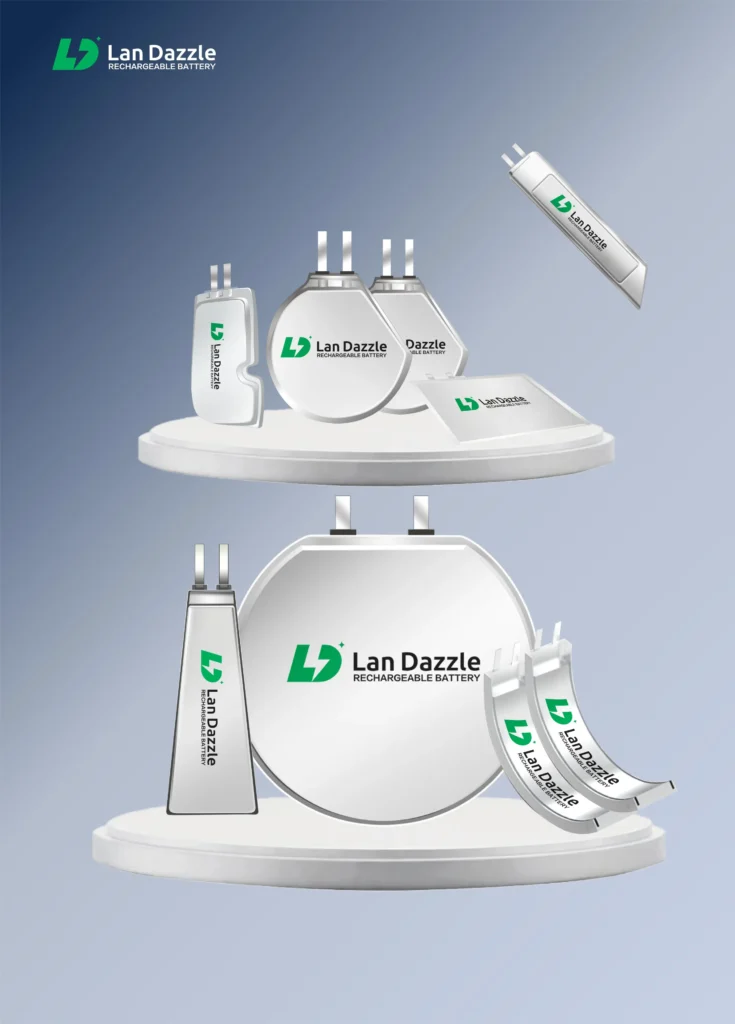
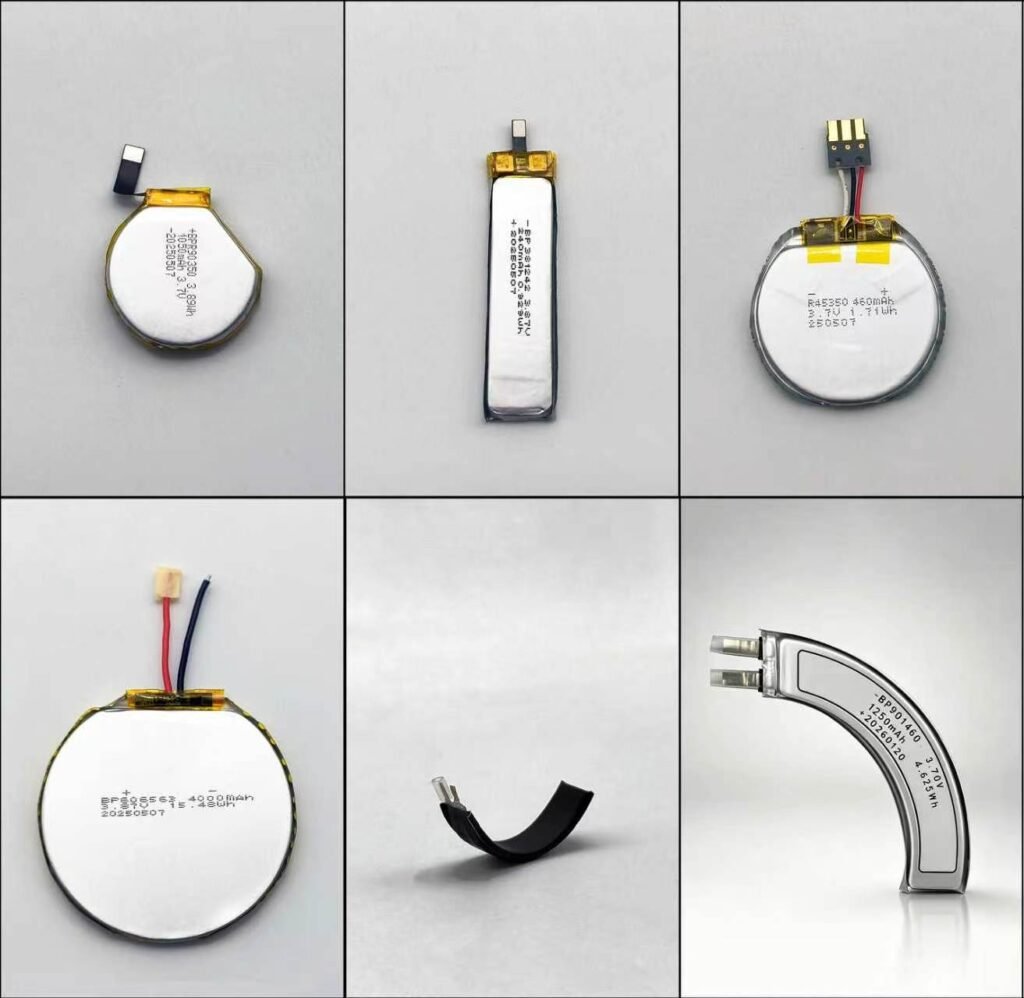
Using stacking technology, curved or trapezoidal pouch cells can be directly integrated into the structural frame of wearable exoskeletons, such as hip belts or leg support assemblies.
Ergonomic Curvature Matching:
The battery arc radius can be customized to match the natural curvature of the human waist and body structure. This allows the battery pack thickness to be reduced from approximately 45 mm to less than 18 mm, while bringing the center of gravity closer to the body’s central axis for improved wearing comfort and balance.
Segmented Distributed Battery Layout:
A total 36V/10Ah battery pack can be divided into multiple compact battery modules connected through flexible printed circuits (FPCs). These distributed battery nodes can be embedded along the hollow sections of the structural support frame, maximizing space utilization while improving mechanical integration.
2. Positive Engineering Feedback Loop
When the battery system geometry closely follows the human body’s contours, it creates a positive engineering feedback loop:
Custom-Shaped Battery Design
↓
Optimized Mass Distribution
↓
Reduced Moment of Inertia (J)
↓
Lower Peak Torque Requirement (τ)
↓
Smaller Motor & Gearbox
↓
Lighter Exoskeleton System
By optimizing the battery pack geometry and moving the waist-mounted battery pack’s center of gravity 35 mm closer to the body’s central axis, real-world testing shows that peak motor power consumption during level walking gait cycles can be reduced by approximately 12%–15%.
As a result, overall system efficiency improves, extending operating time and battery runtime despite using the same battery capacity.
Thermal Runaway Prevention and Mechanical Safety Design
In consumer electronics such as smartphones, battery heat generation may mainly result in user discomfort. However, for medical exoskeletons that are tightly attached to patients with mobility impairments, a battery failure involving thermal runaway could have far more serious consequences.
Therefore, the safety design of body-worn power systems must follow an extreme-case protection philosophy: the system should be designed under the assumption that an individual cell may eventually experience an internal short circuit.
For medical exoskeletons, battery safety must be designed under extreme failure conditions. A multi-layer protection strategy is required, including directional thermal management, pressure relief pathways, and mechanical impact protection. Insulation materials can block heat transfer toward the body, while controlled venting directs high-temperature gases away from the user. Reinforced battery enclosures further protect cells from impact, deformation, and leakage during operation.
Medical-Grade Compliance: Planning Certification Requirements Early in Design
Many hardware startup teams only begin considering third-party certifications when their products enter the NPI (New Product Introduction) stage. However, if the battery fails safety testing at this point, the entire enclosure design and tooling may need to be redesigned or even scrapped.
For wearable robotic systems, the following three standards should be included in the R&D checklist from the early concept design stage:
| Certification Standard | Key Test Requirements | Engineering Design Strategy |
|---|---|---|
| IEC 62133-2 | Safety requirements for portable sealed secondary cells and battery packs, including overcharge, external short circuit, and thermal abuse tests | The BMS (Battery Management System) should include dual hardware-level over-current and over-voltage protection circuits, instead of relying only on software control through a single MCU. |
| UL 1642 / UL 2054 | Fire and explosion safety validation for cells and consumer/medical battery packs | Select high-safety cells with built-in PTC (Positive Temperature Coefficient) and CID (Current Interrupt Device) protection. The battery enclosure should also meet V-0 flame retardant requirements. |
| ISO 14971 | Risk management requirements for medical devices and power systems | Establish a complete battery traceability system and integrate SOH (State of Health) monitoring algorithms to detect battery aging risks in advance. |
Conclusion
The future of wearable robots and medical exoskeletons depends on creating a truly seamless user experience. At its core, this is an engineering challenge of balancing centimeters and grams — maximizing available space while minimizing unnecessary weight.
Upgrading the power system from an off-the-shelf component to a custom-engineered battery solution may require additional upfront investment, such as NRE (Non-Recurring Engineering) costs. However, the long-term benefits are significant.
A customized battery architecture not only gives mechanical engineers greater freedom in system design and reduces the load requirements of the drive system, but also provides a solid foundation for passing strict medical certifications and ensuring patient safety.
Looking for a battery solution optimized for your wearable robotic system?
Contact LanDazzle’s battery engineering team to explore custom-shaped LiPo battery solutions designed for compact, lightweight, and medical-grade applications.
Email: info@landazzle.com
Whatsapp: +8618938252128