
Table of Contents
The answer is yes—but not for every ultra-thin battery.
The biggest value of a silicon-carbon anode is not simply making a battery “thinner.” Instead, it can potentially store more energy within a fixed battery volume when the available space is already limited.
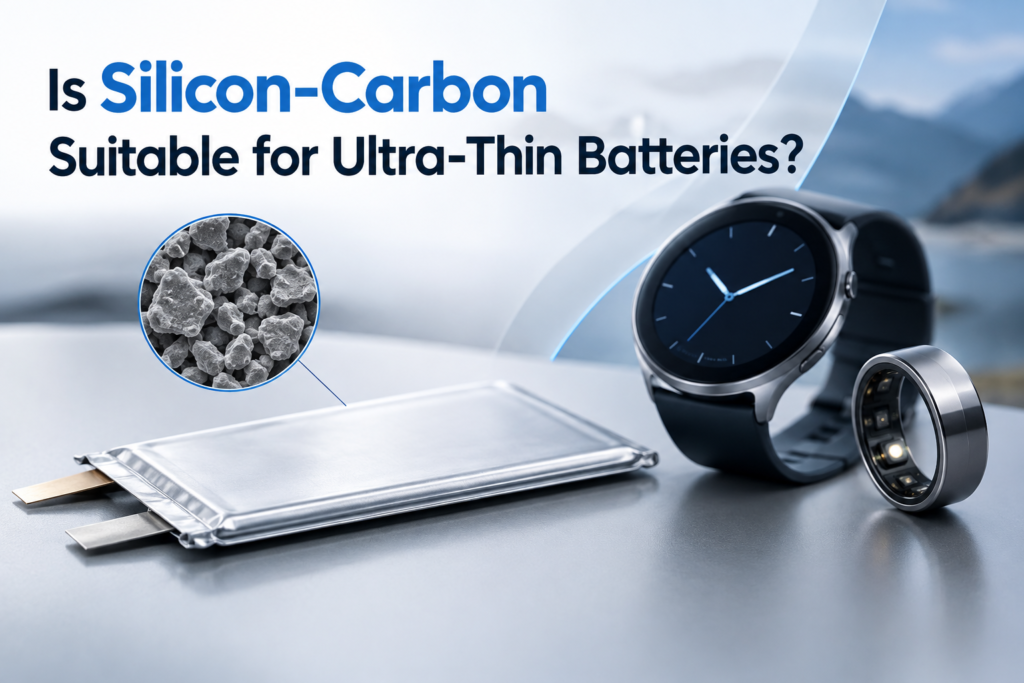
For wearable devices such as smartwatches and smart glasses, which require longer runtime but still have some available thickness, silicon-carbon technology shows clear potential.
However, once a cell approaches 1 mm or even 0.5 mm in thickness, the situation becomes much more complicated. Packaging, separators, current collectors, and other non-active components can already occupy a significant portion of the available thickness. At the same time, silicon expansion becomes more difficult to manage.
More importantly, there is still very limited public evidence combining a commercial silicon-carbon anode, a truly sub-1 mm pouch cell, and long-term cycle-life and expansion data.
Why Is Silicon-Carbon Attracting So Much Attention?
The basic reason is easy to understand. Conventional lithium-ion batteries mainly use graphite as the anode material. Graphite has a theoretical specific capacity of about 372 mAh/g, while silicon can theoretically reach approximately 3,579–4,200 mAh/g. At the material level, silicon can therefore store far more lithium than graphite.
This means that when the battery compartment of a wearable device cannot become larger, increasing the energy stored by the anode material could make it possible to achieve higher capacity without increasing the battery’s overall size.
That is one of the main reasons silicon-carbon technology has attracted attention.
But there is an important point that is often overlooked:
A material’s high specific capacity does not mean the final cell will gain capacity by the same proportion.
The Biggest Challenge for Ultra-Thin Batteries May Not Be the Anode
When people talk about ultra-thin batteries, they often focus only on the active electrode materials and overlook a very practical issue:
Not all of a battery’s thickness comes from energy-storing materials.
A pouch cell also needs packaging film, separators, current collectors, and other structural components.
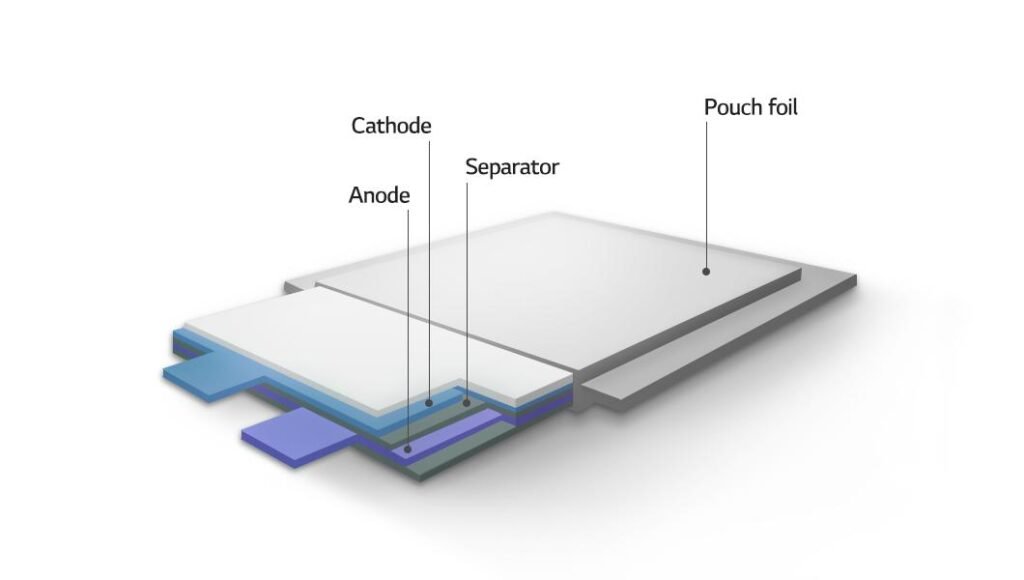
According to publicly available patent data reviewed in the research report, the combined thickness of the pouch packaging layers can reach 200–600 μm, while separators are typically around 15–25 μm thick. Current collectors also consume part of the thickness budget.
This becomes increasingly important as the target cell thickness drops from several millimeters to around 1 mm. Imagine a battery with a total thickness of only 1 mm. A few hundred micrometers of packaging material can already consume a substantial share of the available space.
In other words:
The thinner the battery becomes, the larger the share of the total thickness occupied by fixed, non-active components. This leaves less room for the active electrode layers.
That is why the fact that silicon has a theoretical capacity several times higher than graphite does not mean that an ultra-thin battery will automatically gain several times more capacity.
The Bigger Problem: Silicon Expands
Silicon has another major technical challenge.
During charging and discharging, silicon undergoes significant volume changes. Many studies cite a volume expansion of around 300% for silicon, compared with roughly 10% for graphite. Research published in the Journal of The Electrochemical Society has also shown that adding silicon to graphite can increase capacity, but electrode thickness changes become more significant as silicon content increases. (TUM study)
This is already a challenge for conventional battery cells. For ultra-thin batteries, it can become even more critical.
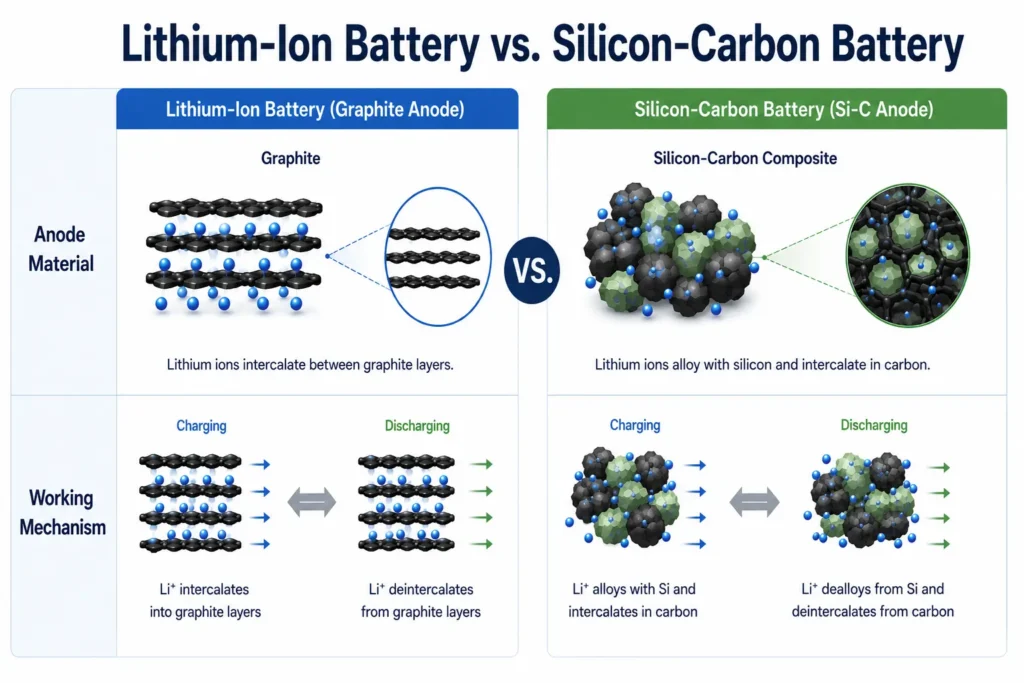
An ultra-thin cell has very little room to accommodate dimensional changes. If the electrode expands repeatedly, it can affect the cell’s dimensions, internal contact between components, mechanical pressure, and cycle life.
A 2024 study published in the Journal of The Electrochemical Society found that mechanical pressure can significantly affect the thickness and porosity of silicon anodes. Under the tested conditions, excessive pressure could even shorten cycle life. (Journal of The Electrochemical Society)
Another 2023 study published in Energy & Fuels investigated silicon-composite pouch cells under external mechanical pressure and showed that pressure management is not simply a case of “more pressure is always better.” (Energy & Fuels)
This creates a very real engineering trade-off for wearable devices:
Silicon requires better expansion management, while wearables also demand batteries that are thinner, lighter, and often more flexible.
High Energy-Density Numbers Cannot Be Applied Directly to Every Battery
Academic research has already demonstrated that silicon-based anodes can enable very high volumetric energy density. For example, a 2021 study published in National Science Review used a carbon-encapsulated silicon microparticle anode and reported a volumetric energy density of up to 1,048 Wh/L in a full cell. (PubMed)
Another study using nanostructured silicon anodes with NMC cathodes achieved 806 Wh/L at the multilayer pouch-cell stack level. (Journal of The Electrochemical Society)
These results demonstrate that silicon-based anodes have real potential to increase the volumetric energy density of lithium-ion cells. However, these numbers should not be interpreted as meaning that ordinary ultra-thin batteries can also achieve 800–1,000 Wh/L.
The experimental systems used different silicon structures, cathode chemistries, areal loadings, cell dimensions, N/P ratios, and packaging designs. It is therefore essential to distinguish between material-level, electrode-level, and full-cell-level performance.
This is one of the easiest mistakes to make when evaluating silicon carbon for ultra-thin battery.
There Is Another Potential Advantage: Fast Charging
Silicon-carbon is not only about higher capacity.
A 2023 study by researchers at Argonne National Laboratory investigated how silicon content affects the fast-charging behavior of silicon-graphite composite anodes. The study found that, under certain conditions and silicon contents, adding silicon could improve high-rate charging performance and reduce some lithium-plating risks. At the same time, the researchers also observed a trade-off with long-term degradation caused by silicon-electrolyte side reactions. (Batteries)
For some wearable devices, this could be more useful than simply increasing battery capacity.
For example, a wearable battery does not necessarily have to increase from 20 mAh to 30 mAh. If it can instead recover a meaningful amount of energy in a much shorter charging period, that could also improve the real-world user experience.
So the value of silicon-carbon may not be limited to:“More capacity.”
It could also mean:“The same space + more energy + faster recharge.”
So Which Ultra-Thin Devices Are Better Candidates for Silicon-Carbon?
Based on the currently available public research, the answer depends more on the product’s mechanical structure than on battery thickness alone.
For smartwatches and smart glasses, the device enclosure is generally more rigid and may provide some mechanical support. These products may therefore have an easier time accommodating expansion-management structures, making it easier to realize the benefits of silicon-carbon.
For smart rings, flexible patches, and extremely thin devices, the challenge is greater.
When a cell approaches the sub-millimeter range, a large portion of the total thickness may already be consumed by packaging and separators. In that situation, the high specific capacity of silicon may not translate efficiently into a cell-level advantage.
More importantly, current academic research contains very limited evidence on sub-1 mm silicon-carbon pouch full cells with long-term cycle-life and expansion data. In other words, this is not a question that has already been fully validated by the research community. There is still a clear evidence gap.
One More Distinction Matters: Thin-Film vs. Ultra-Thin Pouch Cells
There is another important distinction that is often overlooked. When people talk about “thin batteries,” they may actually be referring to two very different technologies: thin-film batteries and ultra-thin pouch cells.
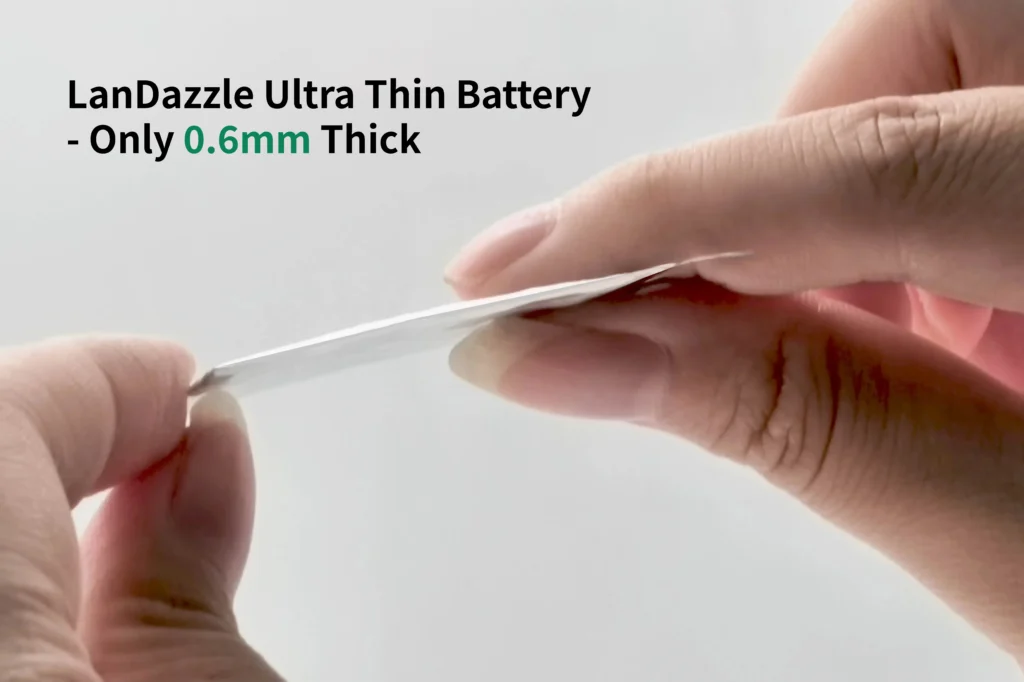
These are not simply two versions of the same battery with different thicknesses. Thin-film batteries generally use a very different manufacturing approach, while millimeter-scale pouch cells used in wearable devices remain based on conventional lithium-ion battery architectures.
According to the research report, current silicon-carbon research is focused primarily on the latter rather than on typical micrometer-scale thin-film batteries. Confusing these two technologies can lead to misleading conclusions about what silicon-carbon can actually achieve in an ultra-thin wearable battery.
The Final Answer
So, is silicon-carbon suitable for ultra-thin batteries?
The answer is not simply “yes” or “no.”
A more accurate conclusion is:
When the main limitation is the need to store more energy within a fixed volume, silicon-carbon has significant potential. But when the battery becomes so thin that packaging, mechanical constraints, and expansion management become the dominant limitations, the advantages of silicon-carbon may become much smaller.
For this reason, the future of ultra-thin batteries may not depend only on which anode material is used. The bigger challenge is likely to be how engineers combine electrode materials, electrode thickness, packaging, expansion control, and overall cell architecture into one optimized design.
For wearable devices, the more useful question may not be:“Can silicon-carbon make the battery thinner?”
but rather:“Can silicon-carbon put more usable energy into the same ultra-thin space?”
Designing a next-generation wearable?
Let’s explore how silicon-carbon technology can fit your battery’s size, thickness, and performance requirements.
Email: info@landazzle.com
Whatsapp: +8618938252128