Table of Contents
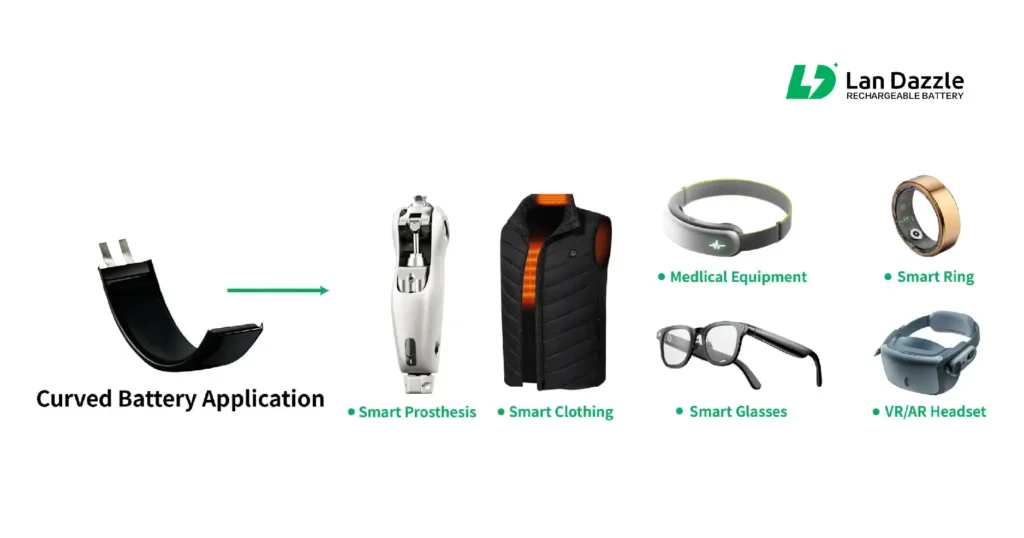
In smart wearables and portable medical device engineering, “dead space is the ultimate enemy of battery life.” Modern hardware—such as AI smart glasses, smart rings, ergonomic wristbands, and medical patches—is rapidly abandoning flat, boxy enclosures in favor of sleek, body-contoured designs. However, traditional flat lithium polymer batteries sit awkwardly at a tangent inside curved cavities, leaving substantial unusable voids. This physical conflict between form factor and energy capacity forces OEMs into frustrating compromises: sacrifice sleek industrial aesthetics or endure abysmal battery runtime.
Why Curved Enclosures Require More Than Standard Rectangular Batteries
Industrial Designers (IDs) prioritize ergonomics and sleek silhouettes, while Mechanical Engineers (MEs) and Electrical Engineers (EEs) face tight internal stacking constraints.
- Dead Space Accumulation: In highly curved cavities (e.g., smart ring bands or smart glasses temples), rectangular cells occupy only the center, leaving 30%–40% of irregular dead space along the edges.
- Volumetric Energy Density Collapse: Unfilled voids drastically reduce system-level volumetric efficiency (Wh/L).
- Zero-Sum Trade-off: Adding 2 hours of battery life often means thickening the enclosure, destroying product aesthetics and wearing comfort.
3 Battery Form Factors for Curved and Space-Constrained Devices
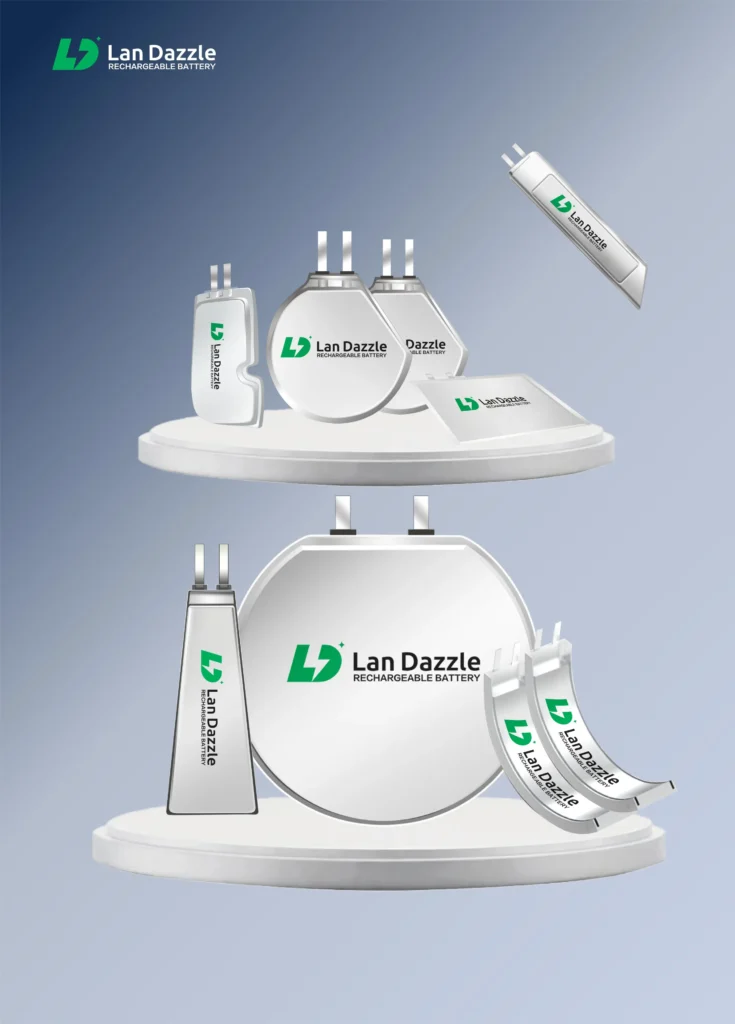
To solve power constraints in non-rectangular spaces, the industry relies on three main battery form factors:
| Evaluation Dimension | Traditional Flat LiPo | Segmented / Stepped Battery | True Curved LiPo Battery |
| Cavity Space Utilization | < 60% (Significant dead space) | 70% – 80% (Stepped transitions) | > 90% (Seamless wall contouring) |
| Exterior & Thickness Impact | Requires thicker housing; rigid design | Noticeable step bumps; internal machining | Smooth profile; enables ultra-thin builds |
| Internal Stress & Safety | Zero bending stress | Stress concentration at step joints | Molded stress relief; highly stable |
| Capacity Gain (Same Volume) | Baseline (100%) | +15% to +25% boost | +30% to +50% boost |
| Application Alignment | Boxy consumer electronics | Roughly contoured devices | Smart rings, AR/AI glasses, wristbands |
How Curved LiPo Battery Reduce Stress and Improve Energy Density
A curved battery is not simply a standard cell bent by force. It requires specialized electrochemical and packaging innovations.
Aluminum Laminated Film Pre-Shaping & Stress Relief
Forcing a standard cell to bend causes wrinkles in copper/aluminum foils, separator buckling, or internal micro-shorts. True curved LiPo cells undergo 3D film pre-shaping in dedicated molds prior to sealing, combined with precise stacking or winding processes to distribute bending stress evenly and maintain consistent internal resistance (IR).
Silicon-Carbon Anode Technology
To squeeze maximum capacity from micro-curved spaces, advanced silicon-carbon anode materials replace traditional graphite, significantly increasing specific capacity. This elevates volumetric energy density by an extra 15%–20% within the exact same footprint, breaking physical and chemical barriers simultaneously.
BMS and Flexible PCB Design for Compact Curved Battery Spaces
Layouts for Protection Circuit Modules (PCM/BMS) inside millimeter-scale curved spaces require rigorous engineering:
- Custom Flexible Printed Circuits (FPC/PCM): Replacing rigid PCBs with multi-layer FPCs allows the protection board to conform to the cell’s curved edge, minimizing longitudinal footprint.
- Micro-Component Placement: Ultra-small ICs and low-RDS(on) MOSFETs prevent the BMS from becoming a dimensional bottleneck.
- Thermal Management & Overcurrent Protection: Integrated NTC thermistors continuously monitor temperatures during high-C discharge, providing millisecond-level shut-off to prevent thermal runaway in sealed cavities.
Real-World Applications of Curved LiPo Batteries
Smart Rings
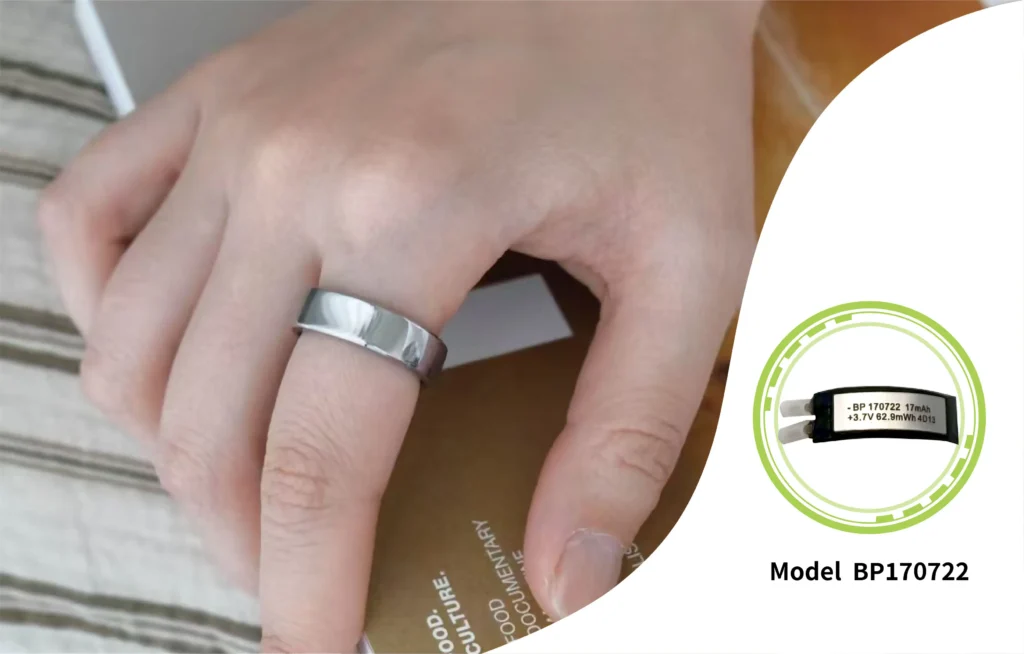
- Space Bottleneck: Micro-cavities with tight bending radii (R = 6mm – 12mm) make standard cells impossible to integrate.
- Curved Solution: Custom ultra-small radius curved or semi-ring cells fit seamlessly inside the band, delivering 15mAh–25mAh to power multi-day heart rate, SpO2, and BLE tracking without adding ring thickness.
AR / AI Smart Glasses
- Space Bottleneck: Optics and display processors consume the front frame, forcing batteries into the temple arms. Flat batteries make temples bulky and cause front-heavy imbalance.
- Curved Solution: Ergonomically contoured curved batteries conceal inside the temple arms, optimizing weight distribution while significantly extending voice assistant and display runtime.
Curved Wristbands & Medical Patches
- Space Bottleneck: Continuous health monitors worn against the skin require low profiles and tight anatomical conformity.
- Curved Solution: Ultra-thin curved cells match body contours, reducing edge height and eliminating skin friction for improved long-term patient compliance.
Case Study: Custom Curved Battery for AI Smart Glasses
Client Background: A consumer hardware startup developing an AI voice-enabled smart glasses frame planned to embed two 100mAh flat batteries into the temple arms.
Engineering Bottlenecks:
- Severe Dead Space: Curvature mismatch wasted 35% of internal temple volume.
- Poor Ergonomics: Accommodating flat cells required a 6.8mm temple thickness, resulting in a heavy, uncomfortable fit.
- Subpar Runtime: A total 200mAh capacity yielded only 3.5 hours of continuous voice interaction, falling short of the 5-hour market requirement.
Custom Curved Solution:
- 3D CAD Remodeling: Engineers extracted the inner radius (R= 65mm) and outer radius (R= 68mm) to design an asymmetrical curved cell matching the temple wall.
- High Voltage & Silicon-Carbon Chemistry: A 3.85V system paired with silicon-carbon anode materials boosted the cell’s volumetric energy density (Wh/L).
- Folded FPC Integration: A flexible BMS board was folded directly over the cell top to shorten overall length.
Project Results:
- Temple thickness reduced from 6.8mm to 4.5mm (12% lighter overall weight).
- Per-side capacity increased from 100mAh to 145mAh (290mAh total), extending runtime by 45% to 5.2 hours.
- Internal cavity utilization jumped from 58% to 92%, successfully passing mass-production validation.
Curved LiPo Battery Safety, Reliability, and Global Certifications
For hardware engineers and procurement managers, custom battery reliability is critical for mass production.
- Integrated Flexible PCM/BMS: Custom-contoured protection boards safeguard against overcharging, overdischarging, overcurrent, and short circuits.
- Long Cycle Life: Cells maintain consistent chemical stability under fixed bending states, retaining >80 capacity after 500 charge-discharge cycles.
- Global Transport Compliance: Certified under international export and safety standards, including UL 1642, IEC 62133, UN38.3, and MSDS.
Custom Curved LiPo Battery Development: From 3D CAD to Mass Production
To help engineering teams validate concepts quickly and reduce Time-to-Market, custom curved battery projects follow a structured path:
- Structural Assessment & Specs: Submit 3D CAD models or key parameters:
- Inner Radius & Outer Radius
- Arc Length or Curvature Angle
- Max allowable Thickness, Width, and Target Capacity (mAh)
- 3D Simulation & Cell Selection: Engineers evaluate cavity limits via 3D software to generate cell drawings and optimize capacity.
- Fast Prototyping: Delivery of functional samples within 45 business days for fit and function testing.
- Mass Production: High-consistency manufacturing using automated bending and testing equipment.
Curved LiPo Battery FAQ for Hardware Engineers and Procurement Teams
Q1: What is the minimum bending radius achievable for curved LiPo batteries?
The current minimum inner radius for production cells is 6mm (commonly used in smart rings and micro sensors). Ultra-thin cells offer even higher flexibility. Exact limits depend on thickness, width, and chemistry.
Q2: What are the tooling fees (NRE) and lead times for prototype samples?
- Prototype Lead Time: Typically 45 business days from CAD sign-off to sample delivery.
- NRE/Tooling Cost: Covers 3D aluminum film molds, cathode/anode punch dies, and FPC jigs. Tooling fees are waived if existing mold sizes are selected.
Q3: Does long-term bending increase internal resistance or compromise safety?
No. True curved batteries undergo winding/stacking and electrolyte filling in their pre-curved shape. The internal materials do not suffer from post-assembly bending stress. Internal resistance curves match standard flat cells across 500 cycles, passing puncture, impact, and thermal shock safety tests.
Q4: Do curved LiPo batteries support fast charging?
Yes. Chemistries can be tailored for 1C to 3C fast charging. A 200mAh curved cell can reach 80% charge in 25–30 minutes, ideal for high-utilization wearables.
Q5: Can you deliver full assemblies (Cell + PCM + Wire/Connector)?
Yes. We offer complete turnkey battery pack assemblies featuring custom flexible PCMs, lead wires, and specified connectors (e.g., Molex, JST, or Pogo Pin contacts) ready for drop-in enclosure assembly.
Q6: What export compliance documents are included for air/sea shipments?
Shipments include full documentation: UN38.3 test summaries, 1.2m drop test reports, MSDS, CE / IEC 62133 (EU), and UL 1642 / UL 2054 (North America) for smooth international customs clearance.
If your hardware team is facing space constraints, battery life bottlenecks, or design trade-offs, submit your 3D CAD files or specification requirements to connect directly with our engineering team for a custom curved power solution.
Email: info@landazzle.com
Whatsapp: +8618938252128