Table of Contents
What is A Low Temperature Battery?
In engineering applications, low-temperature batteries are not just batteries “that work in cold environments.” They are battery systems specially designed with unique materials and structures to maintain stable, predictable performance below 0 °C, even in extreme cold.
Standard lithium-ion batteries often face these problems at low temperatures:
- Internal resistance rises rapidly
- Usable capacity drops significantly
- Charging efficiency decreases, and charging takes longer
These issues are not random. They are caused by the basic electrochemical properties of lithium-ion batteries. The main goal of low-temperature batteries is to reduce performance loss under these unavoidable physical limits, while ensuring safety and consistency.
How Low Temperatures Affect Lithium-Ion Batteries?
1. Limited electrochemical reaction kinetics
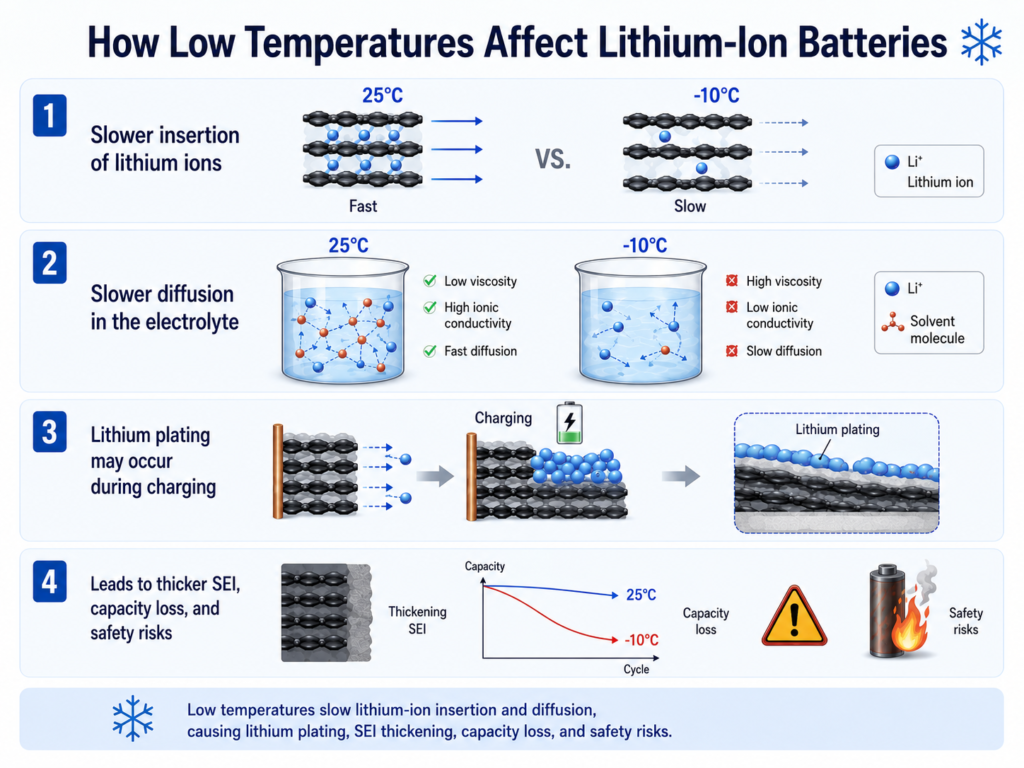
At low temperatures, the speed at which lithium ions insert into the graphite anode drops sharply. At the same time, higher electrolyte viscosity and lower ionic conductivity further slow down lithium-ion diffusion.
During charging, if lithium ions cannot enter the graphite structure quickly and evenly, lithium plating may occur on the anode surface. This not only thickens the SEI layer continuously but also causes irreversible capacity loss and potential safety risks.
2. Lower usable discharge capacity
Low temperatures reduce the activity of cathode and anode materials and weaken lithium-ion movement. This limits the current the battery can output. On a system level, this means:
- The rated capacity cannot be fully used
- Device battery life becomes much shorter in cold weather
This is one of the most common and obvious problems with lithium-ion batteries at low temperatures.
3. Higher internal resistance and worse performance
At low temperatures, many internal processes slow down at the same time:
- Electron and ion movement inside the electrodes
- Ion conduction in the electrolyte
- Reactions at the electrode-electrolyte interface
In addition, deposits or byproducts may form on active material surfaces, further increasing internal resistance. This reduces energy efficiency, creates extra heat during charging and discharging, and speeds up battery aging. Over time, some lithium ions may react irreversibly with the electrolyte, causing continuous capacity fade. In severe cases, this can lead to permanent damage to battery performance.
How does Low Temperature Lithium Battery Work?
1. Targeted Optimization of the Electrolyte System
In low-temperature environments, electrolyte performance is often one of the key factors that determines whether a battery can work properly. The conductivity of standard electrolytes drops sharply at low temperatures, which directly limits the speed of lithium-ion transport.
Low-temperature batteries usually use specially optimized electrolyte formulas that maintain high ionic conductivity even at very low temperatures. This ensures basic discharge performance and stability in cold conditions.
2. Electrode Material and Structure Design
Low-temperature applications have higher requirements for electrode materials. Through engineering improvements to graphite anodes and cathode materials, we can effectively:
- Reduce interface resistance
- Improve lithium-ion diffusion efficiency
- Lower the risk of lithium plating
These designs are not meant to achieve extreme specifications, but to keep performance stable and degradation predictable at low temperatures.
3. Stability Control of the SEI Layer
The SEI layer is a necessary but sensitive component in lithium batteries. At low temperatures, an unstable SEI layer leads to stronger side reactions.
Low-temperature batteries use matched materials and controlled manufacturing processes to form a more stable SEI layer from the beginning. This helps to:
- Prevent abnormal lithium deposition on the anode surface
- Reduce irreversible reactions
- Improve consistency in cycle life
4. Thermal Management and Internal Structure Optimization
For some applications, low-temperature batteries also use:
- Internal heating structures
- Thermal insulation designs
- Optimized internal transport paths
The goal of these designs is not to make the battery hot, but to help the battery reach its working state faster and reduce the impact of extreme low temperatures on performance.
Custom Low-Temperature Lithium Battery Solutions: LanDazzle
Founded in 2018, LanDazzle is a professional battery manufacturer focused on the custom R&D and production of shaped LiPo batteries, low-temperature lithium batteries, and custom battery packs.
Engineering Advantages of LanDazzle Low-Temperature Batteries
1. Custom Structure & Shape
With mature stacking technology and structural design capabilities, LanDazzle supports highly flexible battery shape customization. We maximize internal space utilization while maintaining low-temperature performance.
These solutions are ideal for:
- Products with extremely limited space
- Devices with irregular structures
- Professional applications requiring reliable low-temperature performance
2. Low-Temperature Performance
Under real engineering test conditions:
- -40 °C, 0.5C discharge: efficiency remains above 60%
- -30 °C, 0.5C discharge: delivers about 80% of rated capacity
Operating temperature range: -40 °C ~ 60 °C
Safety standards: certified to UL, CE, UN and other international requirements
3. Weight & System Integration Benefits
At the same voltage and capacity, low-temperature LiPo batteries are usually lighter than low-temperature 18650 cylindrical cells. This is because LiPo batteries use flexible packaging, which reduces the weight of metal casings and supports more compact, high-integration designs.
Common Applications for Low-Temperature Batteries
Low-temperature lithium batteries are deployed wherever standard cells fail in the cold. Below are the most common application categories LanDazzle supports, with example use cases drawn from real customer projects.
Outdoor & Industrial IoT
Asset trackers, environmental sensors, smart agriculture nodes and remote telemetry devices often operate unattended at sub-zero temperatures for months. Low-temperature LiPo cells maintain stable self-discharge and reliable wake-up performance for these IoT device battery deployments.
Two-Way Radios & Field Communications
Public-safety, mining and forestry radios need consistent transmit power even at -30 °C. Custom low-temperature batteries for two-way radios hold voltage under high-current TX bursts where standard packs collapse.
Action Cameras & Outdoor Wearables
Skiing, snowboarding, mountaineering and ice-fishing cameras lose runtime fast in cold conditions. Our low-temperature action camera battery solutions, plus shaped cells for wearable devices, deliver predictable runtime down to -20 °C and below.
Drones & UAVs in Cold Environments
Industrial inspection drones, search-and-rescue UAVs and winter aerial mapping require high C-rate output combined with cold tolerance. Pairing low-temperature electrolytes with high-discharge designs keeps drone batteries stable through full flight envelopes in winter.
Cold-Chain Logistics & Portable Medical
Vaccine transport monitors, blood-bank trackers and portable diagnostics often see refrigerated or frozen shipping legs. Low-temperature cells used in medical device batteries ensure data-logger uptime through the entire cold chain without false alarms.
Defense, Polar Research & Specialty Equipment
Military field equipment, polar research instruments, oil & gas wellhead monitors, cold-chain medical devices, and arctic survey gear demand certified safety plus operation down to -40 °C. Custom shapes and thermal-management features help tailor each pack to the application envelope.
Low-Temperature Battery FAQ
Can lithium batteries freeze?
Standard lithium-ion electrolytes do not solidify at typical winter temperatures, but their conductivity drops sharply below 0 °C. Most cells stop delivering useful current well before the electrolyte itself freezes. Storing a battery at extremely low temperatures is generally safe; running it under load is what causes problems.
Can you charge a lithium battery in cold weather?
Charging standard Li-ion below 0 °C is the most damaging cold-weather mistake. Lithium plating builds on the anode, causing irreversible capacity loss and potential safety risks. Low-temperature batteries with optimized electrolytes and SEI layers can accept charge down to roughly -20 °C, but most designs still require either pre-warming or reduced charge current in extreme cold.
What temperature damages a lithium battery?
Two thresholds matter. On the cold side, charging below 0 °C accelerates lithium plating; prolonged operation below -20 °C can permanently degrade standard cells. On the hot side, sustained exposure above 60 °C accelerates electrolyte breakdown and SEI growth. LanDazzle low-temperature LiPo cells are validated across -40 °C to +60 °C.
How much capacity does a lithium battery lose in the cold?
A standard Li-ion cell typically delivers only 50-70% of its rated capacity at -20 °C, and may drop below 30% at -40 °C. Optimized low-temperature LiPo cells retain about 80% capacity at -30 °C and 60% at -40 °C under 0.5C discharge, which is enough for most outdoor IoT and field equipment.
Which battery chemistry is best for cold weather?
It depends on the priority. Optimized low-temperature Li-ion or LiPo offers the best energy density and cold-discharge performance for compact devices. LiFePO4 trades some energy density for thermal stability and cycle life.
Do low-temperature batteries need a heater or thermal management?
Most applications down to -20 °C do not need active heating; an optimized electrolyte and SEI design are enough. Below -30 °C, internal heating elements, insulation, or pre-warm cycles become useful for high-current applications such as drones and field radios. The right approach depends on duty cycle, current draw and acceptable cold-start latency.
Conclusion
From an engineering perspective, low‑temperature batteries are not “more powerful” batteries. They are reliable, stable, and controllable power systems even in extreme environments. For industrial equipment, drones, smart devices, and other low‑temperature applications, choosing the right low‑temperature battery solution is critical to ensure stable operation, extend service life, and guarantee safety.
If you are looking for a custom battery solution for products used in low‑temperature environments, please feel free to contact the LanDazzle team for free technical evaluation and customized advice. You can also review our practical guide on how to choose a lithium battery for cold weather before reaching out.
We will help you find the most suitable low‑temperature battery solution for your project, considering structure, materials, performance, and safety.
Email: info@landazzle.com
Whatsapp: +8618938252128