Table of Contents
Many products look perfect in the concept stage. But in the prototype phase, teams face common issues:
battery fitting problems, poor temperature control, or unsatisfactory battery life and cycle performance.
Most of these problems stem from improper battery selection.
Why Wearable Devices Need Small Lithium Polymer Battery
From smart bands and smart rings to smart glasses and medical wearables, they share several key features:
- Extremely limited internal space
- Strict weight sensitivity
- Long-term close contact with skin
- Highly fragmented usage scenarios
Under these conditions, traditional cylindrical and coin batteries can hardly fit properly.
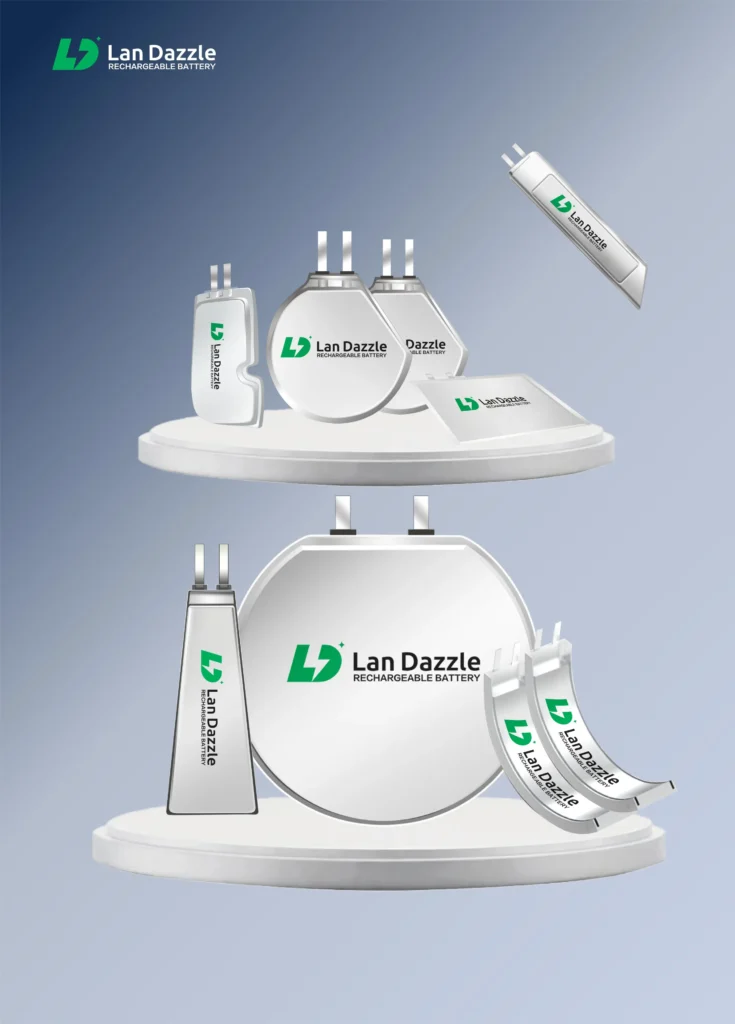
Small lithium polymer batteries offer more than just compact size — they feature structural flexibility.
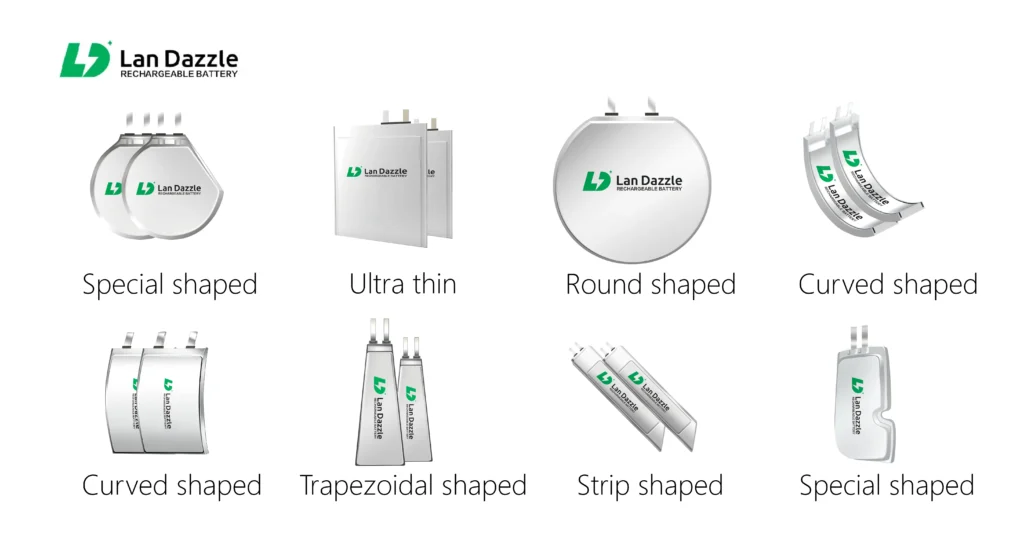
Their soft-pack design allows size, thickness and shape to be customized to fit the product, instead of forcing the device to adapt to the battery.
That is why mature wearable products almost always adopt small lithium polymer batteries.
What Does a “Small Battery” Truly Mean in the Wearable Industry?
Many articles simply define small batteries as “tiny in size and low in capacity”. But for wearable devices, this definition is far from complete.
In real projects, the word “small” includes at least four aspects:
- First, thickness rather than surface area.
A difference of just 0.1mm can decide wearing comfort and affect the overall structural strength of the device.
- Second, the layout of energy density.
Higher capacity is not always better. The key is stable and predictable power output within limited space.
- Third, discharge performance.
Wearables run on low current for long hours with frequent wake-ups — completely different from drones or power tools.
- Fourth, safety limits.
Skin-contact devices allow almost no tolerance for overheating or faults. Small batteries demand stricter design and manufacturing control.
Therefore, “smaller” never means lower standards. It means much higher requirements.
Real differences in battery requirements for common wearable devices
Smart watches & fitness bands
These devices feature compact structures and are extremely sensitive to thickness. The core focus is not on maximizing capacity, but on battery stability during repeated charging cycles and current fluctuations. Most early capacity fading is not caused by cell quality issues, but by long-term structural stress.
Smart rings & ear-worn devices
They have an ultra-miniature size, leaving only marginal space for batteries. They require extremely high shape adaptability from small lithium polymer batteries, and standard batteries are usually not applicable at all.
Medical wearable devices
Safety ranks above all other needs here. Temperature control, consistent service life and reliability under extreme working conditions matter far more than capacity figures.
Smart glasses & AR devices
This is one of the most challenging scenarios for batteries at present. Batteries must be small and lightweight, while also meeting requirements for center of gravity distribution and long-term wearing comfort.
Resolving Competing Engineering Demands for Wearable Battery Physical Designs
| Parameter / Metric | Standard Rectangular Pouch | Curved / Arc Pouch Cell | Micro Pin-Type Cell | Custom-Shaped Micro Cell |
|---|---|---|---|---|
| Primary Form Factor | Smartwatches, Charging Cases | Smart Bands, Eyewear Stems | Stylus Pens, Tiny Earbuds | Smart Rings, AR Frames |
| Non-Rectangular Cavity Utilization | 50% – 60% | 80% – 88% | 75% – 85% | 85% – 93% |
| Typical Capacity Range | 100-150mAh | 80-200mAh | 15-40mAh | 14-150mAh |
| Volumetric Energy Density ($Wh/L$) | 650-750 Wh/L | 580-680 Wh/L | 500-620 Wh/L | 620-720 Wh/L |
| Primary Manufacturing Challenge | Standard winding/stacking | Bending stress on separators | Ultra-narrow seal width | Precision pouch sealing & moisture barriers |
Key performance factors when selecting small lithium polymer batteries
Trade-off between thickness and capacity
In wearable projects, “can it be thinner?” is almost always asked. In fact, ultra-thin batteries require higher standards for materials, processes and consistency. Pursuing extreme thinness alone will usually lead to faster capacity decay.
Cycle life under real usage conditions
Lab cycle data differs greatly from actual user scenarios. Partial charge-discharge and frequent wake-up are the daily working state of wearables.
Safety control for skin-contact use
There is no room for risk tolerance in wearable devices. Battery design must prepare for the worst-case scenario, not just pass standard tests.
Why Standard Batteries Fail — and Why Custom Small Lipo Batteries Work Better
In the early design stage of wearable products, choosing standard-size batteries is almost an instinctive choice.
They cost less, have short lead times, and come with seemingly adequate specifications, making them a safe starting option.
Yet as product design moves forward, problems gradually emerge.
- To fit a fixed-size standard battery, the internal structure has to make compromises, and the original reasonable layout gets disrupted.
- Wiring and solder joints between the battery and main board stay under constant stress. Daily wearing, bending and vibration keep raising the risk of failure over time.
- Even under normal use, battery performance stays unstable, with obvious differences between batches and individual units.
- During mass production, the yield rate can hardly be improved, while the issues cannot be simply blamed on poor battery quality.
In most cases, these problems are not caused by defective batteries themselves. It is because standard batteries are never designed to match the actual usage scenarios of wearables.
This is the true value of custom small lithium polymer battery solutions.
Professional customized compact Li-Po batteries are not just made smaller in size. They are designed based on the overall product structure to redefine the battery’s role inside the device.
- Their shape fits the internal structure perfectly, instead of becoming a hardware limitation that the product has to adapt to.
- Thickness distribution is well arranged to reserve space for wearing comfort and structural strength in key areas.
- Internal stress is calculated and controlled at the design stage, rather than showing up gradually during daily use.
For skin-contact applications, sufficient safety margin is reserved, instead of only meeting basic theoretical parameters.
The goal of customization is not to blindly pursue higher capacity or extreme ultra-thin size. It is to ensure the battery operates steadily and predictably long-term in real wearable environments. Only in this way can the product design be fully feasible, and mass production become practical and reliable.
How to Judge if a Small Lithium Polymer Battery Solution Is Reliable
When evaluating small lithium polymer battery solutions, rather than only comparing specification sheets, focus on these key criteria:
Understanding of wearable operating environments
A reliable solution clearly explains real long-term usage conditions. It covers minor deformation from repeated wearing and removal, vibration from daily movement, and strict requirements for temperature control and stability against skin contact.
Mass production experience for ultra-thin and irregular-shaped batteries
Being able to make samples does not guarantee stable mass production. The real challenges lie in process control, material consistency and risk management during volume manufacturing.
Transparent disclosure of solution limitations
Trustworthy suppliers never only highlight advantages. They clearly mark critical boundaries for thickness, size and structure. They distinguish designs fit for mass production from those only suitable for prototype testing.
Clear and firm judgment on critical design limits
In actual projects, a supplier that clearly states “this cannot be made any thinner” is always more reliable than those promising over-aggressive specs. This honesty helps your wearable product land smoothly into final production.
Future Trends of Small Lithium Polymer Batteries in the Wearable Industry
The future development of wearable batteries is not only about pursuing an ever smaller and thinner size.
As devices grow more functionally complex, batteries need to deliver more stable and predictable power output within limited space.
Meanwhile, requirements for safety boundaries will become increasingly strict.
Batteries must not only pass standard tests but also maintain consistent temperature performance and stability long-term under real wearing conditions.
A more significant shift is that batteries are becoming integrated into product structural design.
They are no longer easily replaceable modules, but co-designed parts combined with housings, supports, and even the overall stress structure of the device.
Under this trend, the value of small lithium polymer batteries will lie more in design compatibility and long-term reliability, rather than just the numbers on a specification sheet.
Conclusion
In the rapidly evolving world of wearable technology, choosing the right small lithium polymer battery is essential for creating devices that are compact, reliable, and high-performing. From smartwatches and fitness bands to medical wearables and smart glasses, the demands for lightweight, flexible, and safe power solutions continue to grow.
Small LiPo batteries stand out as the ideal solution, offering high energy density, customizable form factors, and reliable performance in even the most space-constrained designs for small gadgets. By considering key factors such as size, voltage, capacity, safety certifications, and cycle life, engineers can ensure their wearable devices deliver the best user experience and long-term durability.
If you are developing wearable devices and struggling with these trade-offs:
- Conflicts between battery thickness and wearing comfort
- Standard batteries failing to match structural design
- Higher requirements for safety, service life and consistency
Then custom small lithium polymer batteries tailored for real usage scenarios are usually the more reliable choice.
We provide custom battery solutions for wearables, medical electronics and miniature smart devices, covering ultra-thin, irregular-shaped and high-reliability applications.
If you want to settle battery issues thoroughly at the early design stage, feel free to contact us anytime.
Email: info@landazzle.com
Whatsapp: +8618938252128