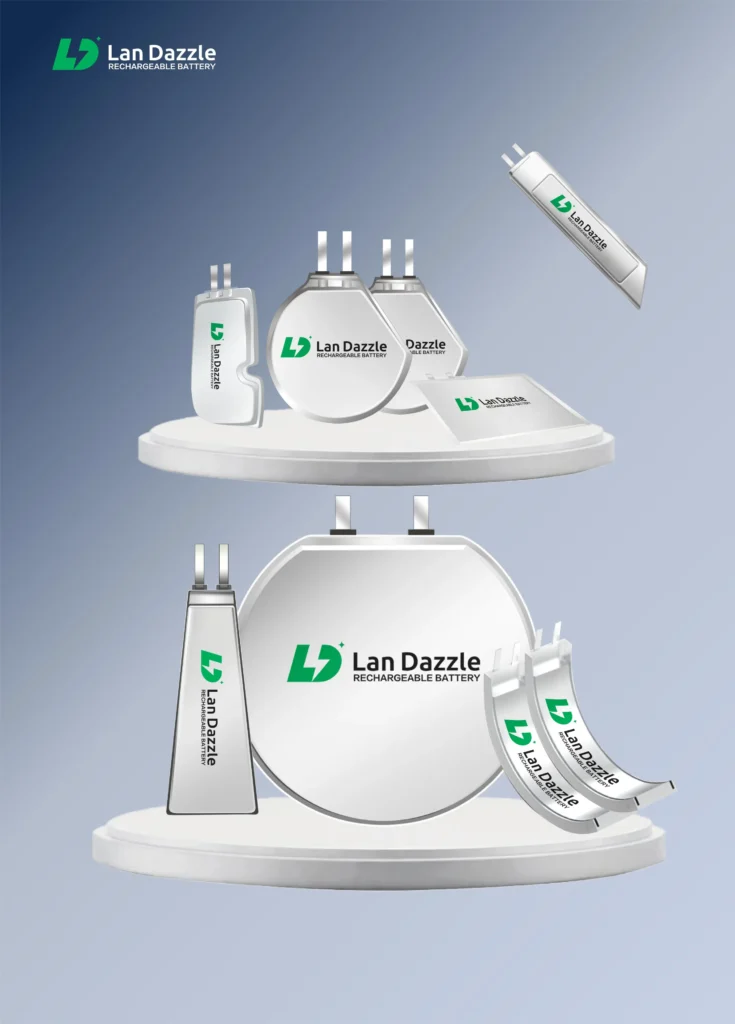
The fragmented and highly limited space inside smart glasses temples is a core challenge for hardware engineers during battery selection. Traditional standard batteries cannot fit the long, narrow, and irregular temple structures, leading to wasted space and insufficient battery life.
Based on teardown data from mainstream smart glasses, this article explains how shaped stacked battery technology works, how to select the right battery design, and how developers can quickly match the optimal battery solution. The goal is to solve two key problems: low space utilization inside the temples and short battery life.
The Core Challenge in Smart Glasses Battery Selection: The “Invisible Constraint” of Temple Space
Innovation in smart glasses design is always limited by the space inside the temples. Unlike smartphones or smartwatches with regular battery compartments, smart glasses temples must balance wearing comfort and hardware integration. As a result, the internal space is long, narrow, irregular, and full of corners—making battery selection a major bottleneck.
Based on teardown data from mainstream models such as RayNeo V3 and Xiaomi AI Glasses, we identified three key constraints of temple space:
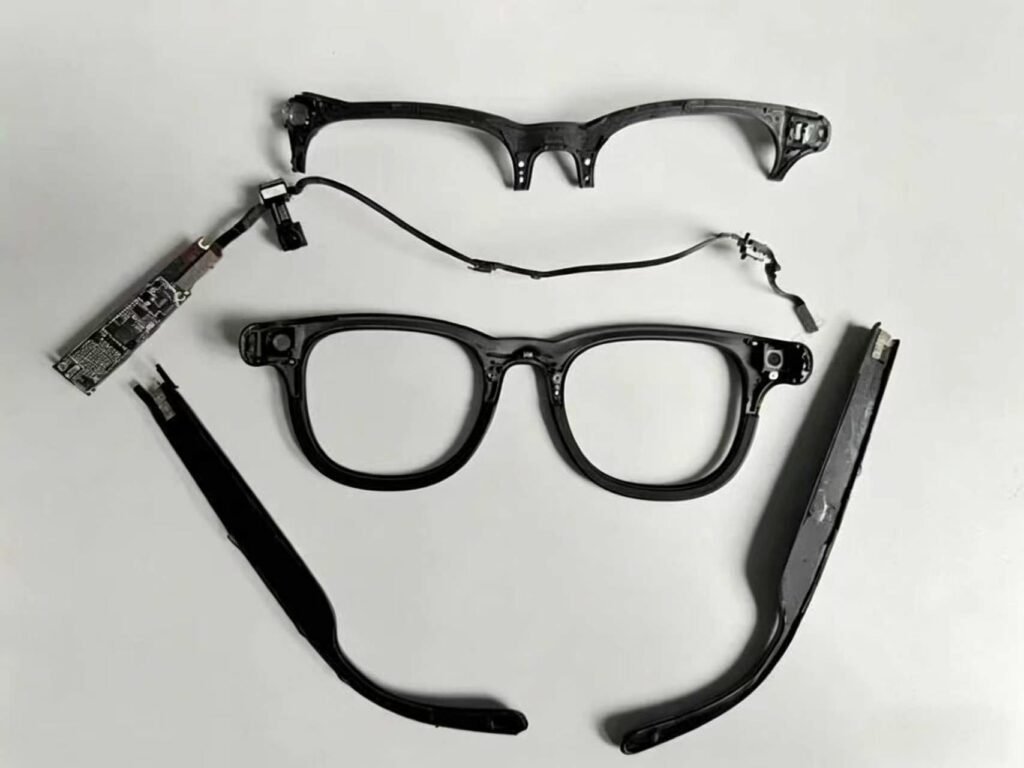
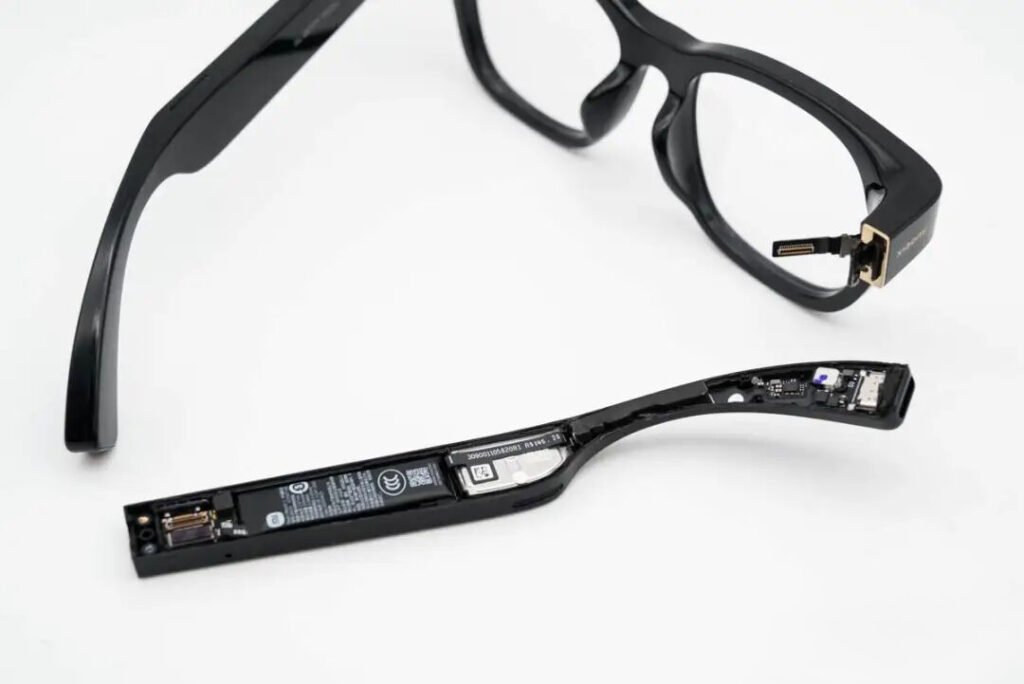
- Size constraints:
The usable battery space in most smart glasses temples is only about 41 mm × 11.5 mm × 3.9 mm. In ultra-thin designs, temple thickness can be even below 3 mm, leaving very limited volume for the battery. - Structural constraints:
The temple must also house the mainboard, speakers, and sensors. The battery can only fill the remaining fragmented spaces, where corner gaps can account for up to 27% of the volume. Standard battery shapes cannot use this space efficiently. - Conflicting requirements:
Developers need batteries that are small and thin to fit the temple, but also require high energy density to achieve more than 4 hours of battery life, while keeping the battery light to maintain wearing comfort.
The standardized shapes of traditional wound batteries and coin cells do not match the irregular temple space. This mismatch leads to poor space utilization and short battery life, becoming a key barrier to mass production of smart glasses. Shaped stacked battery technology is the critical solution to this problem.
Comparison of Battery Compatibility in Smart Glasses Temple Space
To match the unique space characteristics of smart glasses temples, we compared three mainstream battery types currently used in the market: shaped stacked Li-polymer batteries, traditional wound batteries, and coin cells. The goal is to clearly show the strengths and limitations of each option and provide quantitative guidance for battery selection.
| Battery Type | Space Utilization (Measured) | Energy Density (Wh/L) | Battery Weight (g) | Temple Integration Difficulty | Key Limitation |
|---|---|---|---|---|---|
| Shaped Stacked Li-Polymer Battery | 92% | 780 | 2.8 | Low (customizable shape) | Slightly longer customization lead time (7–14 days for samples) |
| Traditional Wound Battery | 73% | 650 | 3.2 | Medium (requires temple structure adjustment) | Severe corner space waste, limited battery life |
| Coin Cell Battery | 58% | 550 | 2.5 | High (requires separate battery compartment design) | Low energy density, cannot support long battery life |
Battery Selection Conclusions
- Recommended option: Shaped stacked Li-polymer battery
With a space utilization of up to 92%, this battery type can fully fit the irregular corners of smart glasses temples. It delivers the highest energy density within the same volume while remaining lightweight, balancing long battery life and wearing comfort. It is suitable for most mid- to high-end smart glasses. - Alternative option: Traditional wound battery
This option is suitable for entry-level smart glasses with lower battery life requirements, tight development timelines, and no need for customization. However, developers should be aware that temple structure adjustments are often required to reduce space waste. - Not recommended: Coin cell battery
Due to very low space utilization and limited energy density, coin cells are only suitable for simple smart glasses with basic functions and battery life requirements of 2 hours or less. They cannot meet the needs of mainstream smart glasses products.
How Shaped Stacked Battery Technology Breaks Temple Space Limits
Shaped stacked battery technology solves the space constraints of smart glasses temples through a dual advantage of customized form factors and high-precision manufacturing. Unlike traditional wound batteries with standardized shapes, this approach enables maximum use of the limited temple space.
Process Principle
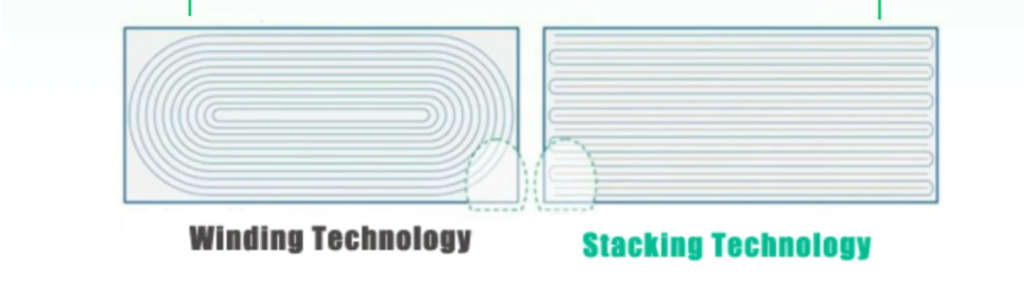
Unlike traditional winding processes that produce round or rectangular cells, shaped stacked technology stacks the battery layers—cathode, anode, and separator—according to the irregular internal structure of the temple. This precise stacking allows the battery to fully match the inner contour of the temple and fill fragmented corner spaces.
Key Advantages
Flexible integration:
Battery shapes can be customized to match different temple designs, including curved temples and ultra-thin temples.
Breaking space limitations:
Space utilization increases from 73% (wound batteries) to 92%, effectively using the 27% corner gaps inside the temple. This results in a 26% capacity increase within the same temple volume.
Balancing battery life and weight:
With high-silicon anode materials, energy density can reach 780 Wh/L, delivering over 20% longer runtime than wound batteries at the same volume. The pouch-type structure is lightweight and does not affect wearing comfort.
Smart Glasses Battery Applications by Category
Different smart glasses categories impose different constraints on battery design — display load, audio chip power draw, weight balance across temples, and prescription-lens compatibility all change the optimal cell shape and capacity. Below are the six categories we engineer custom shaped-stacked cells for.
AI Glasses (Camera + Voice Assistant)
AI glasses with on-device LLM, camera, and voice assistant pull spike currents during inference. Typical capacity is 150–300mAh per temple, often split between a left-arm primary cell and a right-arm secondary for thermal balance.
AR Glasses (Display + Optical Engine)
AR glasses with waveguide displays and micro-OLED optical engines need 250–500mAh per side and high continuous-discharge ratings. Heat management is critical — the cell must sit far from the optical engine. Stacked-lamination construction with thermal-isolation tabs is the standard approach.
Prescription Smart Glasses
Prescription smart glasses must accommodate variable lens thickness, which changes the available temple volume per SKU. We support per-SKU battery customization with tooling re-use across thickness variants. For background, read about how prescription smart glasses are changing battery design.
Audio Smart Glasses (Bone Conduction & Open-Ear)
Audio-only smart glasses (Bose Frames-style products) prioritize all-day weight comfort. Cells are smaller (80–180mAh per side) and must integrate with bone-conduction or open-ear speaker drivers. Capacity per gram is the dominant design metric. Long-thin trapezoidal cells dominate this segment.
Magnetic Quick-Release Glasses
Newer designs use magnetically attached battery modules so users can hot-swap a depleted pack. The cell must ship inside a protective housing with safe contact pins. We discuss feasibility and trade-offs in can magnetic battery fix AI glasses battery life.
Industrial & Enterprise AR Headsets
Enterprise AR (warehousing, field service, surgical assist) tolerates a thicker temple in exchange for 8+ hour runtime. Capacities reach 600–1,200mAh per side, often with hot-swap battery modules and IP54+ sealing. These designs benefit most from our custom shaped battery manufacturing capabilities.
Conclusion
As wearable devices continue to move toward smaller, lighter, and more personalized designs, battery process selection is becoming increasingly critical. For products like smart glasses—where space, weight, and structural compatibility are highly constrained—shaped stacked batteries are gradually becoming the preferred choice. Their flexible form factors, higher space utilization, and better thermal performance make them especially well suited for these applications.
Compared with traditional winding processes, stacked battery technology offers clear advantages in shape adaptability, electrical performance, and safety, making it ideal for structurally complex wearable devices with high customization requirements. Looking ahead, as manufacturing processes continue to improve and costs are further optimized, stacked battery technology is expected to see broader adoption in the wearable sector and become a key foundation supporting future device innovation.
If you are developing your next smart glasses or AR glasses product, choosing shaped stacked battery technology can help you achieve the optimal balance between design freedom, user experience, and performance. If you need a custom-shaped battery solution, feel free to contact us—we are ready to design the optimal power solution tailored to your product.
Email: info@landazzle.com
Whatsapp: +8618938252128