Table of Contents
TWS earbuds have to fit a battery, speaker driver, PCB, antenna, microphones, and other components into a very small enclosure. As manufacturers add active noise cancellation (ANC), more advanced audio processing, and new open-ear designs, tws earbuds battery selection becomes an increasingly important part of product development.
The right battery depends on more than capacity. Engineers also need to consider available space, peak current, voltage stability, weight, mechanical protection, and manufacturing cost.
Rechargeable coin cells can be suitable for designs built around standard dimensions. Rectangular pouch cells offer a lightweight alternative, while custom-shaped pouch cells can help when a standard form factor cannot meet the product’s spatial or electrical requirements.
1. Common Battery Solutions for TWS Earbuds
Coin Cell Batteries
Rechargeable coin cells use a compact, round form factor with a rigid metal casing. They can be a practical choice for small earbuds when the enclosure is designed around a compatible standard cell.
Their main advantages include:
- Standardized dimensions and established sourcing options
- A rigid outer casing that provides structural protection
- Potentially lower development complexity when a suitable model is readily available
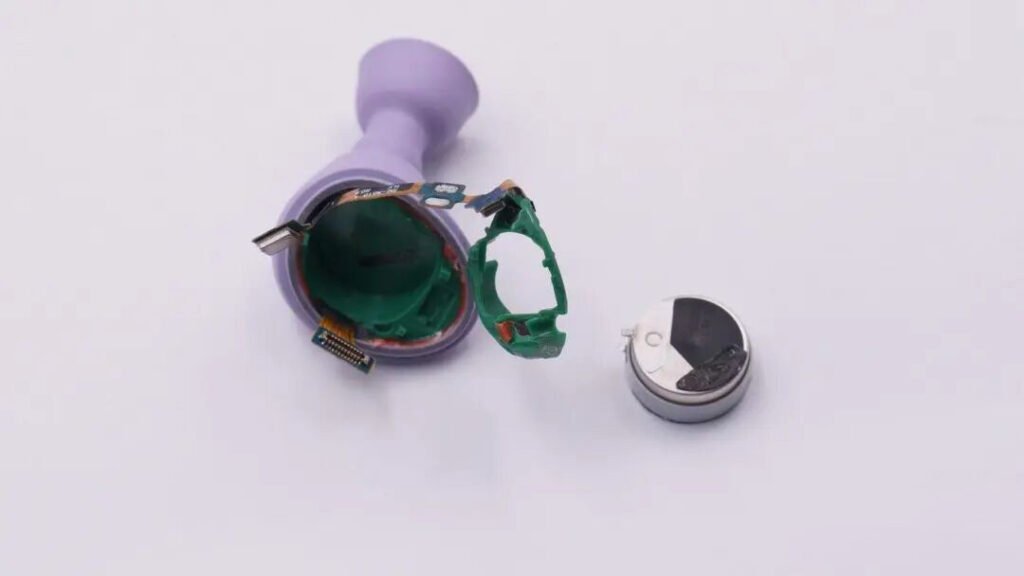
However, the round footprint may leave unused space in an irregular earbud enclosure. The available capacity, thickness, discharge capability, and charging limits are also determined by the selected cell model.
Coin cells should not automatically be considered unsuitable for advanced earbuds. The important question is whether the specific cell can meet the product’s runtime, peak-load, and space requirements.
Rectangular Pouch Cells
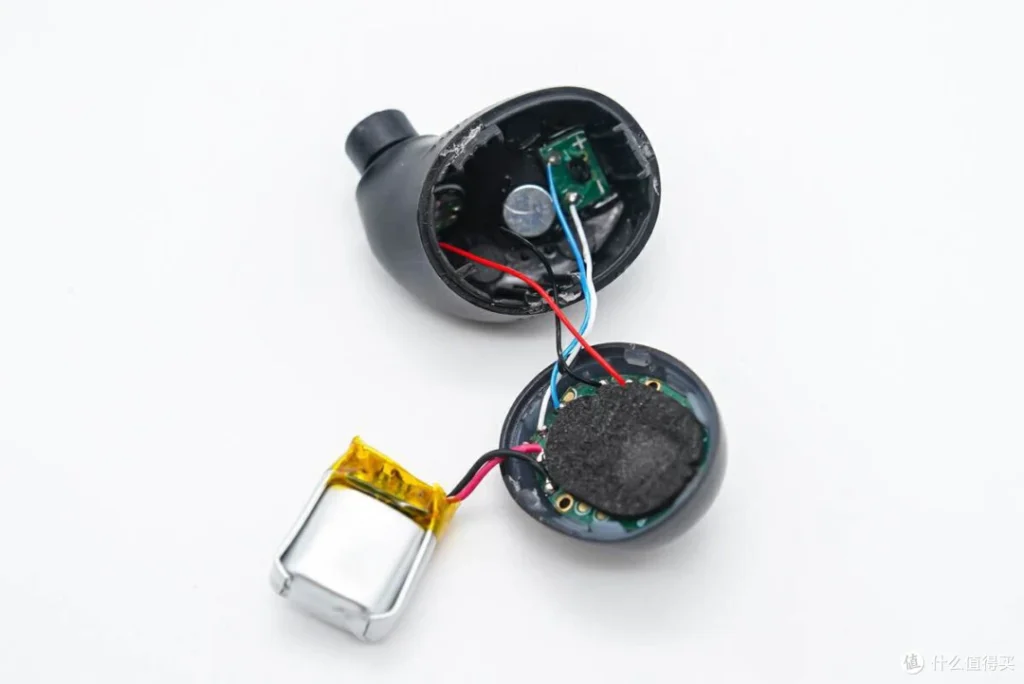
Pouch cells use flexible aluminum-laminate packaging rather than a rigid metal can. Their flat profile and lightweight packaging can make them attractive for compact consumer electronics.
Potential advantages include:
- A form factor that can fit narrow or flat compartments
- Less packaging weight than some rigid-case designs
- More freedom to tailor dimensions for a specific product
However, a rectangular pouch cell is not automatically a custom-shaped battery. A standard rectangular cell may still leave unused space inside a curved or irregular enclosure.
Pouch cells also require appropriate mechanical support, edge protection, and allowance for dimensional changes over their service life. Their suitability depends on the cell design and how the battery is integrated into the device.
For further background, see this NASA technical report on the safety and long-term performance of lithium-ion pouch cells.t, the battery cannot fully match the cavity structure, leaving unused space.
Custom-Shaped Pouch Cells
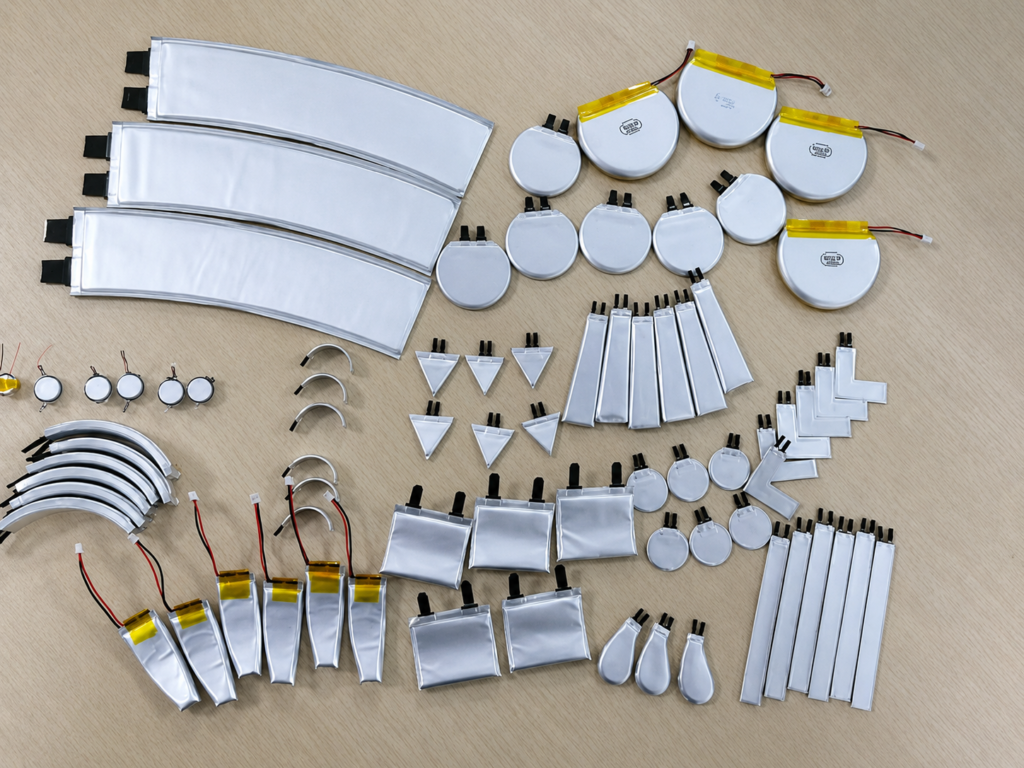
Custom-shaped pouch cells are designed around defined product constraints rather than a standard rectangular footprint. Depending on manufacturing feasibility, the design may use an elongated, curved, L-shaped, or other non-rectangular outline.
This approach can be useful when:
- The earbud enclosure has a narrow or irregular battery compartment.
- A standard cell cannot provide the required capacity within the available dimensions.
- The product design needs to balance battery volume with acoustic, electronic, and mechanical components.
- The development team wants to evaluate a different battery layout before finalizing the enclosure.
Custom-shaped cells still have engineering limits. Electrode layout, packaging, tabs, thickness, electrical performance, and manufacturing tolerances must all be evaluated before a design is approved.
2. Coin Cell vs. Pouch Cell vs. Custom-Shaped Cell
The following table provides a starting point for battery selection. Actual performance depends on the specific cell model, chemistry, dimensions, and operating conditions.
| Evaluation factor | Rechargeable coin cell | Rectangular pouch cell | Custom-shaped pouch cell |
|---|---|---|---|
| Form factor | Round | Usually rectangular | Tailored outline |
| Space adaptation | Best when the cavity suits the round profile | Best for regular, flat spaces | Can address irregular or constrained spaces |
| Capacity potential | Limited by the selected model and dimensions | Depends on available volume and cell design | May improve usable volume within a defined enclosure |
| Mechanical protection | Rigid metal casing | Requires suitable external support | Requires suitable external support |
| Development complexity | Usually lower when a standard model fits | Low to moderate when dimensions are established | Typically higher due to customization and validation |
| Sourcing approach | Standard catalog or qualified supplier | Standard or custom dimensions | Project-specific engineering and qualification |
| Best use case | Compact designs that meet requirements with a standard cell | Designs with a suitable rectangular compartment | Designs where standard cell geometry is a major constraint |
There is no universally best battery format. If a standard cell meets the product’s requirements at an acceptable cost, changing the form factor may add unnecessary development work. Customization becomes more attractive when the existing geometry creates a measurable design limitation.
3. Key Engineering Factors in TWS Earbud Battery Design
Available Space and Battery Geometry
Battery selection should begin with the actual space available inside the earbud, not simply the external dimensions of the product.
The battery compartment must account for enclosure walls, structural supports, wiring, insulation, connectors, and assembly clearances. The design must also avoid sharp edges or localized pressure that could damage the cell.
For curved or clip-on earbuds, the remaining space may not form a regular rectangle. A custom outline can help engineers investigate whether more of that space can be used without compromising other components.
The goal is not to fill every gap at any cost. A viable design must preserve the clearances and mechanical protection required for safe operation.
Capacity and Runtime
Battery capacity, expressed in milliamp-hours (mAh), is an important starting point, but it does not directly determine playback time.
A simplified runtime estimate is:
Estimated runtime (hours) ≈ usable capacity (mAh) ÷ average current draw (mA)
For example, a hypothetical 50 mAh battery delivering an average current of 10 mA would provide approximately five hours under those simplified assumptions.
This is an illustration, not a prediction for a real earbud. Actual runtime depends on usable capacity, voltage limits, average system load, temperature, aging, and power-management behavior.
ANC, Bluetooth operation, audio volume, microphones, and signal processing can all affect power consumption. Engineers should therefore evaluate battery capacity alongside measured system power rather than relying on mAh alone.
Peak Current and Voltage Stability
Average power consumption is only part of the design challenge. The battery must also support transient loads without unacceptable voltage drops.
A simplified relationship is:
Voltage drop ≈ current × effective resistance
When current rises, resistance within the cell and its electrical connections contributes to voltage drop. If the voltage falls below the operating limit of the electronics, the device may reset, disconnect, or behave unpredictably.
For this reason, engineers should review the cell’s internal resistance, permitted discharge current, voltage profile, and performance under the product’s real load conditions.
A custom-shaped cell is not automatically better at high-rate discharge. Its electrical performance must be confirmed against the requirements of the selected chemistry and cell design.
Acoustic and Mechanical Integration
A battery shares limited space with the speaker driver, acoustic chamber, PCB, microphones, and antenna. Changing its dimensions may create more room for other components, but the effect depends on the overall layout.
Battery placement should be assessed alongside acoustic performance, antenna clearance, weight distribution, structural strength, and assembly access.
For example, an elongated cell may suit a narrow earbud stem, while a different outline may be worth investigating for a clip-on design. In both cases, the proposed geometry needs to be checked against the complete device architecture.
Mechanical Protection, Swelling, and Reliability
Pouch cells do not have the same rigid metal casing as coin cells. Their integration therefore requires careful attention to enclosure support, sealed edges, tabs, insulation, and the space needed to accommodate permitted dimensional changes.
Battery swelling can have several causes, including cell aging and abnormal operating conditions. It should not be treated as an inevitable consequence of pouch packaging, nor can it be eliminated simply by choosing a custom shape.
The development team should follow the cell manufacturer’s integration requirements and validate the battery under relevant electrical, thermal, mechanical, and lifecycle conditions. Testing should reflect the intended product and its operating environment.
4. When Should You Consider a Custom-Shaped TWS Battery?
A custom-shaped battery is worth evaluating when a standard cell creates a specific engineering trade-off that cannot be resolved satisfactorily through ordinary layout changes.
Scenario 1: A narrow earbud stem
The battery compartment is long and narrow, leaving limited room for a conventional rectangular cell. An elongated cell design may be worth assessing against the required capacity, thickness, and discharge performance.
Scenario 2: An open-ear or clip-on earbud
The enclosure follows a curved outline, and the battery must coexist with structural supports and other components. A curved or non-rectangular pouch cell may offer more layout options, provided the proposed cell can be manufactured and validated.
Scenario 3: A capacity target that a standard cell cannot meet
The existing design has little room for a larger standard cell. Engineers can investigate whether an alternative outline or internal cell design can improve the usable battery volume without increasing the product’s external dimensions.
Scenario 4: A new product architecture
The team is developing a new enclosure and can still modify the battery compartment. Evaluating the battery and enclosure together at an early stage may reduce late-stage redesigns.
By contrast, if a standard coin cell or rectangular pouch cell already meets the size, runtime, reliability, and cost requirements, a custom design may not provide enough value to justify additional development.
5. What Should You Prepare Before Sourcing a Custom Earbud Battery?
A clear engineering brief helps the battery supplier assess feasibility and identify potential trade-offs earlier.
Before requesting a quote, prepare as much of the following information as possible:
- Battery envelope: Available length, width, thickness, and required clearances.
- CAD files: A 3D STEP model or relevant enclosure drawings, if available.
- Capacity target: Required capacity and expected playback time.
- Electrical requirements: Nominal voltage, operating voltage range, average load, peak current, and charging requirements.
- Mechanical constraints: Permitted outline, tab location, mounting method, and restrictions on pressure or movement.
- Operating conditions: Expected temperature range, service life, and charging and discharging profile.
- Project timeline: Prototype quantity, validation schedule, estimated production volume, and target launch date.
Not every requirement needs to be finalized at the first discussion. A preliminary dimensional drawing and a clear description of the product’s main constraints can be enough to begin an initial feasibility review.
The supplier should then assess whether the proposed dimensions and electrical targets are compatible with the cell design, manufacturing process, and required validation plan.
6. From Battery Concept to Mass Production
Custom battery development involves more than producing a cell in a particular shape. The design must remain feasible as it moves from initial concept to repeatable manufacturing.
A typical workflow includes four stages:
- Define the battery envelope: Review the available space, dimensions, clearances, and tab location.
- Evaluate cell feasibility: Assess the proposed geometry, chemistry, capacity, discharge requirements, and packaging.
- Build and validate samples: Check fit, electrical performance, mechanical integration, and applicable safety requirements.
- Verify production readiness: Confirm dimensional consistency, process controls, inspection methods, and production requirements.
Early collaboration between the product team and battery supplier can help identify conflicts before the enclosure and electronics are finalized. Sample testing and production validation are still necessary; a successful prototype alone does not establish mass-production readiness.
Develop a Battery That Fits Your Earbud Design
If a standard battery cannot meet your space, capacity, or power requirements, LanDazzle can evaluate custom-shaped lithium battery options for your TWS earbud project. Our custom battery work focuses on matching cell geometry to product constraints while considering electrical performance and manufacturing feasibility. Share your battery dimensions, target capacity, discharge requirements, or CAD/STEP file to start a feasibility discussion.
Email: info@landazzle.com
Whatsapp: +8618938252128