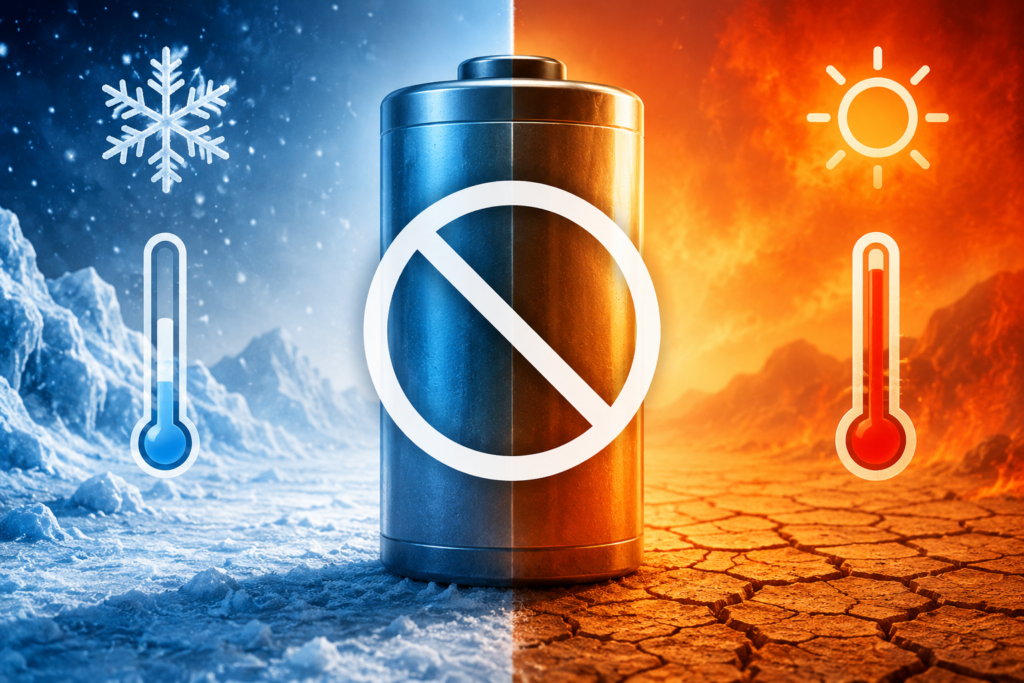
Low-temperature batteries and high-temperature batteries are designed with different materials and structures because they need to work in completely different environments. Below is a comparison of the two from several aspects, including cathode materials, anode materials, electrolytes, battery design, environmental impact, and durability.
1. Cathode Materials
Low-temperature batteries usually use cathode materials with high energy density, good low-temperature performance, and stable structure, such as Lithium Manganese Oxide (LMO), Lithium Nickel Manganese Cobalt Oxide (NCM), and Lithium Cobalt Oxide (LCO). These materials can keep higher discharge capacity and power output even in cold environments.
High-temperature batteries require cathode materials with better heat resistance and thermal stability. Common choices include LCO, NCM, and Lithium Nickel Cobalt Aluminum Oxide (NCA). These materials can maintain stable electrochemical performance at high temperatures and reduce the risk of thermal runaway.
2. Anode Materials
For low-temperature batteries, the anode also needs good performance in cold conditions. Graphite is the most common anode material, but its lithium-ion insertion speed becomes slower at low temperatures. To improve this, manufacturers use modified graphite, silicon-carbon composite materials, or Lithium Titanate (LTO) to improve low-temperature discharge performance.
For high-temperature batteries, the anode must resist heat stress and chemical corrosion. Graphite is still widely used, but it often needs special surface treatment or modification to improve stability. Silicon-based materials provide higher capacity, but they expand more at high temperatures, making them less suitable for high-temperature applications.
3. Electrolytes
Low-temperature battery electrolytes need low viscosity, high ionic conductivity, and good flowability at low temperatures. Special solvents and additives are often used to reduce internal resistance and improve battery performance in cold weather.
High-temperature battery electrolytes need excellent thermal stability and corrosion resistance. They must not easily break down or produce harmful gases under high temperatures. At the same time, they need suitable viscosity to ensure smooth ion movement.
4. Battery Design
Low-temperature batteries are designed to reduce heat loss and improve insulation so the battery can stay within its working temperature range. Their internal structure and electrode design are also optimized for better charging and discharging in cold conditions.
High-temperature batteries focus more on heat management and safety. Their housing and internal structure must withstand high temperatures, and they usually include efficient cooling systems to prevent overheating. They are also designed with extra protection against thermal runaway and fire.
5. Environmental Impact
Low-Temperature Batteries
Low-temperature batteries are usually specially designed lithium-ion batteries that can still work well in cold environments.
- Manufacturing: Production may involve heavy metals and organic solvents, but modern manufacturing has greatly reduced harmful emissions.
- Use: They do not release harmful substances during normal operation. Their high energy density and long service life also help reduce resource consumption and waste.
- Recycling: Recycling technology continues to improve, allowing valuable metals and materials to be recovered and reused.
High-Temperature Batteries
High-temperature batteries often refer to fuel cells such as Solid Oxide Fuel Cells (SOFCs) and Molten Carbonate Fuel Cells (MCFCs).
- Manufacturing: Their production is more complex, and some materials, such as electrolytes and catalysts, may have a greater environmental impact.
- Use: Fuel cells have high energy efficiency and produce very little pollution during operation.
- Recycling: Some components require careful handling after disposal, but recycling technologies are improving.
6. Durability
Low-Temperature Batteries
- Low-temperature performance: They can maintain higher discharge capacity and lower internal resistance in cold environments.
- Cycle life: Cold temperatures alone do not directly shorten battery life, but repeated deep charging and discharging or large temperature changes can speed up battery aging. Batteries specially designed for low temperatures usually have improved materials that help extend service life.
- Safety: They are designed to prevent problems such as electrolyte freezing and internal short circuits.
High-Temperature Batteries
- High-temperature performance: They can provide stable output at high temperatures, but long-term exposure to heat may speed up material aging and corrosion.
- Cycle life: High temperatures can cause faster capacity loss and damage the battery’s internal structure. Some high-temperature batteries use heat-resistant materials and advanced thermal management to reduce this problem.
- Safety: High temperatures increase the risk of thermal runaway and fire, so these batteries require stronger fire protection and safety designs.
Why Can’t Batteries Excel in Both Low and High Temperatures?
Many people wonder: if low-temperature batteries can work normally at temperatures far below freezing, and high-temperature batteries can remain stable at 80°C (176°F) or even higher, why can’t manufacturers simply develop one battery that performs perfectly in both extreme cold and extreme heat?
The answer is that low-temperature performance and high-temperature performance require opposite material properties. Improving one often means sacrificing the other.
1. Electrolyte Requirements Are Opposite
The electrolyte plays a key role in determining how a battery performs at different temperatures.
For good low-temperature performance, the electrolyte must have low viscosity, a low freezing point, and high ionic conductivity. This allows lithium ions to move quickly even in cold conditions.
However, the same low-viscosity electrolyte is more likely to evaporate, break down, or produce flammable gases at high temperatures.
To improve high-temperature performance, battery makers use electrolytes with higher thermal stability and lower volatility.
In other words:
- Electrolytes designed for cold weather are often less stable at high temperatures.
- Electrolytes designed for high temperatures usually become thicker and less conductive in cold environments.
2. Electrode Materials Are Optimized for Different Goals
Low-temperature batteries focus on increasing the movement of lithium ions. They often use materials or surface treatments that reduce polarization and improve electrochemical reactions in cold conditions.
High-temperature batteries, however, focus on maintaining structural stability. Their materials are designed to reduce side reactions, prevent material breakdown, and keep the crystal structure stable during long-term exposure to heat.
As a result, materials optimized for low-temperature performance may not remain stable at high temperatures, while materials optimized for heat resistance may reduce low-temperature discharge performance.
3. The Ideal SEI Layer Is Different
The Solid Electrolyte Interphase (SEI) layer on the anode surface is essential for battery safety and lifespan.
At low temperatures, the ideal SEI layer should be thin and have low resistance, allowing lithium ions to pass through easily.
At high temperatures, the SEI layer should be strong, stable, and dense to prevent the electrolyte from continuously breaking down.
Because of these different requirements, it is difficult for one SEI layer to provide both fast lithium-ion transport in cold weather and long-term stability in hot environments.
4. Thermal Management Has Different Priorities
In cold environments, the biggest challenge is heating the battery. Many low-temperature batteries include insulation or self-heating systems to quickly bring the battery to its ideal operating temperature.
In hot environments, the biggest challenge is cooling the battery. High-temperature batteries need efficient heat dissipation to prevent overheating and thermal runaway.
As a result, battery structures, cooling materials, and even enclosure designs are often very different because the design goals are opposite.
5. Performance Must Be Balanced with Cost
In theory, manufacturers can combine advanced electrolytes, silicon-carbon anodes, special additives, high-performance separators, and intelligent thermal management systems to create batteries that work across a wider temperature range.
However, these technologies significantly increase manufacturing costs and may also reduce energy density, cycle life, or fast-charging performance.
For this reason, battery manufacturers usually optimize their products for specific applications instead of trying to maximize performance under every extreme condition.
For example:
- Electric vehicles (EVs) are usually optimized for overall performance between -20°C and 60°C (-4°F to 140°F).
- Equipment used in extremely cold regions often uses low-temperature batteries.
- Oil and gas exploration, aerospace, and high-temperature industrial equipment are more likely to use high-temperature batteries.
Conclusion
Today’s battery industry is not trying to build a battery that performs perfectly in every extreme environment. Instead, the goal is to achieve the best balance across a wider operating temperature range while maintaining safety, lifespan, energy density, and cost.
Choosing the right battery is not just about finding the widest operating temperature range. It is about selecting the right chemistry, materials, and design for your specific application.
Whether you need a low-temperature battery for cold environments or a high-temperature battery for demanding industrial conditions, the right custom solution can deliver better performance, longer service life, and higher safety.
Looking for a custom battery solution? Contact LanDazzle today. Our engineering team can help you design lithium batteries optimized for your operating temperature, device size, discharge rate, and performance requirements.
Email: info@landazzle.com
Whatsapp: +86 18938252128