Table of Contents
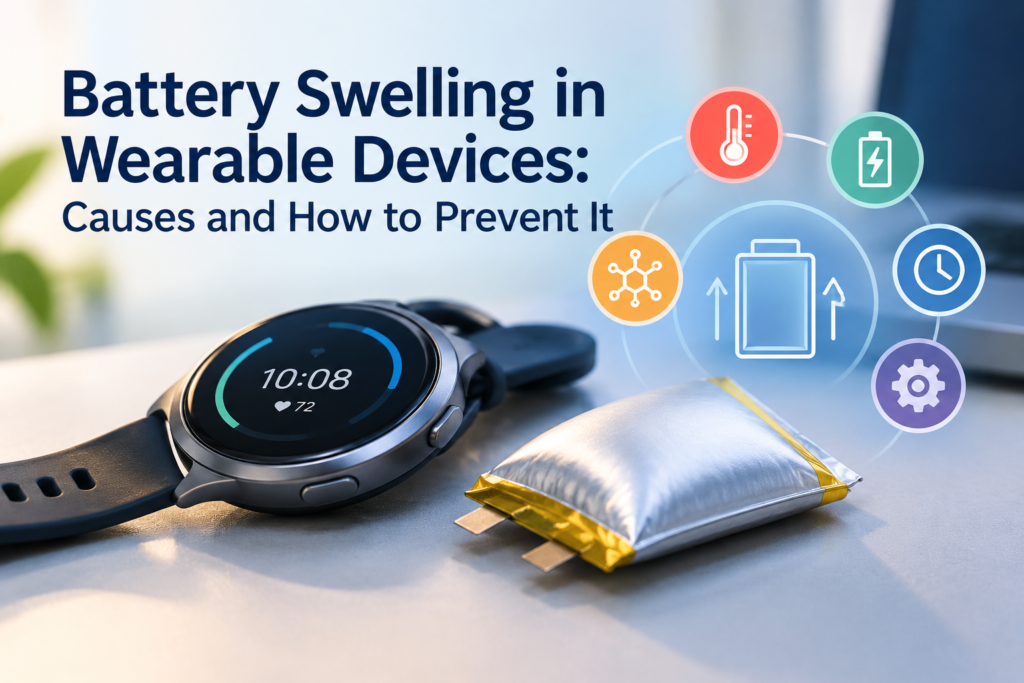
When I look at battery swelling in wearable devices, I rarely ask whether the battery is simply “bad.” Swelling can result from a combination of chemistry, charging, temperature, aging, mechanical pressure, and limited space inside the device.
In wearables, even a small increase in battery thickness can become a structural problem. From a battery manufacturer’s perspective, swelling is both a cell and system-design issue, so the goal is to identify the risks before mass production.
What Causes Battery Swelling in Wearable Devices?
Gas Generation Inside the Cell
One of the first things I look at when investigating a swollen pouch cell is gas generation.
As a lithium-ion battery ages or operates under unfavorable conditions, side reactions can produce gas inside the sealed pouch. This increases internal pressure and can gradually make the cell thicker. In other words, swelling does not always mean a sudden battery failure—it can be the result of degradation over time.
That is why I look beyond the appearance of the battery. I also consider its charging, storage, cycling, and temperature history to understand what caused the swelling.
Heat Accelerates Battery Degradation
Temperature is another factor I pay close attention to. Higher temperatures can accelerate battery degradation, side reactions, and gas generation.
In wearable devices, heat may come from the processor, display, charging circuit, or the battery itself during charging. The battery may also stay close to body heat for long periods. This does not mean skin contact automatically causes swelling, but the actual thermal environment of the finished product should be considered during design and testing.
Charging Conditions Can Increase the Risk
Charging behavior is another factor I pay close attention to. Overcharging, high charging temperatures, and poorly controlled charging conditions can accelerate side reactions and increase the risk of gas generation and swelling.
This is especially important for wearables that are charged frequently. When evaluating a battery project, I look at the battery, BMS or protection circuit, charger, and actual application conditions as one system rather than treating the cell specification separately.
Aging and Long-Term Storage Matter Too
A battery does not need to be heavily used every day to experience degradation. Calendar aging can occur while the battery is sitting in storage, especially under unfavorable temperature or state-of-charge conditions. A product can also spend considerable time at a high state of charge during shipping, storage, or periods when the user is not actively using it.
This is one reason a battery may appear normal during early testing but show swelling later. I have seen this kind of situation discussed in product development many times: the prototype passes the initial functional test, but the team discovers a problem after extended cycling, storage, or environmental testing.
The question then becomes more complicated than “Did the battery pass the first test?” A meaningful evaluation needs to consider how the battery will actually be used throughout its expected life.
Mechanical Damage and Manufacturing Defects
Not every swollen battery is caused by aging. Physical damage, manufacturing defects, internal layer damage, overcharging, and excessive temperature can also contribute to gas generation and swelling.
For pouch cells, I also pay close attention to how the battery is installed. Compression, uneven pressure, sharp edges, limited clearance, or excessive adhesive stress can all create problems. These details are easy to overlook when the product is still only a CAD model.
Why Is Battery Swelling More Serious in Wearable Devices?
The chemistry behind battery swelling is not unique to wearables. What makes swelling more serious is the limited mechanical tolerance of compact, tightly integrated products.
| Key Issue | Why It Matters in Wearable Devices | Potential Impact |
|---|---|---|
| Very Limited Expansion Space | Batteries often use almost all available space, leaving little room for thickness changes. | Pressure on the enclosure, display, sensors, PCB, or other components. |
| Ultra-Thin Battery Design | Thin batteries have very limited mechanical tolerance and must account for assembly and long-term dimensional changes. | Small thickness changes can become significant structural problems. |
| Curved & Irregular Shapes | Smart rings, smart glasses, and medical patches often have curved or narrow battery compartments. | Swelling can change how mechanical forces are transferred inside the device. |
| Mechanical Failure Risk | Battery swelling can create pressure on surrounding components. | Component displacement, lifted covers, damaged displays, weakened adhesive bonding, or product failure. |
| Direct Skin Contact | Many wearables remain against the user’s body for extended periods. | Mechanical deformation and battery safety become more critical. |
| System-Level Design | Battery performance cannot be evaluated separately from the enclosure and surrounding components. | Battery, mechanical structure, thermal conditions, and safety need to be considered together. |
Why Battery Swelling Is Not Always a “Battery Quality” Problem
When a swollen battery is discovered, the first reaction is often to blame the battery supplier. Cell quality, materials, manufacturing, and quality control certainly matter, but I would not stop the investigation there.
In a wearable project, I look at the whole system: Cell + BMS + Charger + Mechanical Design + Thermal Environment + Usage. A good battery can still swell under poor charging conditions, insufficient clearance, excessive heat, or unsuitable use. That is why I treat battery swelling as a system-level engineering issue, rather than automatically blaming one component.
What I Look at Before Choosing a Battery for a Wearable Device
When our engineering team reviews a wearable battery project, we do not start with capacity alone. We look at the product’s space, application, protection requirements, and actual operating conditions.
We Check the Available Battery Space First
We first look at the available battery space, including thickness, shape, surrounding components, and mechanical clearance. These constraints help define the battery specification before we optimize capacity.
We Match Cell Selection to the Application
Capacity is only one requirement. We also consider temperature, charging conditions, discharge rate, cycle life, battery geometry, storage conditions, and protection requirements. A smart ring, smart glasses, and medical patch may require very different battery characteristics.
We Review BMS and Protection Design Early
The BMS or protection circuit should be considered together with the cell and the finished product. Depending on the application, this may include overcharge, over-discharge, over-current, and over-temperature protection, as well as temperature monitoring.
We Test the Battery in the Actual Product
Cell testing is not the same as finished-product validation. A battery may perform well in the lab but behave differently once installed inside the wearable. We therefore consider charging, cycling, thermal, mechanical, and actual operating conditions during validation.
A Typical Wearable Battery Swelling Scenario
Here is a typical situation I have seen in wearable battery projects.
A product team wants longer runtime without increasing the device thickness, so the battery compartment is redesigned to use almost all available space. The prototype works normally, and the battery passes its initial functional tests.
Several weeks later, after extended charging and aging tests, the battery becomes slightly thicker and starts putting pressure on the enclosure. At first, it looks like a battery-quality problem. But after reviewing the system, we find that the mechanical design had left almost no margin for dimensional change.
The issue was not simply that the battery changed. The product had been designed as though the battery would never change.
This is much easier to address before mass production, while the enclosure, tooling, charging system, and battery specifications can still be adjusted.
The lesson is simple: a battery needs operating margin, and the product needs mechanical margin.
How Can Manufacturers Reduce Battery Swelling Risk?
From the manufacturing side, I think about prevention at several levels, starting with the cell itself and continuing through charging, mechanical design, and final product validation.
Start With Cell-Level Control
The first layer is the cell itself. This includes appropriate material selection, electrode and cell design, manufacturing consistency, formation processes, and quality control. The objective is not simply to make the battery smaller or achieve higher energy density, but to ensure that the cell remains stable under the operating conditions expected by the finished product.
Match BMS and Charging Strategy to the Cell
The second layer is protection and charging. The BMS or protection circuit should be designed around the actual cell specification and application requirements, while charging parameters also need to be properly controlled. A battery should not be selected first and then expected to tolerate an unrelated charging strategy. The cell and charging system need to be developed together.
Leave Enough Mechanical Margin
The third layer is the product structure. The goal is not to assume that the battery will never experience any dimensional change throughout its life, but to make sure that normal dimensional variation does not immediately become a mechanical failure. This is particularly important for ultra-thin and irregularly shaped wearable batteries, where even a small increase in thickness can affect surrounding components.
Validate Under Realistic Conditions
The final layer is system validation. I would pay particular attention to the conditions the finished product will actually experience, including repeated charging, long periods of storage, elevated temperatures, mechanical pressure, extended cycling, and the actual enclosure environment. These tests are much more informative than evaluating the battery in isolation because they show how the battery performs as part of the complete product.
A Practical Checklist for Wearable Battery Design
Before freezing the battery design for a wearable device, I recommend reviewing the following items:
| Design Item | What to Review |
|---|---|
| Cell thickness | Maximum allowable thickness and tolerance |
| Mechanical clearance | Space available around the battery |
| Battery shape | Flat, curved, narrow, or irregular geometry |
| Charging voltage | Match the cell’s specified charging range |
| Charging current | Normal and fast-charging conditions |
| Temperature | Product operating and charging environment |
| BMS / protection | Overcharge, over-discharge, over-current, and temperature protection |
| Storage | Expected storage state of charge and temperature |
| Mechanical pressure | Compression or contact from the enclosure |
| Validation | Battery-level and finished-product testing |
I find this checklist useful because it changes the question from“Which battery has enough capacity? to“Which battery can operate reliably inside this product?”
That is a much better question for wearable battery development.
Conclusion
Battery swelling in a wearable device rarely has a single cause. Gas generation, aging, temperature, charging conditions, mechanical stress, manufacturing quality, and product design can all play a role.
What makes wearables more challenging is their limited mechanical margin. A small change in battery thickness can quickly become a product-level problem, especially when the device is worn close to the skin. From a battery manufacturer’s perspective, the best time to address swelling risk is before the battery enters the final product. Cell selection, protection, charging, mechanical clearance, thermal conditions, and system validation need to be considered together.
At LanDazzle, we work with wearable product teams on custom lithium battery development, including ultra-thin, curved, narrow, and other space-constrained battery designs. Our engineering approach starts with understanding how the battery will actually fit and operate inside the product—not simply selecting a cell based on capacity.
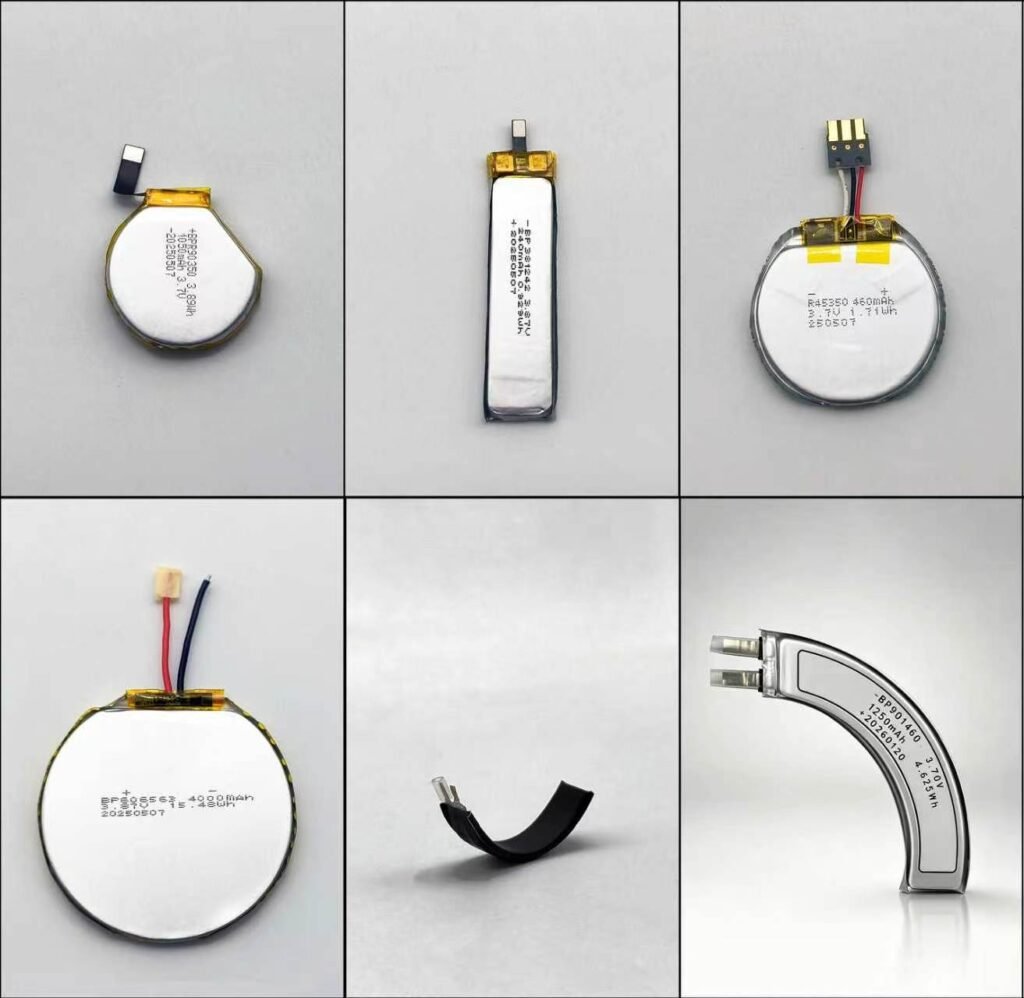
Have a wearable product with tight battery space? Send us your battery dimensions or CAD file, and our engineering team can review a suitable battery approach.
Email: info@landazzle.com
Whatsapp: +8618938252128