Table of Contents
Not every medical device needs a low-temperature battery. However, devices that must operate, monitor, or provide treatment in cold environments may require batteries specifically designed to maintain reliable performance below 0°C.
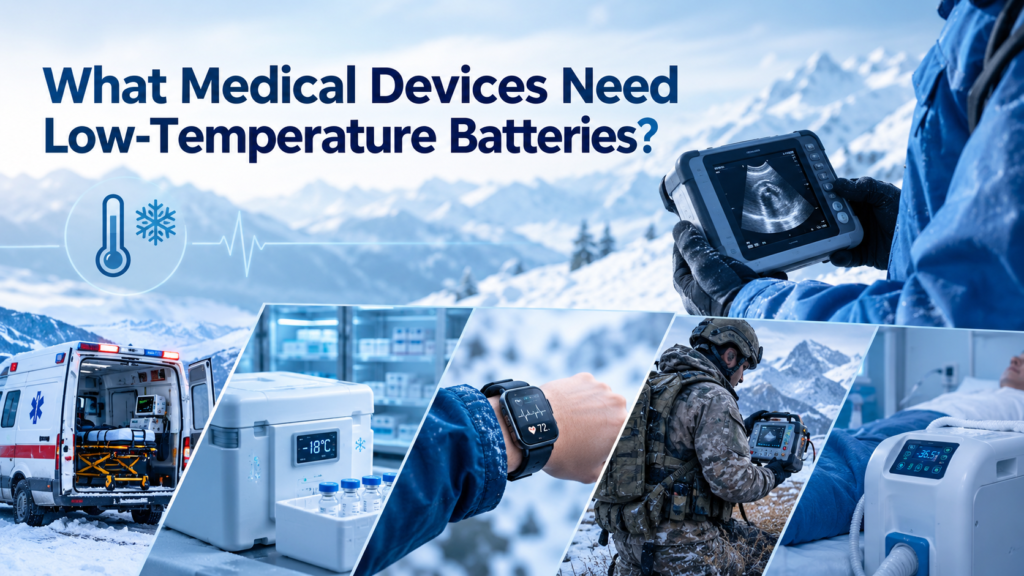
Typical examples include portable ultrasound systems, patient monitoring equipment, portable ventilators, emergency medical equipment, cold-chain monitoring devices, and some wearable medical devices used outdoors or in extreme environments.
The reason is simple: as temperature drops, lithium-ion battery performance can deteriorate. Lower temperatures slow lithium-ion transport and increase internal resistance, which can reduce available capacity, cause greater voltage drop, and limit discharge performance.
So, the key question is not simply whether a medical device is exposed to cold. It is whether the battery must continue providing reliable power while the device is exposed to that temperature.
Why Does Cold Temperature Affect Medical Device Batteries?
Lithium-ion batteries rely on the movement of lithium ions through the electrolyte and electrodes. At low temperatures, ion transport becomes slower and the resistance inside the cell increases. Research reviews identify reduced electrolyte conductivity, slower interfacial charge-transfer kinetics, and slower lithium-ion diffusion as important causes of low-temperature performance loss.
For a medical device, this can lead to several practical problems:
- Reduced usable battery capacity
- Higher voltage drop during discharge
- Lower power output
- Shorter operating time
- Slower or more difficult charging
The impact becomes more important when a device is small, portable, battery-powered, and expected to operate without frequent access to a warm indoor environment.
Which Medical Devices Need Low-Temperature Batteries?
1. Portable Ultrasound and Patient Monitoring Equipment
Portable ultrasound and patient monitoring systems are increasingly useful outside conventional hospital environments, including emergency care, remote medicine, and field operations.
A 2026 review of medical care in extreme cold environments found that portable ultrasound was particularly useful for diagnosis and procedural guidance in cold settings. The same review noted accelerated battery degradation in cold exposure and highlighted the importance of power management and device-warming strategies.
Other portable monitoring equipment may face similar conditions, including:
- ECG monitors
- Pulse oximeters
- Portable vital-sign monitors
- Portable diagnostic devices
These devices may not require specialized batteries when used indoors, but the requirement changes when they must operate outdoors or in very cold environments.
2. Portable Ventilators and Respiratory Equipment
Portable ventilators are another example where temperature can become an equipment-design consideration.
In one study, several portable ventilators were evaluated after storage at temperature extremes, including −35°C. The researchers found that extreme-temperature storage affected the performance of the ventilators tested, with some devices requiring additional acclimation before operating as intended.
The battery is only one part of the system, but for a portable, battery-powered ventilator, reliable power remains an important engineering requirement.
This is especially relevant for:
- Ambulance transport
- Emergency response
- Military medicine
- Remote medical care
- Outdoor patient transport
3. Emergency and Ambulance Medical Equipment
Medical equipment used in ambulances or emergency response may be moved between indoor and outdoor environments, transported through winter conditions, or deployed at accident sites where temperature control is limited.
Potential examples include:
- Portable patient monitors
- Defibrillators
- Infusion pumps
- Portable ventilators
- Emergency diagnostic equipment
In these situations, the battery may need to deliver stable power immediately rather than after the device has been warmed to room temperature.
That creates a different requirement from ordinary consumer electronics: the battery’s actual operating temperature range becomes part of the device design.
4. Cold-Chain Monitoring Devices
Cold-chain monitoring is one of the clearest examples of medical devices operating in controlled low-temperature environments.
The World Health Organization’s specifications for vaccine and immunization cold chains include temperature data loggers, electronic shipping indicators, freeze indicators, event monitoring systems, and equipment monitoring devices.
Some electronic monitoring devices use non-replaceable batteries, and WHO maintains specifications for devices used to monitor temperatures throughout the vaccine cold chain.
For these products, battery requirements can include:
- Reliable operation at low temperatures
- Long operating time
- Low self-discharge
- Stable voltage for sensors and communication
- Compact dimensions for small monitoring devices
The challenge is not necessarily high power. In many cases, long-term reliability in a cold environment is more important.
5. Wearable Medical Devices Used Outdoors
Many wearable medical devices are designed for continuous monitoring and compact form factors. When these devices are used outdoors in cold weather, battery performance can become a limiting factor.
Potential examples include:
- Wearable ECG monitors
- Patch-based medical sensors
- Portable patient monitoring devices
- Wearable vital-sign sensors
For small medical wearables, the challenge is often two-fold: the battery must perform reliably in cold conditions while also fitting within a very limited space.
This can make battery shape and dimensions just as important as electrical performance.
A conventional rectangular battery may not always be the best fit when the available space is curved, narrow, or irregular.
When Does a Medical Device Actually Need a Low-Temperature Battery?
A medical device may need a dedicated low-temperature battery when several conditions apply.
The device operates below 0°C
The first question is the actual minimum operating temperature. A device used occasionally at 0°C has a different requirement from one that must operate continuously at −20°C or −40°C.
The battery must remain functional during cold exposure
Storage temperature and operating temperature are not the same.
A device may tolerate temporary cold storage but still require the battery to perform normally immediately after exposure.
The device has limited access to external power
Portable equipment used in ambulances, field medicine, remote locations, or cold-chain transport cannot always rely on external power or rapid battery replacement.
Stable power is critical
For monitoring, ventilation, emergency response, or other medical applications, unexpected battery voltage drop can affect how long the device can operate.
What Should You Look for in a Low-Temperature Medical Battery?
When selecting a battery for a medical device used in cold environments, several factors should be considered together.
Low-temperature discharge performance is one of the most important. Instead of asking only for the nominal capacity, engineers should evaluate how much usable capacity remains at the actual operating temperature.
Internal resistance and voltage behavior also matter. Higher resistance at low temperatures can produce greater voltage drop, particularly during high-current discharge.
Charging requirements should be evaluated separately. A battery that can discharge at low temperatures may not necessarily be suitable for charging under the same conditions.
Operating temperature range should match the real environment, including both minimum and maximum temperatures.
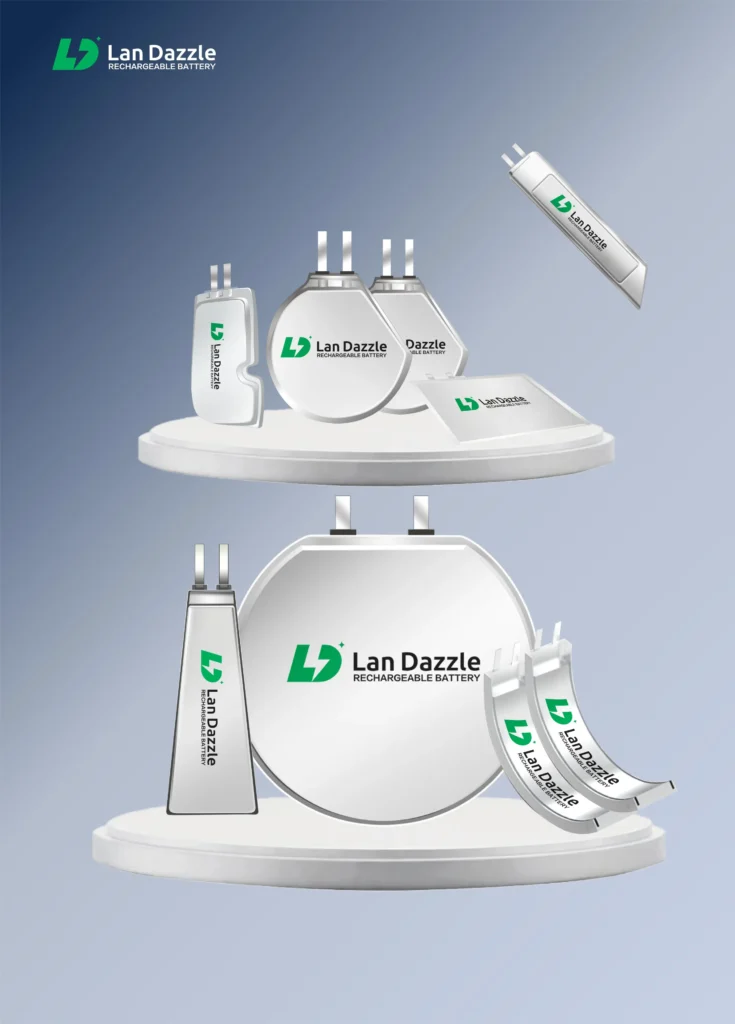
Finally, battery size and shape can be critical for portable and wearable medical devices. A custom-shaped battery can sometimes make better use of constrained space than a standard rectangular cell.
Conclusion
Low-temperature batteries are not required for every medical device. They become relevant when a battery-powered device must continue operating reliably in cold environments.
The most likely applications include portable ultrasound and monitoring equipment, emergency medical systems, portable ventilators, cold-chain monitoring devices, and certain wearable medical devices used outdoors.
For engineers, the best starting point is to define the actual conditions the battery must handle: minimum temperature, runtime, discharge current, charging conditions, available space, and required reliability.
Once those requirements are clear, battery chemistry, cell construction, thermal management, and battery form factor can be evaluated as part of the overall medical device design.
Need a Battery for a Medical Device Used in Cold Environments?
The right battery specification starts with the device’s actual operating conditions. A custom battery supplier can help evaluate temperature range, capacity, discharge requirements, dimensions, and packaging to determine whether a dedicated low-temperature design is appropriate.
Email: info@landazzle.com
Whatsapp: +8618938252128