
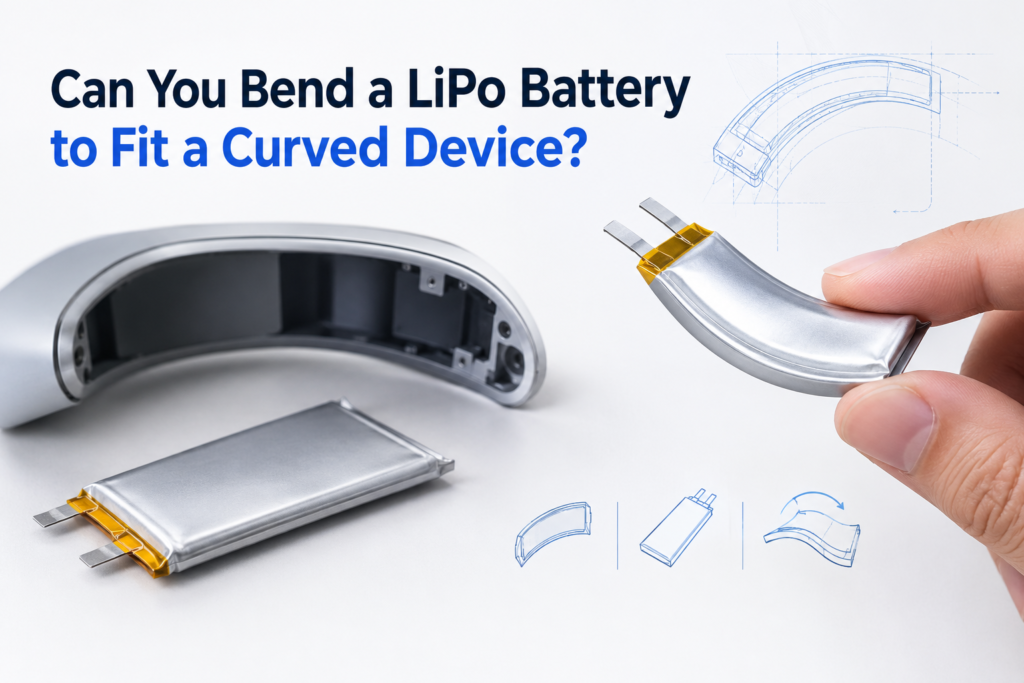
When designing a compact electronic device, battery placement can become a real challenge. The enclosure may have a curved profile, the internal space may be extremely limited, and a standard flat LiPo battery may not fit the way the mechanical design requires.
At that point, a simple question comes up: Can you bend a LiPo battery slightly to make it fit?
My first step would be to distinguish between a battery designed to bend and a finished battery that someone wants to bend after manufacturing. They are not the same thing.
A standard LiPo pouch cell should not be manually bent or reshaped unless the manufacturer has explicitly approved that type of deformation. If the product requires a curved battery profile, I would evaluate the battery design itself before trying to modify an existing cell.
Why Isn’t a Standard LiPo Battery Designed to Bend?
A LiPo battery uses a pouch-style outer package, which can make it look more flexible than a rigid metal-cased battery. However, the soft packaging does not mean the cell’s internal structure can safely change shape.
Inside the cell, the electrodes, separator and other components must maintain their intended arrangement. The separator keeps the positive and negative electrodes from making direct contact while allowing ions to move between them.
When a finished cell is bent beyond its qualified mechanical limits, the internal layers may experience uneven stress, compression or deformation. Depending on the cell construction and loading conditions, this can damage the separator or electrodes and potentially lead to an internal short circuit.
A 2020 study published in the Journal of Energy Storage examined lithium-ion pouch cells subjected to three-point bending. The researchers observed local damage to active materials and separators, even though the cells did not necessarily show immediate, easily detectable electrical symptoms.
This is an important distinction: a battery may continue to operate after mechanical damage, but that does not establish that it remains safe.
Source: Lithium-ion Cell Response to Mechanical Abuse — Three-Point Bend
For this reason, I would not recommend bending a standard LiPo battery by hand, pressing it against a curved housing or trying to flatten it again after it has been deformed.
Can a Battery Be Designed for a Curved Device?
Yes. A curved device does not necessarily need a flat battery.
The key is to determine whether the battery should be manufactured with a curved profile or whether the application actually requires a battery that can flex repeatedly during use.
These are two different design requirements.
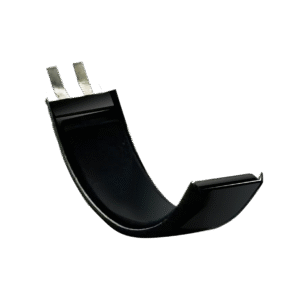
1. Curved Batteries: A Fixed Shape Designed for the Enclosure
A curved battery is designed and manufactured to follow a specified profile. Rather than forcing a flat, finished cell into a curved space, the battery geometry is considered during the design process.
This approach can be useful for products such as:
- Smart rings and curved wearable devices
- Smart glasses and AR wearables
- Wristbands and fitness trackers
- Curved medical patches and compact electronic devices
When evaluating this type of solution, I would start with the available battery cavity, the required curvature, the maximum thickness and the space needed for electrical connections.
I would also check whether the proposed shape can be manufactured consistently and whether the resulting battery can meet the product’s capacity, power and safety requirements.
A curved profile does not automatically guarantee a higher capacity. Its main advantage is that it may use the available space more efficiently than a standard rectangular cell.
2. Flexible Batteries: Designed for Controlled Bending
A flexible battery is a different proposition.
Some battery designs are specifically developed and tested to withstand bending under defined conditions. Their performance depends on factors such as electrode construction, cell dimensions, bending direction, curvature and the number of bending cycles.
Research published in Batteries and Electrochemistry in 2024 examined how repeated flexing affects ultrathin lithium-ion pouch cells. The findings showed that mechanical failure modes and electrochemical performance depend on the cell’s design and bending conditions.
These results should not be interpreted as permission to bend an ordinary LiPo battery. A cell validated for a particular bending radius and test setup is not necessarily suitable for a different radius, bending direction or application.
If a product must flex repeatedly during normal use, I would look for a battery specifically designed and qualified for those conditions rather than assuming that a curved battery can also flex.
What If You Have Already Bent a LiPo Battery?
If a standard LiPo battery has been creased, visibly deformed, punctured or otherwise mechanically damaged, I would stop using and charging it.
Do not try to bend it back into shape or press it flat against the enclosure. Follow the battery manufacturer’s safety guidance and local requirements for handling and disposal of damaged lithium batteries.
For future designs, it is much better to resolve the shape constraint during the engineering stage than to modify a finished cell to make it fit.
Frequently Asked Questions
Can I bend a LiPo battery just a little?
Not unless the battery manufacturer has explicitly confirmed that the cell can withstand the intended deformation under the specified conditions. A small visible bend does not guarantee that the internal layers are undamaged.
Are curved LiPo batteries the same as flexible batteries?
No. A curved battery is generally manufactured to have a defined profile, while a flexible battery is designed and qualified for specified bending conditions. A curved cell should not automatically be treated as suitable for repeated flexing.
Can a custom curved battery provide more capacity?
Potentially, it can accommodate a better-fitting shape and reduce unused space in the enclosure. However, capacity depends on the cell’s active volume, chemistry, thickness and other design constraints. A better fit does not automatically mean a higher-capacity battery.
What information is needed to evaluate a curved battery?
I would start with the available battery cavity, target curvature, maximum dimensions, required voltage and capacity, current profile, charging requirements and expected operating environment. A 3D model or STEP file can help evaluate the mechanical fit, although electrical and manufacturing feasibility must also be assessed.
Final Thoughts
When a flat LiPo battery does not fit a curved device, bending the finished cell is not the solution I would start with.
I would first check whether the enclosure can accommodate a standard battery in another position. If the product genuinely requires a curved profile, I would evaluate a purpose-designed curved battery and validate both its electrical performance and mechanical integration.
The underlying principle is simple: design the battery around the product’s geometry, rather than forcing a finished battery to fit the product.
For devices with tight dimensional constraints, custom curved battery solutions are one option worth evaluating during the early design stage.