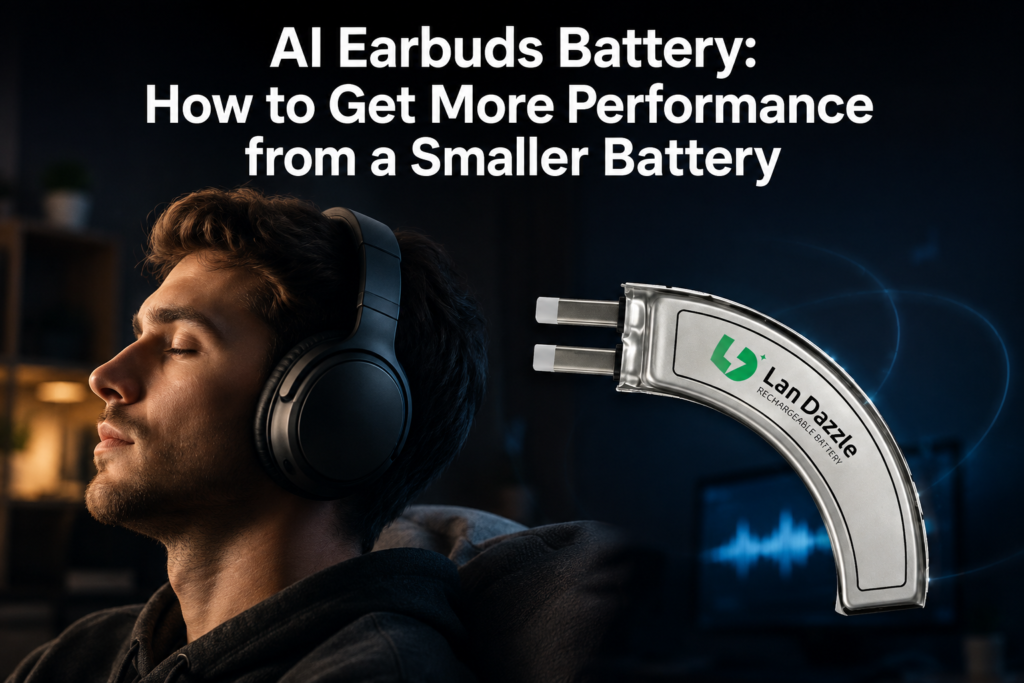
In the past, the core value of earbuds was mainly focused on audio quality, active noise cancellation (ANC), and connectivity. As generative AI, voice recognition, and edge AI technologies move into consumer electronics, earbuds are gradually evolving from simple audio devices into more intelligent and proactive terminals. The latest generation of AI earbuds may support real-time voice interaction, speech transcription, simultaneous translation, environmental sound recognition, and AI assistants in addition to music playback and phone calls.
These functions require more data processing—and inevitably, more power. This raises an important question:
As earbuds become smarter, can the tiny battery inside them still provide enough power and runtime?
For AI earbuds, the real bottleneck may no longer be just the processor. It may be the combination of limited internal space, battery energy density, transient power capability, and thermal management.
The AI Earbuds Battery Challenge
Traditional TWS earbuds mainly handle Bluetooth, audio playback, calls, and noise cancellation.
AI earbuds add more power-hungry functions, such as AI processors or NPUs, multiple microphones, real-time translation, and voice recognition and processing.
These functions can significantly increase power consumption. When earbuds are continuously listening, processing audio, communicating wirelessly, and running AI features, multiple components may work at the same time. The core challenge is simple: More functions, but no more internal space.
Why Traditional Batteries Are Becoming Less Suitable
Earbuds have extremely limited internal space, which must be shared by the battery, speaker, PCB, microphones, antenna, and other components. Standard batteries are easier to manufacture, but their fixed shapes can leave unused space inside the earbud. Even a small amount of wasted space can reduce the available battery capacity.
This creates three common trade-offs:
- Larger battery → More weight
- Same battery size → Shorter runtime
- Higher power demand → More heat
For next-generation AI earbuds, battery design is becoming just as important as chip and software design.
How Custom-Shaped Batteries Improve Space Utilization
Several battery designs can be considered for extremely compact earbud enclosures.
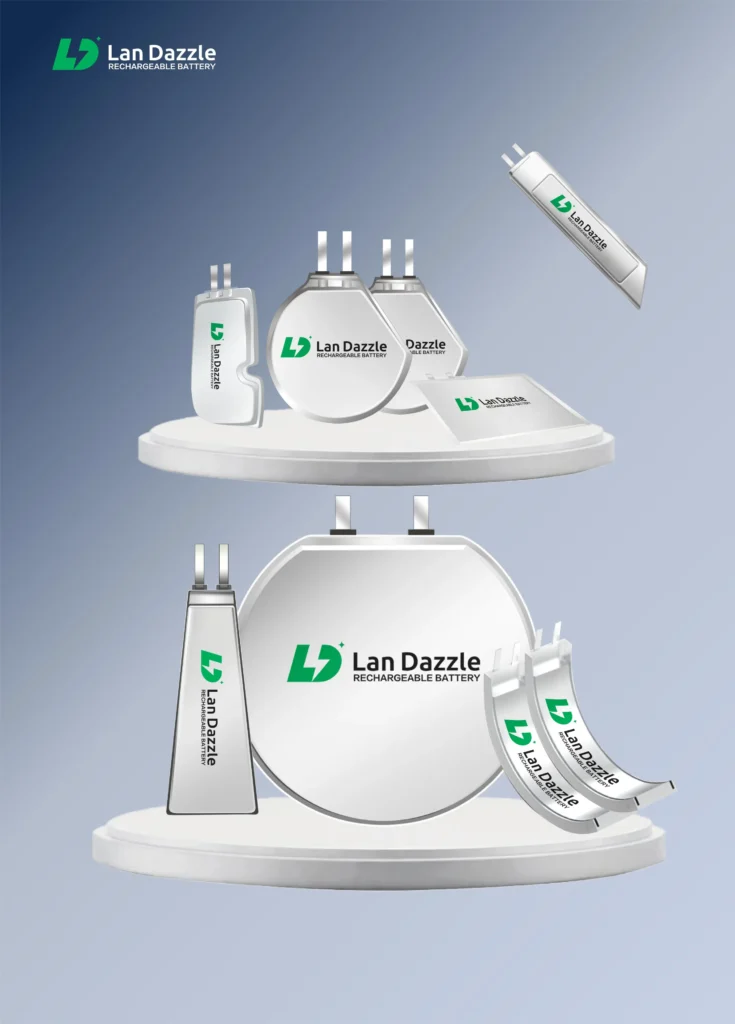
Curved Batteries
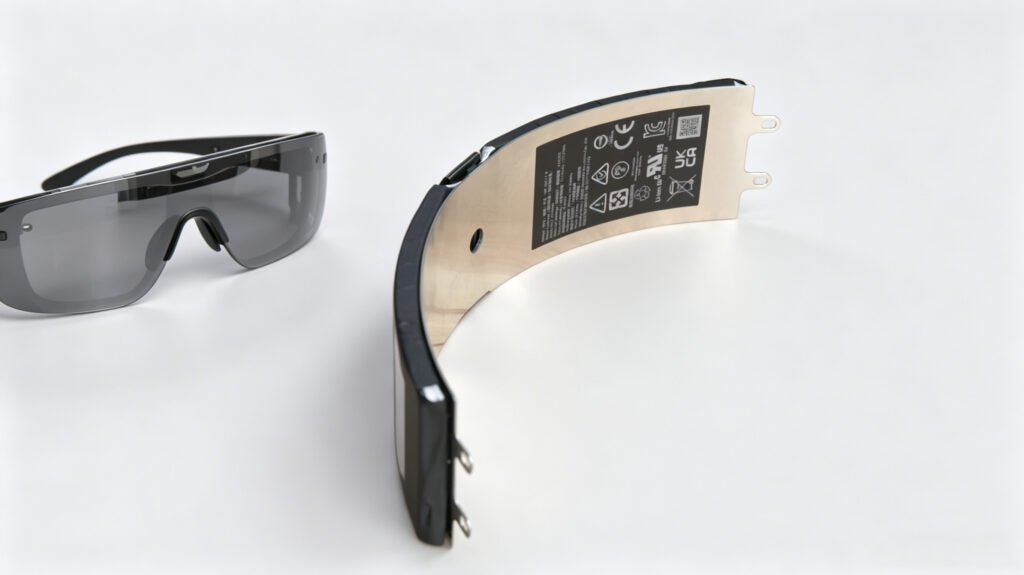
When the internal enclosure includes curved surfaces, the battery can be designed to follow the available geometry. This can reduce unused gaps between the battery and housing and turn otherwise difficult-to-use corner space into active battery volume.
Ultra-Narrow or Pin-Type Cells
For narrow areas such as earbud stems, ultra-narrow cells can be designed to fit into spaces that standard rectangular batteries cannot effectively use. This approach is particularly suitable for spaces that are long, narrow and depth-constrained.
Custom-Shaped Steel-Can Batteries
For applications requiring greater structural rigidity or a specific packaging format, a custom steel-can battery may also be considered.
The goal is not simply to make the battery larger.It is to make the battery occupy as much of the truly usable internal volume as possible.
Battery Chemistry and Higher Energy Density for AI Earbuds
Even after maximizing available space, AI earbuds still face the challenge of how much energy the battery can store within that limited volume, making cell chemistry and internal architecture critical.
Energy Density Determines How Much Energy Fits Into a Small Space
For compact wearable devices, battery dimensions cannot increase indefinitely. That makes volumetric energy density, measured in Wh/L, particularly important.
The higher the energy density, the more energy can be stored within the same volume. This is why technologies such as silicon-carbon anodes, higher-voltage systems, and stacking technology are attracting attention in advanced small-cell designs.
Silicon-Carbon Anodes
Conventional graphite anodes are mature and widely used, but silicon-based materials are receiving increasing attention as battery designers pursue higher energy density. Silicon has a much higher theoretical lithium storage capacity than graphite. Silicon-carbon anode systems can therefore provide a path toward greater energy density.
However, silicon-based materials also introduce technical challenges, particularly volume expansion during cycling and interface stability. For AI earbud batteries, the goal is therefore not simply to “add silicon,” but to balance material system, cell structure and cycle stability.
Higher-Voltage Battery Systems
Increasing operating voltage is another way to increase battery energy density.
Under otherwise similar conditions: Energy = Voltage × Capacity
Therefore, a higher-voltage electrochemical system can potentially provide more energy without significantly increasing cell volume. However, higher-voltage systems also place greater demands on materials, cell design, and safety. The appropriate chemistry must therefore be selected according to the specific application requirements.
AI Earbuds Also Need to Handle Transient Power Demand
AI earbuds do not necessarily consume the same amount of power all the time. Many AI functions create short periods of significantly higher power demand.
For example, when a user says “Translate this,” the device may need to quickly handle voice capture, signal processing, AI computing, wireless communication, and audio output within a very short period.
In these situations, battery capacity alone is not enough; internal resistance, C-rate, and voltage stability are also critical factors.
Why Low Internal Resistance Matters
When a battery delivers a high current, internal resistance causes a voltage drop. At higher current, a battery with higher internal resistance will experience greater voltage drop. This may be less noticeable in low-power electronics, but it becomes more important in AI earbuds that may require bursts of computation and wireless communication.
A low-internal-resistance cell can help reduce:
- Instantaneous voltage drop
- Energy losses
- Internal heat generation
This allows the battery to better handle short bursts of high power.
Near-Ear Safety and Thermal Management
Unlike smartphones or tablets, earbuds stay close to the user’s skin for long periods. This makes thermal management, swelling control, and long-term battery safety especially important.
Low internal resistance also helps reduct heat. A battery’s internal resistance causes energy loss as heat when current flows. As current increases, heat generation rises rapidly:
Power Loss ≈ I²R
Under the same load, a battery with lower internal resistance produces less heat. For highly integrated AI earbuds, this can help control:
- Battery temperature
- AI processor temperature
- PCB and enclosure temperature
- Overall wearing comfort
Battery Swelling Must Be Considered Early
Lithium-ion batteries can experience thickness changes during long-term operation, which is particularly important in earbuds where internal space is extremely limited. If the battery is designed with little or no mechanical allowance, thickness growth may place additional pressure on surrounding components and affect the overall reliability of the device.
Therefore, AI earbud battery design should not ask only:“How much capacity can we get?”
It should also ask:“How much capacity can we safely fit within the allowable swelling and mechanical tolerance?”
This is why capacity, cycle life, and swelling performance should be evaluated together rather than optimizing only for maximum capacity.
Steel-Can Packaging and Battery Safety
For some ultra-compact applications, steel-can packaging may also be worth considering. Compared with flexible pouch cells, steel-can structures provide greater mechanical rigidity and can offer different design possibilities for specific mechanical architectures.
However, the appropriate packaging technology should always be selected based on:
Available Space + Capacity + Thickness + Mechanical Structure + Safety Requirements
Battery safety validation should also be performed according to the specific application and applicable testing requirements, including relevant electrical, thermal, and mechanical abuse conditions. For commercial products, safety design should be aligned with the appropriate battery standards and certification requirements rather than relying on a single test.
Custom AI Earbud Battery Development: From CAD Space to Prototype
Highly integrated products such as AI earbuds often require a battery designed around the device rather than a standard battery format. The development process typically starts with the CAD drawing, 3D model, or available battery space, allowing engineers to define the required length, width, thickness, shape, and PCB position. Different battery concepts can then be developed and optimized for capacity, energy density, C-rate, swelling, and cycle life. Finally, prototypes are tested for mechanical fit, electrical performance, cycle life, swelling, and safety to ensure the battery meets both performance and system-integration requirements.
The Next AI Earbud Competition May Be Inside the Battery
AI is transforming earbuds from simple audio accessories into sophisticated intelligent devices. As microphones, processing power, and real-time AI functions increase, so does power demand—while the available space inside the earbud remains limited.
The future of AI earbuds will therefore depend not only on smarter AI, but also on how much energy can be stored in less space.
This makes custom-shaped batteries, ultra-thin cells, high energy density, and low internal resistance increasingly important. For product development teams, battery design should not be an afterthought. It should be considered from day one of product development.
Looking for a Custom Battery for Your AI Earbuds?
If you are developing AI earbuds, smart earphones, wearable devices, or other space-constrained intelligent products, LanDazzle can develop customized battery solutions based on your internal CAD space, mechanical dimensions, and electrical requirements.
Share your battery space or CAD drawing with us to explore a custom battery solution for your device.
Email: info@landazzle.com
Whatsapp: +8618938252128