A pair of glasses that looks ordinary is becoming a new battleground that big tech companies are betting on for the future. As innovation in smartphones starts to slow down, everyone is turning their attention to this “new device” worn on the face.
AI Glasses 2026: What New Things Can AI Glasses Do?
Independence is the biggest surprise. Thunderbird has launched the industry’s first AI glasses with eSIM, which means they can completely break away from the phone and make calls or use mobile data on their own. This is more than just carrying one less device—it marks the shift of AI glasses from being a phone accessory to becoming a next-generation personal computing platform.
Focus matters more than being all-in-one. In the early stage of the industry, manufacturers tried to build “all-purpose glasses,” but the result was often average in everything. This year, we clearly see a trend toward specialization: glasses designed for gamers with ultra-low latency display, golf glasses that analyze swings, and even assistive glasses for visually impaired users. Going deeper into specific scenarios is proving more effective than trying to cover everything.
Battery life is no longer a false problem. In the past, the biggest pain point of AI glasses was “two hours of use, one day of charging.” This year, many companies introduced replaceable battery temple designs, making battery swaps as easy as changing parts. Magnetic capsule batteries also make charging as simple as snapping onto a power bank. The most important breakthrough is at the architecture level—dual-chip designs with SoC + MCU are becoming mainstream. The high-performance chip handles complex tasks, while the low-power chip maintains basic functions, turning battery life from a theoretical idea into a real user experience.
Lightweight design is the ultimate goal of wearable devices. Several new products have entered the sub-40-gram range, with the lightest weighing only 25 grams—almost the same as regular glasses. This is made possible by the maturity of waveguide display technology and advances in micro-components. When tech products no longer need to sacrifice comfort for “technology feel,” mass adoption truly begins.
How Technology Breaks the “Impossible Triangle”?
AI glasses have long faced an “impossible triangle”: lightweight design, long battery life, and high performance are hard to achieve at the same time. If you want a thinner and lighter device, you have to sacrifice battery capacity. If you want high performance, power consumption increases. If you want long battery life, the device usually becomes thicker and heavier. In 2026, this triangle is starting to break.
The optical module is a key battlefield for weight reduction. Waveguide technology is considered the ultimate solution for AR glasses—it works like an ultra-thin piece of glass that guides images into the lens from the side, enabling high transparency and a lightweight form. Although it is still expensive, the BirdBath solution has been improved this year, finding a better balance between cost and performance, and it is still widely used in the market.
The evolution of display technology is also crucial. Micro OLED, with its high contrast and fast response, is currently the top choice for high-end AI glasses. Micro LED, on the other hand, is seen as the future direction. It offers higher brightness and longer lifespan, and once production costs drop, it could completely reshape the display landscape.
The most important breakthrough is happening in computing architecture. Traditional single-chip solutions often suffer from either low performance or high power consumption. A heterogeneous SoC + MCU design is now becoming the industry standard. The high-performance SoC handles heavy tasks like AI recognition and image rendering, while the low-power MCU takes care of always-on functions such as sensor data collection and voice wake-up. This division of labor allows glasses to “run at full power” when needed and “sleep deeply” when idle.
Battery Technology Progress Is Just As Important
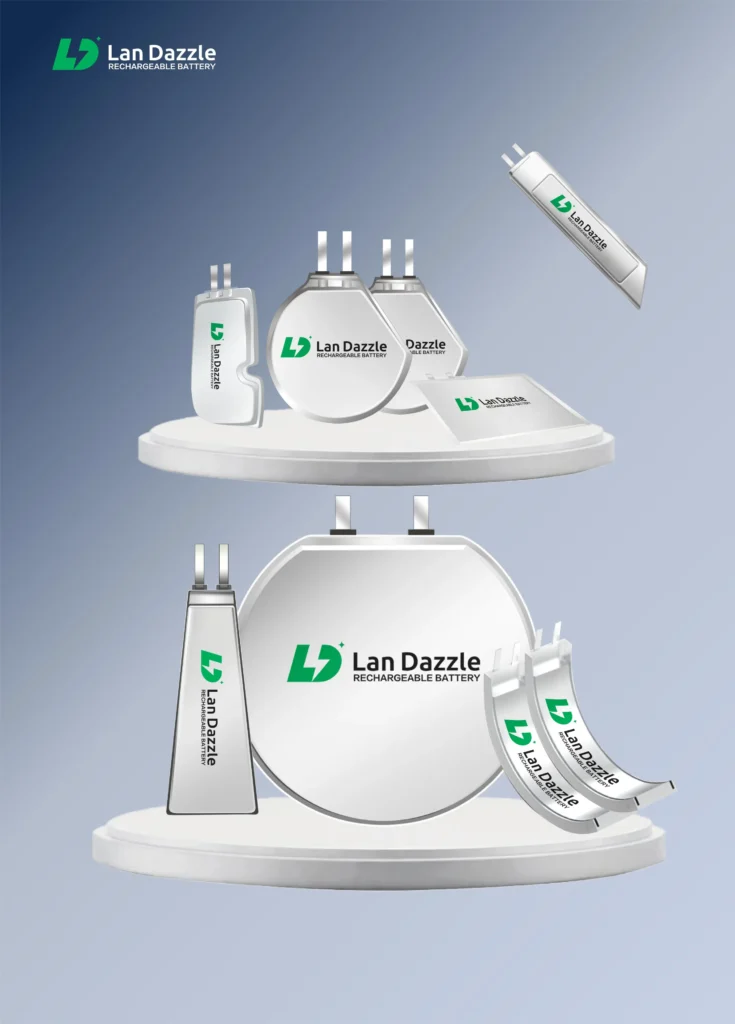
Lightweight Design & Custom-Shaped Packaging
Smart glasses usually need to weigh less than 50 g. Fitting a battery into such limited space requires innovative battery shapes and packaging methods.
By changing from wound cells to a stacked cell structure, the battery can better fit into curved temple areas while maintaining high space efficiency and mechanical strength.
Custom high-adhesion sealing layers are also developed to ensure that thin batteries do not leak or swell during temperature cycling from -20°C to 75°C.
In the future, flexible batteries (bendable or curved to match the temple shape) and integrated power designs (such as batteries built into the frame or headband) are expected to develop in parallel.
Thermal Management & Heat Dissipation
Because smart glasses are worn close to the skin, heat is extremely noticeable, so thermal design is a top priority.
High-conductivity materials such as graphene or copper foil, or phase change materials (PCM), are used to move heat away from the face.
For example, nano-carbon composite heat spreaders integrated on the battery surface can reduce skin-side temperature rise by 3–5°C in tests.
At the system level, distributed computing designs and sleep–wake power strategies help reduce long periods of high battery load.
Safety & Reliability
Battery failure in wearable devices can directly endanger users, so safety standards are very strict.
Using flame-retardant separators, ceramic or inorganic coatings, and gel electrolytes can help prevent fire during puncture or damage.
Manufacturers must comply with safety standards such as IEC 62133 and GB 31241, and conduct tests for high/low temperature, drop, and compression.
To address aging issues common in thin, long batteries, designs often include capacity margins, multi-cell parallel layouts, and high-precision BMS to monitor voltage and temperature.
Charging Solutions
The main charging methods today are USB-C wired charging and magnetic fast charging, with Qi wireless charging as a secondary option.
For safety reasons, fast charging for small cells is usually limited to ≤1C.
Example: Huawei Eyewear 2 uses 5V/1A magnetic charging and reaches full charge in about 50 minutes.
In the future, charging may evolve toward two-way wireless charging (charging while worn) and charging case + glasses systems, similar to TWS earbuds.
However, ultra-fast charging (such as several hours of use from a 5-minute charge) is still limited by battery chemistry safety.
Conclusion
Looking ahead to 2035, the industry has made a bold prediction: AI and AR smart glasses may partially replace traditional eyewear, reach a scale comparable to smartphones, and become the next general-purpose computing platform.
This vision may sound ambitious today, but the rise of smartphones—from early adoption to global mainstream use—took little more than a decade.
LanDazzle provides customized battery solutions specifically designed for smart glasses and other wearable devices.
With deep experience in ultra-thin lithium polymer batteries, curved and flexible cell design, and high-reliability battery packaging, we support our customers from concept design and prototyping to mass production and certification.
If you are developing AI glasses, AR eyewear, or next-generation wearable devices, and need a battery solution that balances size, weight, safety, and performance, our engineering team is ready to support your project.
👉 Contact LanDazzle to discuss your smart glasses battery solution
Email: info@landazzle.com
Whatsapp: +8618938252128