Table of Contents
Every customer wants a “perfect battery”: lightweight, high-capacity, capable of high discharge rates, and durable enough to maintain its performance after hundreds of cycles. But in reality, no such battery exists on the market.
High-rate batteries often sacrifice runtime and cycle life. High-energy-density batteries are generally not designed for aggressive discharge. And batteries optimized for long cycle life are often difficult to make extremely lightweight.
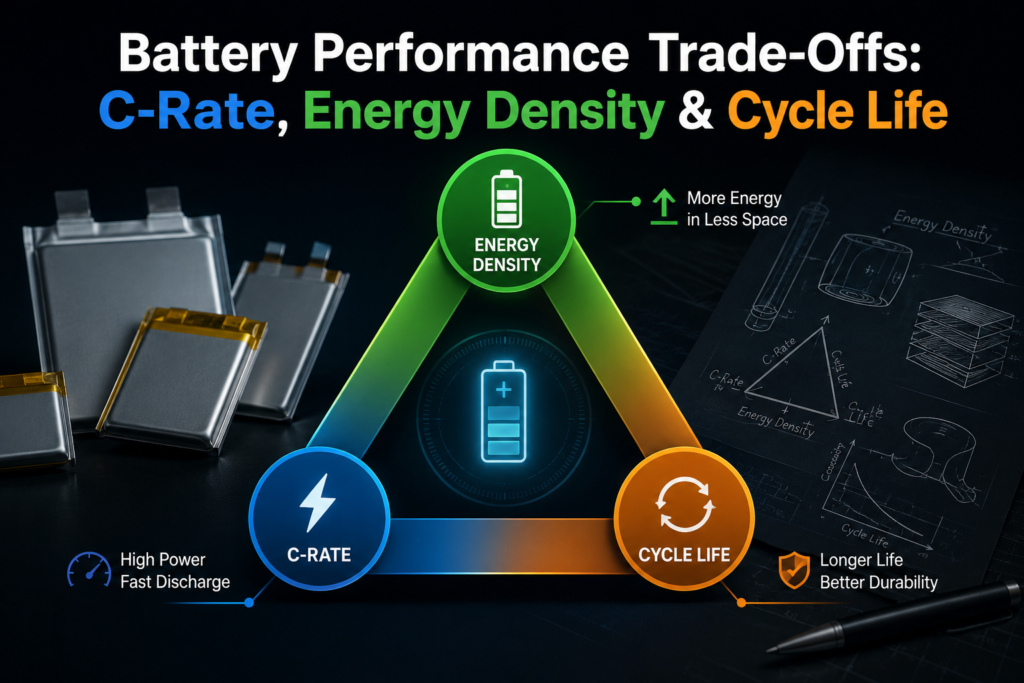
This is not because manufacturers are not trying hard enough. Rather, it is a fundamental limitation imposed by the material systems and engineering structures of lithium-ion batteries: rate capability, energy density, and cycle life cannot be independently maximized. Instead, they form an engineering “impossible triangle,” where improving one often requires compromises in the others.
Battery Trade-offs Betweent C-Rate, Energy Density & Cycle Life
Energy density determines how much energy a battery can store within a given weight or volume. It is typically measured in Wh/kg or Wh/L.
Rate capability indicates how well a battery can handle high-current discharge and is expressed as a C-rate. A 1C rate means the battery can theoretically discharge its full capacity in one hour, while 10C corresponds to about 6 minutes and 20C to about 3 minutes.
Cycle life refers to how many charge-discharge cycles a battery can complete before its capacity falls to a specified level. A common industry benchmark is 80% of the original capacity.
The challenge is that these three metrics compete for many of the same resources: the proportion of active materials, ion-transport pathways, electronic conductivity networks, available space for thermal management, and the structural stability of the battery materials.
The First Trade-Off: Energy Density vs. Rate Capability
The most direct way to increase energy density is to increase the proportion of active materials—for example, by making the electrodes thicker and more densely compacted while reducing the proportion of non-energy-storing components such as copper foil, aluminum foil, separators, and electrolyte. This allows more active material to fit into the same volume, resulting in higher capacity.
However, thicker electrodes introduce significant challenges. Lithium ions have a longer path to travel from the electrolyte into the deeper regions of the electrode. During high-current discharge, lithium ions may not migrate quickly enough through the electrode, increasing concentration polarization and causing the voltage to drop rapidly. The thicker and more densely compacted the electrode, the more likely its rate capability is to be limited.
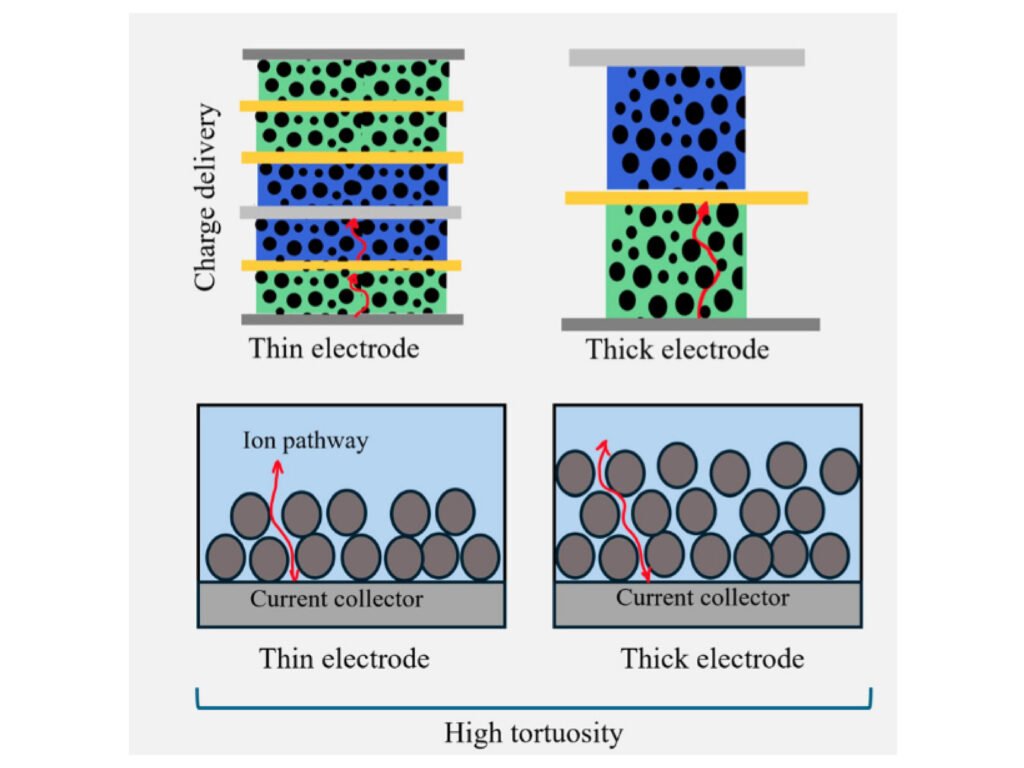
The design priorities of a high-rate battery are almost the opposite. It requires thinner electrodes, higher porosity, stronger conductive networks, and often more conductive additives to reduce internal resistance and shorten ion and electron transport pathways. However, conductive additives, pores, and current collectors do not contribute directly to battery capacity. They provide the “pathways” and “framework,” rather than the energy itself. As a result, improving rate capability often comes at the expense of energy density.
Simply put, high energy density aims to pack in more active material, while high rate capability aims to make current move faster. One prioritizes material loading; the other prioritizes transport pathways. That is where the fundamental trade-off begins.
The Second Trade-Off: Energy Density vs. Cycle Life
High energy density often relies on higher-capacity materials, such as high-nickel cathodes, silicon-carbon anodes, or electrodes with higher compaction density. These approaches can increase capacity, but they also amplify the mechanical and chemical stresses that materials experience during charge and discharge.
Take silicon anodes as an example. Silicon has a much higher theoretical capacity than graphite, but it undergoes significant volume expansion during lithiation. Repeated expansion and contraction can cause particles to crack and pulverize. The SEI (solid electrolyte interphase) layer can also continuously fracture and reform, consuming active lithium and electrolyte and accelerating capacity degradation.
High-nickel cathode materials face similar challenges. They offer high capacity, but their thermal and structural stability is more difficult to control. During cycling, they can be more susceptible to microcracking, interfacial side reactions, and increasing impedance.
Batteries designed for long cycle life, by contrast, tend to use more structurally stable materials and more conservative operating conditions. For example, lithium iron phosphate (LFP) offers excellent cycle life partly because its crystal structure remains relatively stable during charge and discharge. Graphite anodes also provide good cycle durability because their volume change is relatively small and their interface can be maintained more easily.
The trade-off is that these more stable material systems generally have lower capacity limits, which can constrain energy density.
In simple terms, high energy density pushes materials toward higher capacity, higher compaction, and higher operating voltages, while long cycle life aims to minimize mechanical stress and protect material interfaces. One pushes toward the limits of the materials; the other prioritizes long-term stability. Maximizing both at the same time is therefore extremely difficult.
The Third Trade-Off: Rate Capability vs. Cycle Life
High-current discharge generates more ohmic heat and polarization heat. As the cell temperature rises, side reactions such as electrolyte decomposition, SEI thickening, and transition-metal dissolution from the cathode can accelerate. Even a moderate increase in temperature can significantly increase the rate of aging. High-rate discharge may appear to be simply a matter of “more current,” but in reality, it amplifies heat, mechanical stress, and parasitic reactions throughout the cell.
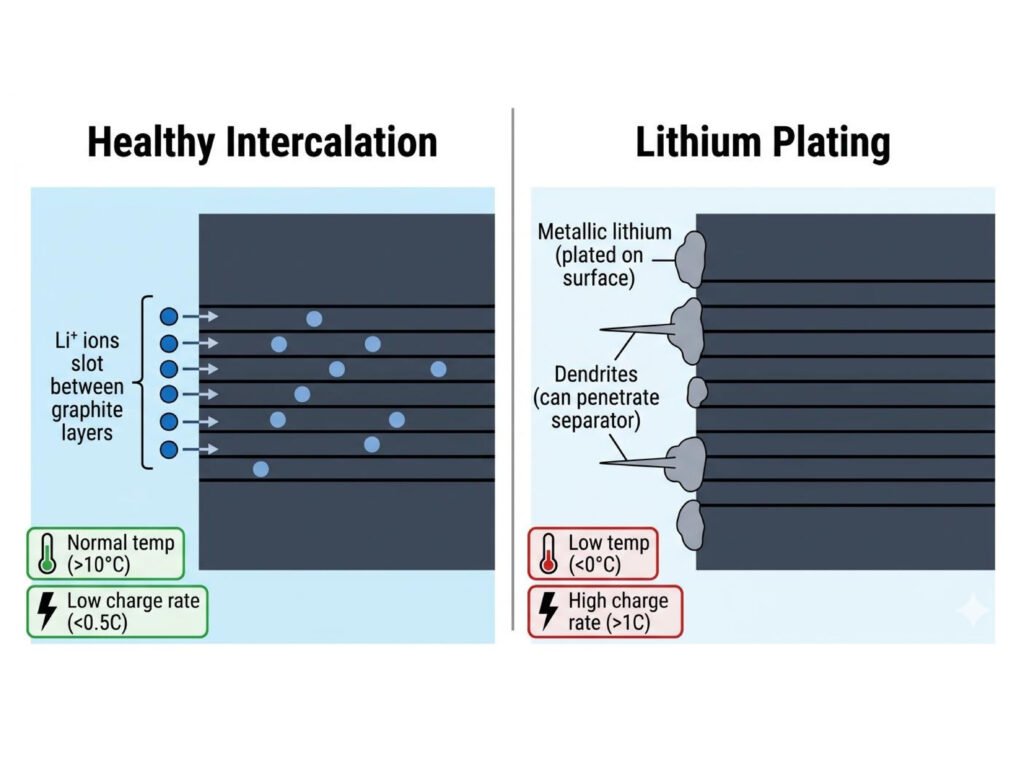
The problem becomes even more serious during high-rate charging. When the charging current is too high, lithium ions may not be able to intercalate into the graphite layers quickly enough and can instead plate as metallic lithium on the anode surface. Some of this plated lithium can become “dead lithium,” causing irreversible capacity loss. In severe cases, lithium dendrites may form, creating additional safety risks.
High current can also subject the electrode coating to greater thermal shock and mechanical stress. Over time, the bond between the active material and current collector can weaken, increasing internal resistance. As resistance rises, the cell generates more heat under the same current, which further accelerates degradation and creates a self-reinforcing cycle of aging.
This is why FPV drone batteries can deliver extremely high C-rates but may show noticeable degradation after only a few hundred cycles or fewer, depending on how aggressively they are used. By contrast, batteries used in surveying or inspection drones typically operate under more moderate loads and can achieve much longer service life.
In simple terms, high-rate performance requires a battery to handle intense current, while long cycle life requires the battery to minimize the thermal, chemical, and mechanical stress caused by that current. The harder a battery is pushed, the greater the challenge of maintaining long-term durability.
Engineering Design Also Requires Trade-Offs
Beyond material selection, cell architecture itself cannot escape this triangle.
Multi-tab, full-tab, and stacked cell structures can shorten current paths, reduce internal resistance, and improve rate capability and heat dissipation. However, tabs, welding areas, and structural components do not store energy. They occupy valuable space and add manufacturing complexity. The higher the required C-rate, the more the cell architecture must be optimized for current flow, making it harder to maximize energy density.
Electrolyte formulation also involves trade-offs. Long cycle life requires stable SEI formation and a dense, durable interfacial layer. High-rate performance benefits from lower viscosity and higher ionic conductivity to reduce transport resistance. High energy density, meanwhile, often requires greater stability at elevated operating voltages. Different electrolyte additives can improve individual properties, but few can enhance all of them simultaneously.
The same principle applies to the separator. A thinner separator can improve energy density and reduce the distance lithium ions need to travel, but it places greater demands on mechanical strength and thermal stability. Thicker or coated separators can provide better safety and durability, but they also add weight and thickness and can increase ionic resistance.
Even thermal management at the system level comes with a cost. Heat spreaders, thermal interface materials, and structural reinforcements can help manage heat during high-rate discharge and extend battery life. But all of these components add additional mass and consume internal space.
Ultimately, battery engineering is not about maximizing every parameter independently. It is about allocating limited material, space, weight, and thermal headroom to achieve the right balance for a specific application.
Technology Can Expand the Triangle, but It Cannot Eliminate It
Advances in battery technology—including material nanostructuring, silicon-carbon coatings, advanced electrolyte additives, full-tab designs, and stacked cell architectures—can certainly improve multiple performance parameters at the same time. Batteries can achieve higher energy density, lower internal resistance, and better cycle life. The significance of these innovations is that they push the performance boundaries outward.
However, as long as lithium-ion batteries rely on the movement of lithium ions between the cathode and anode, the fundamental trade-offs will remain. Thick electrodes will still face challenges at high C-rates. High-capacity materials will still have to contend with structural stability. High-current operation will still create additional thermal and chemical stress.
A true technological breakthrough is therefore not about maximizing all three metrics simultaneously. It is about achieving better overall performance within the same cost, size, weight, and safety constraints.
Ultimately, choosing the right balance is more important than blindly pursuing higher C-rates, greater capacity, or longer cycle life. The best battery is not necessarily the one with the highest specification in every category—it is the one whose performance profile best matches the actual requirements of the application.
Need a Battery Designed Around Your Application?
LanDazzle develops custom LiPo batteries optimized for the right balance of energy density, C-rate, cycle life, and size. Contact us to discuss your custom battery requirements.
Email: info@landazzle.com
Whatsapp: +8618938252128