Table of Contents
For many wearable devices, the battery is not simply a component that engineers place into an empty compartment. The battery can determine how much space remains for the PCB, sensors, antennas, displays, mechanical structures, and other electronics. In products with curved housings or very limited internal volume, a conventional rectangular battery may fit electrically but still waste valuable space.
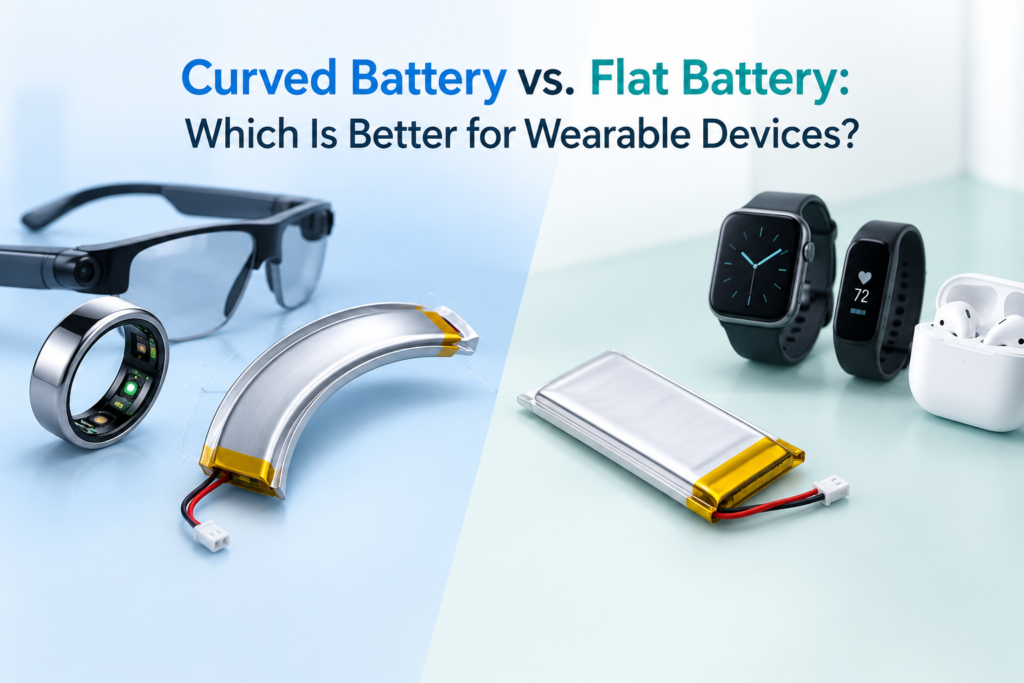
This creates a common engineering question: curved battery vs flat battery — which is the better choice for a wearable device?
There is no universal answer.
A flat lithium battery is often the better option when the product has a simple rectangular battery compartment, cost is a major priority, and standard dimensions already provide sufficient capacity. A curved or custom-shaped battery becomes more attractive when the available space is irregular, curved, extremely thin, or closely tied to the product’s industrial design.
The right choice depends on the complete product architecture rather than battery shape alone.
What Is a Curved Battery?
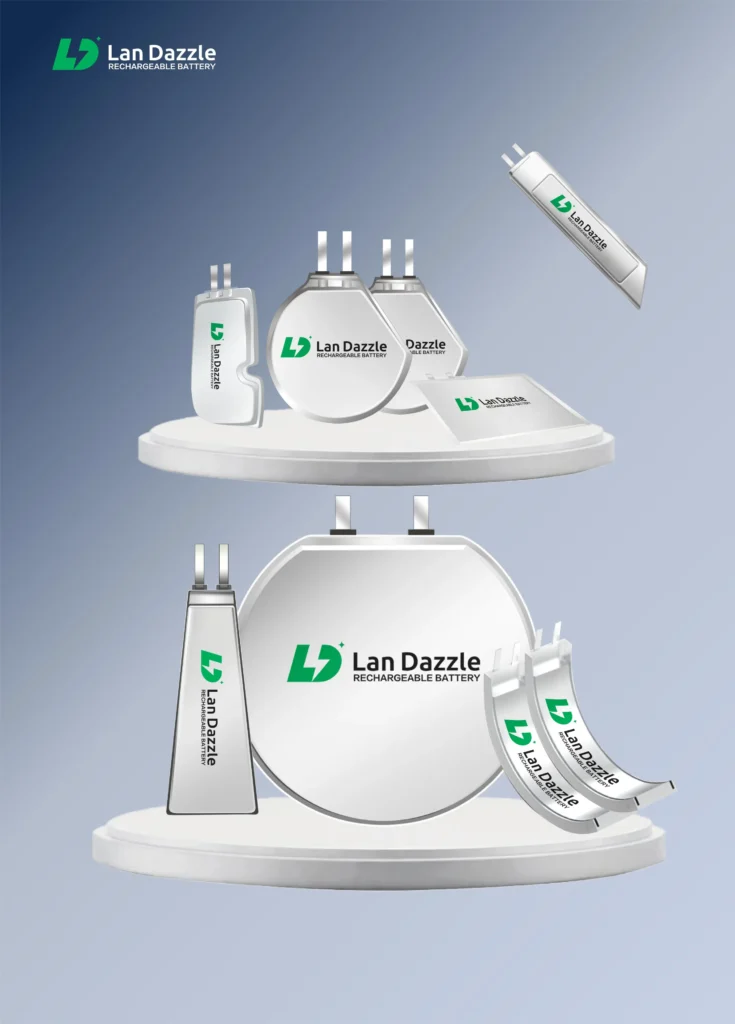
A curved battery is a battery cell that has been designed or formed to follow a non-flat or contoured geometry. In wearable applications, curved batteries are commonly based on pouch-cell structures. Instead of using a simple rectangular outline, the cell can be engineered around the available mechanical space of the product.
Depending on the application, the battery may have:
- A curved outline
- A contoured edge
- An asymmetric shape
- A narrow or elongated section
- A custom geometry designed around mechanical constraints
This approach is particularly useful when a product’s internal structure is not rectangular.
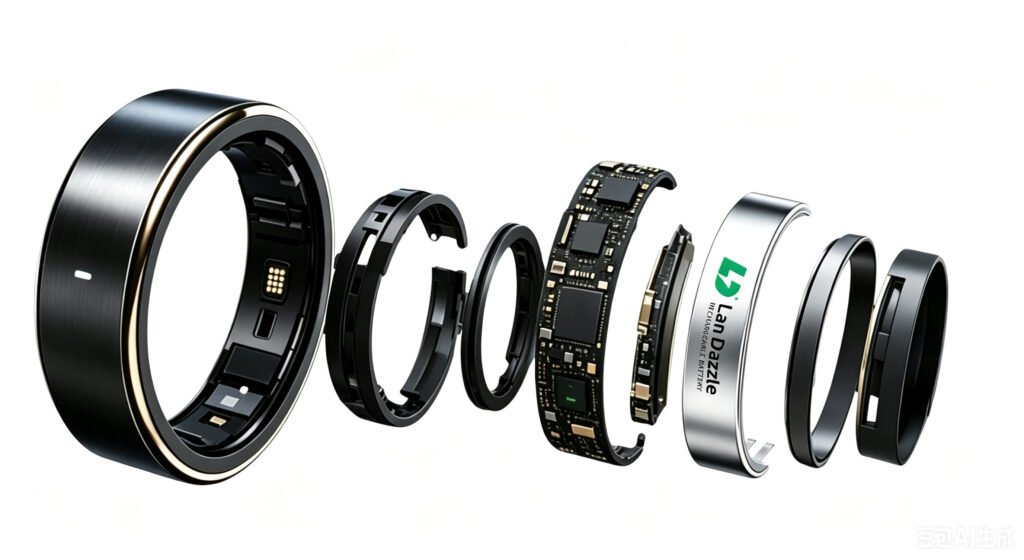
Smart rings are a good example. The available space around a ring-shaped device is fundamentally different from the space inside a smartphone or rectangular handheld product. A conventional flat cell can leave unused areas that cannot easily be recovered elsewhere in the design.
Importantly, a curved battery should not automatically be described as a flexible battery. A formed or curved pouch cell is manufactured with a defined geometry. It should not be assumed that the finished cell can simply be bent freely during assembly.
What Is a Flat Battery?
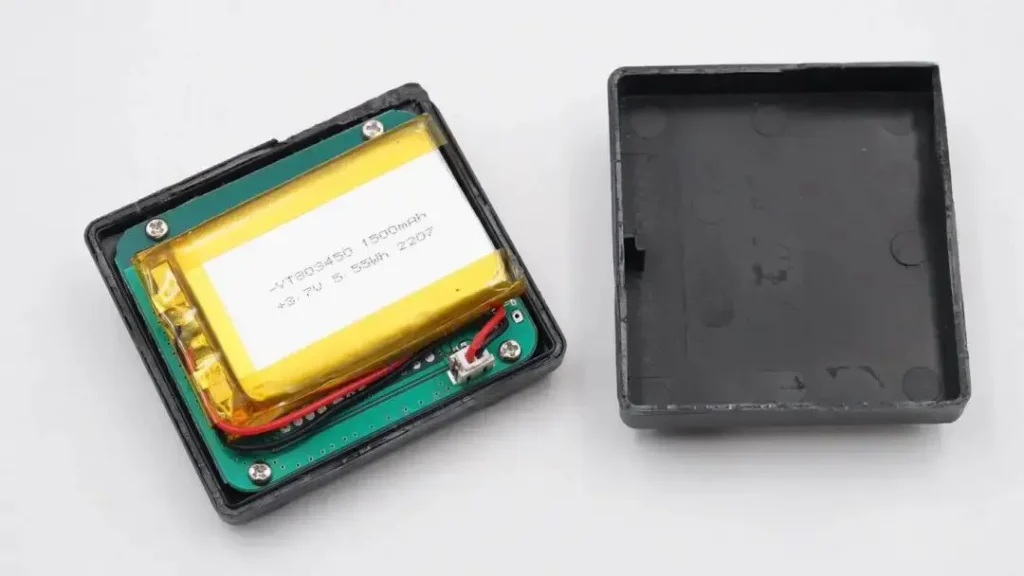
A flat battery is the conventional pouch or LiPo battery format used across many portable electronics. Its basic geometry is typically rectangular or otherwise relatively planar, making it straightforward to integrate into a similarly shaped battery compartment.
Flat LiPo batteries remain widely used because they offer several practical advantages:
- Simpler mechanical integration
- Mature manufacturing processes
- Easier tooling and fixtures
- Straightforward electrical and thermal design
- Lower development complexity for standard sizes
- Wide availability across battery suppliers
For products such as smart watches, compact medical electronics, trackers, handheld devices, and many consumer electronics products, a flat lithium battery may provide the most practical overall solution. When the product already has a suitable rectangular battery space, there may be little engineering value in introducing a more complex battery geometry.
Curved Battery vs. Flat Battery: Key Differences
| Engineering Factor | Curved Battery | Flat Battery |
|---|---|---|
| Space utilization | Better for irregular or curved spaces | Best for regular rectangular spaces |
| Device geometry | Suitable for curved or custom housings | Best for simple geometries |
| Capacity | Can improve usable capacity by filling otherwise unused space | Efficient when the available compartment is rectangular |
| Thickness | Can be optimized for highly constrained areas | Straightforward when uniform thickness is acceptable |
| Energy density | Depends mainly on chemistry and cell design | Depends mainly on chemistry and cell design |
| Wearability | Can support better mechanical conformity | Works well when the housing is sufficiently flat |
| Mechanical integration | More application-specific | Simpler |
| Manufacturing complexity | Generally higher | Generally lower |
| Development cost | Often higher for custom designs | Usually lower for standard formats |
| Prototyping | Requires more design coordination | Faster when a standard cell is available |
| Mass production | Requires controlled custom processes | Typically simpler at scale |
| Design flexibility | High | More limited |
| Typical applications | Smart rings, glasses, medical patches, curved wearables | Watches, bands, trackers, rectangular devices |
One important point is that curved batteries do not automatically have higher energy density.
Energy density is influenced by cell chemistry, active material loading, electrode design, packaging, thickness, and usable volume. Battery shape mainly determines how effectively that battery can occupy the space available inside the product.
1. Space Utilization
For wearable products, one of the biggest differences between curved and flat batteries is how effectively the battery uses available space. Consider a device with a highly irregular internal cavity. A standard rectangular cell may fit into the main area, but corners or curved sections may remain unused.
The battery may have a certain rated capacity, but the product may not be able to take advantage of the maximum battery volume available. This is the difference between battery capacity and usable capacity within the device’s available space.
A custom-shaped battery can sometimes provide more usable capacity without increasing the overall device footprint. The advantage comes from occupying space that a standard rectangular cell cannot efficiently use.
Smart rings
Smart rings often have a narrow annular structure with very limited internal volume. A conventional flat battery can be difficult to distribute around the ring geometry. A custom-shaped or curved battery can potentially make better use of the available space while keeping the overall ring profile compact.
Smart glasses
The arms and frame of smart glasses provide long and narrow spaces that may not be suitable for a conventional rectangular cell. A narrow or custom-shaped battery can be designed to fit within these spaces while leaving more room for electronics and mechanical structures.
Medical patches
Medical wearable patches often need to remain thin and conform closely to the body. In these applications, the battery shape can become part of the overall mechanical design rather than an isolated component.
2. Wearability and User Comfort
Battery geometry can directly affect how a wearable feels on the user’s body.
Three factors are particularly important:
- Thickness
- Shape
- Weight distribution
A battery that is electrically suitable but mechanically too thick can create an unwanted pressure point against the skin.
This is especially important for:
- Smart rings
- Medical patches
- Smart bands
- Head-mounted wearables
- Continuous-monitoring devices
Battery selection should not be based only on mAh. A 100 mAh cell that fits efficiently into the product architecture may be more useful than a higher-capacity cell that requires the housing to become larger or thicker.
3. Capacity and Energy Density
Battery shape itself does not inherently increase energy density. A better way to evaluate the difference is to separate three concepts:
- Cell energy density
- Battery capacity
- Package-level space utilization
A curved or custom-shaped battery may improve the third factor. For example, suppose a wearable has an irregular internal cavity. A rectangular battery might leave several unused areas around it. A custom-shaped cell could occupy some of that previously unused volume.
The resulting product may achieve higher usable capacity without increasing the external dimensions of the device. However, this does not mean that the curved cell chemistry itself has a higher intrinsic energy density.
Energy density depends on factors such as:
- Cell chemistry
- Electrode materials
- Active material utilization
- Electrode thickness
- Electrode stacking
- Packaging
- Cell thickness
- Manufacturing process
For engineers, the more useful question is therefore not:“Does a curved battery have higher energy density?”
but:“Can a battery with this geometry deliver the required capacity within the available product volume?”
4. Manufacturing Complexity
Flat batteries generally have an advantage in manufacturing simplicity. Their geometry is easier to standardize, and existing production equipment, tooling, fixtures, and inspection processes can often be reused.
Custom-shaped batteries require additional engineering control. Depending on the design, manufacturers may need to manage:
- Cell forming
- Electrode alignment
- Stacking
- Lamination
- Pouch forming
- Sealing
- Dimensional tolerances
- Quality inspection
- Electrical testing
- Mechanical testing
- Production yield
The more unusual the battery geometry, the more closely the cell manufacturing process must be coordinated with the product design. This does not mean curved batteries are unsuitable for mass production. It means the development process is usually more application-specific than using a standard flat cell.
Tolerance is also important.
In a compact wearable, a small dimensional difference can affect assembly clearance, mechanical pressure, or contact with surrounding components. Engineers therefore need to consider dimensional specifications early in development rather than treating battery geometry as a final-stage purchasing decision.
When Should You Choose A Curved Battery or Flat Battery?
| Engineering Scenario | Choose a Curved / Custom-Shaped Battery | Choose a Flat Battery |
|---|---|---|
| Internal geometry | The device has curved internal surfaces or a non-rectangular battery compartment. | The device has a simple, flat, rectangular battery cavity. |
| Available space | Irregular spaces leave significant unused volume around a standard rectangular cell. | The available space can be efficiently filled by a standard rectangular cell. |
| Space utilization | A custom shape can make better use of otherwise unused areas inside the device. | A standard flat cell already provides efficient space utilization. |
| Device thickness | The product has strict thickness or narrow-space constraints. | The device has sufficient thickness and does not require a highly optimized battery profile. |
| User comfort | Battery thickness, shape, or position directly affects comfort, especially for skin-contact wearables. | Battery geometry has little impact on user comfort or can be placed away from sensitive areas. |
| Industrial design | The battery needs to follow the product’s specific mechanical architecture or curved housing. | The product can accommodate a conventional battery outline without changing the industrial design. |
| Capacity requirement | The required capacity cannot be achieved efficiently within the available space using a standard battery. | A standard battery already provides the required capacity and electrical performance. |
| Development cost | Higher customization cost is justified by the packaging or performance benefits. | Cost is a major concern and standard dimensions are sufficient. |
| Production volume | The product benefits enough from custom geometry to justify dedicated manufacturing and tooling. | High-volume production favors a simpler and more standardized battery design. |
| Development timeline | The project allows additional engineering and validation time for a custom battery. | A short development schedule favors an existing standard battery. |
| Mechanical integration | Battery geometry needs to be coordinated closely with the housing, PCB, sensors, or other internal components. | The battery can be integrated easily without major mechanical redesign. |
| Typical applications | Smart rings, smart glasses, medical patches, highly compact wearables, and irregularly shaped devices. | Smartwatches, smart bands, trackers, and other products with relatively simple battery compartments. |
| Overall choice | Choose a curved/custom-shaped battery when device geometry is the main constraint. | Choose a flat battery when a standard cell already fits the product requirements. |
Conclusion
When comparing a curved battery vs. a flat battery, there is no one-size-fits-all answer. The better choice depends on the device’s internal geometry, available space, thickness limits, required capacity, comfort requirements, production volume, cost, and development timeline.
Flat batteries remain the practical choice when a standard rectangular cell already meets the product’s requirements. Curved or custom-shaped batteries become more valuable when the available space is irregular, curved, narrow, or highly constrained.
For wearable devices, the key is to evaluate the battery as part of the overall product architecture—not as an isolated component. The right battery geometry can help engineers make better use of limited space while balancing capacity, comfort, manufacturability, and cost.
The key principle is simple: choose the battery shape based on the device architecture, not simply the battery specification.
Need a Battery That Fits Your Device?
LanDazzle develops custom-shaped lithium batteries for wearable devices and other compact electronics with challenging space and thickness requirements. Share your battery dimensions, required capacity, or CAD file with our engineering team to explore a suitable battery design.
Email: info@landazzle.com
Whatsapp: +8618938252128