Over the past two years, the wearable technology market has been changing fast. From Samsung launching the Galaxy Ring to the rapid rise of brands like RingConn, Oura, and Amazfit, smart rings have quickly evolved from a niche gadget for tech enthusiasts into a product that major technology companies and consumer electronics brands are racing to develop.
Compared with smartwatches and fitness bands, the biggest advantage of a smart ring is its comfort. It is small, lightweight, and easy to wear all day. Without a screen, it quietly sits on your finger and continuously tracks your heart rate, blood oxygen, skin temperature, and sleep, 24 hours a day.
But inside this tiny ring, engineers face one of the biggest design challenges in wearable technology.
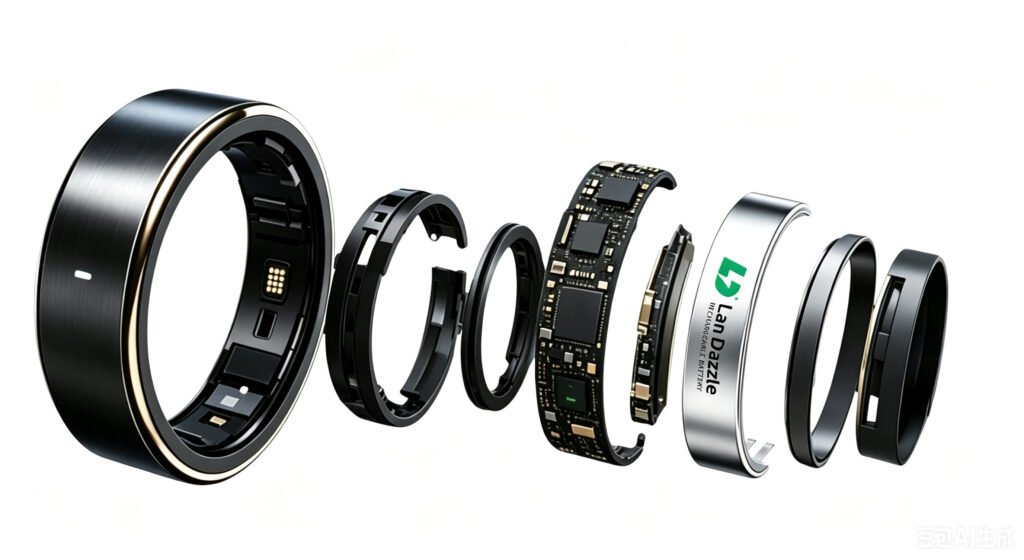
The inner thickness of a smart ring is usually limited to just 2.5–3.0 mm, and the entire device weighs only 3–5 grams. Within this extremely small space, engineers must fit an optical PPG sensor, a microcontroller (MCU), a Bluetooth antenna, an accelerometer, and a printed circuit board (PCB).
After all these components are installed, there is very little room left for the battery. So how difficult is it to turn a battery into a ring while still providing enough power for days of use?
Mechanical Stress: Traditional Winding vs. Stacking
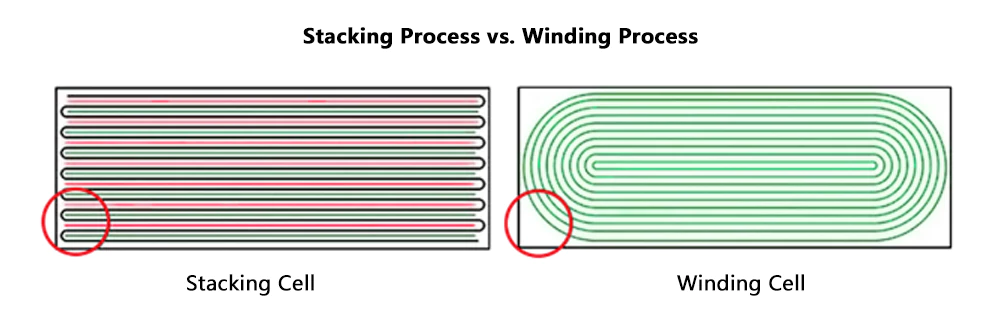
Most consumer electronics, such as smartphones and TWS earbud charging cases, use the traditional winding process to make lithium batteries. Winding is fast, efficient, and cost-effective. However, when it comes to making a curved battery for a smart ring, it creates a serious problem: mechanical stress.
When a wound battery cell is forced into the curved shape of a ring:
- The outer layers are stretched, while the inner layers are compressed. This can cause permanent wrinkles, layer separation, or even tiny cracks inside the electrodes.
- Stress builds up at the curved edges. The active materials inside the battery become unevenly distributed. This not only wastes valuable internal space—creating more than 25% dead space—but also increases the risk of internal micro short circuits.
The Solution: Stacking Technology
To match the natural curve of a smart ring, leading custom battery manufacturers choose stacking instead of the traditional winding process, even though it is more expensive and much more difficult to manufacture.
With the stacking process, the positive electrode, negative electrode, and separator are first cut into small curved pieces. These layers are then carefully stacked one by one on a curved mold without creating mechanical stress. Finally, the battery is shaped through a heat-pressing process.
This design keeps the internal layers tightly aligned even in a curved shape, allowing the electrical current to flow more evenly throughout the battery. As a result, stacking technology can improve space utilization by 20%–30% while greatly reducing the safety risks caused by mechanical stress.
High Pulse Currents and IR Drop: The Electrochemical Challenge of Tiny Ring-shaped Battery
The battery inside a smart ring usually has a capacity of only 15–25 mAh. Although the battery is very small, the device places surprisingly high demands on its discharge performance.
A smart ring does not draw power at a steady rate. To monitor health data and synchronize information, the PPG optical sensor and Bluetooth module wake up at regular intervals, creating short bursts of current that can reach tens of milliamps. For an 18 mAh battery, a 20 mA pulse is already more than a 1C discharge rate.
This leads to the second major challenge for miniature batteries: internal resistance (DCR) and voltage drop (IR Drop).
- Very little electrolyte: A miniature battery contains only a few microliters (μL) of electrolyte. At this scale, battery performance becomes highly sensitive to electrolyte conductivity and manufacturing quality.
- IR Drop can cause false shutdowns: If the battery’s internal resistance is too high, the sudden current spike from the Bluetooth module can cause the battery voltage to drop sharply. Even when the battery still has 50% charge remaining, this voltage drop may fall below the device’s undervoltage lockout (UVLO) threshold, causing the smart ring to shut down unexpectedly.
To avoid this problem, smart ring batteries need a low-resistance electrode design, a dual-tab (Dual Tabs) structure, and a high-conductivity electrolyte. These technologies help the battery deliver strong pulse current performance, even in an extremely small package.
Zero-Tolerance Safety for a Device Worn on Your Finger
Unlike most electronic devices, a smart ring is in direct contact with your skin every day. It is constantly exposed to water, sweat, soap, and cleaning products. It also experiences repeated mechanical stress from washing hands, accidental bumps, gripping objects, and carrying heavy items.
If the battery is damaged by pressure and begins to leak, swell, or overheat, the consequences can be disastrous for both users and the device brand.
For this reason, smart ring batteries must meet extremely high safety and quality standards.
100% X-ray and industrial CT inspection: Every curved battery cell is inspected before shipment using non-destructive testing to check internal alignment, electrode positioning, and tab welding quality, ensuring every battery is delivered without hidden defects.
Miniature pouch cell packaging: The aluminum-laminated pouch must be heat-sealed with exceptional precision along its tiny edges to prevent electrolyte leakage and keep out moisture.
Swell control: Through advanced materials and careful internal space design, the battery should keep thickness expansion below 5% after 500 charge and discharge cycles, preventing the battery from pushing against or cracking the ring housing.
How Custom-Shaped Batteries Power the Next Generation of Smart Rings
As smart rings become smaller while offering longer battery life and more advanced features, battery manufacturers are finding new ways to improve performance through innovations in materials, cell design, and manufacturing. These advances help deliver higher energy density, a better fit inside the ring, and more reliable power.
1. Silicon-Carbon Anodes: More Energy in the Same Space
Every cubic millimeter inside a smart ring matters. By using silicon-carbon anodes instead of traditional graphite, batteries can achieve 15%–25% higher volumetric energy density (Wh/L). This allows more energy to be stored in the same size battery, helping power AI features, continuous health monitoring, and longer battery life.
2. Extreme Miniaturization: Making Every Millimeter Count
The inside of a smart ring is extremely compact. Modern custom batteries can be made as narrow as 5 mm and use ultra-thin packaging, miniature battery tabs, and integrated protection circuit modules (PCM). These designs reduce the space required by the battery while maintaining safety, leaving more room for sensors, antennas, and other important components.
3. Custom Curved Batteries: A Perfect Fit with No Wasted Space
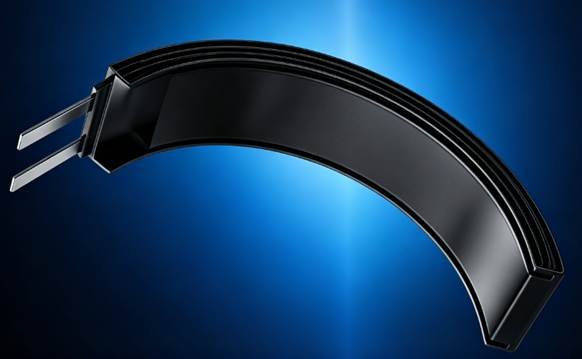
Every smart ring has a different internal shape, depending on the brand and ring size. A custom curved battery can be designed to match ring sizes from US Size 6 to US Size 13, allowing the battery to fit the inner curve of the ring almost perfectly.
This customized design can reduce dead space by more than 30%, creating room for a larger battery without increasing the size of the ring. It also improves weight distribution, making the ring more comfortable to wear.
4. High-Precision Manufacturing: Better Performance, Greater Reliability
Making a custom-shaped battery is not just about fitting it inside the ring—it also has to perform reliably over time.
Using high-precision die cutting, stacking technology, and strict dimensional control, manufacturers can produce complex battery shapes with excellent consistency, low internal resistance, and long cycle life. Even after frequent charging, daily wear, and accidental bumps, the battery can continue to deliver stable and safe performance.
Building the next smart ring?
Let us help you create a battery that delivers longer battery life, a perfect fit, and reliable performance. Talk to our battery experts today.
Email: info@landazzle.com
Whatsapp: +8618938252128