In early 2026, one of the hottest buzzwords in the tech world was “raising lobsters.”
Here, “lobsters” do not mean seafood. It is a casual nickname for AI Agent systems. As the open-source framework OpenClaw became popular, AI Agents moved from a technical concept into the public spotlight and gradually became a common way to describe intelligent agents.
While most people were “raising lobsters” on computers and smartphones, a wearable technology company called Gyges Labs chose a different path — putting an AI Agent into a smart ring.
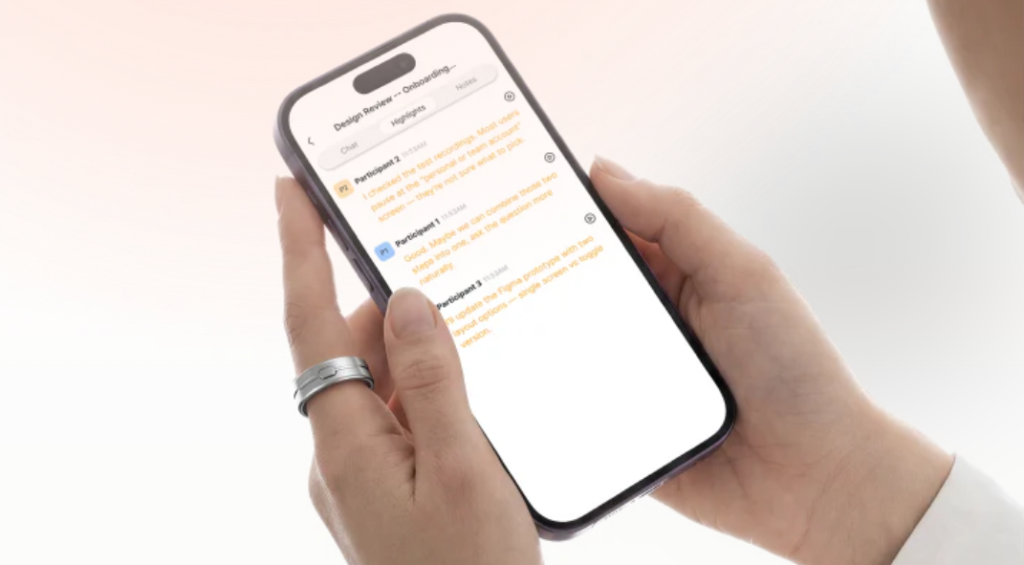
Vocci Ring: Breaking the Health-Only Smart Ring Model
Over the past few years, the smart ring market has grown at an impressive speed.
According to industry research, the global smart ring market was about USD 417.5 million in 2025 and is expected to reach USD 2.0793 billion by 2033, with a compound annual growth rate of 22.5%.
However, behind this fast growth, the product direction of the market has become increasingly fixed.
Almost all smart rings follow the same health monitoring model, focusing on:
heart rate, blood oxygen, sleep, and stress tracking.
In essence, they are lighter versions of traditional health wearables.
As the supply chain matures and more players enter the market, product features start to look the same.
This raises a key question:
Besides health tracking, what else can a smart ring do?
In March 2026, Gyges Labs offered a rare and bold answer with the launch of the Vocci Ring.
Unlike mainstream smart rings, Vocci made a clear decision to move away from the crowd:
no health monitoring, only voice recording and productivity use cases.
This is not just a simple feature choice.
It is a direct challenge to the existing logic of smart ring products.
Voice recording, audio processing, and AI interaction require much more from the device: higher power use, heavier workloads, and strong stability during continuous operation.
This also highlights an important point that is often overlooked.
The innovation of the Vocci Ring is not just “adding a microphone to a ring.”
It places entirely new demands on the energy system and battery design.
As smart rings move from passive monitoring to active input, what truly changes is not only the function—but the underlying power and energy design that supports it.

From AI Glasses to AI Rings: Gyges Labs’ Continuous Bets and Hard Trade-offs
Gyges Labs was founded in 2022. It is not a big-name company, but its direction in AI hardware has always been very clear.
If you follow the AI glasses market, you may already know its work.
In 2025, Halliday Glasses raised more than USD 3.3 million on Kickstarter, and its core technology came from Gyges Labs.
The meaning of this success goes beyond the money raised.
More importantly, it completed a full loop:
from product definition → technology integration → market validation.
For most AI hardware startups, this is a critical step—and one that is very hard to achieve.
When Gyges Labs shifted its focus from AI glasses to AI rings, the challenge was not just a change in interaction style.
Compared with glasses, a ring is much smaller, and the space for the battery is extremely limited, with almost no room for error.
This greatly raises the bar for wearable battery design, custom shapes, and safety margins, making product decisions much tougher.
This “toughness” runs through Gyges Labs’ product philosophy.
From Halliday Glasses to Vocci Ring, they have followed the same path:
focus on how humans interact with devices, not on adding more features;
keep removing features instead of stacking them;
use clear limits to create clear use cases.
Halliday Glasses did not add photo or video functions. It focused only on showing information.
Vocci Ring went even further. It removed health tracking completely and narrowed the product to one core scenario:
recording, understanding, and acting on information during work communication.
Under this strategy, the goal of the battery system also changed.
It is no longer about achieving the longest possible battery life on paper.
Instead, it is about reliably supporting high-value use cases within an extremely small space.
From this view, Gyges Labs’ continuous bets are not random moves between different device forms.
They are steps toward one core question:
as devices get smaller and use cases more focused, what truly decides whether a product works are often the most basic system capabilities—yet the ones most easily overlooked.
Why “Voice Recording” Becomes the Core Capability of Vocci
In meetings, phone calls, and real-time discussions, a large amount of important information is spoken quickly, but it is often difficult to organize and turn into real actions.
This is exactly the problem
Gyges Labs aims to solve—a frequent but long-overlooked issue.
From their point of view, the core problem is not about “recording more information,” but about how information can become actionable at the moment it is created.
As CEO Jia Jieyang once said:
“Work efficiency is never built by simply accumulating transcribed text. What really matters is that the moment a sentence is spoken, it can already drive action.”

That is why, in the design of the Vocci Ring, “voice recording” is treated as a core capability, not just a supporting feature.
However, from an engineering perspective, this seemingly simple function actually depends on three fundamental system challenges:
- Stable voice recording performance
- Power control during continuous operation
- Battery safety within an extremely small space
In other words, whether a smart ring can reliably record voice is, at its core, a battery and system engineering problem.
At the same time, Vocci’s design takes “recording” one step further. It is no longer just for storing information, but becomes the starting point of the entire AI system.
In its architecture, voice is not the endpoint—it is the input:
- The user speaks into the ring
- The system transcribes, understands meaning, and breaks down tasks
- An AI Agent calls external devices or systems to execute actions
- The results are delivered, forming a closed loop
The team describes this experience in a very direct phrase: “what is said becomes reality.”
But to support such a high-frequency, continuous, and real-time system, the requirements for the battery system become very clear and strict:
- High-frequency short bursts of power output
- High sensitivity to voltage stability
- Consistent performance across many charge-discharge cycles
From this perspective, Vocci’s focus on “voice recording” is not just a feature choice. It is the starting point of the entire AI Agent interaction chain.
And what ultimately determines whether this experience works is not only the algorithm or interaction design, but also the hidden foundation behind it—energy system stability and the limits of battery performance.
Minimal Interaction, Extreme Hardware: The Battery Logic Behind Vocci
The product design of the Vocci Ring has one very clear but often overlooked feature: minimalism.
Unlike most devices in the industry that rely on always-on continuous listening, it adopts a more intentional, user-triggered interaction model:
- Double tap: start recording
- Single tap: mark key moments
- Long press: wake up AI
This is not only a privacy decision, but also a very typical power management strategy.
In an extremely small device like a smart ring, the system cannot stay in a high-power state for long periods. As a result, the design principle becomes very direct:
the device only enters high power usage when the user clearly intends it.
In other words, the interaction design itself is shaped by the battery.
From a hardware perspective, the specs of Vocci Ring do not try to look “impressive”:
- Weight: around 3–5 grams
- Aerospace-grade titanium body
- IP4 water resistance
- Voice pickup range: about 5 meters
- Battery life: around 8 hours per charge
But for people familiar with wearable devices, these numbers are not about performance—they are about constraints.
They show that the entire system is already pushed to its physical limits:
battery size, shape, and safety structure all have almost no room for extra space.
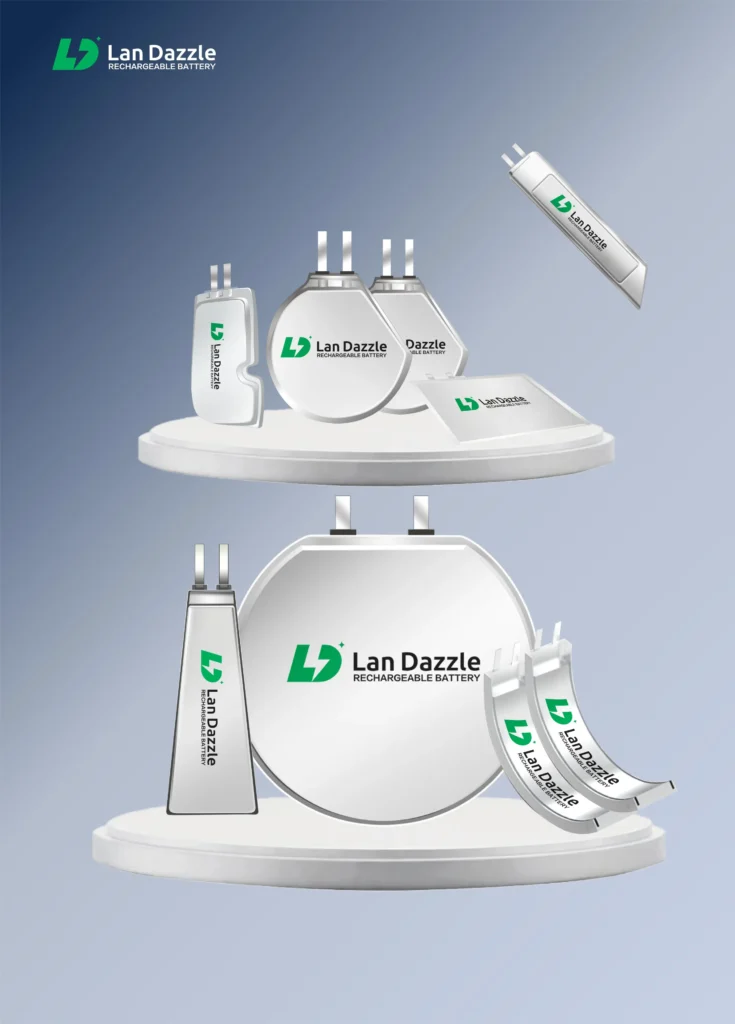
Under these conditions, standard battery cells are often not an option. Instead, the product relies on highly customized micro lithium battery solutions that constantly balance multiple trade-offs:
- Size vs capacity
- Battery life vs discharge performance
- Safety vs energy density
In the end, what defines the product is not only the interaction or the AI system, but a deeper constraint:
the battery is no longer just a power source—it becomes a fundamental boundary that shapes the product itself.
From Health Tracking to Scenario Splitting: Smart Rings Are Fragmenting, and Batteries Are Becoming the Key Variable
Vocci Ring is not the only smart ring product that has moved beyond the “health tracking narrative.”
Across the industry, more and more devices are targeting different vertical use cases. For example:
iQibla smart ring focuses on religious use cases;
Spark Ring is more focused on voice interaction and AI intent recognition.
Behind these different directions, there is actually a shared trend:
smart rings are shifting from a unified health-monitoring device into more specific and higher-value use cases.
This fragmentation leads to a direct consequence—the requirements for underlying hardware are also quickly diverging.
Different scenarios demand very different power usage patterns, interaction styles, and usage frequency. As a result, a single standardized battery solution can no longer fit all cases.
Smart rings are moving away from standard battery designs toward more complex and customized energy system solutions.
If scenario splitting is the surface-level change, a deeper shift is happening at the AI infrastructure level.
As AI Agents become the core interaction model, the way hardware competes is also changing:
It is no longer just about comparing specifications,
but about system stability,
long-term real-world user experience,
and the ability to support a complete workflow loop.
In this process, the role of the battery is also changing significantly.
It is no longer just a “cost component,” but is gradually becoming part of the system’s core capability.
In other words, in the future competition of AI wearable devices, the real differentiator may no longer come from algorithms themselves, but from a more fundamental question:
who can deliver a more stable, safer, and more controllable energy system within an extremely small form factor.
And this is what will define the next generation of smart rings and AI wearable devices at the deepest level.
Conclusion
In a smart ring market still largely dominated by health monitoring, Vocci positions itself as a productivity tool. At its core, this is a fundamental redefinition of the product’s use case.
Whether this path will ultimately succeed remains to be proven over time.
However, one thing is already clear:
As AI hardware moves toward real-world scenarios, batteries are no longer just a “battery life” issue—they become a foundational factor that determines whether the product can actually exist.
This is why an increasing number of AI wearable device companies are now turning their attention to more specialized smart ring battery solutions.
Achieving stable power output, controlled thermal performance, and long-term reliability within an extremely limited form factor is becoming a key prerequisite for bringing smart ring products to market.
If you are developing smart rings or AI wearable devices,
and are looking for stable, safe, and mass-producible battery solutions under strict size constraints, feel free to contact us:
Email: info@landazzle.com
Whatsapp: +8618938252128