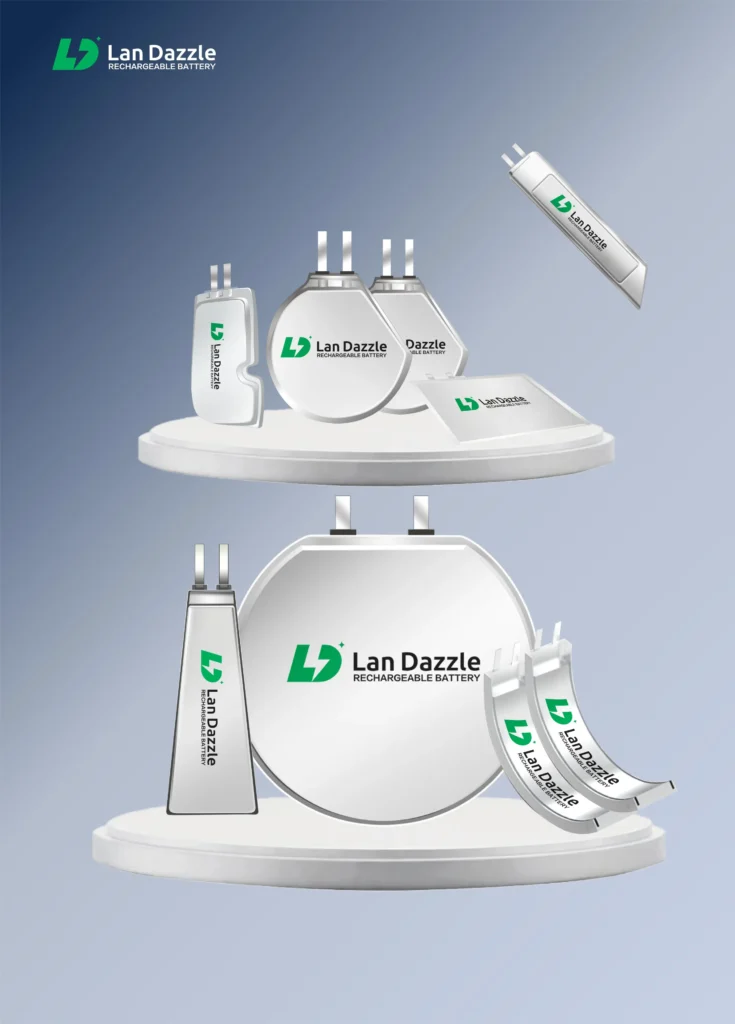
Semi solid state battery vs lithium ion
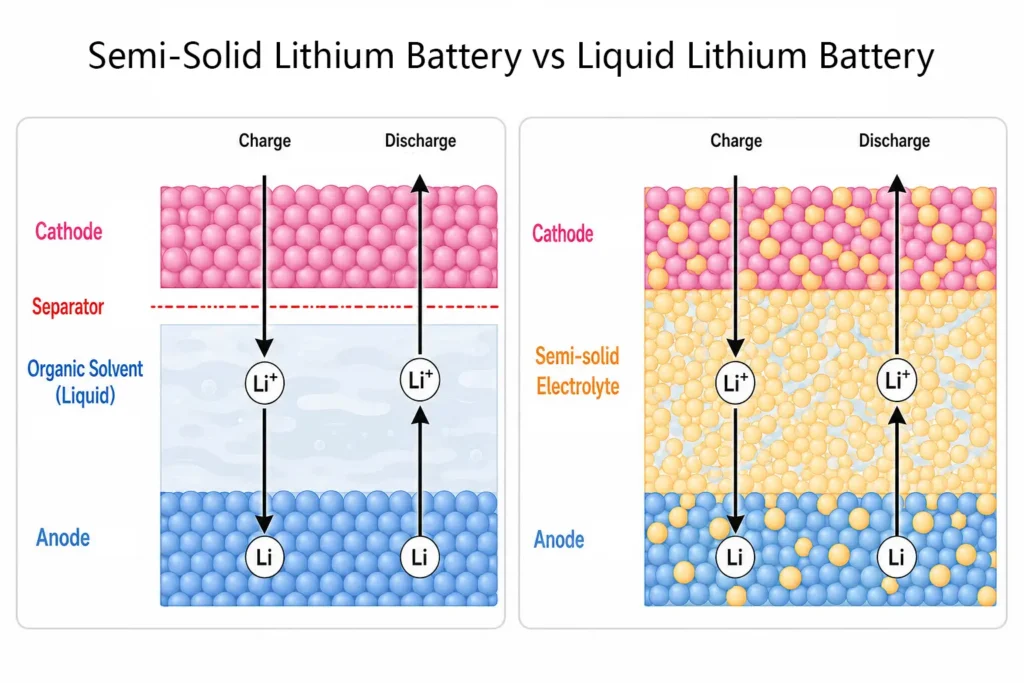
Semi-solid-state batteries use a mixed electrolyte made of solid material plus a small amount of liquid (or gel). They are considered a transition technology from traditional liquid lithium batteries to fully solid-state batteries.
A conventional liquid lithium battery is made up of four main parts: a cathode, an anode, an electrolyte, and a separator. The electrolyte is a flammable organic liquid.
In comparison, semi-solid-state batteries keep only about 5–10% liquid electrolyte. This design improves safety and energy density (reaching about 300–400 Wh/kg), but it comes with some trade-offs, such as slower charge and discharge rates and weaker low-temperature performance.
Performance comparison:
Semi-solid-state batteries offer an energy density more than 1.5 times higher than traditional lithium batteries (150–250 Wh/kg). Their thermal runaway risk is much lower, and they can pass 200°C high-temperature tests and nail penetration tests.
Their cycle life is usually around 1,500–2,500 cycles, which is better than most ternary lithium batteries (500–1,500 cycles; LFP can reach 3,000+ cycles).
In terms of charging speed, liquid lithium batteries support faster charging thanks to higher ion mobility (commonly 1C or higher). Semi-solid-state batteries are slightly slower because of their mixed electrolyte structure.
The self-discharge rate of both types is similar, usually a few percent per month.
In terms of cost, mass production cost for semi-solid-state batteries is about $80 per kWh, slightly higher than current liquid lithium batteries (about $60–70 per kWh).
Overall, semi-solid-state batteries have clear advantages in energy density and safety, but they are weaker than traditional lithium batteries in cost, charging speed, and low-temperature performance.
| Performance Metric | Semi-Solid-State Battery | Conventional Lithium-Ion Battery |
|---|---|---|
| Energy Density (Wh/kg) | ~300–400 | ~150–250 |
| Safety (Thermal Runaway Risk) | Higher thermal stability; can pass high-temperature (≈200 °C) and nail penetration tests | Flammable liquid electrolyte; risk of fire or explosion under abuse or high temperature |
| Cycle Life (cycles) | ~1,500–2,500 | ~500–1,500 (high-quality LFP can reach 3,000+) |
| Charging Speed | Generally slower due to mixed electrolyte system (often below 1C) | Faster ion transport; supports ≥1C fast charging (≈30–60 min to 80%) |
| Low-Temperature Performance | Relatively weaker; noticeable capacity loss at −20 °C | Also degrades at low temperature (depends on chemistry) |
| Self-Discharge Rate | A few percent per month (similar to Li-ion) | A few percent per month |
| Cost | ~USD 80/kWh (mass production estimate) | ~USD 60–70/kWh (market average) |
| Size / Weight | Smaller and lighter for the same energy | Larger and heavier for the same energy |
| Recyclability | Similar to lithium-ion; compatible with existing recycling processes | Mature and well-established recycling system |
Application Scenarios Comparison
| Application | Lithium-Ion Battery (Pros & Cons) | Semi-Solid-State Battery (Pros & Cons) | Commercial Status |
|---|---|---|---|
| Smartphones / Laptops | Pros: Mature, stable, low cost Cons: Limited energy density affects battery life | Pros: Potentially higher energy density, improved safety Cons: Higher cost, not fully mature | Li-ion: mass production Semi-solid: limited or pilot use |
| Electric Vehicles (EVs) | Pros: Mature technology, fast charging Cons: Thermal runaway risk | Pros: Longer range, better safety Cons: Higher cost, weaker low-temp performance | Li-ion: mainstream Semi-solid: used in high-end models |
| Energy Storage Systems | Pros: Long cycle life (especially LFP), low cost Cons: Safety management required | Pros: Higher safety, potentially longer life Cons: High cost, still under development | Li-ion: widely deployed Semi-solid: R&D / demo stage |
Conclusion and Future Outlook
Semi-solid-state batteries show clear advantages in energy density and safety and are seen as a step-by-step upgrade in lithium battery technology. However, they still face obvious technical limits. At present, low-temperature performance is weak—capacity loss can reach around 40% at –20°C—and there are still interface resistance issues between solid and liquid materials.
In the coming years, research will mainly focus on high-ion-conductivity composite electrolytes, new solid separators, and interface engineering to solve these problems.
The industry expects that around 2030, the cost of fully solid-state batteries could drop to about $100 per kWh, with energy density exceeding 500 Wh/kg. At the same time, semi-solid-state battery costs are expected to fall to around $65 per kWh.
In addition, the use of higher-nickel cathodes and silicon-carbon anodes will continue to improve the performance of both semi-solid and solid-state batteries.
Overall, semi-solid-state batteries are likely to be widely adopted over the next 5–7 years as a transition solution, while large-scale use of fully solid-state batteries is expected around 2030, setting a new standard for higher safety and longer battery life.
Email: info@landazzle.com
Whatsapp: +8618938252128