In recent years, the frequency of extreme heatwaves worldwide has been rising, and sweltering weather is compromising the daily lives of an increasing number of people.
From urban commutes and outdoor sports to industrial operations and work in special occupational environments, heat-induced discomfort and even health hazards have drawn growing public attention.
Conventional cooling solutions such as air conditioners, electric fans and large refrigeration equipment deliver effective cooling yet bear obvious limitations:
- Non-portable for personal carry
- High energy consumption
- Only capable of regulating ambient temperature rather than delivering targeted personal cooling
Against this backdrop, wearable cooling devices have emerged as a new frontier in smart wearables.
In the future, people may no longer rely solely on adjusting environmental temperatures to achieve thermal comfort. Instead, close-fitting wearable gear will enable personalized thermal management.
However, the widespread adoption of wearable cooling devices hinges on resolving one core bottleneck: batteries.
Battery performance dictates the weight, power output and safety of such devices, and determines whether wearable cooling products can evolve from conceptual prototypes to mass-market consumer goods.
Rising Demand for Personal Cooling Driven by Global Heat Trends
Global climate has undergone dramatic shifts over the past few decades.
Data from the World Meteorological Organization (WMO) confirms sustained rises in global average temperatures, with extreme heat events growing more frequent.
Excessive heat impairs far more than mere comfort, negatively impacting:
- Outdoor work efficiency
- Athletic performance
- Health of the elderly and vulnerable groups
- Urban living quality
Residents in heat-prone cities face daily heat exposure scenarios including:
- Sweltering commutes
- Prolonged outdoor exposure
- Sharp temperature swings between indoor and outdoor spaces
This has unlocked new market opportunities for personal cooling equipment.
Future wearable cooling products will serve diverse application sectors:
- Outdoor Sports: Scenarios include running, cycling, hiking and outdoor training. The human body generates substantial heat during physical activity, creating urgent demand for rapid heat dissipation. Lightweight cooling gear can reduce users’ thermal load and enhance workout comfort.
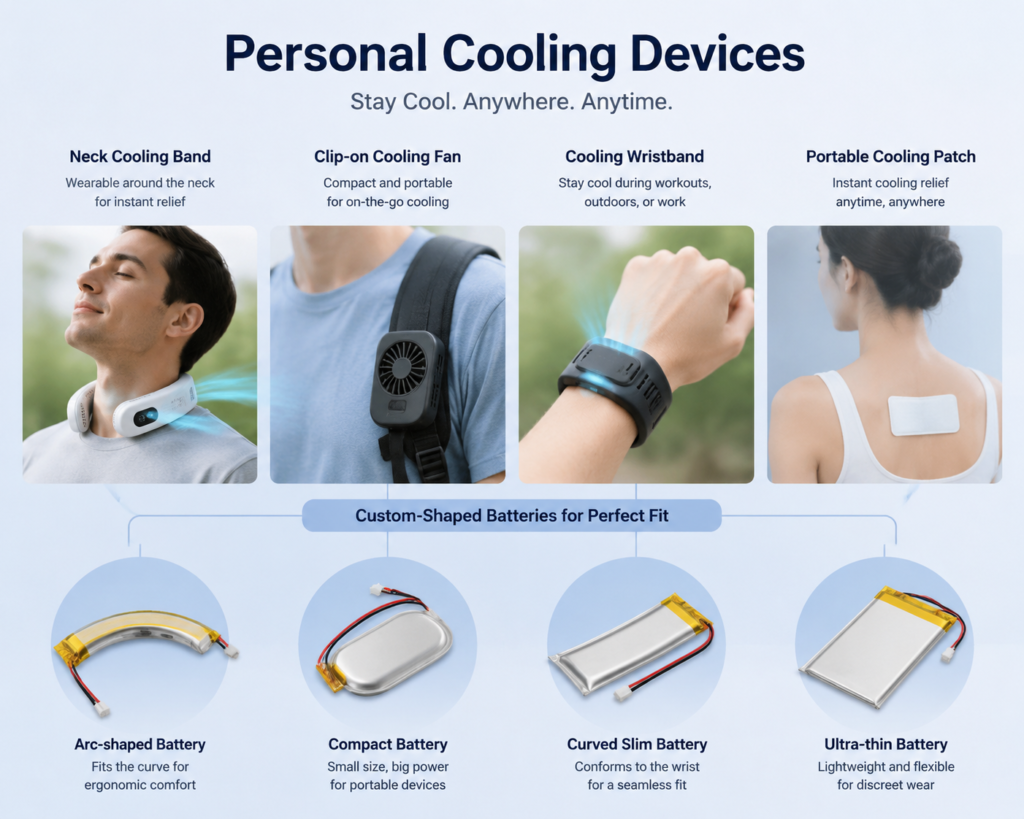
- Urban Commuting: In hot metropolitan areas, daily routines such as walking, public transit rides and outdoor waiting expose people to persistent heat. Neck-mounted fans, smart cooling necklaces, wearable air conditioners and similar products deliver customized personal cooling.
- Industrial&Outdoor Labor: Workers in construction, logistics, power maintenance, agriculture and other sectors endure long hours of high-temperature exposure. For these users, cooling devices are not merely comfort upgrades but critical safeguards for occupational safety.
- Medical&Special Care: The elderly, infants and people with specific medical conditions are far more sensitive to high temperatures. Smart cooling wearables are poised to become an integral component of personalized health management in the years ahead.
Wearable Cooling Devices: Evolving from Basic Fans to Intelligent Integrated Systems
Early portable cooling products relied primarily on small electric fans, operating on a simple mechanism: Battery power supply → motor rotation → airflow generation.
Next-generation products will feature far more sophisticated architectures. Supported by advances in artificial intelligence, sensors and intelligent control technologies, wearable cooling devices will integrate multiple modules:
- Temperature sensors
- Humidity detectors
- Human physiological status monitors
- Bluetooth connectivity
- AI control algorithms
- Semiconductor refrigeration units
Devices will automatically adjust cooling intensity based on real-time data including:
- Ambient temperature
- User’s movement intensity
- Skin surface temperature
- Usage scenarios
For instance: When a user exercises under direct sunlight, the device automatically ramps up cooling capacity; Upon entering indoor spaces, it lowers power output to conserve battery life.
This means future cooling wearables will operate as dynamic energy systems with variable power, rather than fixed-output appliances.
Why Conventional Batteries Fail to Meet the Needs of Next-Gen Wearable Cooling Devices
Standard consumer electronics such as wireless earbuds and smart bands set primary battery requirements around compact form factors, long standby time and low power draw. Wearable cooling devices, by contrast, impose distinct performance demands.
1. Higher Power Output Requirements
Fans, drive motors and semiconductor cooling modules all demand high power draw. Peak power is required during rapid cooling, high airflow operation and maximum refrigeration modes at startup.
Underperforming batteries will trigger issues including voltage drops, compromised cooling efficiency and unstable device operation. Therefore, future batteries must not only deliver large capacity but also feature:
- Low internal resistance
- High-rate discharge capability
- Stable continuous power output
2. Higher Energy Density Requirements
A core design tradeoff inherent to wearable devices lies in conflicting user expectations: consumers demand lighter, thinner, more ergonomic hardware alongside longer battery life, richer functionality and stronger cooling performance.
This compels batteries to store greater energy within constrained physical volumes. Key high-energy-density technologies to be deployed include:
- High-nickel cathode systems
- Silicon-carbon anode materials
- High-voltage lithium-ion battery technologies
- Novel electrode materials
3. Demand for Flexible Battery Form Factors
Wearable devices are defined by irregular, body-conforming spatial constraints. Examples include curved neckwear contours, concealed battery compartments in smart apparel, and miniaturized enclosures for medical wearables.
Standard cylindrical and rigid prismatic batteries cannot fully utilize irregular internal space. The industry will shift toward custom-shaped batteries, ultra-thin cells and curved batteries, which deliver the following benefits:
- Seamless adaptation to product structural designs
- Minimized wasted internal space
- Improved overall wearability
Four Core Development Directions of Batteries for Wearable Cooling Devices
Elevated Energy Density
Superior energy density will stand as a key competitive differentiator, enabling greater energy storage within identical footprint. Higher energy density translates to extended runtime, reduced device size and lighter weight — a critical advantage for all-day wearable equipment. For example, cooling devices with only several hours of operation fail to satisfy the all-day runtime needs of outdoor laborers.
High-Rate Batteries as a Core Enabler
Expanded device functionality creates demand for batteries capable of sustained high-power delivery. Next-generation battery designs must simultaneously support long-duration operation, instantaneous peak power output and restrained temperature rise — performance benchmarks comparable to batteries deployed in drones and power tools.
Custom-Shaped & Ultra-Thin Batteries to Drive Product Innovation
Future wearables will achieve tighter integration with the human body. Product development will no longer force hardware design to accommodate standard battery geometries; instead, batteries will be tailor-made to match device outlines. Use cases include curved batteries for neck cooling gear, ultra-thin cells embedded within smart textiles, and miniature custom-shaped batteries for compact wearable gadgets. Batteries will evolve from standardized off-the-shelf components into integral, co-designed elements of end products.
Advanced Safety-Oriented Thermal Management Design
Given prolonged direct skin contact, wearable cooling devices carry stringent battery safety standards. Batteries must deliver stable cycling performance, resist overheating and maintain high reliability, paired with complementary systems:
- Battery Management Systems (BMS)
- Real-time temperature monitoring
- Intelligent power regulation
Premium next-generation wearable cooling hardware will deliver dual thermal control: regulating external user temperature while suppressing internal battery heat buildup.
Batteries: The Linchpin for Commercialization of Wearable Cooling Devices
The wearable cooling industry is following a development trajectory mirroring smartwatches and wireless earbuds: Early-stage products feature limited functionality and small market scale. As AI technology matures, sensor costs decline and battery performance advances, such devices will penetrate mainstream daily scenarios.
The market will witness the proliferation of AI-powered smart cooling necklaces, thermoregulatory smart apparel, personal micro air conditioners and industrial-grade intelligent cooling gear — all reliant on cutting-edge energy storage solutions.
Conclusion: Future Competition Extends Beyond Cooling Technology to Battery Innovation
Advancements in wearable cooling hardware do not hinge solely on fan efficiency or refrigeration technology. The ultimate determinant of user experience lies in whether manufacturers can deliver devices that are lighter, smaller, more powerful, safer and longer-lasting.
Batteries will no longer remain hidden energy components within devices; they will become a defining technology shaping wearable product form factors and user experience.
Driven by innovations in high-energy-density electrode materials, intelligent energy management and custom-form battery design, personalized thermal management wearables are poised to become a vital segment of the next-generation smart wearable ecosystem — with breakthroughs in battery technology serving as the primary catalyst to bring this future to fruition.
For wearable cooling device manufacturers, choosing the right battery solution at the early design stage can make a significant difference in product performance, user comfort and market competitiveness.
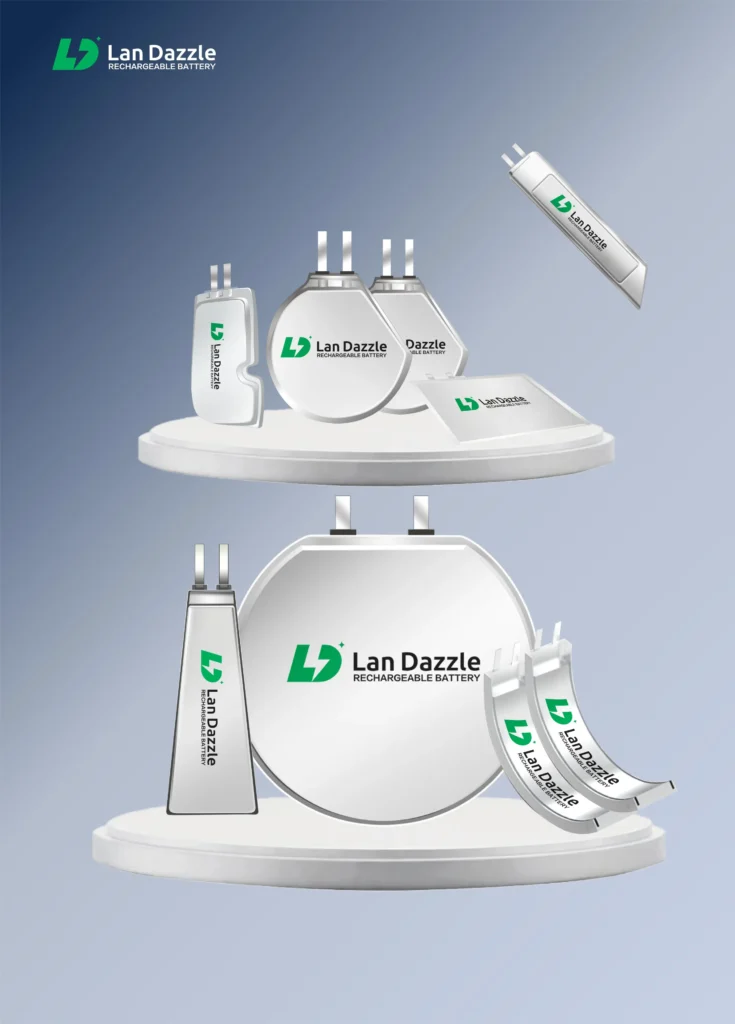
LanDazzle specializes in custom lithium polymer battery solutions for next-generation wearables, offering curved batteries, ultra-thin cells and custom-shaped battery designs tailored to unique product structures. If you are developing wearable cooling devices or other smart wearable products, contact us to explore a battery solution designed for your application.
Email: info@landazzle.com
Whatsapp: +8618938252128