Table of Contents
A battery may look simple, but its performance and safety depend on how it behaves under different conditions.
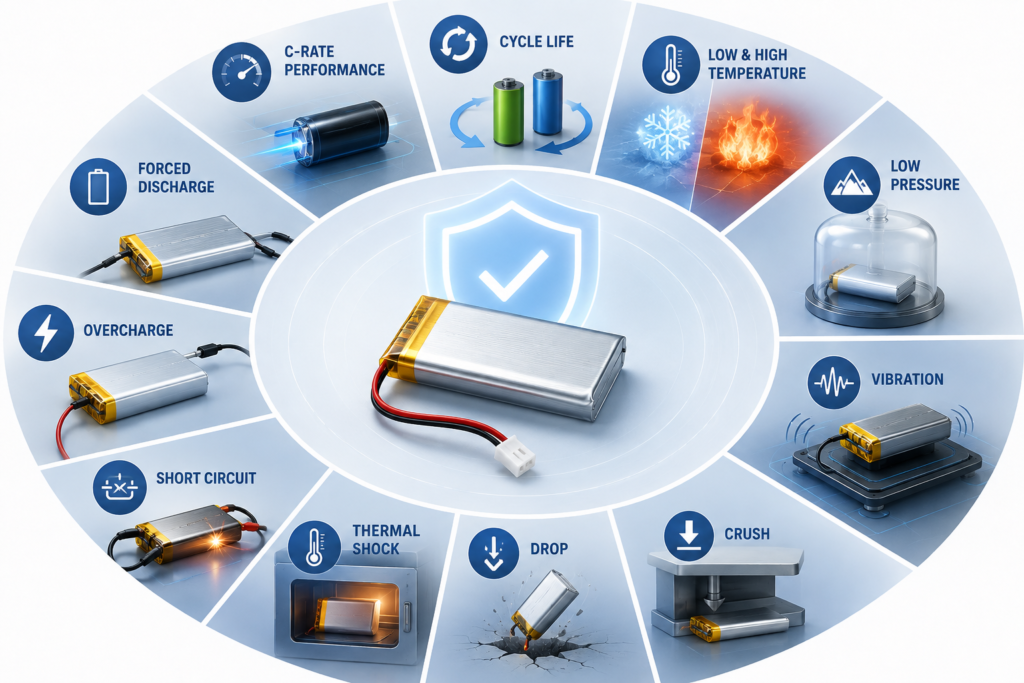
At LanDazzle, our lithium battery testing process covers multiple tests before delivery to evaluate battery performance, durability, and safety. These tests cover everything from high-rate discharge and cycle life to extreme temperatures, mechanical stress, short circuits, and overcharging.
Below are the key lithium battery tests we perform, along with the testing conditions and acceptance criteria used for each test.
1. C-Rate Performance Test
Test Environment
- Temperature: 20 ± 5°C
- Relative Humidity: 60 ± 20% RH
- Atmospheric Pressure: 86–106 kPa
Test Procedure
- Charge the battery at a constant current of 0.5C, followed by constant-voltage charging to 4.2V. The charging process is terminated when the current drops to 0.02C. After charging, allow the battery to rest for 10 minutes.
- Discharge the battery at a constant current of 0.2C until the voltage reaches 3.0V. Allow the battery to rest for 10 minutes, then record the discharge capacity and the duration of the 3.6V voltage plateau.
- Repeat the charging procedure described in Step 1. Then discharge the battery separately at 0.5C, 1C, 2C, and 3C, and record the corresponding test data.
- Organize and analyze the test data to evaluate the battery’s discharge performance at different C-rates.
Acceptance Criteria
| Discharge Rate | 0.2C | 0.5C | 1C | 2C | 3C |
|---|---|---|---|---|---|
| Capacity Retention | 100% | ≥97% | ≥95% | ≥90% | ≥80% |
Note:
The C-rate requirements and acceptance criteria are not fixed for every battery. They may vary according to the customer’s application, peak current requirements, battery capacity, operating conditions, and overall product design.
2. Cycle Life Test
Test Environment
- Temperature: 20 ± 5°C
- Relative Humidity: 60 ± 20% RH
- Atmospheric Pressure: 86–106 kPa
Test Procedure
- Charge the cell at a constant current of 1.0C, followed by constant-voltage charging to 4.2V until the charging current drops to ≤0.01C. Allow the cell to rest for 10 minutes.
- Discharge the cell at a constant current of 1C until the voltage reaches 3.0V, then allow it to rest for 10 minutes.
- Repeat the charging and discharging process described above for the specified number of cycles. Record the discharge capacity at the 1st, 50th, 100th, 200th, 300th, 500th, and 1,000th cycles.
Acceptance Criteria
The cell is evaluated based on its capacity retention relative to its initial discharge capacity:
| Cycle Number | Minimum Capacity Retention |
|---|---|
| 50 cycles | ≥95% of initial capacity |
| 100 cycles | ≥93% of initial capacity |
| 200 cycles | ≥90% of initial capacity |
| 300 cycles | ≥87% of initial capacity |
| 500 cycles | ≥85% of initial capacity |
| 1,000 cycles | ≥80% of initial capacity |
3. Low-Temperature Discharge Test
Test Environment
- Temperature: 20 ± 5°C
- Relative Humidity: 60 ± 20% RH
- Atmospheric Pressure: 86–106 kPa
Test Procedure
- Charge the battery at a constant current of 1C, followed by constant-voltage charging to 4.2V. The charging process is terminated when the current drops to 0.02C.
- Discharge the battery at a constant current of 0.2C until the voltage reaches 3.0V. Allow the battery to rest for 10 minutes, then record the initial discharge capacity (Capacity 1) and calculate the capacity retention.
- Recharge the battery at a constant current of 1C, followed by constant-voltage charging to 4.2V. The charging process is terminated when the current drops to 0.02C.
- Place the sample in a programmable temperature and humidity test chamber and maintain the temperature at -20 ± 2°C for 4 hours. Then discharge the battery at a constant current of 0.2C until the voltage reaches 3.0V. Record the low-temperature discharge capacity (Capacity 2) and calculate the capacity retention.
Acceptance Criteria
After the test, the battery must meet the following requirements:
- No deformation
- No rupture
- No fire
- No smoke
- No electrolyte leakage
- Capacity retention ≥ 70%
4. High-Temperature Discharge Test
Test Environment
- Temperature: 20 ± 5°C
- Relative Humidity: 60 ± 20% RH
- Atmospheric Pressure: 86–106 kPa
Test Procedure
- Charge the battery at a constant current of 1C, followed by constant-voltage charging to 4.2V. The charging process is terminated when the current drops to 0.02C.
- Discharge the battery at a constant current of 0.2C until the voltage reaches 3.0V. Allow the battery to rest for 10 minutes, then record the initial discharge capacity (Capacity 1) and calculate the capacity retention.
- Recharge the battery at a constant current of 1C, followed by constant-voltage charging to 4.2V. The charging process is terminated when the current drops to 0.02C.
- Place the sample in a programmable temperature and humidity test chamber and maintain the temperature at 55 ± 2°C for 4 hours. Then discharge the battery at a constant current of 0.2C until the voltage reaches 3.0V. Record the high-temperature discharge capacity (Capacity 2) and calculate the capacity retention.
Acceptance Criteria
After the test, the battery must meet the following requirements:
- No deformation
- No rupture
- No fire
- No smoke
- No electrolyte leakage
- Capacity retention ≥ 95%
5. Low-Pressure Test
Test Environment
- Temperature: 20 ± 5°C
- Relative Humidity: 60 ± 20% RH
- Atmospheric Pressure: 86–106 kPa
Test Procedure
- Discharge the battery at a constant current of 0.2C until the voltage reaches 3.0V. Allow the battery to rest for 10 minutes.
- Charge the battery at a constant current of 1C, followed by constant-voltage charging to 4.2V. The charging process is terminated when the current drops to 0.02C. After charging, allow the battery to rest for 10 minutes.
- Place the sample in a vacuum chamber maintained at 20 ± 5°C. Reduce the pressure inside the chamber to 11.6 kPa and maintain this pressure for 6 hours.
Acceptance Criteria
After the test, the battery must:
- Not catch fire
- Not explode
- Not leak electrolyte
6. Vibration Test
Test Environment
- Temperature: 20 ± 5°C
- Relative Humidity: 60 ± 20% RH
- Atmospheric Pressure: 86–106 kPa
Test Procedure
- Discharge the battery at a constant current of 0.2C until the voltage reaches 3.0V. Allow the battery to rest for 10 minutes.
- Charge the battery at a constant current of 1C, followed by constant-voltage charging to 4.2V. The charging process is terminated when the current drops to 0.01C. After charging, allow the battery to rest for 30 minutes and record the voltage.
- Subject the battery to sinusoidal vibration with an amplitude of 0.8 mm. The vibration frequency is swept between 7 Hz and 200 Hz at a rate of 1 Hz/min, with the vibration test lasting approximately 90–100 minutes. The battery is tested along three mutually perpendicular axes.
- After the vibration test, allow the battery to rest for 30 minutes. Measure the battery’s open-circuit voltage and visually inspect its external appearance.
Acceptance Criteria
After the test, the battery must meet the following requirements:
- No electrolyte leakage
- No fire
- No explosion
- Battery voltage ≥ 3.6V
- Change in internal resistance ≤ 10%
7. Crush Test
Test Environment
- Temperature: 20 ± 5°C
- Relative Humidity: 60 ± 20% RH
- Atmospheric Pressure: 86–106 kPa
Test Procedure
- Discharge the battery at a constant current of 0.2C until the voltage reaches 3.0V. Allow the battery to rest for 10 minutes.
- Charge the battery at a constant current of 1C, followed by constant-voltage charging to 4.2V. The charging process is terminated when the current drops to 0.02C. After charging, allow the battery to rest for 10 minutes.
- Position the battery with its largest flat surface facing upward. For pouch cells with a length of less than 25 mm, apply the crush force directly to the wide surface. For pouch cells with a length of 25 mm or greater, place a 25 mm diameter steel semi-cylindrical rod centrally on the wide surface of the battery for the crush test.
- Place the battery flat on the base platform of the battery crush testing machine. Start the equipment and gradually increase the pressure until the force reaches 13.0 ± 0.78 kN, then stop the test. No external short circuit shall occur during the test.
Acceptance Criteria
After the crush test, the battery must:
- Not catch fire
- Not explode
8. Drop Test
Test Environment
- Temperature: 20 ± 5°C
- Relative Humidity: 60 ± 20% RH
- Atmospheric Pressure: 86–106 kPa
Test Procedure
- Discharge the battery at a constant current of 0.2C until the voltage reaches 3.0V. Allow the battery to rest for 10 minutes.
- Charge the battery at a constant current of 1C, followed by constant-voltage charging to 4.2V. The charging process is terminated when the current drops to 0.02C. After charging, allow the battery to rest for 60 minutes and record the voltage.
- Secure the battery to the test fixture and adjust its position to ensure a drop height of 1 meter. Allow each of the battery’s six faces to freely drop onto a concrete surface. Record the battery voltage after the test.
Acceptance Criteria
After the drop test, the battery must:
- Not catch fire
- Not explode
9. Thermal Shock Test
Test Environment
- Temperature: 20 ± 5°C
- Relative Humidity: 60 ± 20% RH
- Atmospheric Pressure: 86–106 kPa
Test Procedure
- Discharge the battery at a constant current of 0.2C until the voltage reaches 3.0V. Allow the battery to rest for 10 minutes.
- Charge the battery at a constant current of 1C, followed by constant-voltage charging to 4.2V. The charging process is terminated when the current drops to 0.02C. After charging, allow the battery to rest for 10 minutes.
- Place the battery in the high-temperature test chamber. Increase the chamber temperature from room temperature to 130 ± 2°C at a rate of 5 ± 2°C/min, then maintain the temperature at 130 ± 2°C for 30 minutes.
Acceptance Criteria
After the thermal shock test, the battery must:
- Not catch fire
- Not explode
10. High-Temperature Short-Circuit Test
Test Environment
- Temperature: 20 ± 5°C
- Relative Humidity: 60 ± 20% RH
- Atmospheric Pressure: 86–106 kPa
Test Procedure
- Discharge the battery at a constant current of 0.2C until the voltage reaches 3.0V. Allow the battery to rest for 10 minutes.
- Charge the battery at a constant current of 1C, followed by constant-voltage charging to 4.2V. The charging process is terminated when the current drops to 0.02C. After charging, allow the battery to rest for 10 minutes.
- Attach the thermocouple of the temperature measurement system to the center of the battery surface using high-temperature adhesive. Place the battery in a high-temperature test chamber maintained at 57 ± 4°C. Connect the positive and negative terminals of the battery to the short-circuit test system, with the resistance between the positive and negative terminals set to 80 ± 20 mΩ. Allow the battery to rest for 30 minutes.
- Activate the short-circuit switch to short-circuit the battery and record the peak surface temperature of the battery.
- Terminate the test when either of the following conditions occurs:
- The battery has remained in the short-circuit condition for 24 hours; or
- The battery temperature drops to 80% of its peak temperature (a decrease of 20% from the peak value).
Acceptance Criteria
After the test, the battery must:
- Not catch fire
- Not explode
- Have a surface temperature of no more than 150°C
11. Overcharge Test
Test Environment
- Temperature: 20 ± 5°C
- Relative Humidity: 60 ± 20% RH
- Atmospheric Pressure: 86–106 kPa
Test Procedure
- Discharge the battery at a constant current of 0.2C until the voltage reaches 3.0V. Allow the battery to rest for 10 minutes.
- Place the battery in a fume hood and attach the thermocouple of the temperature measurement system to the center of the battery surface using high-temperature adhesive. Connect the positive and negative terminals of the battery to the constant current/constant voltage power supply.Set the test voltage according to the battery’s rated charging cut-off voltage:
- Rated charging cut-off voltage < 4.25V: Test voltage = rated cut-off voltage + 0.4V
- Rated charging cut-off voltage of 4.25–4.45V: Test voltage = 4.65V
- Rated charging cut-off voltage ≥ 4.45V: Test voltage = rated cut-off voltage + 0.2V
- Terminate the test when either of the following conditions occurs:
- The continuous charging time reaches 7 hours; or
- The battery temperature drops to 80% of its peak temperature (a decrease of 20% from the peak value).
- Record the peak surface temperature of the battery.
Acceptance Criteria
After the overcharge test, the battery must:
- Not catch fire
- Not explode
12. Forced Discharge Test
Test Environment
- Temperature: 20 ± 5°C
- Relative Humidity: 60 ± 20% RH
- Atmospheric Pressure: 86–106 kPa
Test Procedure
- Discharge the battery at a constant current of 0.2C until the voltage reaches 3.0V. Allow the battery to rest for 10 minutes.
- Connect the positive and negative terminals of the battery in reverse polarity to the test chamber terminals.
- Apply a forced reverse-current charge at 1× the rated current for a total test duration of 90 minutes:
- If the voltage reaches the specified negative charging limit voltage within 90 minutes, maintain the battery at that voltage until the 90-minute test period is completed.
- If the voltage does not reach the specified negative charging limit voltage during the 90-minute period, terminate the test when the 90-minute period is reached.
- After the test is stopped, allow the battery to rest for 30 minutes and continuously observe it for signs of thermal runaway or other safety hazards.
Acceptance Criteria
After the forced discharge test, the battery must:
- Not catch fire
- Not explode
Reliable Battery Quality Starts with Rigorous Testing
Battery quality is not determined by capacity alone. Performance, safety, durability, and reliability all need to be verified under different operating and abnormal conditions.
At LanDazzle, our batteries undergo a comprehensive testing process covering C-rate performance, cycle life, low- and high-temperature discharge, low pressure, vibration, crush, drop, thermal shock, short circuit, overcharge, and forced discharge. These tests help us identify potential risks and verify that each battery meets the required performance and safety criteria before delivery.
For custom battery projects, testing requirements can also be adjusted according to the application, operating environment, discharge rate, capacity, and customer’s specific requirements.
Looking for a custom lithium battery with verified performance and reliability? Contact LanDazzle to discuss your battery requirements and testing needs.
Email: info@landazzle.com
Whatsapp: +8618938252128