
In recent years, smart rings have gradually moved from a niche wearable category into the mainstream. While the market was initially driven mainly by technology companies, traditional jewelry brands are now entering the space as well.
This shift is creating an interesting new category: smart rings are no longer just technology products. They are becoming a combination of precious metals, jewelry design, smart hardware, and digital services.
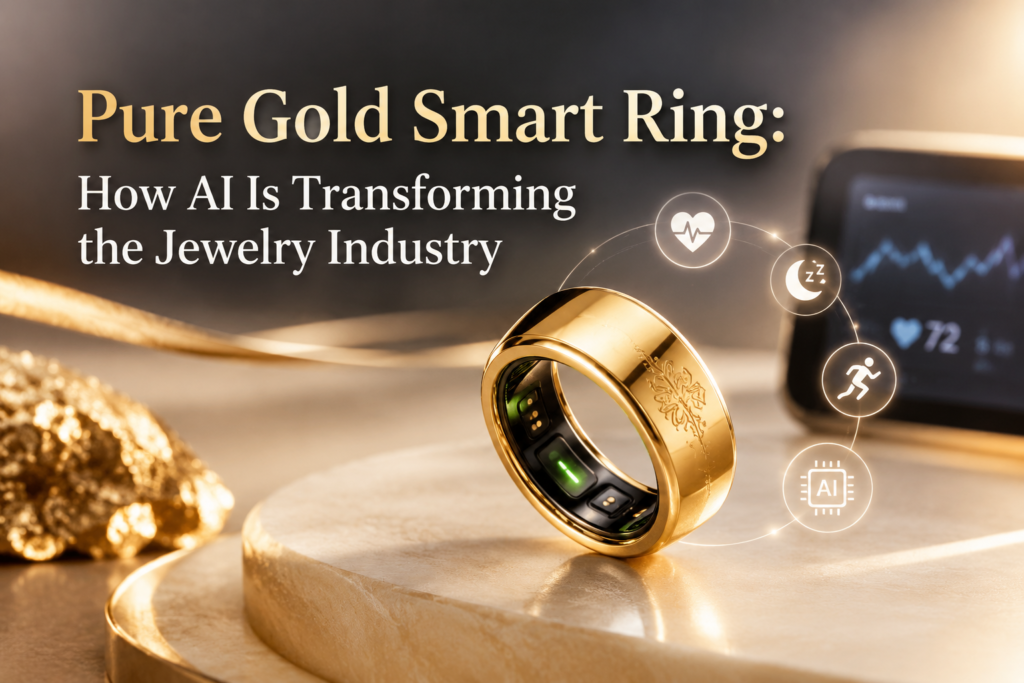
On September 10, 2026, Hong Kong-listed company Shenzhen Xipuni Precision Technology Co., Ltd. (02583.HK) announced its latest developments in smart jewelry at its “Xipuni Smart New Product Launch & AI + Gold Jewelry Capital Forum” in Shenzhen. The company introduced a pure gold smart ring and also announced a collaboration with porcelain manufacturer Guo Ci Yong Feng Yuan to develop another smart ring product.
Why are traditional jewelry companies entering the smart ring market?
Xipuni is not a technology company that has suddenly moved into smart hardware.
Founded in 2013, the company initially focused on gold watches, a relatively specialized market in which it developed its own approach to improving the hardness and durability of pure gold. In 2014, Xipuni reported a breakthrough in its supramolecular hard gold technology and launched a mass-produced pure gold watch.
As the wearable market developed, the company gradually expanded from traditional precious-metal watches into smart wearables.
In 2023, Xipuni began working with Huawei to develop precious-metal smartwatch products. The company later listed on the Hong Kong Stock Exchange in 2025.
Its move into pure gold smart rings represents another step toward combining its traditional jewelry manufacturing capabilities with smart wearable technology.
The broader trend is worth noting. As smart hardware becomes more mature, competition is no longer only about chips, sensors, software, or connectivity. Materials, industrial design, comfort, and cultural identity are becoming increasingly important to wearable products.
What makes a pure gold smart ring different from a conventional smart ring?
The key difference is not simply putting a smart module inside a gold housing.
Traditional smart rings are generally designed around functions such as health monitoring, sleep tracking, activity tracking, and notifications. A pure gold smart ring adds another layer of value: the material and aesthetic qualities normally associated with fine jewelry.
In other words, future smart rings may need to serve three roles at the same time:
A smart device, a piece of jewelry, and a product with cultural and aesthetic value.
This is one reason traditional jewelry companies are becoming increasingly interested in AI and wearable technology.
Xipuni is not the only example. Earlier, Chinese jewelry company Laofengxiang was also reported to be developing a gold version of an AI gourd pendant, exploring another way to combine traditional gold jewelry with AI hardware.
While detailed product specifications have not yet been fully disclosed, developments like these suggest that the boundaries between jewelry and consumer electronics are becoming less distinct.
How is smart jewelry different from simply combining gold with electronics?
Another product announced by Xipuni highlights this shift.
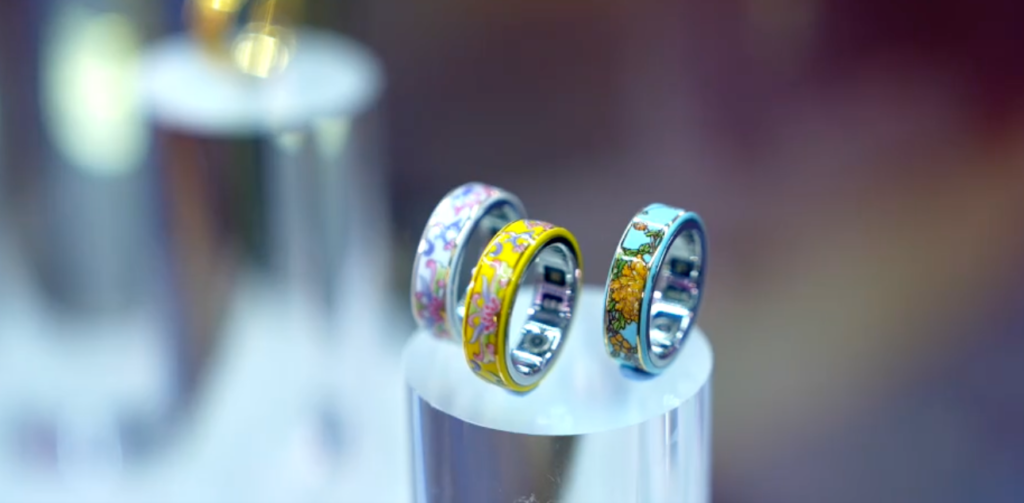
The company plans to collaborate with Guo Ci Yong Feng Yuan on a “Guo Ci Smart Ring,” combining traditional Chinese porcelain materials and decorative patterns with smart sensing, health monitoring, and AI services.
This represents a different design philosophy from conventional smart hardware.
Traditional wearable devices are often designed around their electronic components first, with the exterior developed afterward. Smart jewelry has to consider materials, shape, comfort, internal space, and electronics at the same time.
This is particularly challenging for rings and other compact wearables, where batteries, sensors, chips, and communication modules all have to fit into a very limited space.
As smart devices become more jewelry-like, battery design becomes an increasingly important part of the overall product architecture.
Why do smart rings need more flexible battery designs?
For products such as smart rings and AI-enabled pendants, conventional battery shapes do not always make the best use of the available internal space.
In curved or irregular products, for example, a standard rectangular battery may force designers to compromise on the industrial design. In highly compact wearables, battery thickness, width, and how closely the cell can follow the product’s geometry can directly affect the final form factor.
This is where curved, ultra-thin, and custom-shaped lithium batteries can provide greater design flexibility.
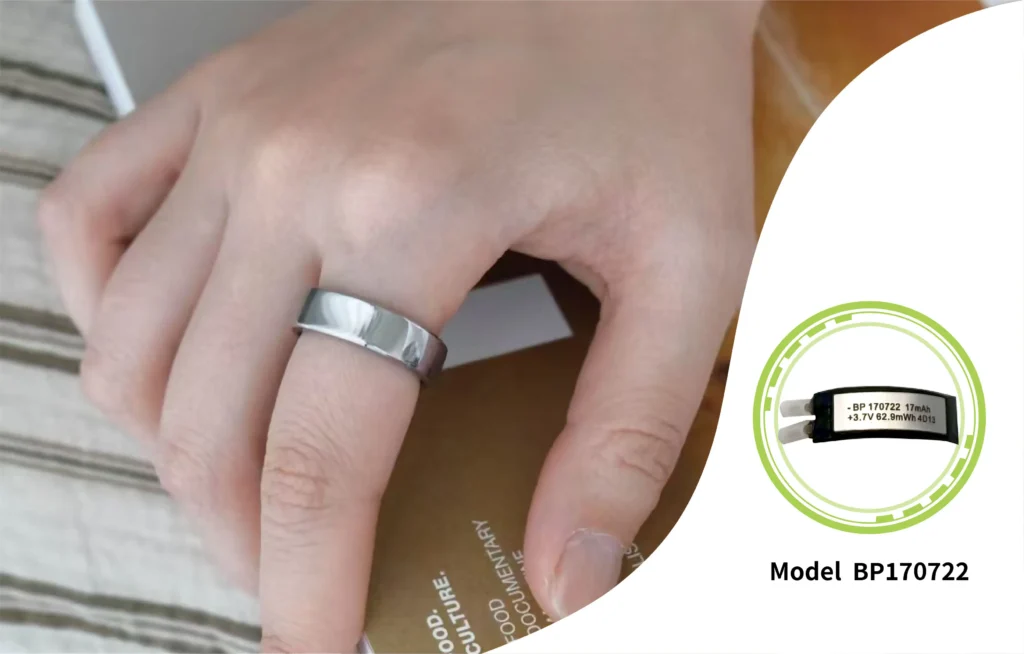
A curved battery can be designed around the internal geometry of a device, allowing the cell to follow a curved surface and reduce unused space. This can be particularly useful for smart rings, smart bands, hearables, and other jewelry-inspired wearable devices.
Of course, battery shape is only one part of the engineering challenge. Capacity, cycle life, charging performance, thermal behavior, and safety also need to be considered together.
As a result, future smart jewelry may rely less on one standardized battery format and more on battery designs customized to the structure of each device.
How is AI expanding beyond the smart jewelry product itself?
Xipuni’s latest announcement also extends beyond hardware.
The company introduced an AI-powered retail solution for jewelry stores, designed to support functions such as intelligent sales assistance, inventory management, customer insights, targeted recommendations, and business decision support.
This illustrates another important development: AI is moving beyond being a feature inside a wearable device and becoming part of the broader jewelry business ecosystem.
On one side, there is AI + smart jewelry, where traditional jewelry products gain sensing and intelligent functions.
On the other, there is AI + jewelry retail, where AI tools are used to improve store operations and customer engagement.
Together, these developments suggest that the jewelry industry is exploring a broader digital transformation—from materials and product design to smart hardware, AI services, and retail operations.
What does the rise of pure gold smart rings mean for the future of wearables?
Gold and AI may seem to belong to completely different worlds. One is associated with traditional craftsmanship, luxury, and cultural value, while the other represents digital technology and intelligent hardware. Yet smart rings, AI pendants, and other forms of smart jewelry are bringing these two worlds closer together.
The real challenge is not simply putting a chip into a gold accessory. It is about integrating jewelry design, electronics, sensors, batteries, and user comfort into a product that can be manufactured reliably at scale.
As smart jewelry moves toward commercialization, battery technologies such as custom-shaped, curved, and ultra-thin lithium batteries may become increasingly important in giving designers more freedom to create compact and distinctive wearable products.
The next generation of jewelry may therefore be more than a traditional accessory—and more than a conventional smart device. It could be a new category that combines jewelry, electronics, and AI in a single product.
For wearable developers exploring compact or curved product designs, choosing the right battery architecture early can make a significant difference in both product form and performance.
Looking for a custom-shaped battery for a smart ring, wearable, or AI device? Explore how a battery can be designed around your product—not the other way around.
Email: info@landazzle.com
Whatsapp: +8618938252128