Table of Contents
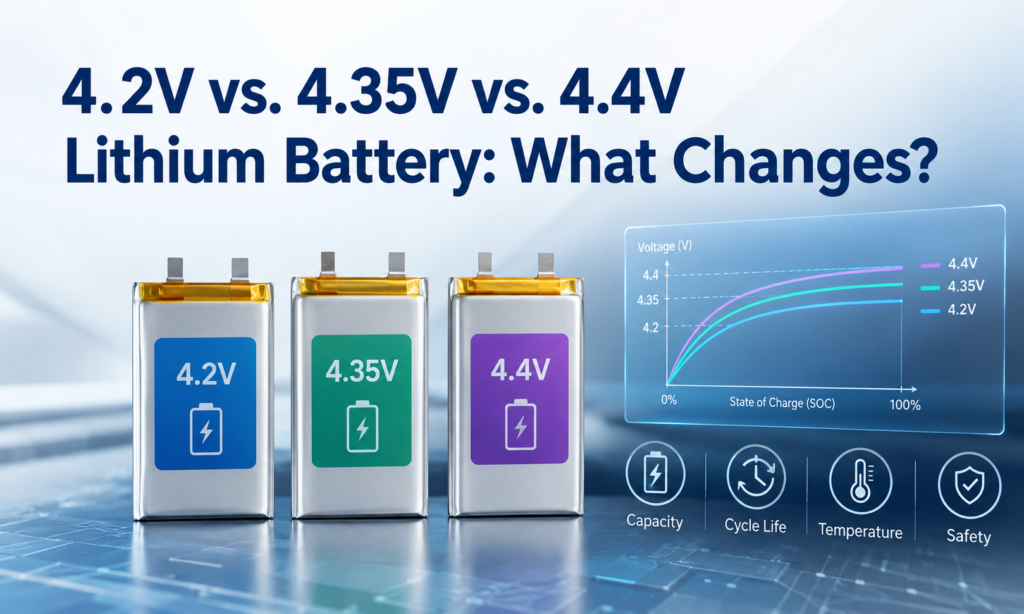
The main difference between 4.2V, 4.35V, and 4.4V lithium batteries is their maximum charging voltage. A higher charging limit may allow a specifically designed lithium-ion cell to deliver more usable energy, but it can also affect cycle life, charging requirements, and long-term reliability.
For product engineers and battery buyers, choosing the right voltage is not simply a matter of selecting the highest number. Cell chemistry, charger compatibility, battery protection settings, and the requirements of the end device all need to be considered.
In this guide, we compare 4.2V, 4.35V, and 4.4V lithium batteries and explain what these differences mean for product development.
1. 4.2V vs 4.35V vs 4.4V Lithium Battery: A Quick Comparison
The three voltage levels represent different maximum charging voltage settings for compatible single-cell lithium-ion or lithium-polymer batteries. They are not the nominal operating voltage of the battery.
| Comparison | 4.2V Battery | 4.35V Battery | 4.4V Battery |
|---|---|---|---|
| Maximum charging voltage | 4.20V | 4.35V | 4.40V |
| Potential usable energy | Depends on cell design | May be higher with a compatible design | May be higher with a compatible design |
| Cycle life | Depends on chemistry and operating conditions | Higher voltage may increase aging | Higher voltage may increase aging |
| Charging requirements | Compatible 4.2V charging profile | Compatible 4.35V charging profile | Compatible 4.4V charging profile |
| Main design consideration | Balance energy and longevity | Verify cell and charger compatibility | Verify cell and charger compatibility |
The table provides a general comparison, not a universal performance ranking. The actual capacity, energy density, and cycle life of a battery depend on its electrode materials, electrolyte formulation, construction, and operating conditions.
For example, Texas Instruments’ BQ25170 single-cell battery charger supports selectable lithium-ion charging voltages of 4.05V, 4.1V, 4.2V, 4.35V, and 4.4V. This demonstrates why the charging voltage must be treated as a specific design parameter rather than a simple indicator of battery quality.
2. What Do 4.2V, 4.35V, and 4.4V Actually Mean?
Maximum Charging Voltage vs. Nominal Voltage
Maximum charging voltage is the upper voltage limit that a cell is designed to reach during charging. Nominal voltage is the representative voltage used to describe a cell’s normal operating range.
These values are different. A lithium-ion cell with a nominal voltage around 3.6V or 3.7V may have a maximum charging voltage of 4.2V, 4.35V, or 4.4V, depending on its specific chemistry and design.
During conventional lithium-ion charging, the charger initially regulates current and then holds the voltage at the prescribed limit while the current gradually decreases. The final voltage must be accurately controlled to avoid overcharging.
Why Do Lithium Batteries Have Different Voltage Limits?
Lithium-ion batteries are not all designed to operate under the same electrochemical conditions. Electrode materials, electrolyte formulation, and other design choices determine the appropriate charging voltage.
Some cells are specifically engineered to operate at higher charging voltages. However, a conventional 4.2V cell cannot automatically be converted into a 4.35V or 4.4V cell simply by changing the charger setting.
The cell must be designed and validated for the intended voltage range. This is particularly important when a battery is integrated into a compact electronic device with limited space for additional protection or thermal management.
3. How Does Charging Voltage Affect Battery Performance?
Usable Capacity and Energy Density
One reason manufacturers develop higher-voltage lithium-ion cells is to increase the energy available from a given cell design.
By allowing a compatible cell to reach a higher charging voltage, it may be possible to extract additional capacity from the electrochemical system. However, the amount of additional energy varies with the cell chemistry and design.
A higher maximum charging voltage does not automatically mean a battery has higher energy density. Energy density also depends on the amount and properties of active materials, cell construction, and the balance between electrodes and other components.
For product developers, the more useful question is how much usable energy a battery delivers within the available weight and volume.
This distinction is important for compact products such as smart glasses, wearables, and portable electronic devices, where battery dimensions and weight can be as important as electrical performance.
Cycle Life and Battery Aging
Charging voltage can also influence how quickly a lithium-ion battery ages.
Operating certain lithium-ion chemistries at higher upper-voltage limits can accelerate electrolyte oxidation, electrode degradation, and other side reactions. Over time, these processes may contribute to capacity loss and increased internal resistance.
The review article Electrolytes for High-Voltage Lithium Batteries, published in Trends in Chemistry, discusses the degradation challenges associated with higher-voltage operation and the role of electrolyte design in improving stability.
However, it would be misleading to claim that every 4.2V battery lasts longer than every 4.35V or 4.4V battery. Cycle life also depends on charging current, operating temperature, discharge depth, time spent at high state of charge, and the materials used in the cell.
A battery designed for higher-voltage operation may offer a useful energy advantage, but its longevity should be evaluated using the manufacturer’s specifications and relevant test results.
Temperature, Charging Conditions, and Reliability
Charging voltage is only one factor affecting battery reliability.
Charging current, ambient temperature, heat dissipation, and the charging control strategy can all influence battery performance. A well-designed system should ensure that the cell stays within its specified operating limits under expected conditions.
For instance, a battery intended for a compact wearable device may require careful consideration of its charging current, temperature monitoring, protection circuit, and available heat dissipation.
Rather than selecting a battery based on maximum charging voltage alone, engineers should evaluate the complete charging system and its intended operating environment.
4. Can You Use a 4.35V or 4.4V Battery in a 4.2V Device?
This is one of the most important compatibility questions when selecting or replacing a lithium battery.
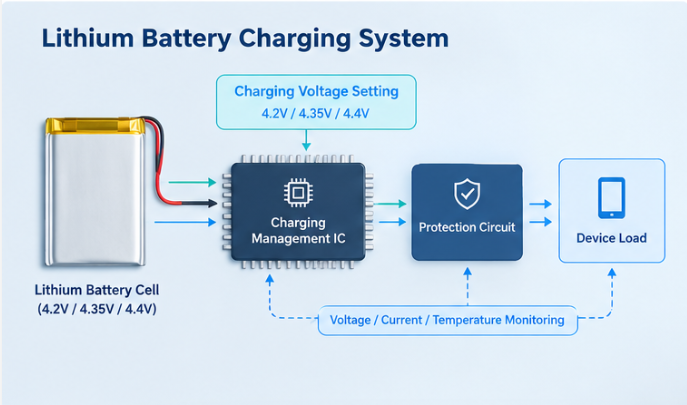
A battery’s physical dimensions and connector do not guarantee electrical compatibility. The charger and protection system must be appropriate for the specific cell.
| Battery and Charger Combination | What to Know |
|---|---|
| 4.35V cell with a 4.2V charger | The charger may stop at 4.2V, leaving some of the cell’s potential capacity unused. Verify compatibility with the battery and device specifications. |
| 4.2V cell with a 4.35V charger | Do not use a 4.35V charging profile unless the cell manufacturer explicitly specifies that voltage as permissible. |
| 4.4V cell with a 4.2V charger | The cell may not reach its intended full-charge voltage, reducing the energy available from a full charging cycle. |
| 4.35V or 4.4V cell with a matching charger | Verify that the charger, protection circuit, battery monitoring system, and device are all designed for the selected cell. |
A lower charging-voltage limit may be suitable for a compatible higher-voltage cell, but it can reduce the energy obtained per charge. That does not mean every combination is automatically approved for use; the cell manufacturer’s specifications and the device’s electrical requirements must still be checked.
By contrast, charging a cell above its permitted maximum voltage can cause degradation and create safety risks.
Texas Instruments’ BQ27427 battery fuel gauge, for example, provides selectable profiles for 4.2V, 4.35V, and 4.4V cells. This illustrates that battery monitoring and system configuration are also relevant when integrating different voltage classes.
Before replacing a battery, verify the following:
- The cell’s specified maximum charging voltage.
- The charger IC’s voltage regulation setting.
- The protection circuit’s overvoltage threshold.
- The battery fuel gauge configuration, where applicable.
- The device’s operating voltage range and validation requirements.
If any of these parameters are unknown, confirm them with the battery manufacturer or the device’s engineering team before making a substitution.
5. How to Choose the Right Battery Voltage for Your Product
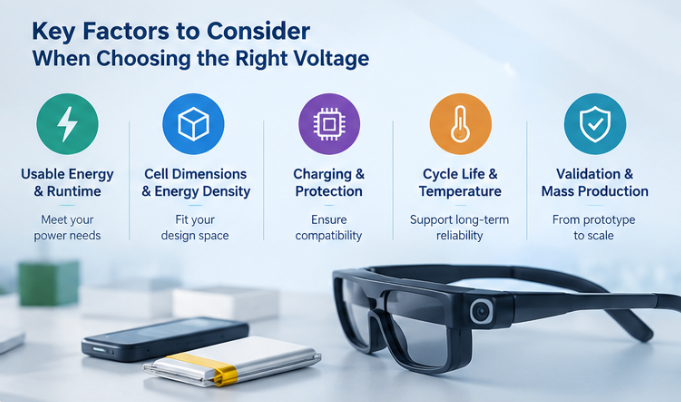
The best voltage option depends on the product’s actual requirements rather than a general assumption that higher is better.
Start with Usable Energy and Runtime
Determine the device’s average power consumption, peak power demand, and target operating time. Compare suitable cells using their specified capacity and energy ratings, rather than charging voltage alone.
Consider Cell Dimensions and Energy Density
For compact electronics, available battery space may limit the dimensions, capacity, and shape of the cell. A higher-voltage option is useful only if its performance and physical design fit the product.
Check Charging and Protection Requirements
Make sure the charger, battery protection circuit, fuel gauge, and device are compatible with the proposed cell. Any voltage change should be evaluated as part of the complete electrical design.
Define Cycle-Life and Temperature Requirements
Consider how often the product will be charged, the expected operating temperature, and the required service life. Use test results from the intended cell rather than assuming that charging voltage alone predicts long-term performance.
Validate the Design Before Mass Production
For a new product, verify the battery’s actual capacity, dimensions, charging behavior, discharge performance, and cycle-life requirements. A suitable battery should perform consistently under the conditions expected in the finished device.
These considerations become especially important for space-constrained products such as smart glasses, wearable electronics, and portable medical or monitoring devices, where battery performance must be balanced with size, weight, reliability, and integration requirements.
6. Frequently Asked Questions
Is a 4.35V lithium battery better than a 4.2V battery?
Not necessarily. A compatible 4.35V cell may provide additional usable energy, but the actual benefit depends on its design. Cycle life, charging compatibility, and application requirements should also be considered.
Can a 4.35V battery be charged with a 4.2V charger?
A compatible 4.35V cell may be charged using a charger limited to 4.2V, but it may not reach its full-charge condition. Always verify compatibility with the cell manufacturer and the complete device design.
Can a 4.2V battery use a 4.35V charger?
Not unless the battery manufacturer explicitly permits a 4.35V charging limit for that exact cell. Exceeding the specified maximum charging voltage can damage the cell and create safety risks.
Does a 4.4V battery always have higher capacity?
No. Maximum charging voltage alone does not determine capacity or energy density. These depend on the cell’s chemistry, electrode design, and overall construction.
Does a higher charging voltage reduce battery life?
A higher upper-voltage limit can accelerate aging in certain lithium-ion chemistries, but the effect depends on the complete cell design and operating conditions. Consult the manufacturer’s cycle-life data for a meaningful comparison.
Conclusion: Choose a Battery Based on the Complete Design
The difference between 4.2V, 4.35V, and 4.4V lithium batteries goes beyond a single voltage number. Higher charging limits may help certain cell designs deliver more usable energy, but they also place specific requirements on cell chemistry, charging control, and long-term reliability.
For product engineers and battery buyers, the right choice is the cell that meets the required energy, dimensions, cycle life, charging compatibility, and operating conditions.
Developing a compact electronic product that requires a battery tailored to its design? Share your target dimensions, capacity, charging specifications, and runtime requirements with our engineering team to discuss a suitable custom battery solution.
Email: info@landazzle.com
Whatsapp: +8618938252128