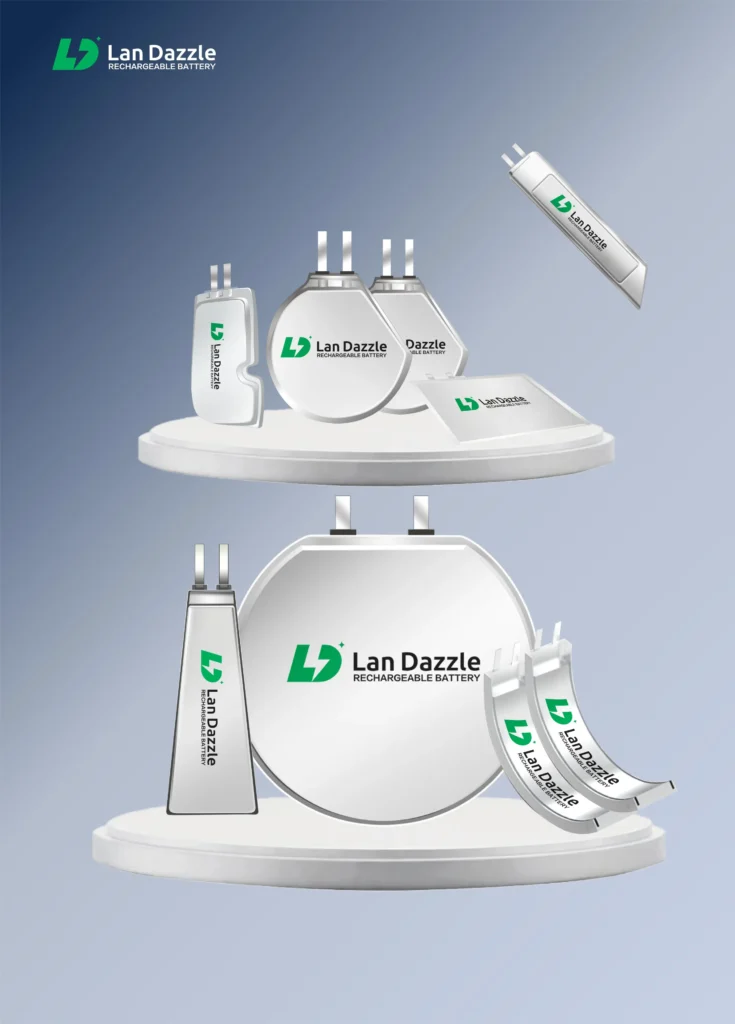
People who have truly worked in the AR/VR industry know that today’s upgrade “ceiling” is no longer about computing power or display quality. Chips are powerful enough, resolutions are high, and optical designs keep improving—but real user feedback still comes back to the same problem: battery life is too short, and devices are too heavy.
Many brands continue to invest heavily in faster chips and better displays, but often overlook the battery. This is where problems appear. The reason is simple: traditional square or cylindrical batteries are not well suited for AR/VR devices, which have very limited space and highly irregular internal structures.
This usually leads to only two outcomes:
- Either the device sacrifices structure and weight to fit a larger battery, making it bulky and uncomfortable to wear;
- Or the battery capacity is reduced, resulting in much shorter usage time and limited real-world scenarios.
In this context, custom-shaped batteries are moving from a “niche solution” to the spotlight. They are not about pushing specs on paper, but about redesigning battery shape based on the device structure—redefining space efficiency and usable energy inside AR/VR hardware.
Custom-Shaped Batteries for AR VR Devices
The internal space of AR/VR devices is extremely limited by design.
Whether it is the curved head strap of a VR headset, the edges of the main body, or the very slim 8–10 mm temples of AR glasses, all of these structures place very high demands on battery shape.
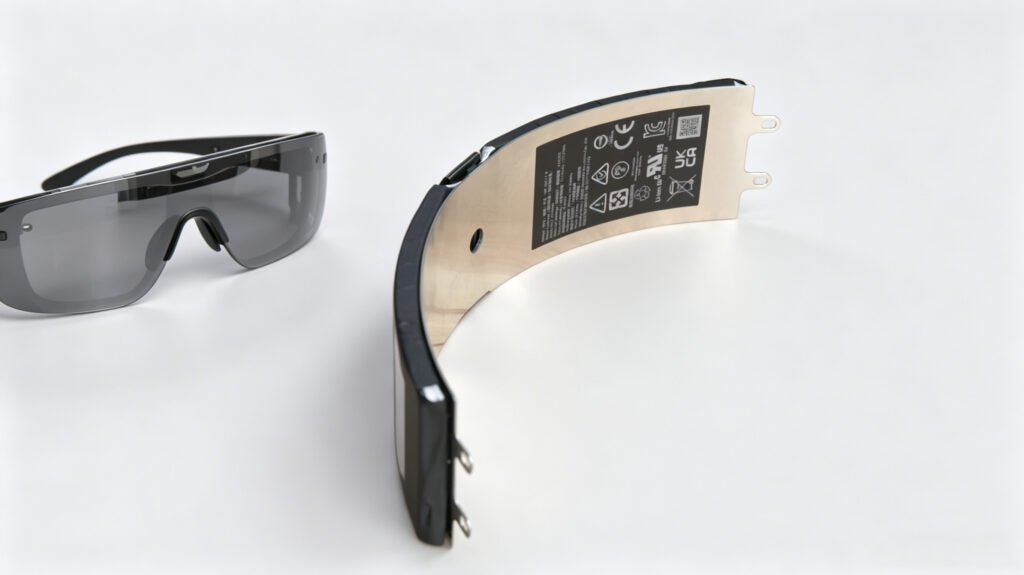
Traditional square or cylindrical batteries are hard to fit into such irregular spaces:
- They either waste a lot of internal space and add extra weight to the device;
- Or the battery capacity has to be reduced, which often limits AR glasses to less than 2 hours of battery life, seriously restricting real-world use.
The core value of custom-shaped batteries lies in designing the battery around the device structure, not the other way around.
This directly addresses the key conflict in AR/VR devices: battery life versus lightweight design. The advantages are mainly seen in three areas:
Higher space efficiency
In AR/VR devices, traditional batteries often use less than 50% of the available space.
Custom-shaped batteries can increase space utilization to over 70%, and in high-end designs even close to 90%, significantly increasing capacity without increasing overall size.
Better weight distribution and wearing comfort
Curved or ring-shaped battery designs can follow the contours of the head strap or glasses frame.
This helps balance the device’s center of gravity, reduce pressure on the face, and minimize forward head tilt, making long-term wear much more comfortable.
A better balance between battery life and lightweight design
With the same device size, battery capacity can increase by 10–30%.
For a VR headset weighing around 650 g, this can extend real immersive usage time by about 1 hour.
Three Innovative Application Directions for Custom-Shaped Batteries in AR/VR
AR Glasses — Metal-Cased Custom Batteries Solve the “Temple Battery Life Problem”
The space inside AR glasses temples is extremely limited, usually only 8–10 mm wide.
Under such tight limits, traditional square pouch batteries either do not fit well—hurting appearance and wearing comfort—or must reduce capacity, often resulting in less than 2 hours of battery life.
Because of this, metal-cased custom-shaped batteries have become one of the most representative solutions for AR glasses today.
Take the Oakley Meta HSTN sports AR glasses jointly released by Meta and Oakley as an example.
They use a custom metal-cased battery with a size of about 10 × 5 × 20 mm, which fits fully inside the temple.
Compared with a traditional pouch battery, the volume is reduced by about 40%, while the battery capacity is increased by 40%.
This design uses a stacked (laminated) cell structure instead of a traditional winding structure, allowing high energy density and strong structural stability even in a very small size.
On this basis, the industry is exploring higher-integration solutions, such as:
- Square metal stacked cells + SiP packaging, using 3D stacking of components to shrink the mainboard and leave more space for the battery;
- 4.55V high-voltage cathodes + third-generation silicon-based anodes, enabling higher capacity, better safety, and longer cycle life inside narrow temples, with cycle life exceeding 1,500 cycles.
A more forward-looking idea is the ring-shaped custom battery.
By designing the battery to match the shape of the glasses frame and embedding it directly inside, space utilization can increase by over 40%, battery life can improve by 25–50%, and the front-heavy balance problem of AR glasses is greatly reduced. This results in better wearing comfort and a more balanced look.
VR Headsets — Curved Custom Batteries Enable “Structure and Function Integration”
In VR headsets, innovation in custom batteries goes beyond shape and moves toward the idea of “the battery as part of the structure.”
The battery is no longer just a power source—it also helps with weight balance and structural support.
In one MR headset solution released in 2024, a custom one-piece curved pouch battery is used.
Instead of being simply bent, the battery is fully shaped to match the curve of the head strap. The battery casing itself acts as a support structure, removing the need for extra brackets. This saves space and reduces weight at the same time.
From a process point of view, these batteries usually use:
- Flexible stacked cell technology
- Ultra-thin current collectors (about 6 μm copper foil and 12 μm aluminum foil)
With stable structure, battery thickness can be reduced by over 20%, while maintaining resistance to bending and pressure, and avoiding electrode separation.
With a total device weight of around 650 g, a dual-cell series design can deliver about 3.5 hours of immersive gaming time, with energy density reaching 280 Wh/kg.
Accessories and Concept Devices — “Scenario-Based Innovation” with Custom Batteries
Beyond headsets and glasses, custom-shaped batteries also show strong value in AR/VR accessories.
For VR controllers, custom-shaped AA-type batteries are already in testing.
Thanks to non-standard shapes and side-exit wiring, they can fit irregular handle spaces. Compared with standard AA batteries, capacity increases by about 20%, extending usage time by around 3 hours.
Some designs with dual positive and dual negative terminals can raise space utilization from 40% to over 60% without increasing controller size.
For external battery accessories, such as the magnetic “boomerang” battery module of Pico 4 Ultra, a custom-shaped pouch battery is designed to match the rear structure of the headset.
Without changing weight balance, battery life is extended from 2 hours to about 5 hours, and PD fast charging is supported, adding around 30% power in just 15 minutes.
More disruptive ideas are coming from cutting-edge concept devices.
For example, Nanyang Technological University in Singapore is developing AR contact lenses that use flexible bio-batteries with thickness close to that of the human cornea. These batteries store and release energy using tears, and may offer a completely new power solution for future AR contact-lens devices.
Pain Points and Future of Custom-Shaped Batteries
Cost is the main challenge.
Custom-shaped batteries require dedicated tooling and extra R&D, which makes them 30%–50% more expensive than traditional standard batteries. This is why many entry-level and mid-range AR/VR devices hesitate to use them.
However, as battery manufacturers scale up mass production and achieve breakthroughs in electrolyte processes, costs are expected to gradually decrease in the future.
Many AR/VR battery solutions still focus on one thing only: more capacity in a smaller size.
What often gets overlooked is the user’s real priority — wearing comfort and practical battery life.
The real innovation of custom-shaped batteries is a change in mindset.
Instead of forcing batteries to fit devices, the device now defines the battery.
From steel-cased stacked batteries in AR glasses, to curved, integrated batteries in VR headsets, and even early-stage bio-batteries, every step in custom-shaped battery design is driven by real user pain points.
Looking ahead, as materials and manufacturing processes continue to improve, custom-shaped batteries will not only appear in high-end products. They will gradually move into mid-range and mass-market devices, helping AR/VR products become lighter, longer-lasting, and more comfortable to wear — and finally breaking today’s battery life limitations.
For AR/VR manufacturers, instead of competing endlessly on computing power, it may be smarter to look closely at battery innovation.
After all, only devices that people are willing to wear for hours can truly succeed.
Conclusion
Custom-shaped batteries are no longer a niche option for AR/VR devices.
They are becoming a key factor that defines comfort, battery life, and overall user experience.
As AR/VR products move toward lighter designs and longer wearing time, battery solutions must move beyond standard shapes and fixed formats. Batteries need to be designed around the device structure, usage scenario, and real user needs.
For manufacturers, this shift is not just a technical upgrade — it is a strategic decision that can directly impact product competitiveness and user acceptance.
If you are developing AR glasses, VR headsets, or related accessories and are facing challenges with battery life, space constraints, or weight balance, we’re here to help.
LanDazzle specializes in custom lithium battery solutions, including:
- Battery solutions optimized for wearable devices
- Custom-shaped LiPo batteries
- Steel-cased and curved battery designs
Email: info@landazzle.com
Whatsapp: +8618938252128