
Elderly care robots are moving out of research labs and into real homes.
When people imagine an elderly care robot, they often picture a humanoid machine that can talk, walk, and act like a robotic caregiver. But real-world projects in 2026 are showing something much simpler: older adults may not need a robot that does everything.
What they often want are practical things:
Can someone know if I fall? Did I remember to take my medication? Can something help me pick up an item I cannot reach? And when I am alone, is there someone—or something—I can talk to?
These everyday needs are starting to shape what the next generation of elderly care robots will actually look like.
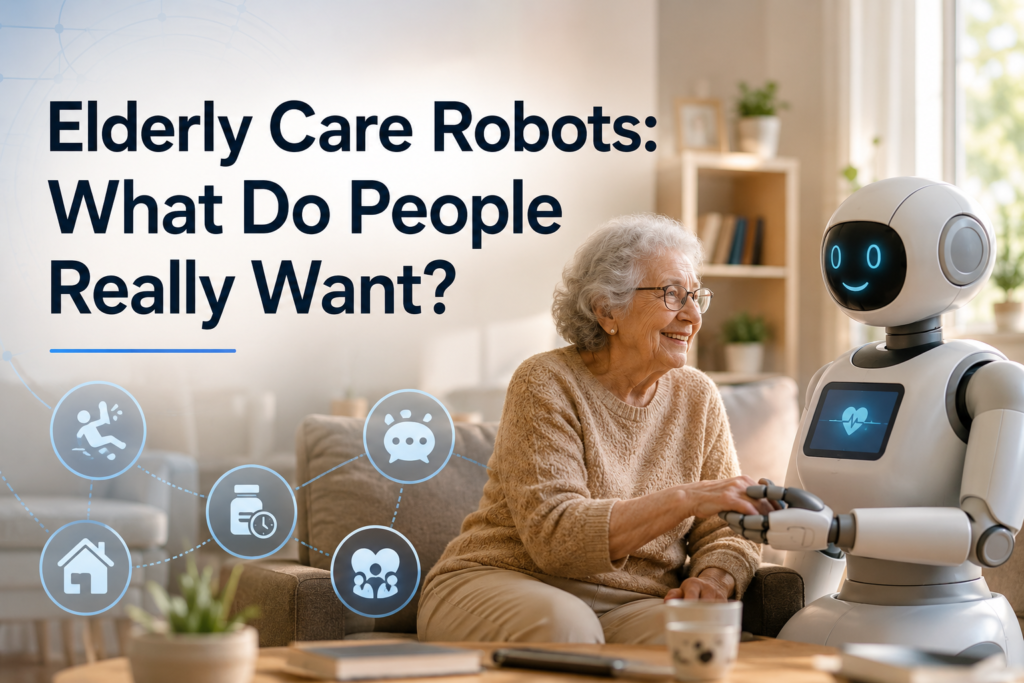
Are elderly care robots already being used in real homes?
Yes. In 2026, several projects have moved beyond demonstrations and started testing robots in real homes and care environments. In February 2026, Barcelona launched an elderly care robot project involving around 600 robots deployed in homes and care centers.
One of the users, 67-year-old Irene Veglison, named her robot Sandi.
Sandi wakes her up in the morning, reminds her to take medication at 9 a.m., reminds her about medical appointments, and says goodnight in the evening. It can also play music and even dance with her. More importantly, the robot is connected to human support. Staff can monitor her situation, and social workers can be contacted when necessary.
This example reveals something important.
Older adults are not necessarily looking for a machine to replace their families or caregivers. Instead, they may value having some extra support when they are alone, while giving family members and care workers greater peace of mind.
A similar direction is emerging in the United States. In 2026, UC Davis launched a long-term study examining the use of the humanoid social robot Abi in dementia care. Researchers are looking at how robots interact with older adults over time and whether they can provide meaningful support in real care environments.
This represents an important shift:
Instead of asking what a robot can do, researchers are increasingly asking whether older adults actually want a robot in their daily lives.
Those are two very different questions.
What functions do older adults actually want from care robots?
When current products and research are considered together, the answer is surprisingly practical.
1. Fall detection and emergency assistance
One of the most obvious needs is fall detection.For many older adults, the biggest fear is not simply falling. It is falling when nobody is around to help. If someone falls in the bathroom, for example, several hours could pass before another person notices. A useful elderly care robot therefore needs to determine:
- Did the person actually fall?
- Are they conscious?
- Do they need help?
- Should a family member be contacted?
- Should a caregiver or emergency service be notified?
The next step could be physical assistance. Researchers at MIT have been developing robots that can help older adults sit down and stand up, support walking, and provide assistance when someone falls. Once robots begin supporting human movement, their battery requirements become much more demanding.
2. Medication reminders and health monitoring
Many older adults do not forget because they do not understand their medication schedule. They simply forget. A useful robot might only need to say:“It’s time to take your medication.”
Or:“Your medication is still on the table.”
If there is no response, the robot could notify a family member.
Research is already exploring how robots can adapt medication reminders to an individual’s abilities instead of simply repeating the same message. For example, a robot could provide a simple reminder to someone who occasionally forgets, offer additional guidance when needed, and involve caregivers when necessary.
This points to an important principle: A good elderly care robot does not need to do everything for an older adult. It needs to provide the right amount of help at the right time.
Do older adults really want to talk to robots?
For some people, absolutely. In July 2026, U.S. media reported on several older adults using AI companion robots.
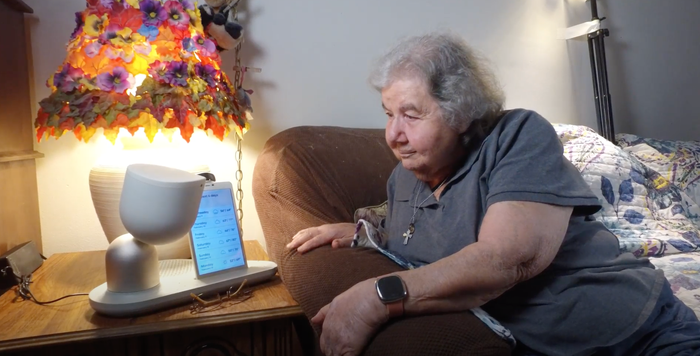
69-year-old Lucinda Page had been using ElliQ for four years.
The robot reminds her to take medication, encourages exercise, and can play games such as bingo and crossword puzzles. It can also take users on virtual trips and even help them write poetry.
Another user, 73-year-old Dee Humphrey, used ElliQ while recovering from a broken leg and limited mobility. The robot helped her draw, create shopping lists, and manage appointments. She even described feeling a noticeable sense of loss while waiting for a replacement device.
But there is an important detail here. Lucinda does not see the robot as a replacement for real friends.
That may actually be the most realistic role for AI companion robots:
They do not replace family. They provide some company and support when family members are not around.
And not every older adult wants a robot. Some families worry that overly complicated technology could confuse older users or interfere with human relationships. Others simply want to maintain their existing lifestyle without having technology involved in every part of their daily routine.
So the competition in elderly care robotics may not be about building the smartest AI. It may be about building a robot that is smart enough to help without becoming annoying or complicated.
Could household tasks become the biggest value of elderly care robots?
Talking is easy to demonstrate. Real physical assistance is much harder—and potentially much more valuable.
Older adults may care less about whether a robot can dance and more about whether it can:
- Bring them a bottle of water
- Pick something up from the floor
- Carry lightweight objects
- Move clothes from one room to another
- Help organize everyday items
- Assist with simple household tasks
A 2026 study involving older adults found that everyday challenges included finding and organizing objects, managing medication, and handling physical tasks. Participants also emphasized that robots should confirm actions before performing them, allow movement speeds to be adjusted, and behave in predictable ways.
This may be more important than how the robot looks. A humanoid robot that looks impressive but cannot safely pick up a cup may have limited practical value. A simpler robot that can reliably carry objects, detect falls, remind someone to take medication, and provide assistance when needed may have a much better chance of becoming part of everyday life.
Why could battery technology become a challenge for elderly care robots?
When a care robot only needs to talk, its battery is relatively easy to manage. But once the robot starts participating in everyday life, it needs to move.
It may need to:
- Monitor an older adult continuously
- Move around a home autonomously
- Carry objects
- Operate robotic arms
- Assist with standing or walking
- Perform sudden high-power movements
- Run cameras and sensors continuously
- Power onboard computing and communication systems
At that point, the battery becomes a critical part of the robot’s design. There is also an important difference between an elderly care robot and many consumer robots:
It cannot simply run out of power at the wrong moment.
A robot vacuum can return to its charging station when its battery is low. But if a care robot is helping someone walk, carrying an object, or monitoring an older adult living alone, suddenly shutting down because of low battery could have much more serious consequences.
That means future elderly care robots will need more than simply larger batteries. They will need better battery designs.
Higher energy density can help extend operating time within a limited space. Lower battery weight can reduce the energy required for movement. At the same time, the battery needs sufficient power output for motors, robotic arms, and other high-load functions. Long operating hours also mean that cycle life, thermal management, and safety become increasingly important.
Why is a larger battery not always the best solution?
Robot designers face a very practical problem: There is never enough space inside a robot.
A humanoid or home care robot needs room for motors, controllers, sensors, cameras, communication modules, actuators, and mechanical structures. Simply installing a larger battery may increase runtime, but it also increases weight. More weight means the robot needs more energy to move. That can lead to a difficult trade-off between battery capacity, robot weight, and operating time.
The answer is therefore not necessarily a bigger battery. It can be a better-fitting battery.
Depending on the robot’s internal structure, the battery may need to be:
- Thin enough to fit into limited spaces
- Custom-shaped around internal components
- Lightweight enough to reduce the robot’s movement load
- Designed for high energy density
- Capable of handling short periods of high power demand
- Designed around the robot’s charging and operating requirements
This is where custom lithium polymer batteries can become valuable.
At LanDazzle, we develop custom LiPo battery solutions based on the actual dimensions, power requirements, and available space inside a device rather than forcing the product design to accommodate a standard battery.
For elderly care robots, this approach can be particularly useful when the available battery space is irregular, narrow, curved, or highly constrained.
Will the next generation of elderly care robots need to look more human?
Not necessarily.
The industry has spent a lot of time asking how to make robots look and behave more like humans. But once these robots enter real homes, another question may become more important:
Can the robot understand what an older adult actually needs?
Older adults may not want a robot constantly talking to them.
- They may simply want it to appear when help is needed.
- They may not want a robot to do everything for them.
- They may want assistance only when they cannot complete a task themselves.
- And they may not need an artificial “family member.”
But imagine a robot that can detect a fall at night, remind someone to take medication in the morning, encourage a short exercise session in the afternoon, bring an object when needed, and notify a family member when something unusual happens.
That kind of robot has a very clear purpose.
The goal of elderly care robotics is not to replace people. It is to help older adults live independently, safely, and with greater dignity for longer.
As robots take on more physical and monitoring tasks, battery technology will become increasingly important to their runtime, weight, reliability, and overall user experience.
If you are developing an elderly care robot, home care robot, rehabilitation robot, or service robot and need a custom battery for limited space, long runtime, high power output, or a unique mechanical structure, LanDazzle can help develop a custom lithium polymer battery solution around your robot’s actual requirements.
Tell us your robot’s dimensions and power requirements, and let’s design a battery that fits the robot—not the other way around.
Email: info@landazzle.com
Whatsapp: +8618938252128