In our previous article, Why Smart Necklaces Could Be the Next Big Wearable Trend, we explored the market potential of smart jewelry in combining fashion with seamless health and activity monitoring.
However, once a concept moves from industrial design (ID) to actual hardware and mechanical engineering, development teams often face extremely tight physical constraints.
Unlike smartwatches and fitness bands, which typically offer relatively regular and flat internal spaces, smart necklaces and pendants are designed to be lightweight, discreet, and visually appealing. To provide a comfortable, barely noticeable wearing experience, a typical miniature wearable may need to keep its weight below 15 g and its thickness below 8 mm, while the enclosure may feature non-orthogonal geometries such as teardrop, circular, oval, or organic curved shapes.
Within such a compact and irregular three-dimensional space, engineers must fit sensors, the mainboard, wireless communication modules, and a battery with enough capacity to support the required runtime.
This creates a fundamental hardware challenge: How can manufacturers maximize battery capacity without compromising the size, weight, appearance, or comfort of a smart necklace?
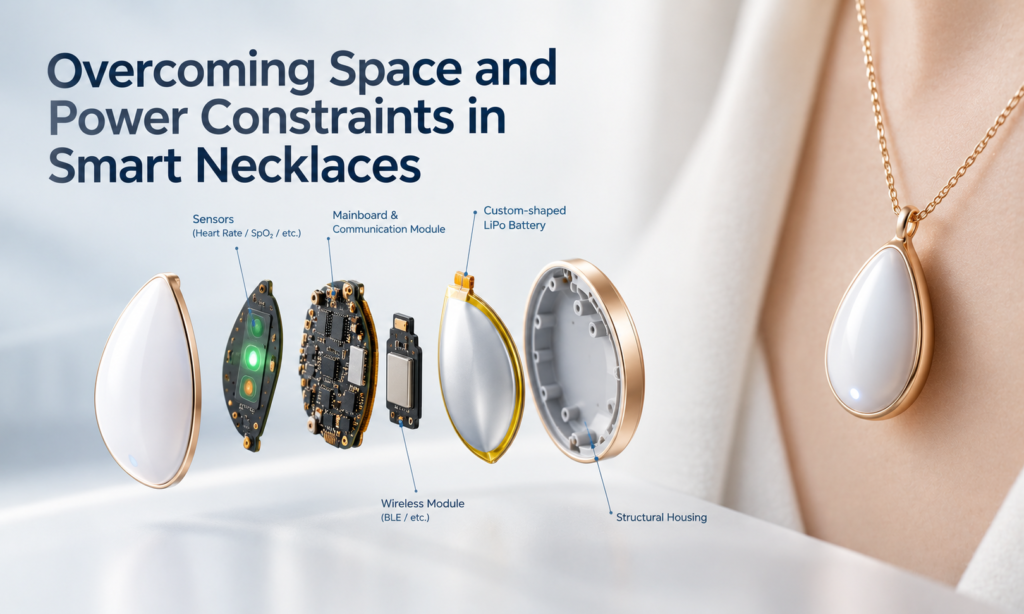
How Do Miniature Smart Necklaces Fit So Much Hardware Into Such a Small Space?
In the stack-up design of miniature pendants and smart necklaces, every cubic millimeter needs to be carefully allocated.
1. How Can the Mainboard and Communication Modules Be Miniaturized?
Rigid-Flex PCB:
To follow the curvature of a pendant enclosure, a conventional rigid multi-layer PCB may not provide sufficient space utilization. A rigid-flex PCB can allow the control circuit, sensors, and interface sections to be folded into different planes, making better use of the available three-dimensional space.
SiP and Miniature BLE SoCs:
Highly integrated System-in-Package (SiP) solutions and miniature Bluetooth Low Energy (BLE) SoCs can integrate components such as oscillators, inductors, and RF circuits into a much smaller footprint, helping reduce the overall size of the main control section.
2. How Should Engineers Handle Sensor Placement and Structural Openings?
Optical Sensors (PPG):
Wearable pendants designed for skin-contact applications may incorporate PPG sensors for heart-rate or blood-oxygen monitoring. The optical path between the lens, LEDs, and photodiodes needs to align with the curvature of the enclosure while maintaining structural sealing and the required water-resistance level, such as IP67 or IP68.
MEMS Microphones for AI Voice Interaction:
For AI-enabled pendants with voice interaction or recording functions, the acoustic opening of the MEMS microphone must be carefully integrated into the mechanical stack-up. Proper acoustic isolation is also needed to minimize interference caused by internal vibration and other components.
Even after the PCB and sensors have been miniaturized as much as possible, hardware engineers still face one of the biggest challenges in the stack-up: the battery.
Why Can’t Standard Rectangular Batteries Fully Utilize Smart Pendant Space?
In conventional consumer electronics, standard rectangular lithium-polymer (LiPo) cells are popular because they are cost-effective, widely available, and relatively easy to integrate.
However, when used inside miniature smart necklaces and pendants with irregular enclosures, standard rectangular cells can create significant design limitations.
【Rectangular Battery Inside a Round / Curved Enclosure】

 +-----------------------+
 |   [Dead Space]        |  <-- Unused enclosure volume
 |    +---------------+  |
 |    | Rectangular   |  |
 |    | Battery       |  |
 |    +---------------+  |
 |                       |
 +-----------------------+
1. How Much Space Is Lost to Dead Space?
When a flat square or rectangular battery is placed inside a circular, curved, or teardrop-shaped enclosure, the corners of the battery may not follow the internal geometry of the housing. This creates unused space between the battery and the enclosure wall.
In miniature devices with an internal volume of only a few cubic centimeters, even a relatively small amount of unused space can significantly reduce the amount of battery capacity that can realistically be installed.
2. Why Is Volumetric Utilization More Important Than Battery Energy Density Alone?
In highly compact hardware designs, simply selecting a battery with a higher nominal energy density (Wh/L) does not necessarily result in longer runtime.
What matters is how efficiently the available enclosure volume is converted into usable battery volume.
A battery with slightly lower cell-level energy density may still provide better overall system performance when its shape allows engineers to make better use of the available space.
This is why system-level volumetric utilization can be just as important as the battery’s nominal energy density.
3. Can a Custom Single Pouch Cell Solve the Space Problem?
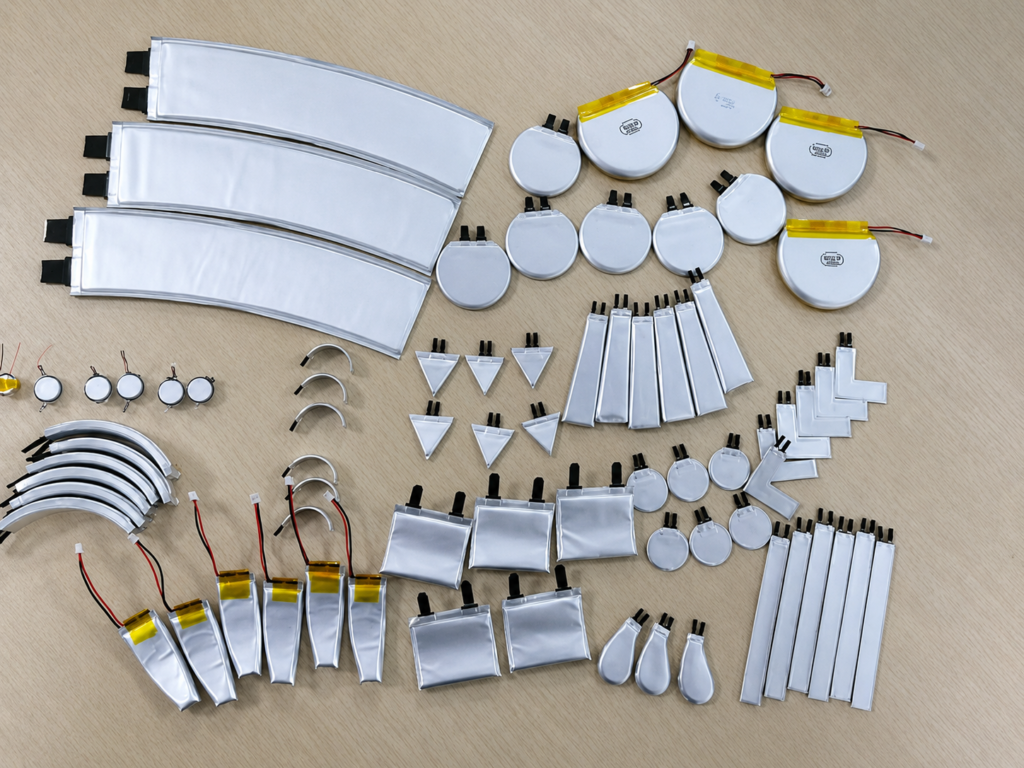
A custom-shaped single pouch cell can help eliminate unused space and make the battery better match the enclosure geometry.
Curved and round pouch cells:
These can follow the internal contours of teardrop-, oval-, or circular-shaped pendants, helping convert previously unused areas into active battery space.
Ultra-thin pouch cells:
For designs with strict thickness constraints, ultra-thin cells can be positioned closer to the inner wall of the enclosure, allowing engineers to maintain a slimmer overall product profile.
Simplified system architecture:
A single custom-shaped cell can also avoid some of the interconnections and assembly complexity associated with using multiple cells in parallel, potentially simplifying manufacturing and reducing integration risks.
What Battery Specifications Matter Most for a Miniature Smart Necklace?
When selecting or developing a miniature LiPo battery for a smart necklace, hardware engineers should evaluate several key parameters rather than focusing on capacity alone.
| Engineering Parameter | Design Requirement / Challenge | Recommended Solution |
|---|---|---|
| Dimensions | Thickness of approximately 1.5–3.0 mm, with capacity typically around 30–120 mAh depending on the product design | Use precision pouch-cell manufacturing and carefully control the sealing margin to maximize usable battery area |
| Pulse Current | BLE transmission, AI voice processing, and other functions can create short-duration peak current demands | Use a battery with suitable high-rate discharge capability to minimize voltage sag and reduce the risk of MCU reset during current peaks |
| Micro PCM | Conventional protection circuits may occupy too much space in miniature products | Use a low-profile protection circuit or integrate miniature protection components near the tabs to reduce the footprint |
| Cycle Life | Frequent charging and discharging can accelerate capacity degradation | Optimize electrode design and electrolyte formulation to achieve the required cycle-life target, such as maintaining 80% capacity after 500 cycles |
How Can Thermal Management and Battery Safety Be Improved in Smart Necklaces?
Because a pendant may remain in direct contact with the skin around the neck or chest, thermal comfort and safety can be even more important than in many conventional wearable devices.
1. How Can Smart Necklace Battery Temperature Rise Be Controlled?
The skin around the neck and chest can be sensitive to heat generated by electronics and battery operation.
During BLE transmission, charging, or other relatively high-load operating conditions, the surface temperature of the product should be carefully managed according to the actual product safety and thermal requirements.
A battery with low internal resistance can help reduce resistive heating, while the PCB and mechanical structure should be designed to distribute heat toward appropriate non-contact surfaces whenever possible.
Rather than relying on a single fixed temperature-rise value, thermal limits should be validated through system-level testing under the actual operating conditions, charging profile, enclosure material, and skin-contact configuration.
2. How Much Space Should Be Reserved for Battery Swelling?
Lithium-polymer pouch cells can experience some thickness growth over their service life, particularly under elevated temperature and repeated cycling.
Mechanical clearance:
The battery compartment should include sufficient Z-axis clearance to accommodate expected cell thickness changes throughout the product’s lifetime. The exact allowance should be determined through cell characterization, cycle testing, temperature testing, and mechanical tolerance analysis rather than applying one universal percentage to every battery design.
Water and structural protection:
Smart necklaces may use engineering plastics, aluminum alloys, ceramics, or other enclosure materials. Appropriate sealing structures and adhesives can help protect the internal electronics and battery from sweat, humidity, and accidental water exposure.
However, the final IP rating and safety performance depend on the complete product design, including housing, sealing, charging interface, battery construction, and validation testing.
Conclusion: Can Better Battery Geometry Unlock Better Smart Necklace Design?
For smart necklaces and pendants, battery design is not simply a matter of choosing a higher-capacity cell. The real challenge is balancing capacity, energy density, battery geometry, peak-current performance, thermal behavior, safety, weight, and available installation space within an extremely compact enclosure.
As smart jewelry becomes thinner, lighter, and more feature-rich, standard battery formats may increasingly limit industrial design freedom. Custom-shaped LiPo batteries can provide a way to turn irregular and previously unusable spaces into functional battery volume.
For product developers, the battery should therefore be considered at the beginning of the hardware stack-up process—not as a component added after the enclosure has already been designed.
Need a Custom Battery for Your Smart Necklace?
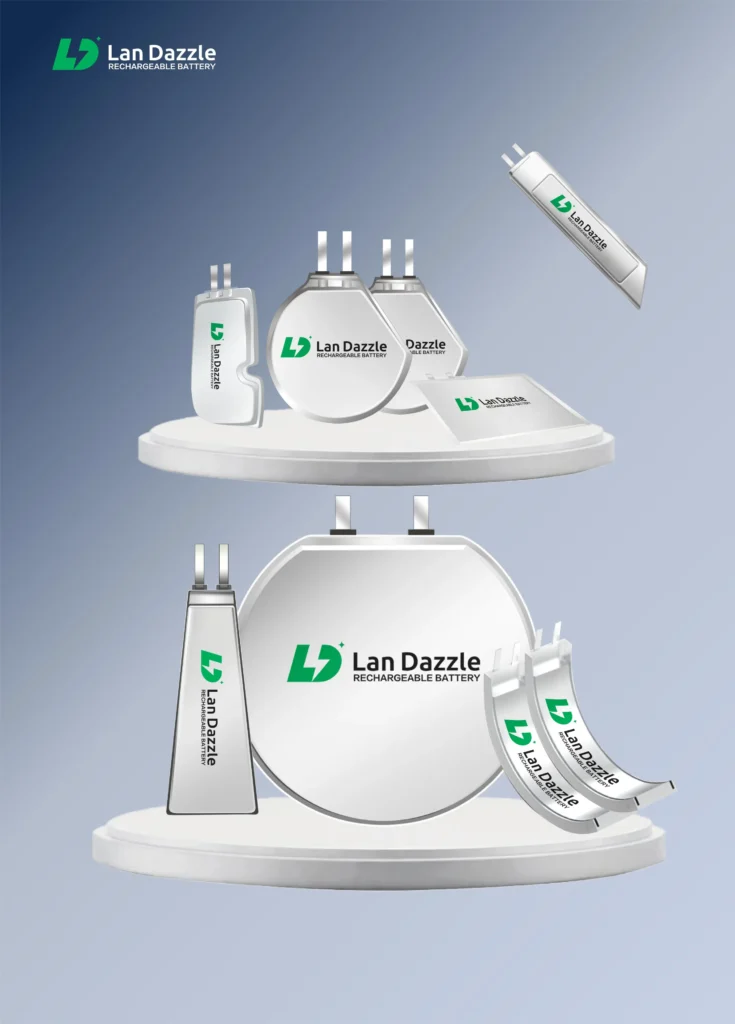
LanDazzle develops custom-shaped LiPo batteries for compact wearables, including ultra-thin, curved, narrow, and irregular-shaped battery designs.
Share your available battery space, target capacity, dimensions, operating current, and product requirements with our engineering team, and we can help evaluate a battery solution designed around your device.
Contact LanDazzle to discuss your custom smart necklace battery project.
Email: info@landazzle.com
Whatsapp: +8618938252128