Table of Contents
Smart knee rehabilitation wearable are rapidly evolving from static mechanical braces into ultra-compact wearables packed with sensors, wireless chips, and feedback modules. In these joint-worn devices, battery selection dictates far more than runtime—it directly impacts product thickness, weight, wearing comfort, and internal layout.
What Is a Smart Knee Rehabilitation Wearable?
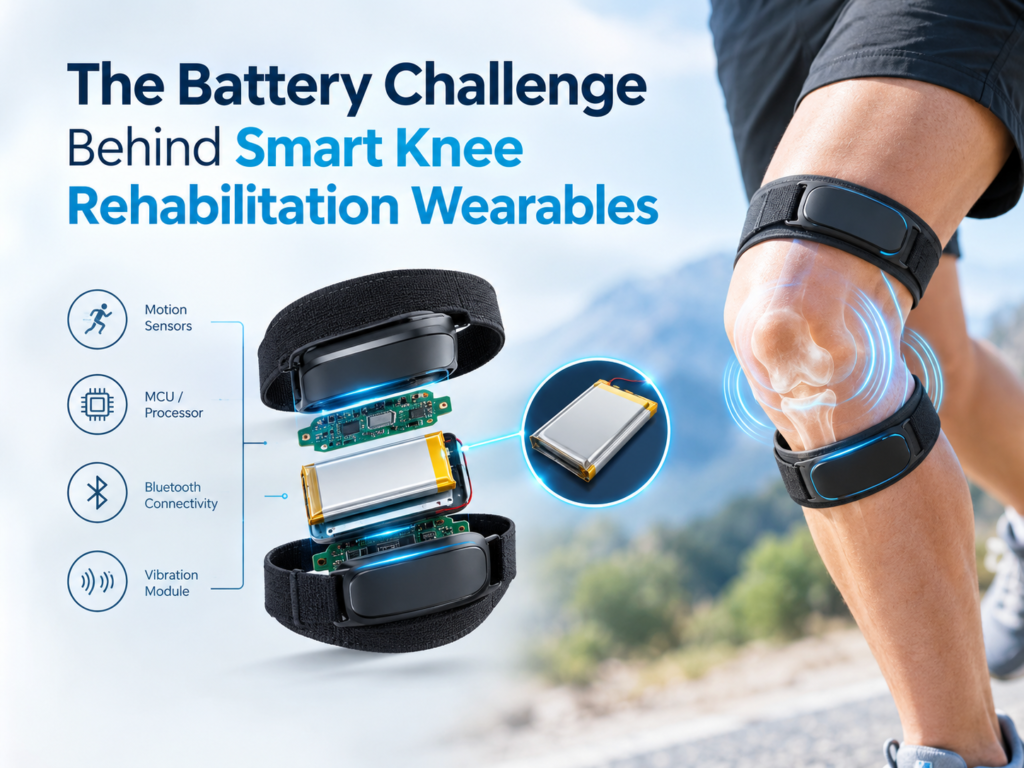
A smart knee rehabilitation wearable is an active electronic system worn around the leg to monitor joint movement and guide recovery. Unlike conventional braces that only provide static mechanical support, these smart devices analyze movement in real time and provide immediate physical or digital feedback.
Core System Architecture
- Motion Sensors: Track gait dynamics, joint angles, and movement cycles.
- MCU / Processor: Runs algorithms and processes sensor data on the device.
- Wireless Module: Transmits health metrics via Bluetooth/ANT+ to smartphones or clinical platforms.
- Vibration / Haptic Module: Delivers tactile cues at specific points during movement.
- Battery: Delivers continuous power to the electronic stack inside a flexible enclosure.
System Workflow Body Movement → Sensor Detection → MCU Processing → Wireless / Algorithm Analysis → Haptic Feedback
For example, when motion sensors detect an abnormal gait during exercise, the system instantly triggers subtle vibration feedback to encourage proper posture. This shifts knee rehabilitation from passive mechanical constraint to active, real-time sensing—making the internal battery design a critical factor for both device stability and user comfort.
Why Are Knee Rehabilitation Wearables Becoming Smaller?
For knee rehabilitation wearables, miniaturization is about function and comfort, not just aesthetics. Because these devices are worn during dynamic movement—such as walking, climbing stairs, or exercising—a bulky or heavy module creates noticeable bulges and degrades long-term wearability.
While sensors, PCBs, and wireless chips continue to shrink, the battery remains the hardest component to scale down—chemical energy storage doesn’t follow Moore’s Law.
This creates a fundamental engineering challenge: packing sufficient battery capacity into a compact, flexible enclosure without compromising the wearable’s sleek, low-profile form factor.
What Makes Battery Design Challenging for Knee Wearables?
1. Limited Internal Space
A smart knee rehabilitation wearable may need to accommodate several electronic components within a very compact enclosure. Sensors may need to be positioned close to the body, the PCB has to connect different functional modules, the antenna requires appropriate placement, and the vibration motor also takes up valuable space.
As a result, the remaining area for the battery may not be a simple rectangular cavity. Using a fixed-size standard battery can create a situation where:
The battery fits, but the available space is not used efficiently.
For example, a rectangular battery may occupy a large central area while leaving narrow spaces around the edges unused. As wearables become more compact, this wasted space becomes increasingly significant. Battery dimensions should therefore be considered together with the PCB, sensors, enclosure, and overall mechanical architecture rather than selected independently.
2. Ultra-Thin Battery Requirements
Thickness is another important consideration for smart knee rehabilitation wearables. Devices worn close to the leg may become less comfortable when the electronics module creates a large protrusion.
This creates demand for thinner battery solutions.
Ultra-thin pouch LiPo batteries can provide greater flexibility because their dimensions can be developed around the requirements of the wearable rather than being limited to a fixed standard format. When the enclosure is not completely flat, irregular-shaped or curved batteries can also be considered so that the battery follows the geometry of the device more closely. The goal is not simply to make the battery as thin as possible. It is to make the battery part of the product architecture rather than a standard component that has to be squeezed into whatever space remains.
The battery should be designed around the wearable—not forced into it.
3. Dynamic Power Loads: More Than Just Average Current
The power consumption of a smart knee rehabilitation wearable is usually not constant. Different operating modes can create different current demands.
For example:
Motion Sensing → MCU Processing → Bluetooth Transmission → Vibration Activation
A device may consume very little power while idle, but power demand can increase when the vibration module is activated or when wireless data is being transmitted. This means battery selection should consider more than average current.
A more complete evaluation should include:
Average Current + Peak Current + Internal Resistance
If battery internal resistance is relatively high, a sudden increase in load can result in a more significant voltage drop. In extreme cases, the system may experience unstable operation or protection shutdown if the supply voltage falls below its required operating range. For rehabilitation wearables that combine vibration feedback with wireless connectivity, simply comparing battery capacity is therefore not enough to determine whether a battery is suitable.
4. Low-Temperature Performance for Outdoor Rehabilitation
Not every knee rehabilitation device will be used indoors.
For products designed for outdoor exercise, walking programs, or cold-weather environments, low-temperature battery performance should also be considered during development. At low temperatures, battery internal resistance typically increases, while available capacity and instantaneous power capability can decrease.
For devices expected to operate in cold environments, engineers should evaluate not only rated capacity at room temperature, but also low-temperature discharge performance and voltage stability under load.
For example, testing at temperatures such as -20°C can provide useful insight into how the battery performs under cold conditions and changing loads. For outdoor rehabilitation products, these characteristics can directly affect system stability and the user experience.
Why Standard Batteries May Not Be Enough
Standard batteries offer mature technology and low upfront costs, making them practical for spacious hardware. However, as smart knee rehabilitation wearables become thinner and more compact, fixed battery formats quickly create engineering bottlenecks.
Standard vs. Custom Battery Architecture
- Standard Batteries: Fixed Dimensions → Limited Layout Flexibility → Unused Cavity Space → Bulky Device Profile
- Custom LiPo Batteries: Tailored Dimensions → Optimized Space Utilization → Flexible Component Layout → Slim & Low-Profile Wearable
In joint-mounted wearables with narrow, curved, or irregular internal cavities, custom-shaped LiPo batteries eliminate wasted space. Instead of forcing the hardware layout to fit a rigid cell, custom geometries give engineers the freedom to design sleeker, more ergonomic devices that improve long-term patient compliance.
What Battery Does a Smart Knee Wearable Need?
The specific battery requirements will vary from one product to another. However, several key factors can be evaluated when developing a battery for a smart knee rehabilitation wearable:
| Wearable Requirement | Battery Consideration |
|---|---|
| Slim profile | Ultra-thin battery |
| Irregular enclosure | Custom-shaped battery |
| Long training sessions | Adequate usable capacity |
| Vibration motor | Stable pulse output |
| Bluetooth connectivity | Low internal resistance |
| Outdoor use | Low-temperature performance |
| Long-term use | Cycle life |
| Compact enclosure | High energy density |
| Body-worn application | Safety and reliability |
As this shows, selecting a battery for a smart knee wearable is not simply about maximizing capacity.
What really needs to be optimized is: Size + Thickness + Capacity + Weight + Power Output + Reliability
This is one of the key differences between custom battery development and simply purchasing a standard battery.
Custom Battery Solutions for Wearable Rehabilitation Devices
As rehabilitation devices evolve from traditional mechanical supports toward smarter, sensor-based, and connected wearables, the battery is becoming an increasingly important part of the product design. An effective battery solution should be developed together with the mechanical and electronic architecture of the device.
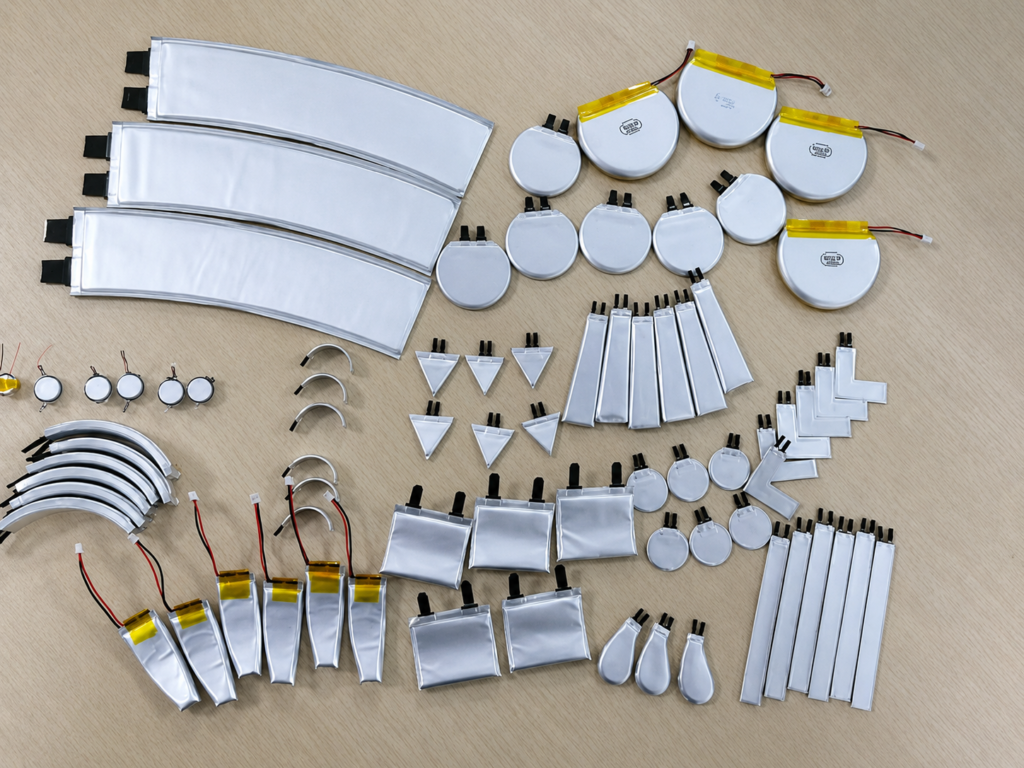
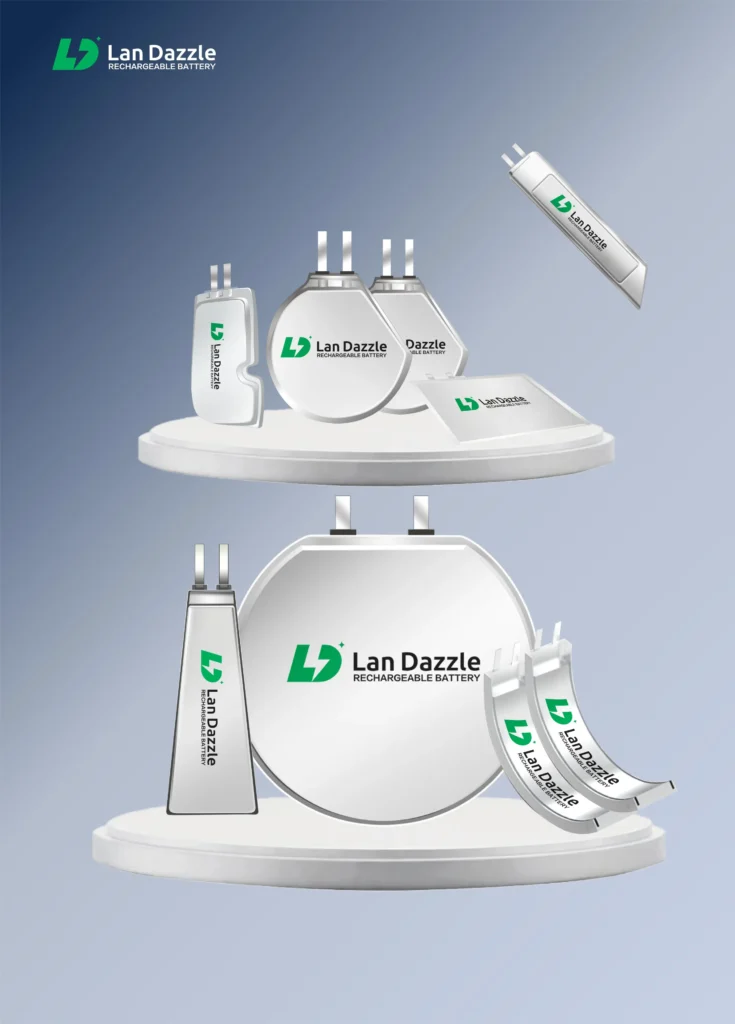
LanDazzle specializes in custom lithium polymer batteries for space-constrained wearable applications, including ultra-thin, irregular-shaped, and custom-sized battery solutions. For smart knee rehabilitation wearables, battery development can take into account the available installation space, target capacity, average and peak current, operating temperature, and required runtime.
Instead of forcing the product architecture to accommodate a standard battery, a more flexible approach is to design the battery around the product itself. This can improve space utilization while providing greater design freedom for thinner, lighter, and more comfortable next-generation rehabilitation wearables.
Conclusion
Smart knee rehabilitation wearables are making traditional rehabilitation support more intelligent. Motion sensors detect movement, the MCU processes the data, Bluetooth provides connectivity, vibration modules deliver feedback, and the battery supplies the energy that keeps the entire system running. As these devices become thinner, lighter, and more body-conforming, the battery can no longer be treated as a simple off-the-shelf component.
A smaller wearable requires a smarter battery design.
From ultra-thin form factors and custom shapes to stable pulse output and low-temperature performance, battery design needs to evolve together with the product’s mechanical structure and functional requirements. For next-generation rehabilitation wearables, a custom LiPo battery is not only a power source—it can also play an important role in enabling a smaller form factor and a better wearing experience.
Need a Custom Battery for Your Rehabilitation Wearable?
Developing a compact rehabilitation wearable? LanDazzle can help evaluate the available battery space and recommend a suitable custom LiPo solution based on your size, capacity, current, runtime, and temperature requirements.
Share your device dimensions and battery specifications with our engineers to discuss a customized battery solution.
Email: info@landazzle.com
Whatsapp: +8618938252128