Smart rings are seen as the “ultimate form” of wearable devices because they can be worn comfortably 24 hours a day. Thanks to more stable blood flow signals at the fingertip, smart rings can measure heart rate and blood oxygen levels with 15–20% higher accuracy than smartwatches. This makes them especially valuable for sleep monitoring and chronic disease management.
The market is growing rapidly. Global smart ring shipments exceeded 4 million units in 2025, and are expected to grow by 87.5% in 2026. China is the fastest-growing market, accounting for 32% of global shipments in 2025, far outpacing other wearable device categories.
However, power supply is the biggest challenge for smart rings. Due to their extremely small size, battery capacity is usually limited to 15–30 mAh, making it difficult to achieve both long battery life and advanced health features. 47% of users consider switching products because of short battery life, which makes battery and energy solutions a key factor in smart ring competitiveness.
Current Energy Solutions for Smart Rings
Battery selection for smart rings must meet three key requirements at the same time:
size limits (thickness ≤ 2 mm, width 4.5–10 mm),
energy density (≥ 300 Wh/L),
and safety (no leakage risk and cycle life of at least 500 cycles).
At present, the main battery types used in smart rings are custom lithium polymer batteries, thin-film batteries, and coin cell batteries, each used in different scenarios.
Custom Lithium Polymer Batteries (Li-Polymer)
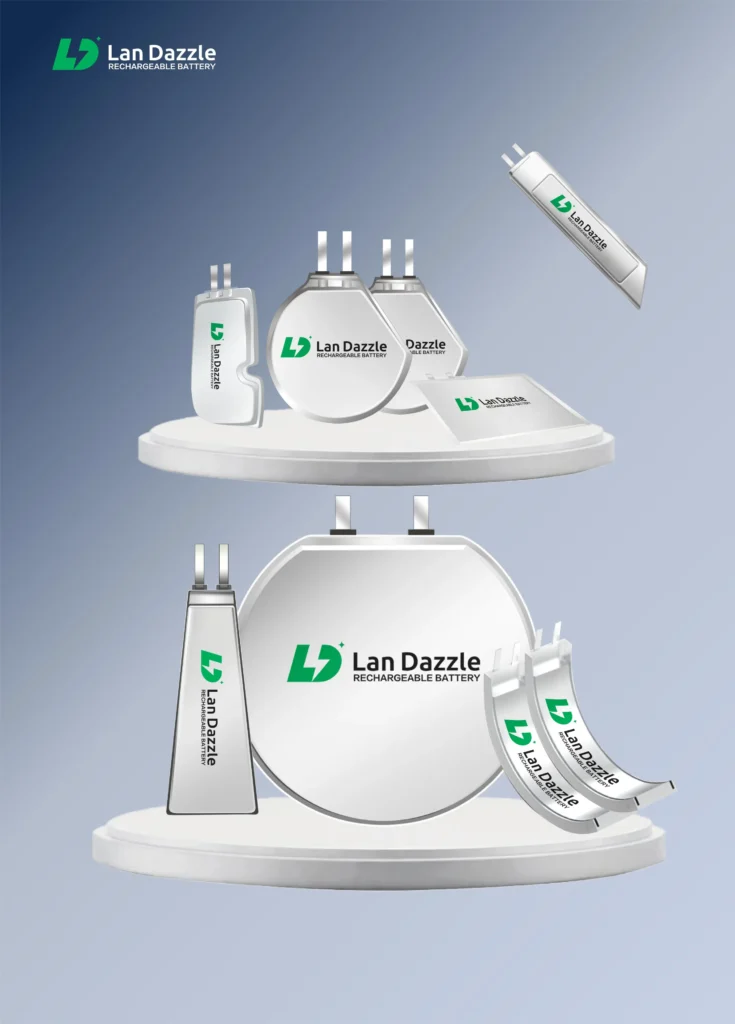
This is the dominant solution for smart rings today, with a market share of over 90%. Its biggest advantage is that it can be customized into curved or irregular shapes, allowing it to fully fill the limited and uneven space inside a ring.
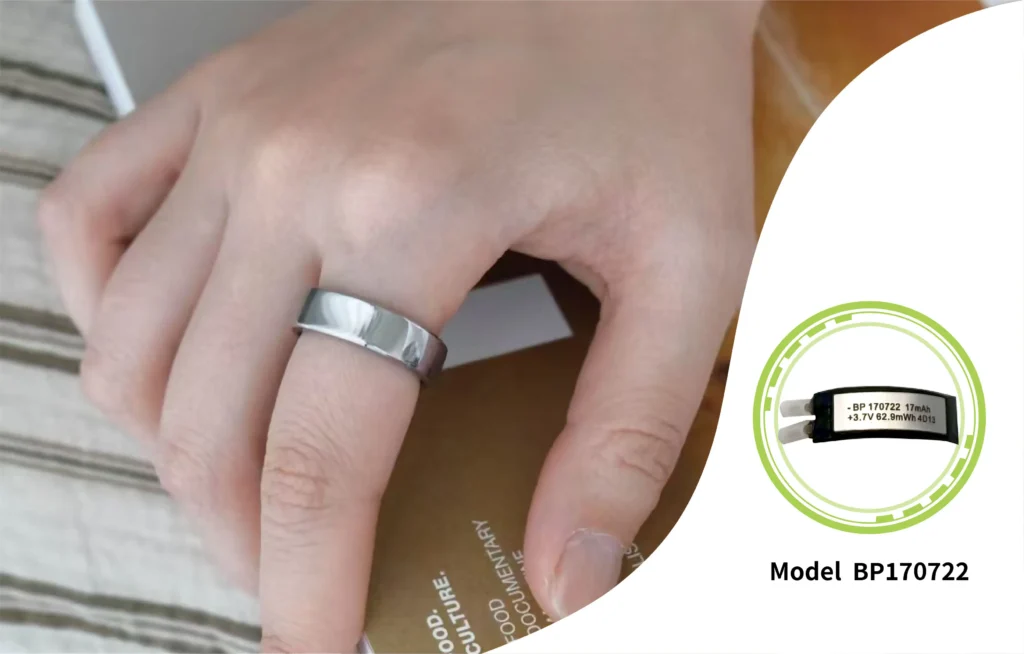
In terms of performance, these batteries typically have a nominal voltage of 3.7–4.4 V and an energy density of 300–375 Wh/L. This improvement is mainly due to the use of silicon-carbon anode materials. Compared with traditional graphite anodes, silicon-carbon anodes offer 27.8% higher capacity and 17.2% higher volumetric energy density, increasing battery capacity by 20–30% within the same volume.
For cycle life, high-voltage versions (4.35 V) can still retain 95% capacity after 500 cycles of 3C fast charging and 1C discharging. This is much higher than the 80% typical of standard lithium polymer batteries and is sufficient for over two years of smart ring use.
In real applications, custom Li-polymer batteries are used in most mainstream smart rings.
Basic models (for example, 16.5 mAh) can support 7–10 days of basic monitoring.
Medical-grade models (around 22 mAh) support ECG and multi-parameter health monitoring, with 7–12 days of battery life.
Flagship models (around 25 mAh) can achieve 9–12 days of long battery life.
Thin-Film Batteries
Thin-film batteries are a niche solution, with a market share of less than 5%. Their main advantage is their ultra-thin design (thickness ≤ 0.2 mm) and flexibility. They can be embedded into curved ring structures and even designed as mesh or strip shapes, without affecting wearing comfort.
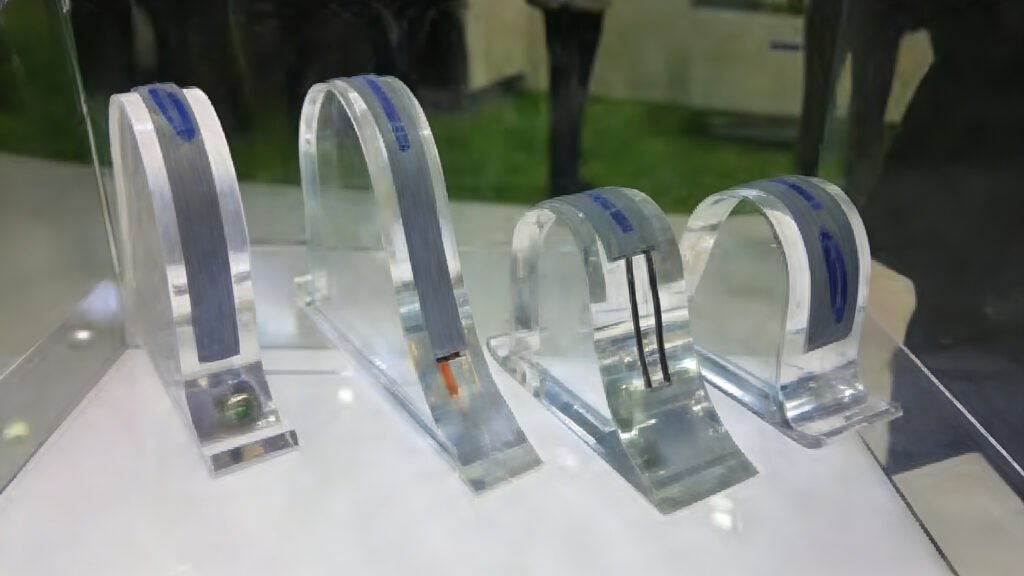
Some experimental thin-film batteries can even generate power from the small temperature difference between the human body and the environment (about 2°C). Under laboratory conditions, this type of battery can produce around 0.5 μW/cm².
However, thin-film batteries have clear limitations. First, their energy density is low. While lab results can reach 450 Wh/kg, mass-produced versions are usually only around 200 Wh/kg, which is not enough for medical-grade functions. Second, they are difficult to mass-produce, and their cost is 3–5 times higher than lithium polymer batteries. As a result, they are mainly used in a few high-end fashion smart rings.
Coin Cell Batteries
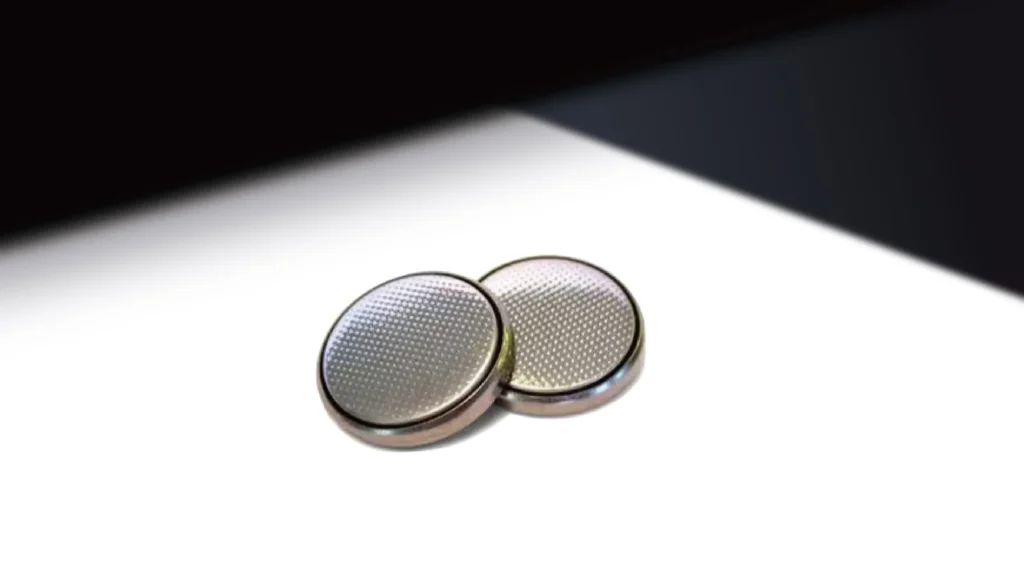
Coin cell batteries are a near-obsolete solution, now used only in a small number of entry-level smart rings. Their advantages are low cost (about 1–2 RMB per cell) and very low self-discharge (≤ 2% per year).
However, their biggest weakness is very limited discharge current. For example, a CR1216 coin cell can only provide about 3 mA of continuous current, which is far below what is needed for ECG or advanced health monitoring, where peak current can exceed 10 mA. In addition, coin cells are usually 1.2–3.2 mm thick, making it difficult to meet the smart ring requirement of ≤ 2 mm thickness. As a result, they have largely been phased out of the market.
Charging Methods for Smart Rings
Smart ring charging solutions must meet three key requirements at the same time:
miniature coils, efficient power transfer, and user convenience.
Because charging ports are too large for rings, wired charging has been completely replaced by wireless charging.
Currently, the main charging methods used in smart rings are magnetic inductive charging and NFC wireless charging, with magnetic inductive charging dominating the market.
Magnetic Inductive Charging (Mainstream Solution)
This is the dominant charging solution today, with a market share of over 90%.
Its core principle is based on Faraday’s law of electromagnetic induction.
The transmitter coil in the charging dock is driven by high-frequency AC power (110–205 kHz), creating an alternating magnetic field.
The receiver coil inside the ring cuts through this magnetic field, generating electrical current, which is then rectified and filtered to charge the battery.
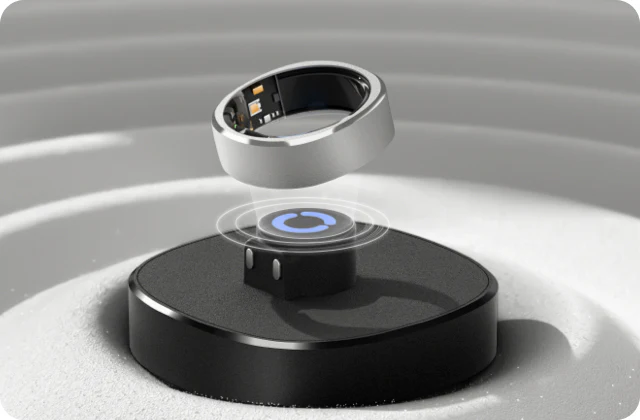
To fit the extremely small size of smart rings, the hardware design is specially optimized:
- The receiver coil uses flexible winding, with a thickness of only 0.3–0.5 mm, and is placed behind the battery
- Some high-end models (such as Oura Ring 4) use dual parallel coils inside the charging case to improve alignment and charging efficiency
In terms of efficiency, charging performance is limited by the small coil size, and overall system efficiency is typically 40%–60%.
For example, the ROHM ML7670/71 chipset achieves about 45% peak power efficiency on the SOXAI Ring 2, which is close to the physical limit for micro-coil charging in smart rings.
Fast charging performance is already sufficient for daily use:
- JCring X6 can be fully charged in less than 1 hour
- NexRing reaches 60% in 30 minutes
- VERTU MetaRing supports 50% charge in 15 minutes
Even for heavy users, short charging sessions are enough to restore battery life.
Advantages of this solution include mature technology, reasonable cost, and stable performance.
However, it also has clear drawbacks:
- Very short charging distance (effective distance < 10 mm), requiring precise alignment
- Sensitive to metal objects — metal decorations on the ring can reduce charging efficiency by 10%–20%
NFC Wireless Charging (Niche Solution)
This is a secondary solution, with a market share of less than 10%.
It uses a 13.56 MHz electromagnetic field for power transfer. This frequency belongs to the ISM band, requires no special licensing, and has very low radiation, making it safe for the human body.
In terms of performance:
- Output power is usually ≤ 250 mW
- Charging efficiency is 40%–60%
- For example, the ROHM ML7630/31 chipset achieves about 40% efficiency on the SOXAI Ring 2
Its main advantages are:
- Very small coil size (as small as 5 mm in diameter)
- Strong resistance to interference, maintaining stable charging even with metal nearby
However, the limitations are significant:
- Low power output, resulting in slow charging (for example, QuzzZ Ring needs 10 minutes to reach 50%)
- Only suitable for low-power devices, and unable to support medical-grade monitoring
As a result, NFC charging is currently used only in entry-level smart rings.
Solar Charging (Concept Solution)
This is an experimental concept still in the laboratory stage, with no mass-produced products yet.
The idea is to embed ultra-thin amorphous silicon solar cells (thickness ≤ 0.1 mm) on the inner surface of the ring.
Even under weak indoor light (such as near a window), they can generate about 0.1 μW/cm² of power.
However, due to the very limited surface area of a ring (only about 1–2 cm²), the total yearly energy generated can support only about one day of battery life.
At present, solar charging is considered only a supplementary power source, not a primary charging solution.
Future Innovations in Energy Solutions for Smart Rings
From 2026 to 2030, energy solutions for smart rings are expected to evolve from passive recharging to active energy harvesting combined with long-term energy storage. The core goal is to break the physical limits of battery capacity and move toward all-day, no-charging use or ultra-long battery life.
All-Solid-State Batteries
This is considered the most important future breakthrough.
The key idea is to replace traditional liquid electrolytes with solid electrolytes. This brings both higher energy density and much better safety. Solid electrolytes are more than 10 times more thermally stable than liquid ones, and they do not leak or cause fire or explosion risks.
Because of these advantages, all-solid-state batteries are seen as a core technology for future smart rings.
Micro Fuel Cells
This is a long-term exploration direction.
Micro fuel cells generate electricity by directly converting chemical energy into electrical energy through electrochemical reactions. Fuels such as methanol or glucose can be used. In theory, they offer extremely high energy density. For example, glucose fuel cells can reach over 1000 Wh/kg, which is more than twice that of all-solid-state batteries.
At present, research teams have developed palm-sized solid oxide fuel cell (SOFC) micro-reactors that can start up at room temperature and generate power within 5 minutes. However, to be used in smart rings, the system must be shrunk to millimeter scale, which requires solving major challenges such as heat management and fuel storage.
In addition, researchers have developed planar micro zinc–air batteries with ultra-thin electrode structures only 200 micrometers wide, already integrated on-chip. These designs show future potential for smart ring applications.
Silicon-Carbon Anodes / Lithium–Sulfur Batteries
These are considered transitional solutions for the future.
Among them, lithium–sulfur batteries are especially promising. Their theoretical energy density exceeds 2600 Wh/kg, which is more than eight times higher than current lithium polymer batteries.
If mass production becomes possible, smart ring battery life could be extended to over 21 days.
However, lithium–sulfur batteries still face major challenges. Their cycle life is relatively short (currently about 500 cycles in laboratory tests), and cost remains high. Further improvements, such as nanomaterial modification, are needed before they can be widely adopted.
Conclusion
Smart rings are moving toward a future of smaller size, higher accuracy, and longer battery life.
However, extreme space limits make energy solutions the key factor that defines product performance, user experience, and market competitiveness.
From today’s custom lithium polymer batteries and wireless charging, to future innovations such as solid-state batteries, energy harvesting, and ultra-high-density chemistries, energy technology will continue to shape what smart rings can achieve.
Brands that invest early in customized, reliable, and scalable energy solutions will be better positioned to deliver continuous health monitoring, medical-grade accuracy, and true all-day or multi-week usage — without compromising comfort or safety.
If you are developing a smart ring or next-generation wearable device, choosing the right battery and energy solution is critical.
LanDazzle specializes in custom lithium battery solutions for wearables, including smart rings, smart glasses, and medical devices.
We help hardware teams optimize battery shape, thickness, energy density, safety, and charging design to match real product requirements.
Whether you are in early R&D, prototype validation, or mass production, our engineering team is ready to support your project.
Email: info@landazzle.com
Whatsapp: +8618938252128