Table of Contents
Smart glasses are rapidly evolving from niche gadgets into mainstream consumer devices. As AI assistants, real-time translation, voice interaction, photography, navigation, and AR displays become standard features, internal space is becoming increasingly limited.
For product designers, the biggest challenge is no longer the processor—it’s the battery.
How do you fit enough battery capacity into an ultra-slim frame without compromising comfort, weight, or industrial design? The answer for many manufacturers is the slim LiPo battery.
This article explains why narrow, long lithium polymer batteries are becoming the preferred choice for smart glasses and what factors you should consider when selecting a battery for your next wearable device.
LanDazzle’s 5mm Slim Lipo Battery for Smart Glasses
LanDazzle specializes in custom-shaped lithium polymer batteries and can develop slim LiPo battery solution specifically for smart glasses. Designed to maximize the limited space inside eyewear temples, our batteries can be customized to match different frame structures while delivering higher energy density and longer battery life.
Our smart glasses battery solutions offer:
- Width as narrow as 5 mm
- Thickness as low as 0.6 mm
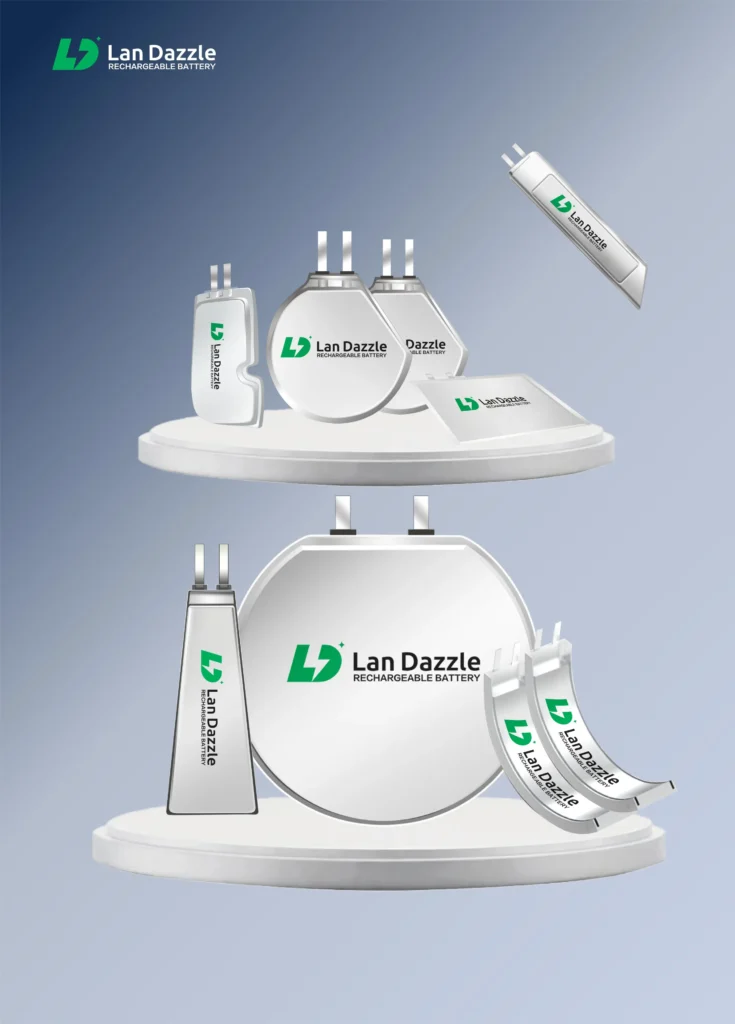
- Straight, curved, and custom-shaped battery designs
- Custom lengths to fit different temple structures
- High energy density for longer runtime
- Integrated battery pack and protection circuit solutions
- Compliance with international standards such as UN38.3 and IEC 62133
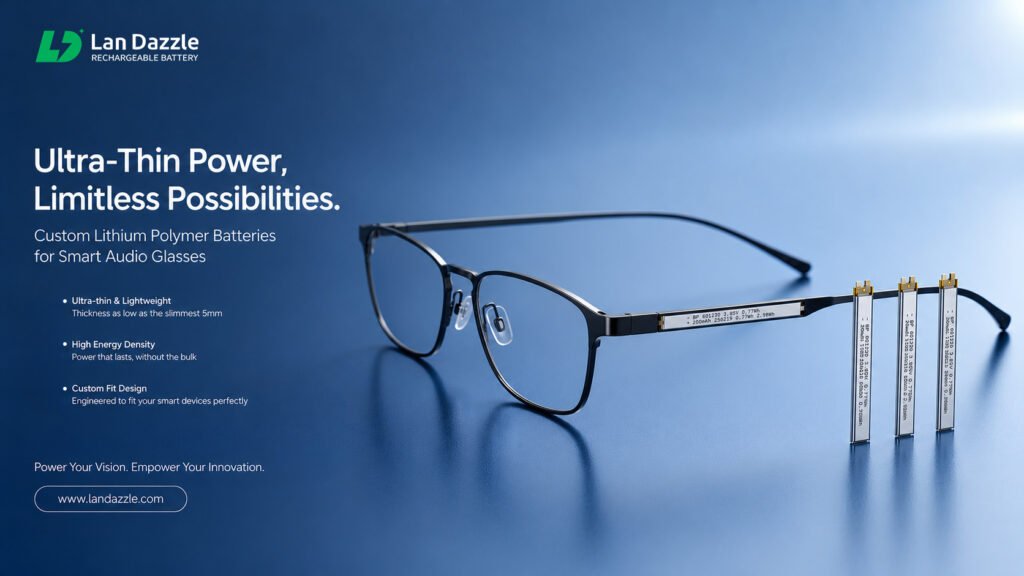
Compared with standard rectangular batteries, our slim batteries fit naturally inside narrow temples, making better use of every millimeter of available space.
For smart glasses manufacturers, this means not only higher battery capacity but also greater freedom in product design.
Why Smart Glasses Need Narrow and Long Batteries
Modern AI smart glasses are designed to be lighter, thinner, and more comfortable than ever before. Most manufacturers now place the batteries inside the temples, making battery shape a critical design factor.
A long and narrow battery better matches the geometry of the frame while improving both product performance and user experience.
Lighter and Thinner for Better Wearing Comfort
Smart glasses are designed for all-day use.
If the temples are too thick or the battery is concentrated in one area, users may experience discomfort, ear pressure, or fatigue after extended wear.
A slim battery distributes its volume along the length of the temple instead of increasing its thickness.
This offers several advantages:
- Slimmer temple design
- Reduced overall thickness
- Improved long-term wearing comfort
- A more natural appearance that resembles traditional eyewear
As smart glasses become everyday consumer products, users increasingly expect them to look and feel like regular glasses rather than electronic devices.
Better Weight Distribution for Improved Stability
Many smart glasses use batteries in both temples instead of placing one large battery on a single side.
This balanced configuration provides several benefits:
- Better weight distribution
- Reduced pressure on the nose bridge
- Improved stability during walking or exercise
- Less slipping during extended wear
For devices that already contain cameras, speakers, AI processors, and wireless modules, balanced battery placement plays an important role in overall comfort.
More Space for Advanced Electronics
Today’s AI smart glasses integrate far more components than previous generations.
A typical device may include:
- Camera modules
- AI processors
- Speakers
- Microphones
- Wi-Fi and Bluetooth antennas
- IMU sensors
- Ambient light sensors
- Touch controls
- Vibration motors
Every component competes for limited internal space.
Traditional rectangular batteries often occupy valuable areas that could otherwise be used for additional electronics.
A slim battery can be positioned along the edge of the temple, freeing more room for critical components without increasing the size of the glasses.
This is one of the key reasons why custom-shaped batteries are becoming increasingly popular in AI eyewear.
Why Lithium Polymer Batteries Are Better for Smart Glasses
Smart glasses require batteries that are not only compact but also highly adaptable to complex product structures. Compared with cylindrical cells or metal-can batteries, lithium polymer pouch batteries offer several significant advantages.
Greater Design Flexibility
Unlike rigid battery formats, LiPo pouch cells can be customized in almost every dimension, including:
- Length
- Width
- Thickness
- Curvature
- Overall shape
This flexibility allows manufacturers to fully utilize the narrow and irregular space inside smart glasses temples.
Higher Space Utilization
Lithium polymer batteries use lightweight aluminum-plastic film instead of rigid metal housings. This design reduces unnecessary structural material and allows a larger percentage of the battery volume to store active materials.
The result is more energy within the same available space.
Lower Weight
Without a heavy metal casing, LiPo batteries are significantly lighter.
Since most smart glasses weigh only around 40–50 grams, even a small reduction in battery weight contributes to better comfort during all-day wear. Lightweight construction is one of the primary reasons lithium polymer batteries have become the preferred choice for wearable electronics.
Easy Customization
Every smart glasses model has a unique internal layout.
Standard battery sizes rarely fit perfectly. Custom LiPo batteries can be designed according to specific product requirements, including:
- Battery dimensions
- Tab position
- Wire routing
- Voltage
- Capacity
- Protection circuit integration
This allows manufacturers to maximize internal space while simplifying product assembly.
What Should You Consider When Choosing a Smart Glasses Battery?
Battery capacity is only one part of the equation. When selecting a battery for smart glasses, several technical parameters should be evaluated together.
- Battery Dimensions: Battery size should be determined based on the product structure rather than forcing the product to accommodate a standard battery. A custom-designed battery usually results in better space utilization and improved overall product design.
- Energy Density: Higher energy density means more operating time without increasing battery size. Since smart glasses have extremely limited internal space, maximizing energy density is one of the most effective ways to extend battery life.
- Discharge Performance: AI smart glasses experience rapid power demands during activities such as video recording, voice recognition, wireless communication and AI processing. The battery must deliver stable output under peak loads to prevent voltage drops that could affect device performance.
- Cycle Life: Smart glasses are often charged daily. A battery with a long cycle life helps maintain capacity over hundreds of charging cycles, extending the usable lifespan of the device.
- Safety and Reliability: Battery safety is essential for wearable electronics. Manufacturers should choose batteries that comply with internationally recognized safety standards and have passed rigorous reliability testing, including UN38.3, IEC 62133 and UL1642. Additional testing for overcharge, short circuit, drop resistance, and high- and low-temperature performance is equally important for ensuring long-term reliability.
- Custom Engineering Support: Different smart glasses require different battery designs. Working with an experienced battery manufacturer allows engineers to optimize battery dimensions during the early design stage, shortening development time while improving overall product performance.
Conclusion
As AI smart glasses continue evolving toward lighter designs, longer battery life, and higher levels of integration, the slim LiPo battery is becoming an increasingly important solution.
Compared with conventional battery formats, narrow lithium polymer batteries fit naturally inside slim temples, improve wearing comfort, optimize weight distribution, and free valuable space for cameras, speakers, processors, and other advanced electronics.
For smart glasses manufacturers, the battery is no longer simply a power source—it has become a critical component that directly influences industrial design, runtime, comfort, and overall user experience.
Build Your Next Smart Glasses with LanDazzle’s Custom Battery Solutions
Whether you’re developing AI smart glasses, AR glasses, audio glasses, or other wearable devices, LanDazzle provides customized lithium polymer battery solutions tailored to your product requirements.
Our capabilities include:
- Ultra-slim narrow LiPo batteries
- Ultra-thin, curved, and custom-shaped pouch cells
- High-energy-density battery design
- Complete cell, PCM, and battery pack integration
- Engineering support from prototype development to mass production
Contact LanDazzle today to explore a custom battery solution that helps your next-generation smart glasses become lighter, slimmer, and longer-lasting.
Email: info@landazzle.com
Whatsapp: +8618938252128