On July 14, King Abdullah University of Science and Technology (KAUST) announced a promising research breakthrough: its research team successfully developed a wearable microneedle patch. The patch uses tiny, painless microneedles to continuously monitor drug levels under the skin and can wirelessly send the collected health data to the user’s smartphone in real time.
This breakthrough shows that continuous health monitoring is moving from traditional hospital-based equipment toward small, wearable patches that can monitor health in a simple and continuous way. However, like many promising lab technologies, moving from research to mass production brings new engineering challenges. Once the sensors and microneedle technology solve the problem of sampling and measurement, the focus shifts to the hardware that supports the whole system—especially its power supply.
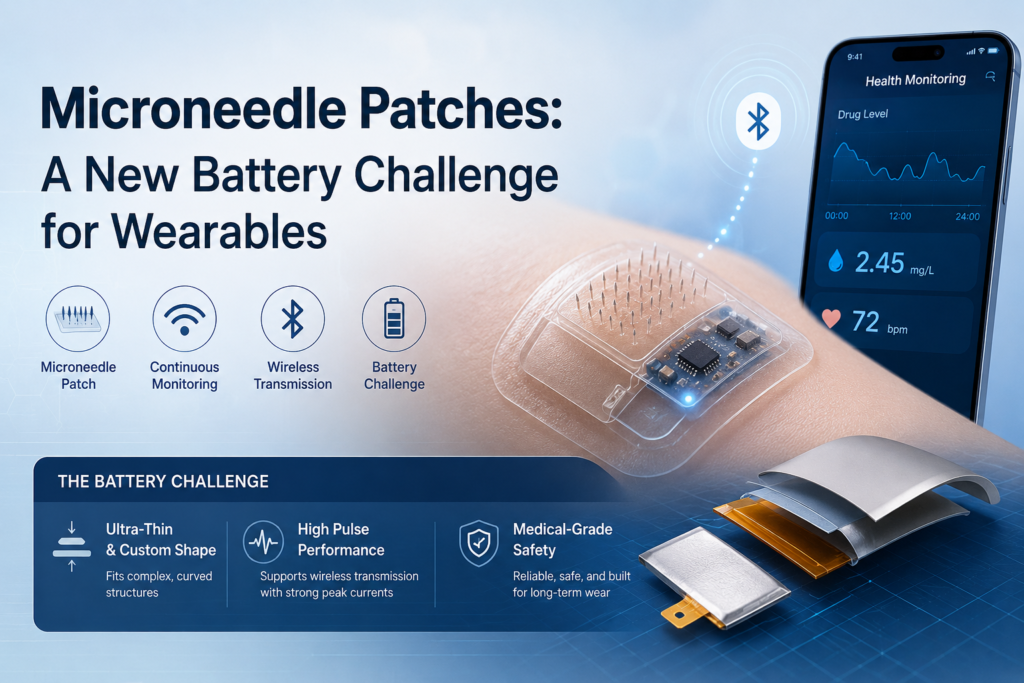
Battery Challenge for Wearables: A Battle for Space and Form Factor
Wearable microneedle patches like the one developed by KAUST have extremely strict requirements for size, weight, and flexibility to ensure that patients can wear them comfortably for long periods.
The device needs to fit not only a microneedle array and sensing chips, but also wireless communication modules such as Bluetooth Low Energy (BLE). This means the entire system must perform multiple functions within an extremely small physical space while maintaining a flexible shape that can conform to the curves of human skin.
In the past, many promising wearable medical device concepts struggled to move into mass production, largely because traditional hardware components were still rigid. When circuits and sensors have already been miniaturized to the micron scale or made flexible, a thick, rigid, rectangular battery can easily become the final component that compromises the entire user experience.
Breaking Physical Limits: Why Rigid Batteries No Longer Fit Wearable Medical Devices
For skin-mounted medical devices, traditional rigid rectangular lithium batteries face three major conflicts that are difficult to solve.
First is the ergonomic conflict. Human skin is curved and constantly moving. A rigid standard battery cannot bend. When forced into a wearable patch, it can cause the edges to lift or the patch to peel off, directly affecting microneedle penetration depth and data accuracy.
Second is poor use of space. The internal space of a medical patch is highly irregular. Fitting a rectangular battery into it often leaves a large amount of unused space around the edges. As a result, even if the battery itself is small, the overall device may still need to be larger.
Finally, there is a trade-off between battery life and device size. Wireless data transmission, such as Bluetooth communication, can require a strong pulse of current when data packets are sent. Choosing a larger standard battery to handle these current peaks can make the device bulky. But choosing a very small battery to keep the device thin and lightweight may cause frequent power interruptions, defeating the purpose of continuous monitoring.
How Custom-Shaped and Ultra-Thin Batteries Can Power the Next Generation of Medical Devices
For the KAUST microneedle patch to move from research to a real-world product, the battery needs to become almost invisible. This is driving the rise of custom-shaped batteries and ultra-thin flexible batteries in wearable medical devices.
Unlike traditional rectangular or cylindrical batteries, these batteries can be customized to match the structure of the device:
A shape that fits the device: Whether the device needs a round, curved, ring-shaped, or flexible form, custom-shaped batteries can make better use of available space. They can even be made into ultra-thin, film-like designs that can be seamlessly integrated into the adhesive layer or patch material.
High pulse discharge: Wireless data transmission, such as Bluetooth communication, can require short bursts of high current. Custom medical-grade lithium polymer batteries can be designed with optimized cell chemistry to support high-rate pulse discharge even in a very small package. This helps maintain stable data transmission without unexpected interruptions.
Medical-grade safety and reliability: Since these patches sit directly on the skin and may even use microneedles that enter the skin, batteries must meet strict requirements for leak protection, thermal stability, and packaging. Professional custom battery manufacturers can build multiple layers of safety into the battery design from the early stages of development.
LanDazzle: Professional Power Solutions for Next-Generation Medical Devices
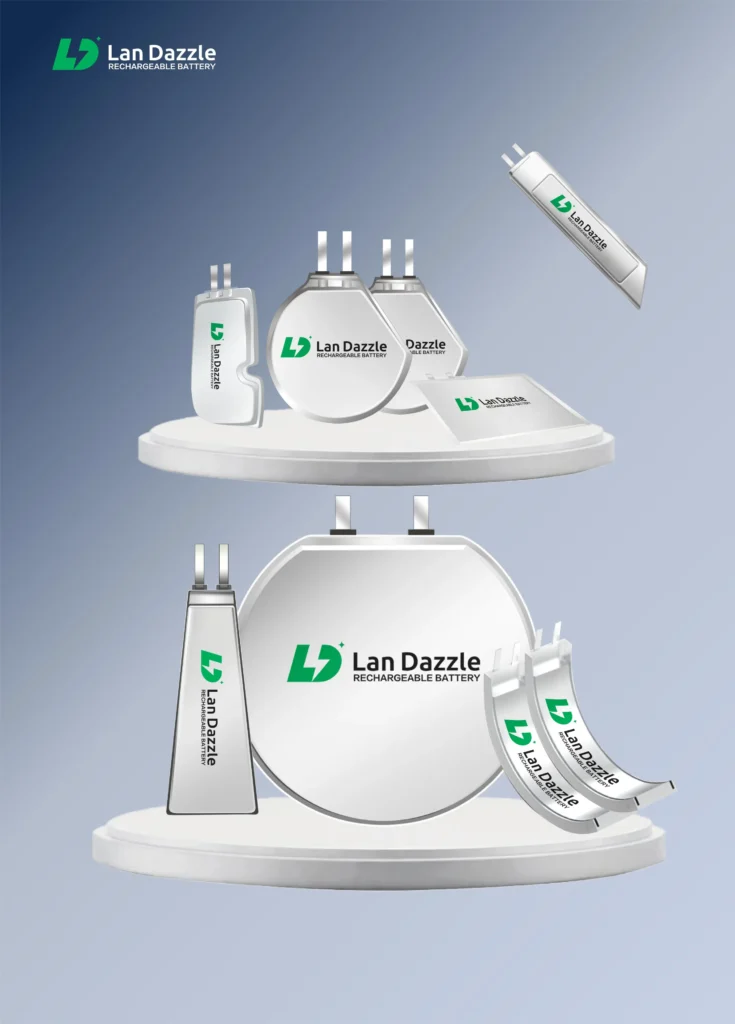
As a manufacturer specializing in high-performance and custom-shaped batteries, LanDazzle has extensive experience developing power solutions for wearable medical devices, smart patches, and miniature sensors.
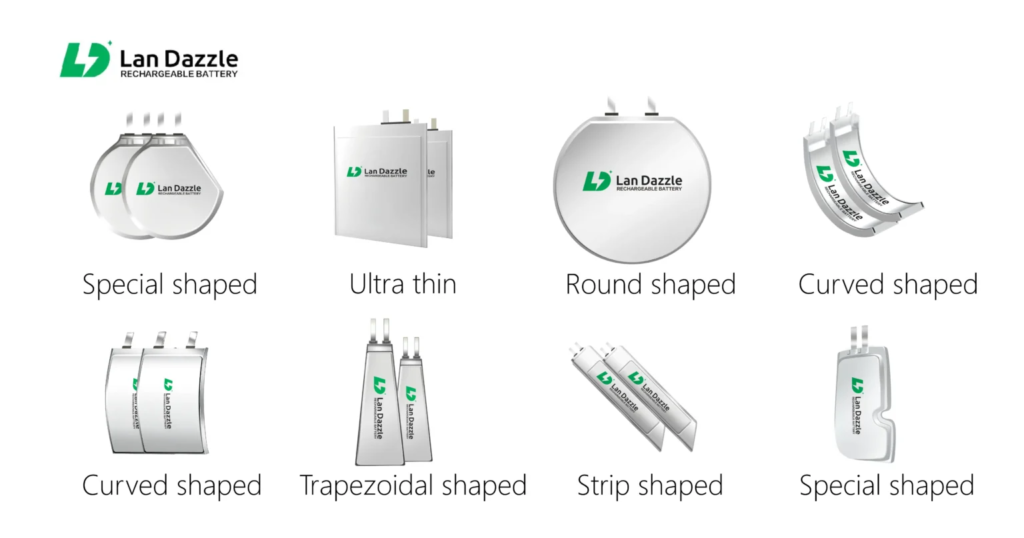
To meet the demanding requirements of medical devices for both ultra-thin designs and high reliability, LanDazzle provides comprehensive engineering support from development to production.
Ultra-thin designs and flexible customization: LanDazzle uses advanced stacking and miniature cell packaging technologies to develop ultra-thin and custom-shaped lithium polymer batteries. These batteries can fit the complex internal spaces of curved patches, smart rings, and wearable medical devices, helping maximize battery capacity and space utilization.
Discharge performance optimized for wireless communication: Continuous monitoring devices often need to transmit data through Bluetooth or other wireless connections. LanDazzle’s custom batteries are designed to provide strong pulse discharge performance and low self-discharge rates, delivering stable and reliable power for continuous data transmission while maintaining a compact form factor.
Medical-grade safety and collaborative development: From concept design and prototype testing to mass production, LanDazzle provides one-stop engineering support for hardware developers worldwide. Through strict quality control and customized packaging solutions, LanDazzle helps ensure the safety and reliability of batteries used in direct-contact medical and wearable applications.
Conclusion
KAUST’s microneedle patch research offers a glimpse into the future of healthcare: painless, continuous, seamless, and intelligent health monitoring. But turning this promising laboratory technology into a product that can reach millions of patients requires every part of the supply chain to work together.
As sensors become more sensitive and wireless communication becomes more power-efficient, battery innovators like LanDazzle are playing an important role in helping advanced medical technologies move from the lab to the real world. With a focus on custom-shaped and ultra-thin batteries, LanDazzle helps overcome the power and space challenges of next-generation wearable medical devices.
Developing the next generation of wearable medical devices or smart patches?
Connect with our engineering team and explore a custom battery solution designed around your device’s space, shape, and power requirements.
Email: info@landazzle.com
Whatsapp: +8618938252128